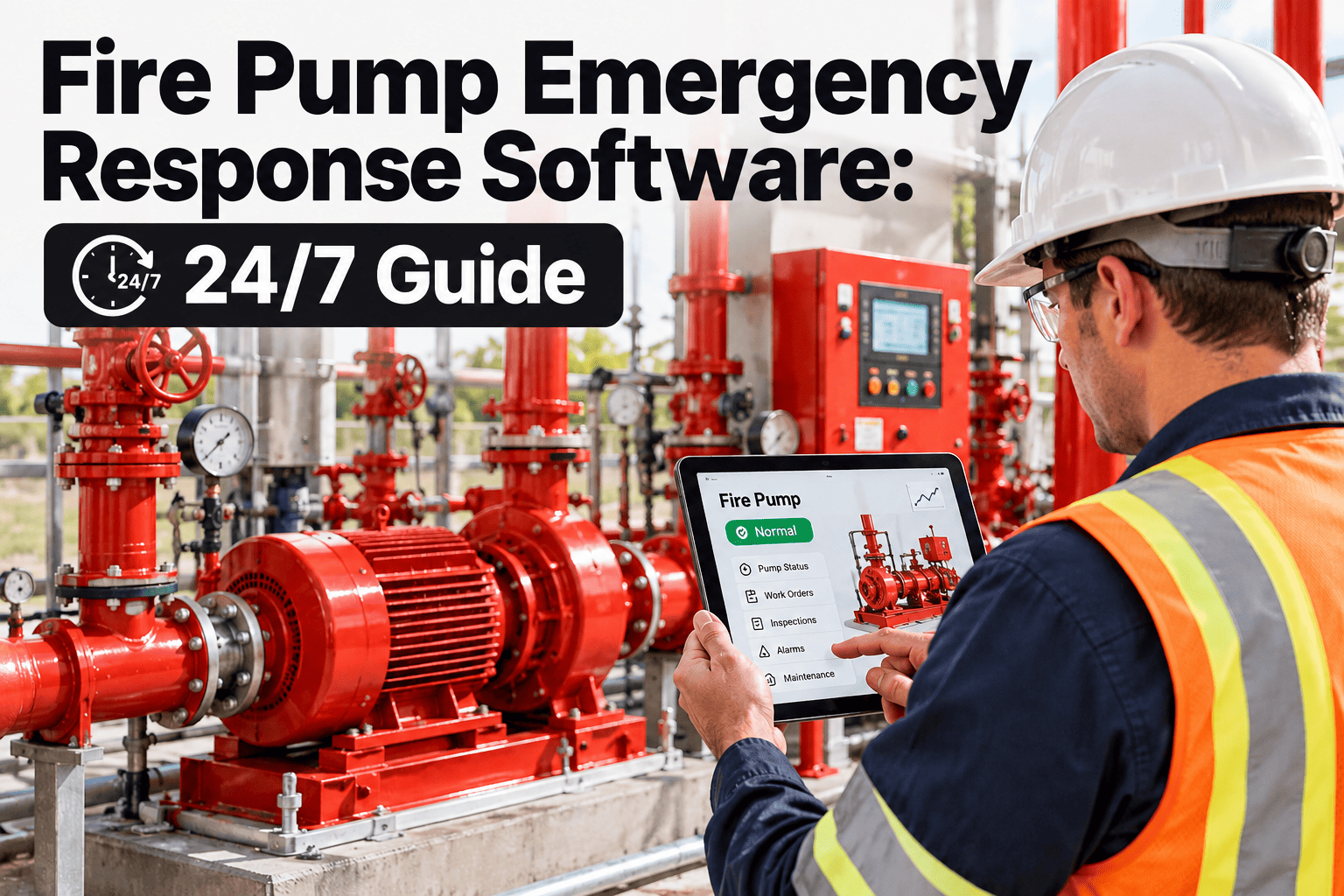
A fire pump failure rarely announces itself at a convenient hour. The controller alarm sounds at 2 a.m., the building is occupied or full of stock, and the person who knows the pump room is asleep. What happens in the next thirty minutes depends on whether an escalation path, a response checklist and the pump's history are already in place. This guide explains how facilities teams prepare for fire pump emergencies, what to look for in 24/7 response software, and how a facility CMMS supports the work.
Fire Pump Emergency Response Software: 24/7 Guide
Turn a fire pump alarm into a controlled response. Route alerts to the right person, guide the first responder, record the impairment and keep the pump's history ready for the next shift.
Why After-Hours Fire Pump Emergencies Go Wrong
Most fire pump problems are survivable when they are caught early and handled in order. They become emergencies when the response depends on one person's phone, a paper binder or a verbal handover.
Common Fire Pump Failure Modes and What They Look Like
Knowing the usual failure patterns helps responders triage faster. The table below groups typical conditions by pump type. Always follow the pump manufacturer's instructions and the requirements your authority having jurisdiction enforces.
| Condition | Applies to | Typical signs | First response focus |
|---|---|---|---|
| Failure to start | Electric and diesel | Pressure drop with no run signal, controller alarm | Confirm power, controller state and manual start options |
| Loss of power or phase | Electric | Power failure or phase alarm at the controller | Check supply, transfer switch and generator status |
| Low fuel or fuel quality | Diesel | Low fuel alarm, hard starting, rough running | Check tank level, fuel condition and delivery contacts |
| Battery or charger fault | Diesel | Battery alarm, charger failure indication | Verify both battery banks and charger output |
| Overheating | Diesel | High temperature alarm, coolant leaks | Check coolant, cooling flow and belts |
| Jockey pump cycling | Both | Frequent starts, pressure drift, noise | Look for leaks, check valves and pressure settings |
| Valve closed or restricted | Both | Low flow, pressure anomalies | Confirm supervised valve positions along the supply |
| Suction supply problem | Both | Low suction pressure, tank level alarm | Check tank level, suction valves and water source |
The 24/7 Escalation Ladder
An escalation ladder defines who is contacted, in what order and after how long. The timings below are placeholders. Set yours from your own risk assessment, insurer requirements and local rules.
Escalation must be tested like any other system
Contact lists decay. People change roles, phone numbers change and rotas shift. Run a scheduled drill to confirm that alerts arrive, back-ups respond and records are created as expected.
Do Not Let the Next Pump Alarm Wait for the Morning Shift
Set up on-call routing, response checklists and impairment records before the alarm sounds.
First-Responder Workflow at the Pump Room
A good checklist lets a competent technician act calmly even if the pump is unfamiliar. It should be short, ordered and available on a phone without a signal. Adapt it to your pump and controller model.
Impairment Handling: Before and After Structured Software
When a fire protection system is out of service, impairment procedures apply. NFPA 25 describes an impairment programme with roles such as coordinator, tagging and notification of stakeholders. Confirm the edition and local amendments your authority having jurisdiction uses.
Items an impairment record should hold
- The affected pump, system and area, and the reason for impairment.
- Date and time impairment began and who authorised it.
- Interim protective measures, including any fire watch.
- Who was notified, when, and how they acknowledged.
- Planned repair steps, parts, supplier contacts and target date.
- Restoration test results and the time protection was returned.
Prevention: The Test Schedule That Reduces Emergencies
The best emergency response is fewer emergencies. NFPA 25 sets inspection and test frequencies for fire pumps, including periodic no-flow run tests and annual flow testing. Intervals and methods vary by pump type and edition, so verify them against the version your jurisdiction enforces.
| Frequency | Typical activity | Why it prevents emergencies |
|---|---|---|
| Weekly | Walk-through of the pump room, controller state, fluid levels and run test on diesel units | Finds low fuel, leaks and starting problems early |
| Monthly | Run test on electric units, battery checks and valve position review | Confirms that the pump starts and valves are open |
| Quarterly | Fuel quality checks and supplier or contract review | Prevents degraded fuel and supply gaps |
| Annual | Flow test, controller and transfer switch tests, performance comparison against baseline | Reveals capacity loss before it matters |
| As needed | Repairs, parts replacement and retest after any impairment | Returns the pump to service with proof |
Trend results, not just pass or fail
Churn pressures, run times, vibration, temperatures and flow results tell a story when plotted over time. A pump that passes every test but shows a slow decline in output deserves attention before it fails in an emergency.
What to Look For in 24/7 Fire Pump Emergency Software
Instead of chasing a ranking, assess software against the realities of an after-hours event. The criteria below help you compare any maintenance or facility platform fairly.
How Oxmaint Supports Fire Pump Emergency Response
Oxmaint is a maintenance management platform built around assets, work orders, inspections and schedules. Used for fire pumps, those capabilities map to each stage of an emergency.
Integration needs a conversation
Connecting fire alarm panels, building systems or sensors depends on what your equipment supports. Discuss integration options early. You can book a demo to review your pump rooms and alerting needs with the Oxmaint team.
Root Causes Behind Repeat Fire Pump Alarms
Closing an alarm is not the same as fixing the cause. Repeat events usually trace back to a small set of underlying issues, and the maintenance record should capture which one applied.
Record cause codes consistently
A short list of cause categories on the work order makes patterns visible across pumps and sites. Without consistent coding, every repeat event looks like a new problem. Review the codes quarterly with the pump service contractor, so recurring causes lead to a permanent fix, a revised test routine or a change in spare parts policy.
Compliance Records Insurers and Inspectors Ask For
Auditors and insurers look for evidence that inspections happened, results were acted on and impairments were controlled. A well-kept record answers those questions without a search through filing cabinets.
- Dated inspection and test results per pump
- Flow test data compared with earlier results
- Controller and transfer switch test records
- Technician name and qualification
- Photos of readings and conditions
- Alarm time, acknowledgement and arrival time
- Diagnosis, repair actions and parts used
- Impairment start, notifications and restoration
- Post-event review and follow-up actions
- Vendor reports and warranty details
Keep records retrievable
Retention periods differ by jurisdiction, insurer and standard. Store records against the asset so a report by pump, site or date range can be produced quickly, and confirm the periods that apply to you.
Measures to Review After Every Event and Every Quarter
Run a post-event review within days
Ask what triggered the alarm, how long each step took, which information was missing and what must change. Record the actions as work orders so improvements are tracked rather than forgotten.
A Readiness Checklist for Your Next Audit or Drill
- Every fire pump, controller, jockey pump and transfer switch is registered as an asset with a unique tag.
- Inspection and test schedules match the standards and local rules that apply.
- An on-call rota exists with a primary, a secondary and an escalation contact.
- A response checklist is stored on mobile devices and works offline.
- Impairment procedures and notification lists are current and documented.
- Critical spares, fuel suppliers and pump service vendors have contacts recorded.
- Technicians have the training the pump and controller require.
- Drills are run on a schedule, and the lessons are logged as actions.
Fire Pump Emergency Software FAQs
No. It complements monitoring by managing the response, work and records. Sign up to set up on-call routing for pump alarms.
NFPA 25 sets weekly or monthly run tests and annual flow tests, depending on pump type and edition. Confirm local requirements.
Scope, start time, authorisation, interim measures, notifications, repair actions and restoration test results.
Offline access helps in pump rooms with poor coverage. Book a demo to see how checklists sync later.
Yes. A central asset register and dashboards let teams compare pumps, alarms and overdue tests across locations.
Be Ready Before the Pump Alarm Sounds
Give every after-hours responder the checklist, history and escalation path they need, and keep proof of every test and repair.