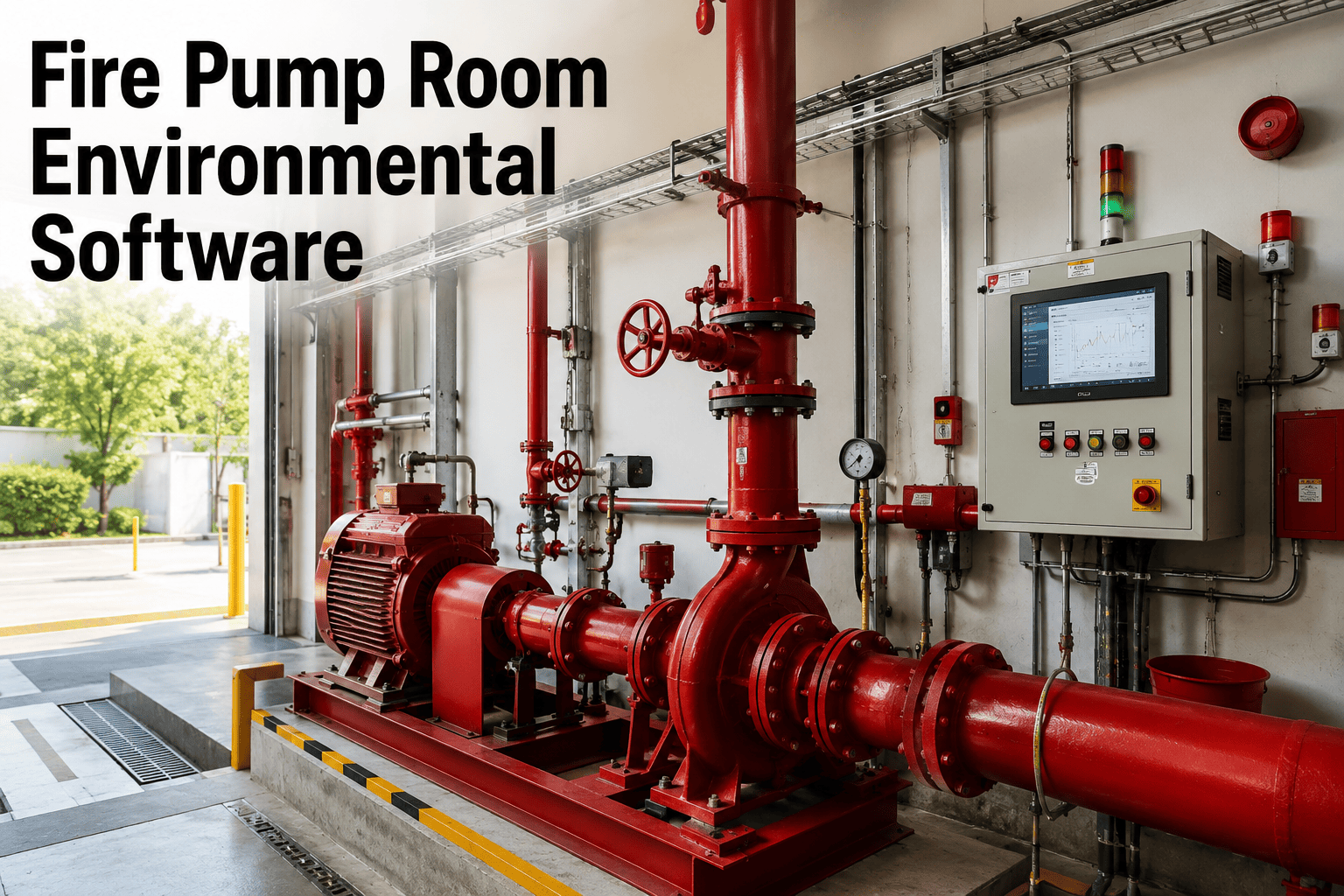
A fire pump that will not start because its room dropped below 40°F is not a maintenance failure — it is a life safety failure waiting for a fire to expose it. NFPA 20 sets firm environmental limits for fire pump rooms because the pump, its driver, and its controller only perform within a defined temperature, humidity, and ventilation envelope, and most facilities discover a violation only after an AHJ inspection flags it or, worse, after a pump fails to prime during an actual event. Fire pump room conditions drift quietly — a failed unit heater in January, a blocked louver in August, a controller cabinet sweating condensation after a humid week — and nothing on a paper log catches that drift between quarterly checks. Facility and fire protection teams are now closing that gap with connected environmental monitoring built into their CMMS platform, turning a blind spot into a continuously verified compliance record.
40°F
Minimum room temperature required for diesel-driven fire pump rooms per NFPA 20
70°F
Minimum ambient temperature typically required where an electric motor controller is not rated for lower ranges
weekly
Minimum frequency for diesel pump churn tests, one of many checks tied to room conditions
24/7
Window during which a fire pump room must remain within its rated operating envelope
See Your Pump Room Compliance Gaps in One Call
A fire protection engineer and a facility manager rarely see the same data. OxMaint puts room temperature, humidity, ventilation status, and pump test history on one dashboard both teams can trust.
Why Fire Pump Room Conditions Are a Compliance Requirement, Not a Comfort Setting
A fire pump room is not climate-controlled for occupant comfort — it is climate-controlled because the equipment inside physically cannot perform its life safety function outside a defined range. A diesel engine that will not start in a cold room cannot supply water to a standpipe during a fire. A controller cabinet running above its rated temperature can shut down or nuisance-trip at the exact moment it is needed. Humid, poorly ventilated rooms accelerate corrosion on suction and discharge piping, degrade wiring insulation, and create condensation inside electrical enclosures that NFPA 20 and NFPA 25 inspectors are specifically trained to look for.
Diesel Engine Cold-Start Failure
Below the rated minimum, diesel fuel thickens, battery output drops, and glow plug or block heater systems struggle to bring the engine to a startable state within the required time window.
Controller Thermal Shutdown
Electronic fire pump controllers carry manufacturer temperature ratings. Rooms that exceed those limits during summer heat can trigger protective shutdowns exactly when demand is highest.
Condensation-Driven Corrosion
High humidity combined with poor ventilation causes condensation inside control cabinets and on exposed piping, accelerating corrosion of terminals, relays, and suction fittings over time.
Combustion and Exhaust Ventilation
Diesel engine rooms require combustion air and heat-relief ventilation sized to the engine. Blocked louvers or failed exhaust fans raise room temperature well beyond ambient conditions.
Manual Room Checks vs. Continuous Environmental Monitoring
What a Fire Pump Room Environmental Monitoring Program Actually Tracks
1
Room Temperature
Continuous readings compared against the minimum rating for the pump driver type in that room — diesel-driven rooms and electric-driven rooms often carry different thresholds, and both need year-round verification, not just a winter check.
2
Relative Humidity
Sustained high humidity is tracked as a leading indicator of condensation risk inside controller enclosures and on exposed metal surfaces, well before visible corrosion appears during a physical inspection.
3
Ventilation and Airflow Status
Fan run status, damper position feedback, and airflow sensors confirm that combustion air and heat-relief ventilation are actually functioning, not just present on the drawings.
4
Water Intrusion and Floor Moisture
Floor-level moisture sensors flag piping leaks, foundation seepage, or discharge test water pooling before it reaches sensitive electrical components mounted low in the room.
5
Battery and Heater Circuit Health
Block heater current draw and starting battery voltage trends are logged alongside room temperature so a failing heater is caught as a cause, not discovered as a symptom during the next churn test.
From Sensor Reading to Work Order: How the Alert Workflow Runs
Sense
Temperature, humidity, airflow, and moisture sensors report on a fixed interval
→
Compare
Readings are checked against the NFPA-aligned threshold set for that specific room
→
Alert
Out-of-range conditions notify the facility team and fire protection contact instantly
→
Dispatch
A work order is generated automatically and routed to the assigned technician
→
Document
Resolution, timestamps, and readings are logged for the compliance record
Electric-Driven vs. Diesel-Driven Pump Rooms: Different Rules, Same Platform
Not every fire pump room carries the same environmental risk profile, and a monitoring program that treats every room identically will either over-alert on low-risk spaces or under-protect the ones that matter most. Diesel-driven pump rooms carry the tightest constraints because the engine, battery bank, and fuel system all degrade in cold conditions, and because the room must also manage exhaust heat and combustion air during a run — conditions a purely electric room never faces. Electric-driven pump rooms shift the risk profile toward the controller cabinet: humidity, condensation, and ambient heat around variable frequency drives or across-the-line starters become the dominant concern rather than cold-weather starting. A monitoring platform configured room-by-room, rather than with a single blanket threshold, reflects this difference and avoids desensitizing staff to alerts that do not actually represent risk in that specific room.
Diesel Room Priorities
Minimum temperature enforcement, block heater and battery health, combustion air supply, and exhaust heat relief during weekly churn tests all need dedicated thresholds tuned to the specific engine manufacturer's rating.
Electric Room Priorities
Controller cabinet temperature, humidity-driven condensation risk, and ventilation around VFDs or soft starters take priority, since these rooms rarely face the cold-start risk a diesel engine does.
Where Room Conditions Intersect NFPA 20 and NFPA 25
Fire pump room environmental conditions are not a standalone checklist item — they are woven into the same inspection, testing, and maintenance cycle that governs the pump itself. NFPA 25 requires weekly and monthly checks that already send a technician into the room; environmental monitoring extends that visibility to every hour in between. NFPA 20 sets the equipment-side requirements the room exists to protect. A facility that can show continuous room data alongside its pump test logs presents a materially stronger record during an AHJ walkthrough or an insurance loss-control audit.
NFPA 20
Driver-Specific Temperature Ratings
Room minimum temperature is set by the pump driver type and the equipment manufacturer's rating — diesel engine, electric motor, and controller components each carry their own floor.
NFPA 20
Combustion and Ventilation Air
Diesel-driven pump rooms require sized combustion air supply and heat-relief ventilation so engine operation does not push the room outside its safe range during a run.
NFPA 25
Weekly and Monthly Pump Room Checks
Routine inspection intervals already require a technician to observe room condition — continuous sensor data fills the gap between those scheduled visits.
NFPA 25
Documented Deficiency Correction
Identified deficiencies, including room condition issues, must be corrected and documented — an auto-generated work order trail satisfies this directly.
NFPA 20
Controller Enclosure Environmental Rating
Fire pump controllers carry a manufacturer-specified ambient operating range, and rooms housing them must be maintained within that range regardless of the driver type installed.
NFPA 25
Annual Comprehensive Inspection Record
Annual inspections review the full pump assembly and room condition history together, making a full year of continuous environmental data far more useful than a single day's snapshot.
Insurance and Risk Implications Facility Teams Often Overlook
Property insurers underwriting facilities with fire pump protection increasingly ask for evidence, not assurances, that life safety equipment stays within its operating envelope. A loss-control survey that turns up a paper log with gaps, or no room temperature record at all, can affect renewal terms even when the pump itself has never failed a test. Conversely, a facility that can produce a continuous digital record of room temperature, humidity, and ventilation status alongside its NFPA 25 test history demonstrates the kind of proactive risk management underwriters reward. For multi-site operators, this record also becomes the fastest way to answer a broker's data request during renewal season instead of chasing down individual site logs under deadline pressure.
Fire Pump Room Monitoring Program Metrics Worth Tracking
Facility leadership rarely gets asked how a fire pump performed on its last test — they get asked to prove the whole program is under control. The metrics below give a facility director or fire protection manager a quick, defensible summary of program health across every monitored room in the portfolio, and they translate directly into the kind of language a board, an insurer, or an AHJ wants to hear during a review.
100%
Pump Rooms Under Continuous Monitoring
< 15 min
Time From Excursion to Alert Delivery
0
Unresolved Room-Condition Work Orders at Month End
100%
Weekly Churn Tests Logged With Room Data Attached
Building a Fire Pump Room Monitoring Program: Where to Start
Facility teams rolling out environmental monitoring for the first time do not need to instrument every pump room in the portfolio on day one. The programs that stick start narrow, prove the value on the highest-risk rooms, and expand once the alert workflow is trusted by both facility staff and the fire protection contractor. The sequence below reflects how most multi-site operators actually build this out, moving from a single pilot room to a portfolio-wide compliance record over a few maintenance cycles.
01
Audit Current Room Ratings and Equipment
Pull the manufacturer temperature ratings for every diesel engine, electric motor, and controller currently installed, since these ratings — not a generic standard — set the actual thresholds each room's sensors should alert against.
02
Pilot on the Highest-Consequence Room
Start with the pump room protecting the largest occupancy, the tallest standpipe run, or the facility with the least redundant water supply, so the pilot generates data where a failure would matter most.
03
Connect Alerts to a Real Work Order Workflow
A sensor alert that lands in an inbox no one checks after hours delivers no protection. Route excursions directly into the CMMS as a work order with an assigned technician and a response deadline.
04
Layer in the NFPA 25 Test Schedule
Attach weekly churn test results and monthly inspection findings to the same asset record as the environmental sensor history, so a reviewer sees pump performance and room condition together.
05
Expand Room by Room Across the Portfolio
Once the pilot room's alert response times and false-alarm rate are dialed in, replicate the sensor package and threshold configuration across remaining pump rooms using the same platform.
What Happens When a Pump Room Condition Goes Unnoticed
The cost of an undetected pump room excursion rarely shows up as a single dramatic event — it shows up as a pattern of near-misses that eventually catches up with a facility. A block heater that quietly failed in November may not be discovered until a January churn test reveals a hard-starting engine, at which point the room has already spent weeks below its rated minimum every single night. A blocked exhaust louver might not trigger a complaint until a summer heat wave pushes the controller into thermal shutdown during the exact week wildfire smoke has occupants on edge and insurers watching claims closely. These are not hypothetical scenarios; they are the recurring findings fire protection contractors report when a facility has no continuous record between scheduled visits, and they are precisely the gap a monitored, CMMS-connected pump room closes.
Frequently Asked Questions
Why does a diesel fire pump room need to stay above a minimum temperature year-round?
Diesel engines depend on battery output, fuel viscosity, and glow plug performance that all degrade below the manufacturer's rated minimum, which typically sits at or above 40°F. A room that drifts below this threshold overnight or during an HVAC outage can leave the pump unable to start within the time a fire event demands, which is why continuous tracking through a platform like
OxMaint matters more than a single winter spot check.
Is environmental monitoring required by NFPA 20, or is it just a best practice?
NFPA 20 sets the temperature and ventilation conditions the room must maintain, and NFPA 25 requires routine checks that include room observation. Continuous monitoring is not separately mandated as a technology, but it is the most reliable way facility teams demonstrate ongoing compliance with those existing requirements between inspection intervals.
What sensors are typically installed in a fire pump room monitoring setup?
A standard configuration includes a temperature sensor, a humidity sensor, airflow or fan-run status on ventilation equipment, and a floor-level moisture sensor near piping connections. Battery voltage and heater current can also be logged where the controller supports that data output.
How does this data help during an AHJ inspection or insurance audit?
A continuous, timestamped record of room temperature, humidity, and ventilation status alongside weekly pump test logs gives an inspector or loss-control auditor direct evidence of ongoing compliance, rather than a facility's word that conditions were checked. Teams using
a connected CMMS platform can export that history in minutes instead of searching through paper logs.
Can one platform manage both fire pump testing and room environmental monitoring?
Yes — combining pump churn test scheduling, deficiency tracking, and environmental sensor alerts in one system means a room condition issue and the pump test record that depends on it stay linked, rather than living in separate logs that are never cross-checked.
Stop Finding Out About Pump Room Failures During an Inspection
OxMaint connects environmental sensors, pump test schedules, and work order tracking into one fire protection compliance record your team and your AHJ can both rely on.