According to the buildings that maintain LEED certification for five or more consecutive years demonstrate 28% lower energy intensity and 22% lower water consumption compared to initially certified buildings that let performance tracking lapse. However, 41% of LEED-certified facilities lose at least one compliance point between recertification cycles due to undocumented filter changes, missing water meter reads, or uncalibrated sensors — each lost point representing a potential energy efficiency slip of 2–5%. Unlike the initial certification, which requires design-phase documentation, ongoing LEED maintenance demands continuous performance tracking, alert-based corrective action, and an audit-ready log of every operational decision affecting energy, water, waste, and indoor air quality. OxMaint's Energy & ESG Reporting Module automates LEED Ongoing Performance requirements — tracking energy use intensity (EUI), water metering, waste diversion, green cleaning compliance, and refrigerant management — with automated work orders when any parameter drifts outside certified thresholds. Book a demo to see how facility teams are maintaining LEED points across recertification cycles without adding documentation burden.
01
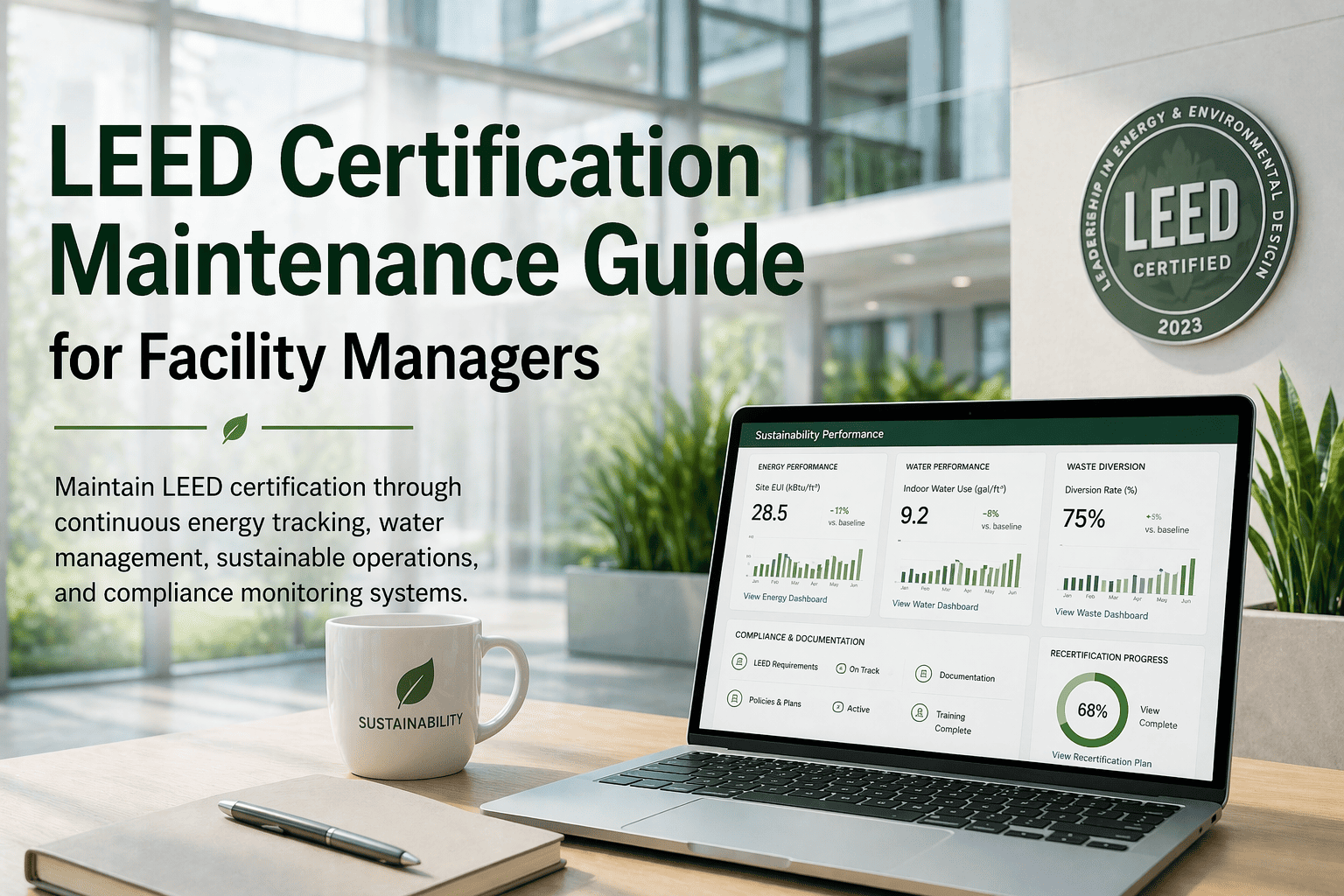
LEED Certification Maintenance Guide for Facility Managers
Energy tracking · Water management · Sustainable operations · Compliance monitoring · ESG reporting
41%Of LEED-certified facilities lose compliance points between recertification cycles
28%Lower energy intensity in long-term LEED-maintained buildings vs. lapsed buildings
22%Lower water consumption in continuously certified facilities
LEED by the Numbers — Maintenance Phase
105,000+
LEED-certified commercial projects globally
USGBC data 2024
LEED O+M
Existing Buildings Operations & Maintenance certification track
Designed for certified buildings maintaining performance
5 years
Maximum interval between LEED recertification submissions
Annual performance reporting required within cycle
Five Critical LEED Categories Requiring Continuous Maintenance Tracking
01
Energy & Atmosphere — EUI Tracking
LEED O+M requires continuous Energy Use Intensity (EUI) tracking with ENERGY STAR Portfolio Manager integration. EUI more than 5% above baseline triggers corrective action documentation and potential point loss. Requirements include monthly meter reads, sub-metering for major energy end uses, and seasonal adjustment normalization. Without automated tracking, facilities miss trend-based threshold breaches until annual recertification — at which point corrective action cannot be backdated.
02
Water Efficiency — Submetering & Leak Detection
LEED requires permanent water meters on two major end uses (cooling towers, irrigation, domestic hot water) with monthly consumption logging. A continuously running toilet flapper consumes 6,000–8,000 gallons per month — enough to breach water efficiency thresholds if undetected for one billing cycle. Monthly meter reads with automated leak detection generate alerts for a 15% month-over-month consumption increase, triggering work orders before documentation is due for recertification.
03
Indoor Environmental Quality — IAQ & Ventilation
LEED O+M requires annual indoor air quality testing (CO2, PM2.5, TVOC, formaldehyde) plus continuous CO2 monitoring in densely occupied spaces. Ventilation systems must maintain minimum outdoor air rates per ASHRAE 62.1. Filter tracking with documented MERV ratings and change logs is required. Missing filter logs account for 18% of IEQ point deductions in LEED recertification audits — preventable with automated filter pressure drop tracking and change documentation.
04
Materials & Resources — Waste Diversion & Green Cleaning
LEED requires ongoing waste diversion tracking (minimum 50% diversion for point eligibility) and documented green cleaning program with low-VOC product purchasing records. Monthly waste audits log diversion rates by stream (single-stream recycling, organics, construction debris). Green cleaning logs require purchase orders for certified cleaning products, dilution control equipment calibration, and staff training dates. Missing purchase receipts or training logs invalidate up to 3 LEED points during recertification.
05
Refrigerant Management — Leak Rate Tracking
LEED O+M requires annual refrigerant leak rate below 5% for HVAC systems with 50+ pounds of charge and quarterly leak inspections for systems with 500+ pounds. Monthly pressure logging and immediate leak repair documentation (EPA 608) is required. A single unreported refrigerant leak exceeding 10% annual rate disqualifies the refrigerant management point — worth 1–2 LEED points depending on system size. Automated refrigerant pressure monitoring catches leaks at 5–8% deviation, triggering repair work order before annual threshold is breached.
LEED Ongoing Maintenance Checklist — Monthly, Quarterly & Annual Tasks
01
Energy Use Intensity (EUI) — Monthly Log
Record whole-building energy consumption from utility bills. Enter into ENERGY STAR Portfolio Manager. EUI above 5% of baseline triggers energy audit work order for lighting, HVAC, or plug load investigation.
Maintains EA credit
02
Water Submeter Reads — Monthly Log
Record consumption from cooling tower, irrigation, and domestic hot water submeters. Month-over-month increase exceeding 15% triggers leak detection or equipment inspection work order.
Maintains WE credit
03
Waste Diversion Rate — Monthly Audit
Track weight by stream (recycling, organics, landfill). Calculate diversion percentage. Below 50% triggers waste stream audit and vendor performance review.
Maintains MR credit
04
Filter Change & MERV Verification — Monthly/Quarterly
Log filter changes with date, MERV rating, and pre/post pressure drop. Maintain 12-month rolling log for LEED audit. Missing filter changes trigger corrective documentation.
Maintains IEQ credit
05
Refrigerant Pressure & Leak Rate — Monthly/Quarterly
Log system pressures, calculate annualized leak rate. Rate exceeding 5% triggers EPA 608 leak repair within 30 days. Maintain leak log for LEED audit.
Maintains EA refrigerant credit
06
Green Cleaning Product Logs — Quarterly
Document purchase orders for green cleaning products, dilution control calibration dates, and staff training completion. Missing documentation invalidates credit.
Maintains EQ credit
LEED O+M Documentation Requirements & Automation Solutions
| LEED Category | Documentation Required | Frequency | Manual Burden (hrs/year) | OxMaint Automation |
|---|
| Energy & Atmosphere |
EUI tracking, Portfolio Manager sync, seasonal adjustment, ASHRAE audit logMonthly40–60Automated EUI calculation, Portfolio Manager API sync, alert at 5% deviation Water EfficiencySubmeter readings, leak detection log, irrigation schedule, cooling tower conductivityMonthly25–35Automated meter reads via BMS integration, leak detection alerts, trend reporting Indoor Environmental QualityFilter log (MERV/dates), IAQ test results, CO2 monitoring, green cleaning logMonthly/Annual30–50Filter pressure drop tracking, CO2 sensor integration, automated cleaning product PO logs Materials & ResourcesWaste diversion weights, green purchasing receipts, e-waste tracking, composting logsMonthly20–40Waste stream weight entry app, vendor scorecard integration, automated diversion calculation Refrigerant ManagementPressure logs, leak inspection records, repair documentation, annual leak rateQuarterly15–25Wireless pressure monitoring, auto leak rate calculation, EPA 608 repair work orders
Source: USGBC LEED O+M v4.1 Reference Guide. Manual hour estimates based on 200,000–500,000 sq ft facility portfolio.
ROI Impact at a Glance — LEED Maintenance Program
28%
Lower energy intensity in continuously maintained LEED buildings
USGBC long-term study
$0.85–1.20
Average LEED certification maintenance cost per square foot annually
Documentation + tracking + testing
15–25%
Higher rental rates and asset value for LEED-certified buildings
Commercial real estate studies
"The biggest misconception about LEED certification is that the hard work is done at design and construction. In reality, 60% of the points for LEED O+M come from ongoing operations — things you have to do every month, every quarter, every year: log energy data, read meters, change filters, document cleaning products, track waste diversion. And here's what I see in recertification audits across 200+ buildings: the facilities that lose points almost never fail because they weren't doing the work. They lose points because they did the work and didn't document it. A filter changed without a log entry, a waste audit performed but the spreadsheet lost, a refrigerant pressure logged in a notebook that never made it into the recertification file. OxMaint solves that by making documentation automatic: every filter change generates a timestamped record, every meter read goes into the compliance database, every work order includes the LEED category it supports. When the auditor asks for proof, the proof is already there — not sitting in a filing cabinet or a forgotten spreadsheet."
— Jonathan Hwang, PE, LEED AP BD+C, O+M · Director of Sustainability — Global Real Estate · 17 Years Green Building Certification and Ongoing Performance · USGBC Faculty Member
Stop losing LEED points to missing documentation. Start automating energy tracking, water metering, filter logs, and refrigerant monitoring.
Frequently Asked Questions
What is the difference between LEED for Existing Buildings (LEED O+M) and initial LEED certification?
LEED BD+C (Building Design and Construction) certifies design, materials, and construction practices — the building at turnover. LEED O+M (Operations and Maintenance) certifies ongoing performance: energy use, water consumption, waste diversion, green cleaning, refrigerant management, and indoor air quality. Many buildings achieve BD+C certification but never pursue O+M recertification. However, buildings that maintain O+M certification every 5 years show 28% lower energy intensity and 22% lower water consumption compared to those that let tracking lapse. LEED O+M requires continuous performance monitoring with monthly or quarterly documentation — not just design-phase credits.
Sign in to access OxMaint's LEED O+M documentation templates.How often must LEED-certified buildings submit ongoing performance documentation?
LEED certification under the O+M rating system requires annual performance reporting to USGBC and full recertification every 5 years. Annual reporting includes: 12 months of ENERGY STAR Portfolio Manager data, 12 months of water use data (whole building and submetered end uses), waste diversion summary (quarterly data aggregated annually), green cleaning product purchasing log, and refrigerant leak inspection records for all systems with 50+ pounds of charge. The 5-year recertification requires re-submission of all prerequisite and credit documentation plus third-party verification for energy and water data. Missing annual reports trigger certification probation; missing recertification after 5 years results in certification lapse.
Book a demo to see automated annual reporting.What is the minimum ENERGY STAR score required for LEED O+M energy credit eligibility?
LEED O+M v4.1 requires an ENERGY STAR score of 75 or higher (on a 1–100 scale) to achieve 18 out of 33 possible Energy & Atmosphere points. Buildings with scores between 65–74 qualify for reduced points (12–16 depending on score). Buildings below score 65 require an ASHRAE Level 2 energy audit and implementation of all measures with payback under 10 years to earn any EA points. The ENERGY STAR score compares your building's energy performance to similar buildings nationwide, normalized for weather, hours of operation, and occupancy. OxMaint integrates directly with ENERGY STAR Portfolio Manager via API, syncing monthly consumption data and tracking score changes with alert at 70 (2 points below threshold) and 75 (threshold reached).
Start a free trial to connect your Portfolio Manager account.What documentation is required for LEED green cleaning credit compliance?
LEED O+M EQ Credit Green Cleaning requires: a written green cleaning policy (covering goals, training, purchasing, and performance metrics), product purchase logs showing 75% of cleaning products by cost meet third-party eco-labels (Green Seal, EPA Safer Choice, EU Ecolabel), janitorial training records (initial and annual refresher), dilution control equipment calibration logs for concentrate dispensing systems, and entryway mat inspection logs (maintaining 10 feet of matting at all entrances). Missing documentation for any single quarter invalidates the entire credit for the recertification period. OxMaint's green cleaning module automates: PO tracking against approved product list, training due date alerts, dilution equipment calibration work orders, and mat cleaning frequency logs — all exportable as a LEED audit binder.
Book a demo to see green cleaning documentation automation.
LEED MAINTENANCE AI — OXMAINT
Every LEED Point You Earned in Design — Protect It with Automated Ongoing Compliance
Energy tracking · Water metering · Waste diversion · Filter logs · Refrigerant monitoring · Green cleaning documentation — all automatically logged, alert-driven, and recertification-ready.