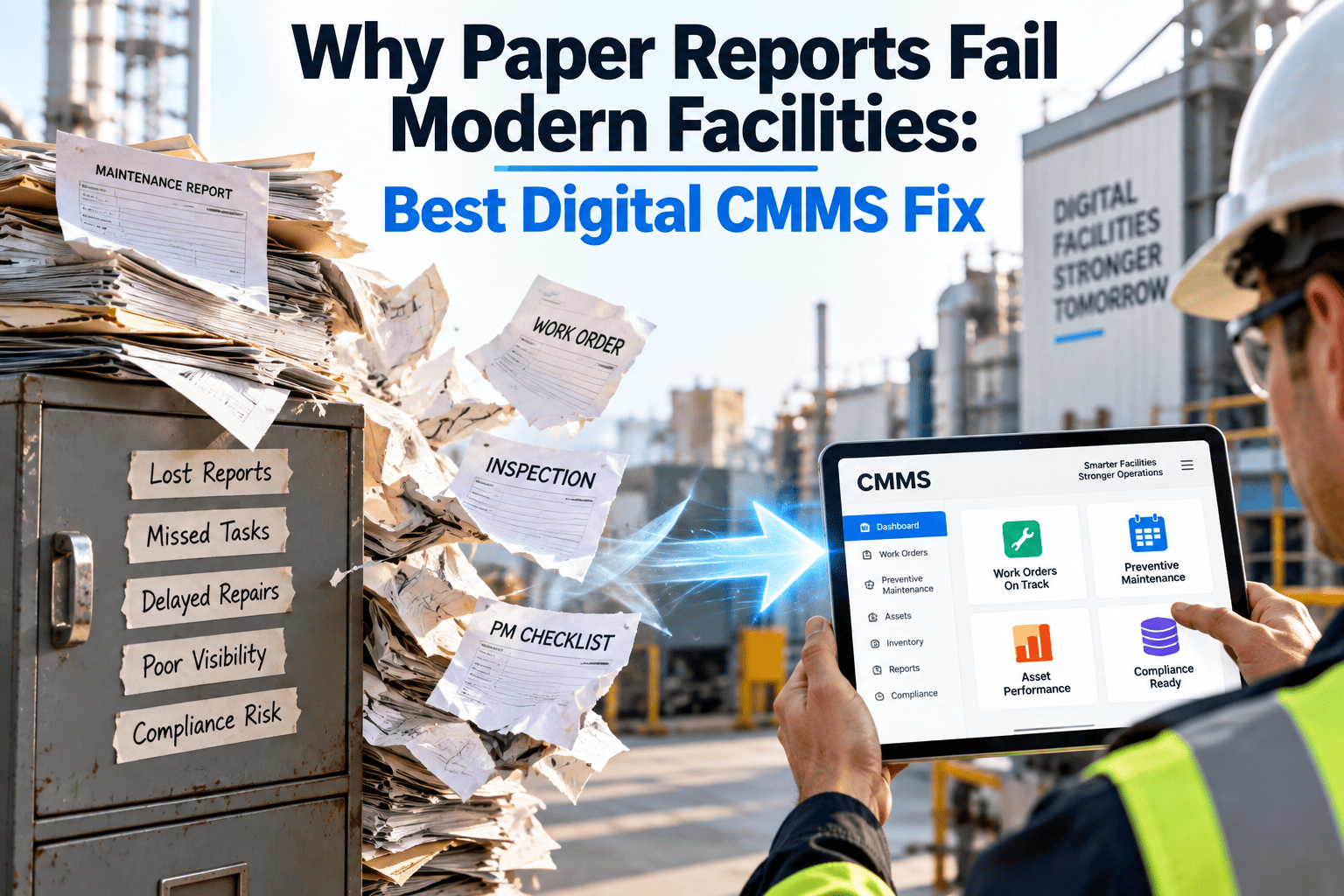
A paper checklist can only record what a person remembers to write down after the fact. A technician walks a rooftop unit, notices the belt is slightly glazed, means to note it, gets pulled to another call, and the observation never makes it onto the sheet that lands on a manager's desk three days later. Multiply that gap across every inspection round a facility runs in a year and the pattern becomes the real story: it is not that paper inspections fail occasionally, it is that they are structurally unable to capture the evidence a defect needs before it becomes a failure. Photos, timestamps, exact readings, and the technician's actual observation in the moment all get compressed into a checkbox and a signature. Oxmaint closes that evidence gap with mobile inspections built to capture what paper cannot, and you can sign up free or book a demo to see the difference on your own equipment.
What a Paper Checklist Actually Captures
- A checkbox marked "pass" or "fail" with no context for why
- A signature added at the end of a shift, sometimes for work done hours earlier
- Handwriting that a second reader has to interpret or guess at later
- No photo, so a borderline defect has no visual record to compare against next time
- A single paper copy that can be lost, damaged, or never filed at all
What Oxmaint Captures Instead
- A required photo attached to every flagged reading, timestamped automatically
- Exact numeric readings entered in the field, not recalled afterward
- A digital signature captured at the moment the inspection actually closes
- Every past inspection for that asset visible side by side for comparison
- A record stored the instant it is submitted, with no possibility of being misfiled
The Defect Was Real. The Paper Just Never Said So.
Most equipment failures were technically inspected right before they happened. The inspection just did not produce evidence anyone could act on. Oxmaint makes every field observation structured, photographed, and time-stamped, so a small deviation gets flagged as work, not lost as a memory.
The Evidence Gap
5 Defect Types Paper Inspections Consistently Miss
None of these defects are exotic. They are the ordinary, gradual kind that a checklist is theoretically designed to catch, and structurally cannot, because a checkbox has no room for the detail that would have mattered.
Gradual Drift Readings
A vibration or temperature reading that creeps 2 percent higher every month looks fine on any single paper sheet. Without past readings side by side, nobody sees the trend until the equipment fails.
Borderline Visual Wear
A belt that is slightly glazed, a gasket that is starting to crack, a connector that is barely discolored: all pass a checkbox and all show clearly in a photo taken at the right moment.
Intermittent Faults
A device that alarms occasionally and resets itself before the technician arrives leaves no trace on paper. Digital logs capture the alarm event even when the technician was not standing there.
Deferred Write-Ups
Technicians filling out paperwork at the end of a shift, not at the equipment, routinely lose the specific detail that made an observation worth flagging in the first place.
Location and Asset Confusion
Similar units in adjacent rooms get mixed up on paper sheets often enough that a defect gets logged against the wrong asset, delaying the actual repair while the wrong unit gets serviced.
Lost or Illegible Sheets
Water damage, a misplaced clipboard, or handwriting nobody can read after the fact turns a completed inspection into one that, for practical purposes, never happened.
Where Digital Inspections Matter Most
Five Equipment Categories Where a Missed Reading Gets Expensive Fast
Not every asset punishes a missed observation equally. These are the categories where the gap between a paper checkbox and a photographed, logged reading shows up fastest in the maintenance budget.
Rooftop and Central HVAC
Belt glazing, refrigerant pressure drift, and filter loading are all gradual and all invisible on a single pass-fail checkbox, right up until a compressor fails during a heat wave.
Electrical Switchgear
Thermal signatures and connection looseness build slowly. A photographed reading compared against last quarter's is often the only way anyone notices before an arc fault.
Elevators and Escalators
Intermittent faults that reset themselves before a technician arrives leave nothing on paper, while a digital alarm log captures the event even when nobody was standing there to see it.
Plumbing and Domestic Water
A slow pressure drop or a hairline pipe crack rarely fails a single inspection, but tracked over six months against a baseline reading it becomes an obvious, budgetable repair.
Backup Power and Generators
A generator that starts fine every monthly test can still be losing battery capacity or fuel quality, deviations a load-test reading catches and a checkbox simply cannot.
How a Missed Defect Becomes a Budget Line
The Hidden Cost Chain That Starts With One Unrecorded Observation
1
Missed at Inspection
A technician notices something slightly off but the checklist has no field for it, so it is never written down or photographed.
2
Undetected Deterioration
The same asset gets inspected again next cycle by a different technician with no record of the earlier observation to compare against.
3
Escalates to Failure
What started as a minor deviation becomes an actual breakdown, usually during peak operating hours rather than during a scheduled inspection window.
4
Emergency Repair
Emergency labor rates, expedited parts shipping, and unplanned downtime replace what would have been a scheduled, budgeted repair.
5
Budget Overrun
The maintenance budget absorbs a cost that a single photo and a structured field, captured months earlier, would have prevented entirely.
Platform Comparison
Oxmaint vs Paper Checklists and Generic Digital Forms
Scroll to compare all methods
Stop Losing Defects to a Checkbox With No Room for Detail
Oxmaint gives every inspection a required photo, an exact reading, and a place for the technician's actual observation, then compares it automatically against the asset's history so drift gets caught before it becomes a failure.
Client Results
What Facility Teams See After Switching From Paper to Oxmaint
46%
Fewer Emergency Repairs
Portfolios moving from paper to structured digital inspections saw emergency work orders drop within two full inspection cycles as drift got flagged before failure.
9 sec
Average Photo Capture Time
Adding a required photo to a flagged reading adds seconds to an inspection, not minutes, while giving every future technician a visual baseline to compare against.
Zero
Lost Inspection Records
Every submitted inspection is stored the instant it closes, eliminating the misplaced clipboards and water-damaged sheets that erase completed work on paper.
Regional Distribution Center
Conveyor motor failure predicted 6 weeks early
A distribution center comparing monthly vibration readings side by side in Oxmaint caught a gradual increase on a conveyor drive motor that would have been invisible on separate paper sheets, scheduling replacement six weeks before it would have failed mid-shift.
Multi-Site Retail Portfolio
HVAC callouts down 38% in first year
A retail portfolio running quarterly HVAC inspections switched every store to mobile checklists with mandatory photos on any reading outside range, cutting emergency HVAC callouts by more than a third in the first year on the platform.
Frequently Asked Questions
Digital Inspections vs Paper: What Facility Teams Ask First
Does a required photo on every flagged reading actually slow down an inspection round?
No. Adding a photo to a reading that is already outside normal range takes a few seconds and is the single field that most often explains a failure after the fact.
Can technicians still complete inspections in areas with no cellular signal?
Yes. Oxmaint captures inspections offline and syncs automatically once the technician's device reconnects, so basement mechanical rooms and remote sites work the same as anywhere else.
Sign up free to test offline capture on your own site.
How does Oxmaint decide when a reading is significant enough to trigger a work order?
Each asset has a configured normal range, and any reading outside it automatically generates a corrective work order assigned to the responsible technician with no manual step required.
Book a demo to see threshold configuration for your equipment.
Can we see a specific asset's full inspection history to spot a slow trend ourselves?
Yes. Every past reading, photo, and technician note for an asset is stored together and viewable as a single timeline, making a slow drift visible the moment someone looks for it.
How long does it take to move a facility's existing paper checklists into Oxmaint?
Most facilities convert their existing checklist templates into mobile forms within a few days, with technicians running their first digital inspection alongside paper to confirm nothing was lost.
Sign up free to start converting your checklists today.
The Next Defect Your Team Misses Will Cost More Than This Would Have
Oxmaint replaces the checkbox with a photo, a reading, and a comparison against everything that came before it, so the small deviation gets caught while it is still cheap to fix. Bring your next inspection cycle onto a platform built to notice what paper cannot.