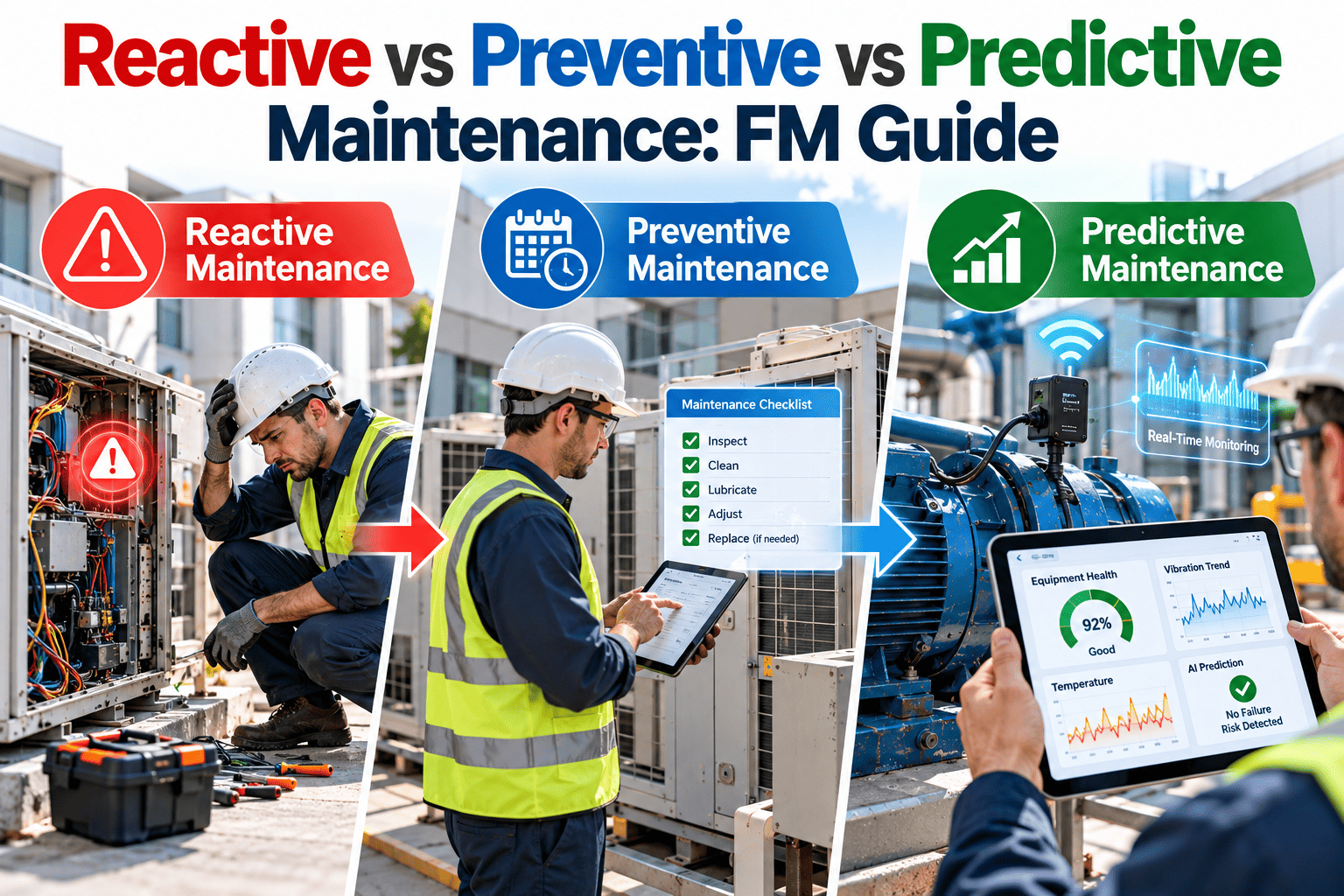
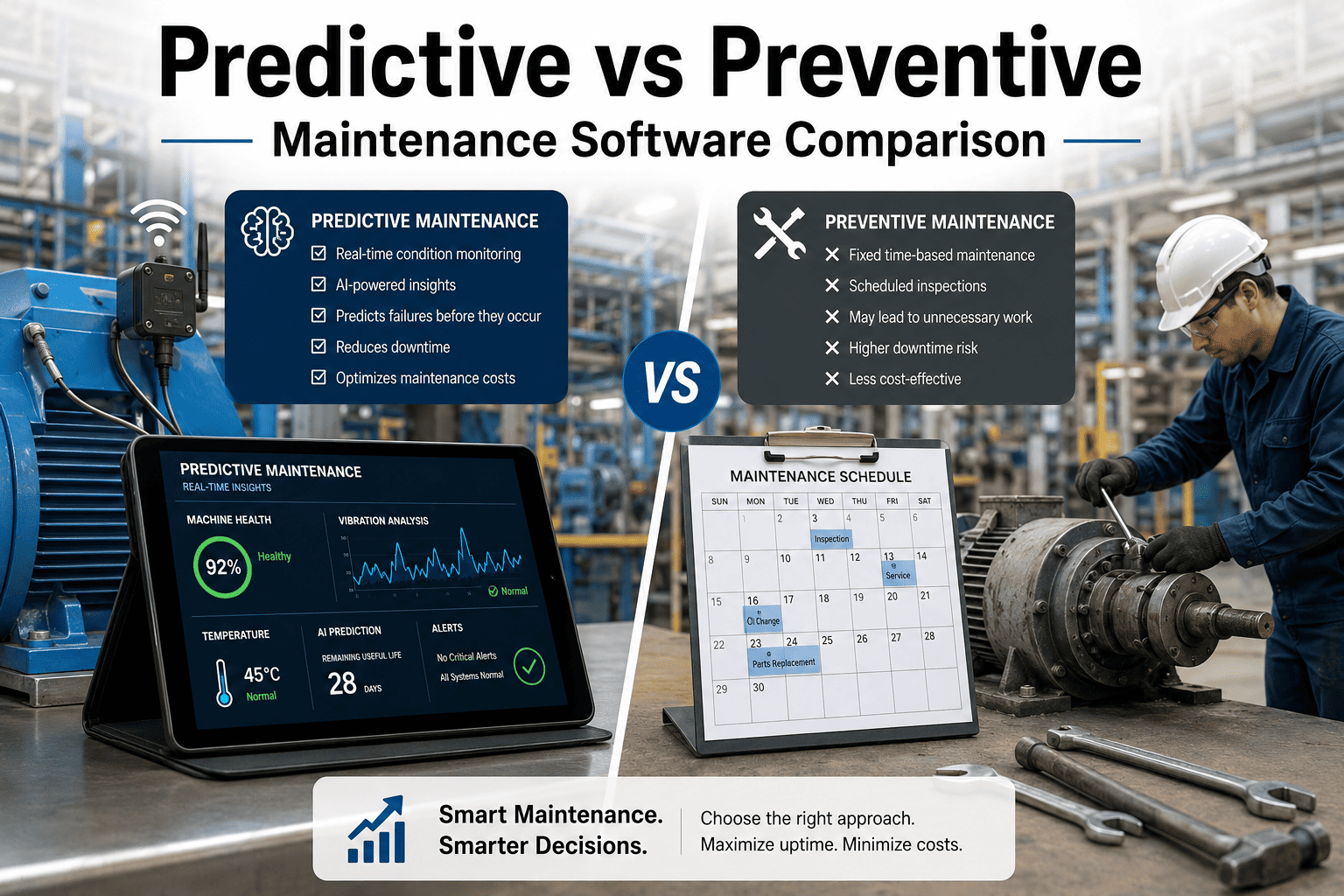
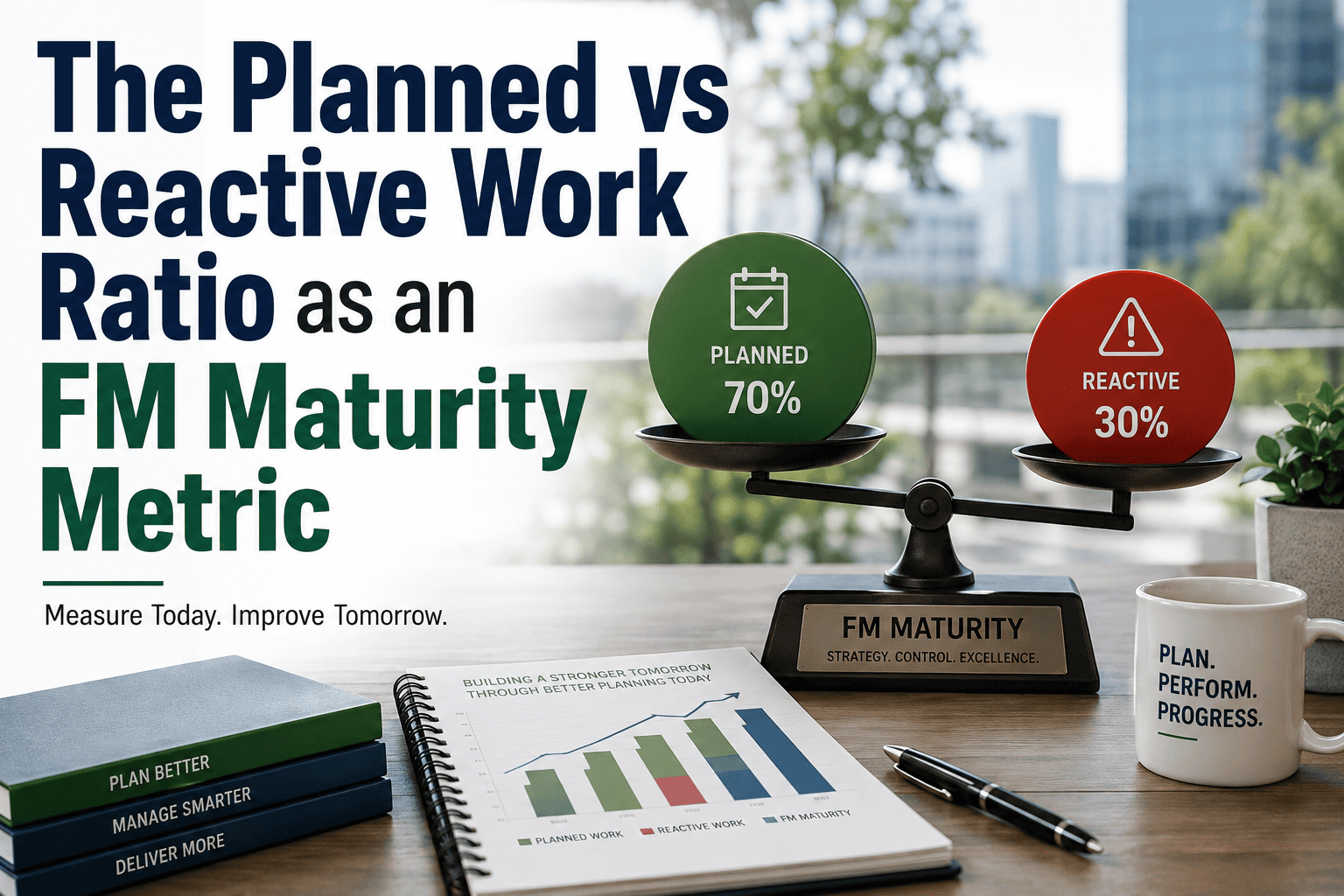
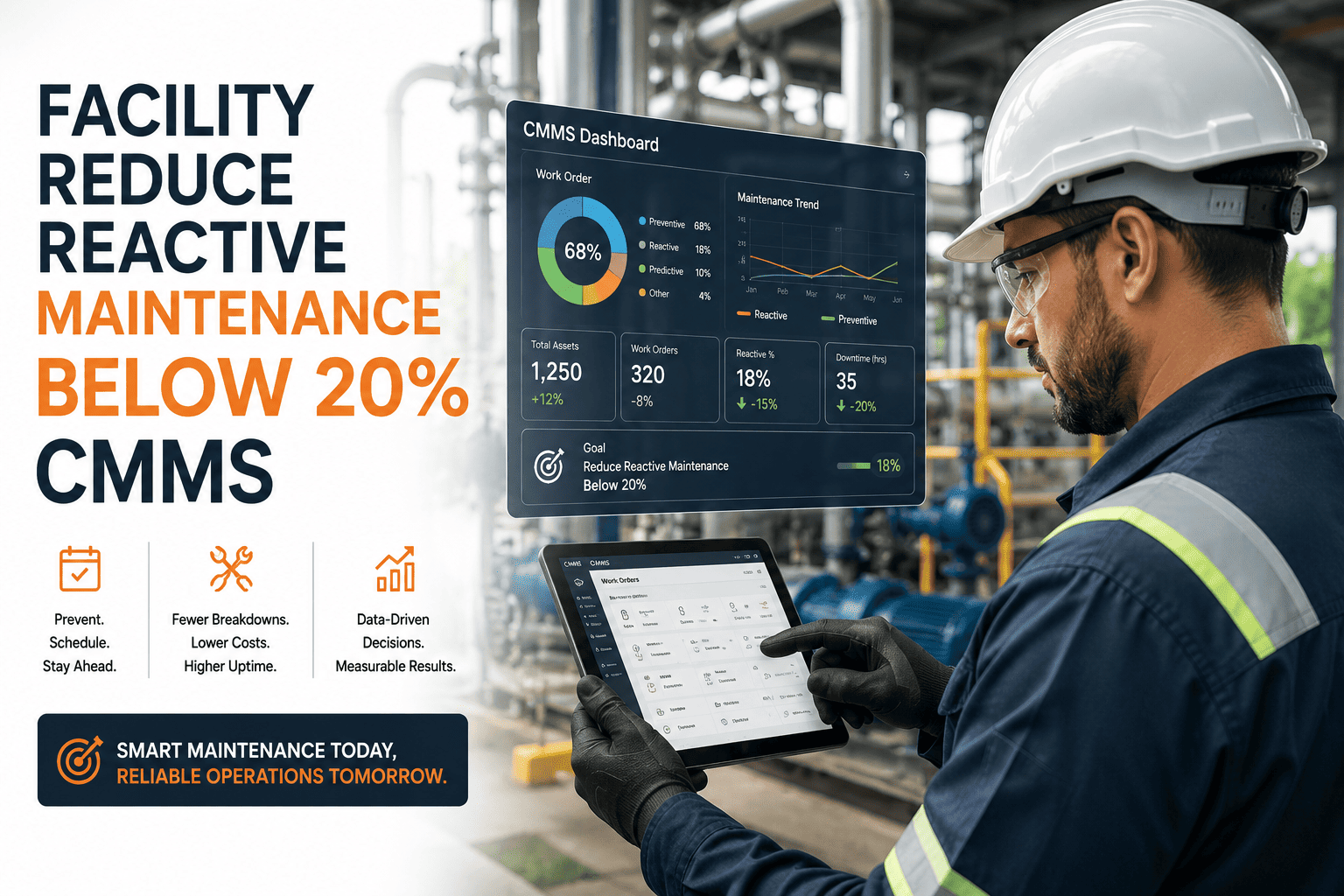
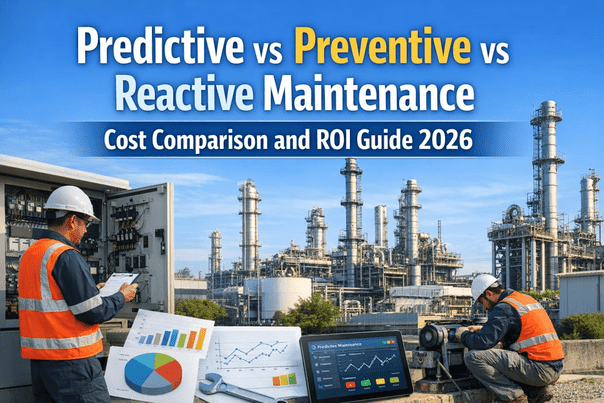
The maintenance strategy your facility runs today is one of the most consequential operational decisions you make. Facilities spending 4 to 6% of Replacement Asset Value on maintenance annually are running reactive operations. Best-in-class facilities spend 1.5 to 2.5% RAV because they have shifted to structured preventive and predictive programmes. Yet despite years of industry education, 49% of all maintenance activities globally remain reactive in 2026 (McKinsey), and 88% of facilities claim to use preventive maintenance while only 51% of actual work hours go to scheduled tasks. This guide provides the full operational and financial comparison of all three strategies, the decision framework for deploying the right approach on each asset class, the implementation roadmap from reactive to predictive, and how OxMaint's CMMS platform makes the transition measurable and fast for US and UAE facility teams. Start free on OxMaint or book a demo to see your maintenance strategy mapped against 2026 benchmarks.
Stop Paying the Reactive Premium. OxMaint Moves Your Team From Firefighting to Intelligence-Driven Maintenance in Days.
Asset registry, PM scheduling, IoT integration, and predictive analytics all in one platform. No heavy implementation. No IT project. Operational from day one for US and UAE facility teams.
The Three Maintenance Strategies: Full Comparison
No facility runs a single strategy exclusively. The goal is not to choose one, it is to deploy the right strategy on each asset class based on failure consequence, monitoring cost, and downtime impact. Here is the complete side-by-side breakdown.
Head-to-Head: What Changes Across Every Performance Dimension
| Performance Factor | Reactive | Preventive | Predictive (OxMaint) |
|---|---|---|---|
| Maintenance Trigger | Equipment failure, after breakdown | Fixed calendar or hours regardless of condition | Real-time condition data crossing threshold |
| Annual Cost (RAV%) | 4 to 6% of RAV, emergency premium applies | 2.5 to 4% of RAV, some over-maintenance waste | 1.5 to 2.5% of RAV, best-in-class benchmark |
| Failure Detection | Zero. Discovered at breakdown. | Partial. May miss failures between intervals. | 2 to 8 weeks advance warning, 85 to 92% AI accuracy |
| Emergency Share of Budget | 38 to 52% of total maintenance spend | Reduced but still 20 to 35% | Target under 15% within 18 months |
| Asset Lifespan | Shortened by cascade failures and deferred repairs | Extended vs reactive through regular servicing | 20 to 40% extension vs reactive baseline |
| Parts Strategy | Emergency sourcing at 2 to 3x standard cost | Stocked per schedule, some inventory waste | JIT ordering from condition forecast, 20 to 30% stock reduction |
| CapEx Forecast Accuracy | 40 to 65% variance vs actual | Moderate, age-based estimates | Under 15% variance from condition-data forecasts |
| Team Productivity | Firefighting, no forward planning | Scheduled but 30% of tasks wasted on healthy assets | Work triggered by data, full context from asset history |
How OxMaint Implements All Three Strategies on the Right Assets
The optimal facility maintenance programme is not a single strategy. It is a deliberate blend: predictive on high-criticality assets, preventive on moderate-criticality assets, and reactive only where failure consequence is genuinely low. OxMaint manages all three from one platform.
Deploy the Right Strategy on Every Asset. Automatically. Without a 12-Month Implementation Project.
OxMaint classifies your assets, assigns strategies, generates PM schedules, connects your IoT sensors, and delivers CapEx forecasts from one platform. Facilities go live in days, not quarters.
Implementation Roadmap: Reactive to Predictive in Three Phases
Most facilities cannot jump directly to full predictive maintenance. This phased roadmap delivers measurable ROI at every stage while building the data foundation that advanced predictive analytics requires.
Results: What Facilities Achieve After Deploying OxMaint
These benchmarks reflect outcomes from facilities that transitioned from reactive-dominant operations to OxMaint-structured maintenance programmes. Results measured within 18 months of full deployment.
OxMaint vs Competitors: Maintenance Strategy Capability Comparison
Not all CMMS platforms support all three maintenance strategies. This comparison evaluates leading platforms on the capabilities that determine whether each strategy is actually deployable. Data from G2, Capterra, and Gartner Peer Insights public reviews.
| Platform | Reactive WO Management | Preventive PM Scheduling | AI Predictive (IoT) | CapEx Forecasting | Multi-Site Portfolio | Mobile-First | Deploy Time |
|---|---|---|---|---|---|---|---|
| Oxmaint Best | Full | Full + condition triggers | Built-in, OPC-UA/MQTT | 5 to 10 yr rolling | Portfolio level | Native, offline capable | Days |
| IBM Maximo | Full | Full | Custom dev required | Custom modules | Enterprise | Limited | 6 to 18 months |
| MaintainX | Full | Good | Not available | Not available | Basic | Strong | 1 to 3 weeks |
| UpKeep | Full | Good | Limited | Not available | Basic | Strong | 1 to 3 weeks |
| Fiix (Rockwell) | Full | Good | Basic analytics | Not available | Moderate | Good | 4 to 10 weeks |
| Limble CMMS | Full | Good | Not available | Not available | Basic | Good | 2 to 4 weeks |
| Hippo CMMS (Eptura) | Full | Moderate | Not available | Not available | Basic | Moderate | 2 to 3 weeks |
| Cryotos | Full | Good | Partial | Not available | Moderate | Good | 2 to 4 weeks |
| eMaint (Fluke) | Full | Full | Via Fluke sensors | Partial | Multi-site | Good | 3 to 8 weeks |
| Asset Essentials (Dude) | Full | Good | Not available | Basic | Moderate | Good | 2 to 4 weeks |
Full: native out-of-box capability. Partial: requires configuration or add-on. Not available: not in current product. Deploy time: time to operational value.
Your Competitors Are Already Running Predictive Maintenance. OxMaint Gets You There Without a Year-Long Implementation.
One platform for reactive tracking, preventive scheduling, and AI-driven predictive analytics. No custom development. No heavy consulting fees. Operational in days for US and UAE facility teams.
Regional Compliance: How Each Maintenance Strategy Satisfies Your Regulatory Obligations
Each region imposes specific inspection frequency, documentation, and audit trail requirements that directly determine which maintenance strategy is not just preferable but legally mandated for certain asset classes.
| Region | Key Compliance Frameworks | Mandatory Maintenance Requirements | Strategy Implication | OxMaint Coverage |
|---|---|---|---|---|
| USA | OSHA 29 CFR 1910, ASHRAE 180, NFPA 72 and 25, ADA, NYC Local Law 97, BEPS | Documented PM for pressure systems, fire suppression, HVAC in regulated buildings. BPS penalties require EUI documentation. OSHA requires timestamped inspection records. | Preventive mandatory for life-safety systems. Predictive strongly incentivised for BPS compliance and energy intensity reduction. Reactive legally exposed for regulated systems. | OSHA-aligned work orders, NFPA inspection scheduling, BPS energy dashboards, digital audit trails with timestamps and signatures |
| UAE | UAE Civil Defence codes, OSHAD-SF, Dubai Green Building Regulations, Abu Dhabi Estidama, Vision 2030 ESG mandates | Civil Defence requires documented fire system inspections. Estidama and Dubai Green Building mandate energy performance records. OSHAD-SF requires equipment safety inspections. | Preventive legally required for fire and safety systems. Predictive aligned with Vision 2030 smart building mandate and ESG reporting requirements for investor-grade properties. | Civil Defence inspection scheduling, ESG KPI tracking, Dubai Green Building energy dashboards, OSHAD-SF compliant work order records |
| United Kingdom | Building Safety Act 2022, PUWER 1998, LOLER 1998, COSHH, HSE codes, NHS PLACE | PUWER requires maintained work equipment with documented records. LOLER mandates thorough examination of lifting equipment. NHS PLACE requires facility condition assessments. | Preventive legally required under PUWER and LOLER for all regulated equipment. Condition-based monitoring satisfies thorough examination requirements for lifting equipment. | PUWER and LOLER inspection scheduling, NHS PLACE compliance records, HSE-aligned audit exports, Building Safety Act documentation |
| Canada | CSA Z1000, provincial OHS Acts (OHSA Ontario, WSIA BC), National Building Code, ASHRAE compliance | CSA Z1000 requires systematic maintenance management. Provincial OHS Acts mandate equipment inspection records. NBC requires building system maintenance documentation. | Preventive required under CSA Z1000 framework. High labour costs in Canada make predictive ROI exceptionally strong. Multi-province operations require centralized CMMS. | CSA Z1000-aligned PM records, provincial OHS documentation, multi-province portfolio dashboards, CapEx forecasting for high-labour markets |
| Europe (EU/Germany) | BetrSichV, EU Directive 2019/1152, DIN EN ISO 45001, ISO 14001, GDPR, EU ETS, CSRD ESRS E1 | BetrSichV requires documented safety inspections with competent person verification. ISO 45001 mandates hazard management records. CSRD requires sustainability performance documentation. | Preventive and condition-based both legally required under BetrSichV for plant and work equipment. CSRD makes ESG-linked maintenance data an investor reporting obligation. | BetrSichV inspection scheduling, ISO 45001 CAPA workflows, GDPR-compliant data handling, CSRD-aligned ESG maintenance reporting exports |
Frequently Asked Questions
Which maintenance strategy delivers the best ROI for commercial buildings in the US and UAE?
How long does it take to see results after switching from reactive to preventive maintenance?
What IoT sensors does OxMaint require for predictive maintenance?
How does OxMaint handle compliance documentation for OSHA, UAE Civil Defence, and PUWER?
Every Asset Deserves the Right Strategy. OxMaint Makes Sure Every Asset Gets It, Automatically.
Reactive tracking, preventive scheduling, and AI-driven predictive analytics in one platform. Used by facility teams across the US and UAE to cut emergency repair spend and build compliance-ready documentation from daily operations.
Continue Reading
Explore the full Facility Management knowledge cluster for deeper dives into each component of a complete maintenance strategy.