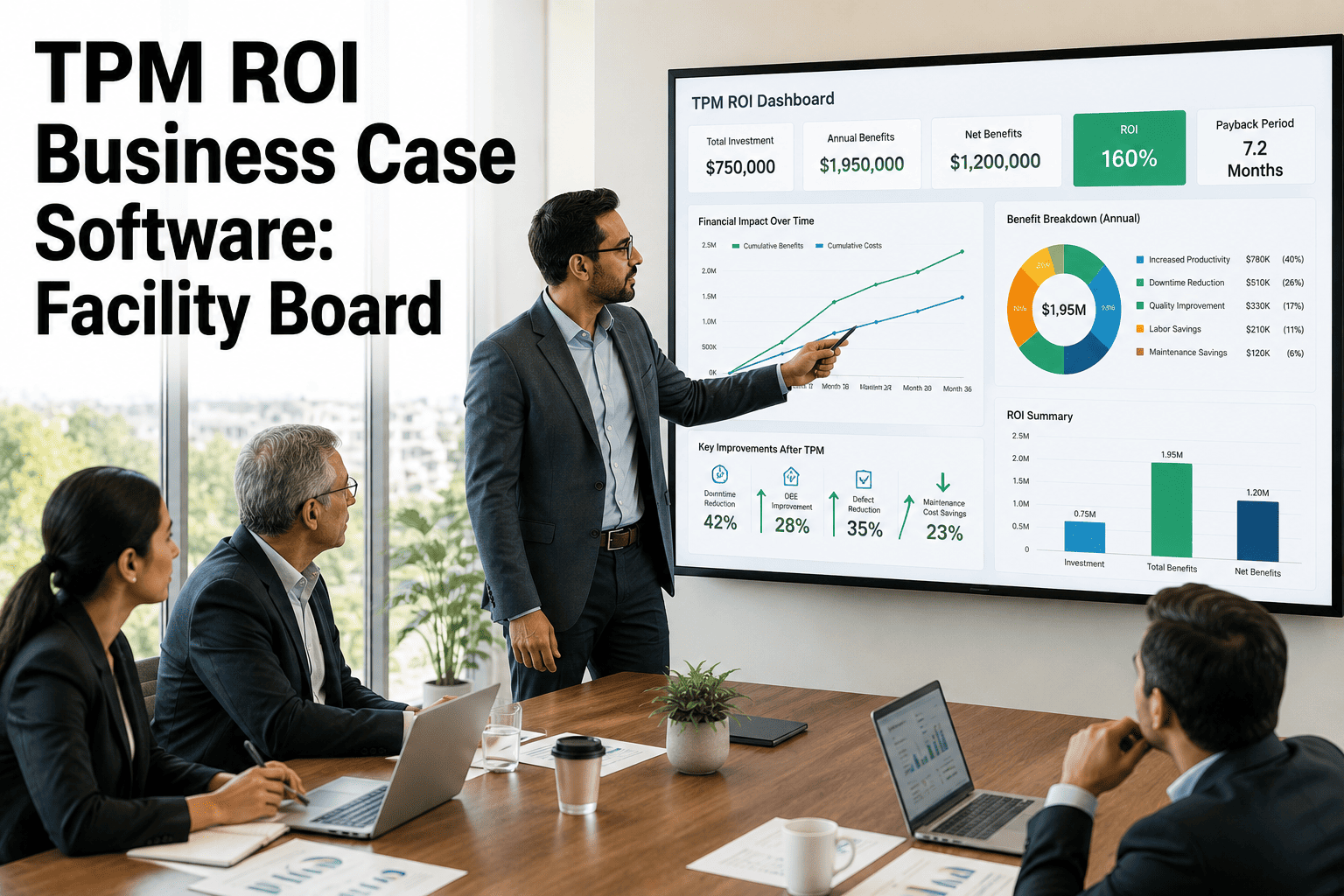
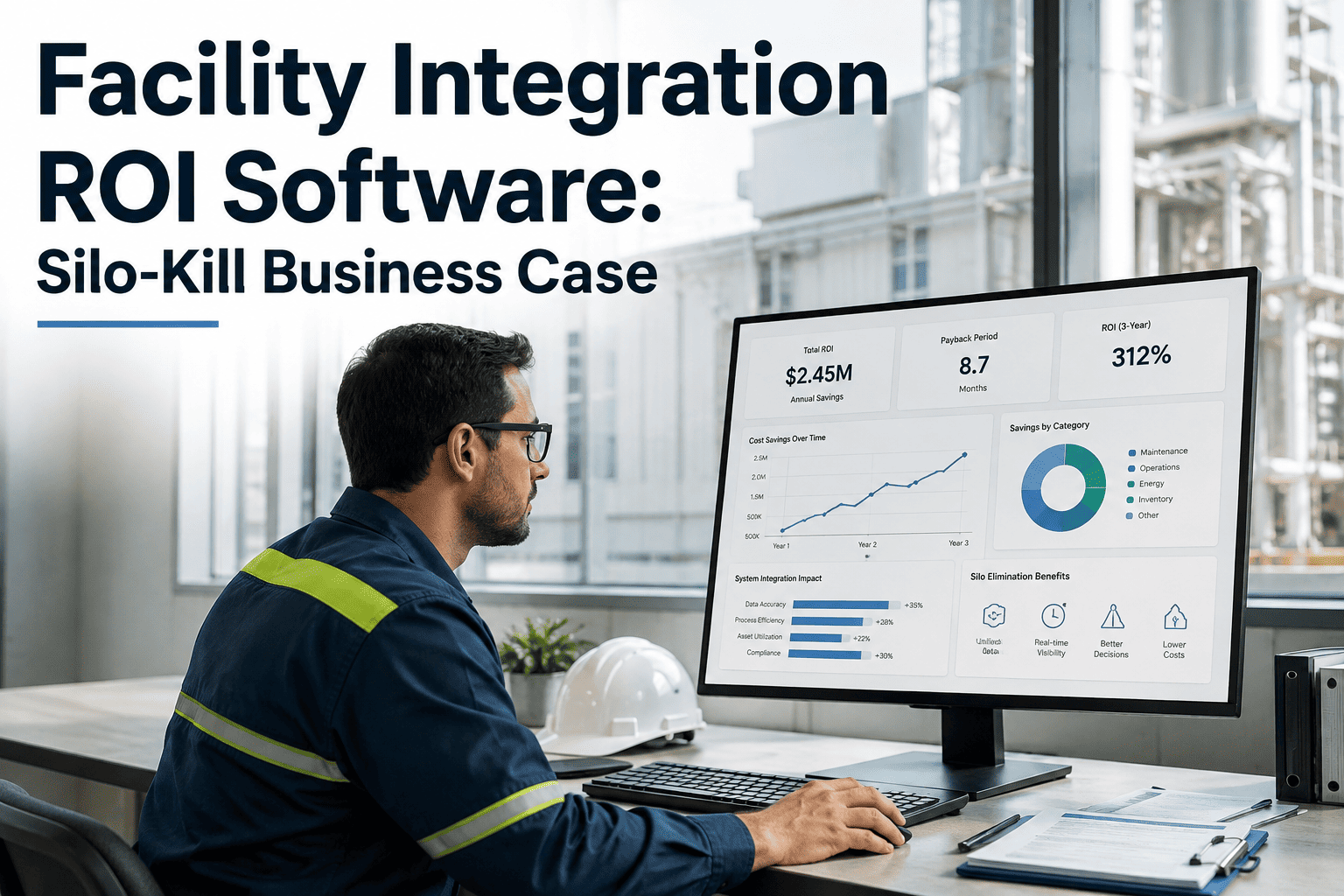
A plant reliability manager can walk into the boardroom with a spreadsheet full of downtime hours, but numbers alone rarely unlock a TPM budget. Facility boards want to see a direct line between preventive maintenance spending and dollars saved, not just a list of machines that broke last quarter. Most maintenance teams spend weeks rebuilding the same business case every budget cycle because the data lives scattered across logs, spreadsheets, and a supervisor's notepad. A facility CMMS that already tracks asset history, work order cost, and downtime hours turns that same spreadsheet into a board-ready ROI pack in an afternoon instead of a month. OxMaint's TPM ROI dashboard pulls every number a facility board asks for into one exportable report.
Turn Maintenance Data Into a Board-Approved Budget
OxMaint auto-generates the cost avoidance, downtime savings, and payback period numbers your facility board actually asks for before it approves a dollar.
$340K
Average annual reactive maintenance cost a mid-size facility absorbs before a documented TPM program starts
3.2x
Typical return facility boards see within 18 months once a documented ROI trail exists
6 weeks
Average time saved building a budget case when ROI data pulls automatically instead of by hand
Why Most TPM Budgets Get Rejected at the Facility Board
Boards rarely reject a total productive maintenance request because the idea is bad. They reject it because the case in front of them cannot survive one hard question about where the numbers came from, and most reliability teams walk in without an answer ready.
No Baseline Cost Data
Teams ask for money to prevent failures they never actually costed. Without a documented baseline of repair, downtime, and labor cost, a board has nothing solid to compare the new ask against.
Savings Claims Without a Trail
A projected twenty percent drop in downtime sounds reasonable until someone asks how it was calculated. Verbal estimates are usually the first line item cut when budgets tighten.
One-Time Snapshot, Not a Trend
A single spreadsheet pulled together last quarter cannot show whether the problem is improving or getting worse. Boards fund trends they can track, not a moment in time.
No Link to Business Outcomes
Metrics like mean time between failures mean little to a finance committee unless they are translated into dollars, downtime hours, and units of production saved.
The ROI Formula OxMaint Builds Automatically
A total productive maintenance business case only needs four numbers to hold up under questioning: what failures currently cost, what planned maintenance would cost instead, how much downtime would drop, and how quickly that difference pays back the investment. OxMaint tracks all four continuously so the report is never more than a few clicks away.
1
Baseline Capture
Every work order, failure, and downtime minute logged in OxMaint over the trailing twelve months becomes the current-state cost baseline automatically, with no separate data entry project required.
2
Planned Maintenance Model
OxMaint models a preventive schedule against manufacturer intervals and the facility's own historical failure patterns to estimate a realistic planned-maintenance cost.
3
Downtime Delta Calculated
The system compares projected downtime under a planned program against the reactive baseline to isolate exactly how many hours and dollars a facility stands to save.
4
Payback Period Generated
Implementation and subscription cost are weighed against the annualized savings figure to produce a payback period measured in months, not a rough guess on a whiteboard.
5
Board-Ready Export
The finished business case exports as a formatted report with charts, so the reliability manager walks into the meeting with the answer already built and defensible.
Reactive vs Planned Maintenance — The Cost Difference
The gap between a reactive shop and a documented total productive maintenance program is rarely subtle once it is measured properly, which is exactly why boards ask to see it in writing before releasing funds.
Metric
Reactive Maintenance
Planned (TPM) Maintenance
OxMaint Advantage
Average repair cost per failure
$4,800
$1,900
Auto-logged per work order
Unplanned downtime per month
38 hours
11 hours
Tracked in real time
Parts on emergency order
22% of orders
6% of orders
Inventory forecasting
Technician overtime per month
64 hours
19 hours
Scheduled labor planning
Mean time between failures
210 hours
640 hours
Asset history trending
Annual cost, 50-asset site
$612,000
$398,000
Full cost comparison report
Stop Rebuilding the Business Case Every Budget Cycle
OxMaint keeps the baseline, the savings trend, and the payback math current automatically, so the next budget ask takes an afternoon instead of a month of spreadsheet work.
5 Numbers Every Facility Board Wants to See
Boards move faster when a business case leads with numbers instead of narrative. These are the five figures that show up in almost every approved TPM proposal built inside OxMaint.
$186,400
Cost Avoidance Year to Date
94%
Planned Work Compliance
-58%
Emergency Purchase Orders
Our board had rejected our TPM funding request twice before we started using OxMaint. The third time, we walked in with twelve months of documented downtime cost, a payback calculation, and a trend line instead of a hunch. The budget was approved in a single meeting.
— Reliability Director, Multi-Site Manufacturing Group
Frequently Asked Questions
How does OxMaint calculate TPM ROI without months of manual data entry?
OxMaint pulls cost, downtime, and labor data directly from work orders already logged in the system, so the baseline builds itself as the team does its normal maintenance work.
Explore the ROI dashboard to see the calculation run on your own asset data.
What information does a facility board actually need to approve a TPM budget?
Most boards want a documented baseline cost, a comparable planned-maintenance cost, a downtime delta, and a payback period in months. All four are generated automatically in an OxMaint export.
Can OxMaint show ROI trends over multiple years, not just one snapshot?
Yes, the dashboard tracks cost and downtime trends continuously, so a board can see whether the program is improving quarter over quarter instead of relying on a single static report.
Does OxMaint work for facilities that don't yet have a formal TPM program?
Baseline capture works from day one, even in a purely reactive shop, which means the reactive-cost data needed to justify starting TPM is already being collected before the program formally begins.
How long does it take to get a board-ready ROI report from OxMaint?
Facilities already logging work orders in OxMaint can export a formatted business case in minutes.
Book a walkthrough to see a live report built from sample data.
Build Your Next TPM Business Case in an Afternoon