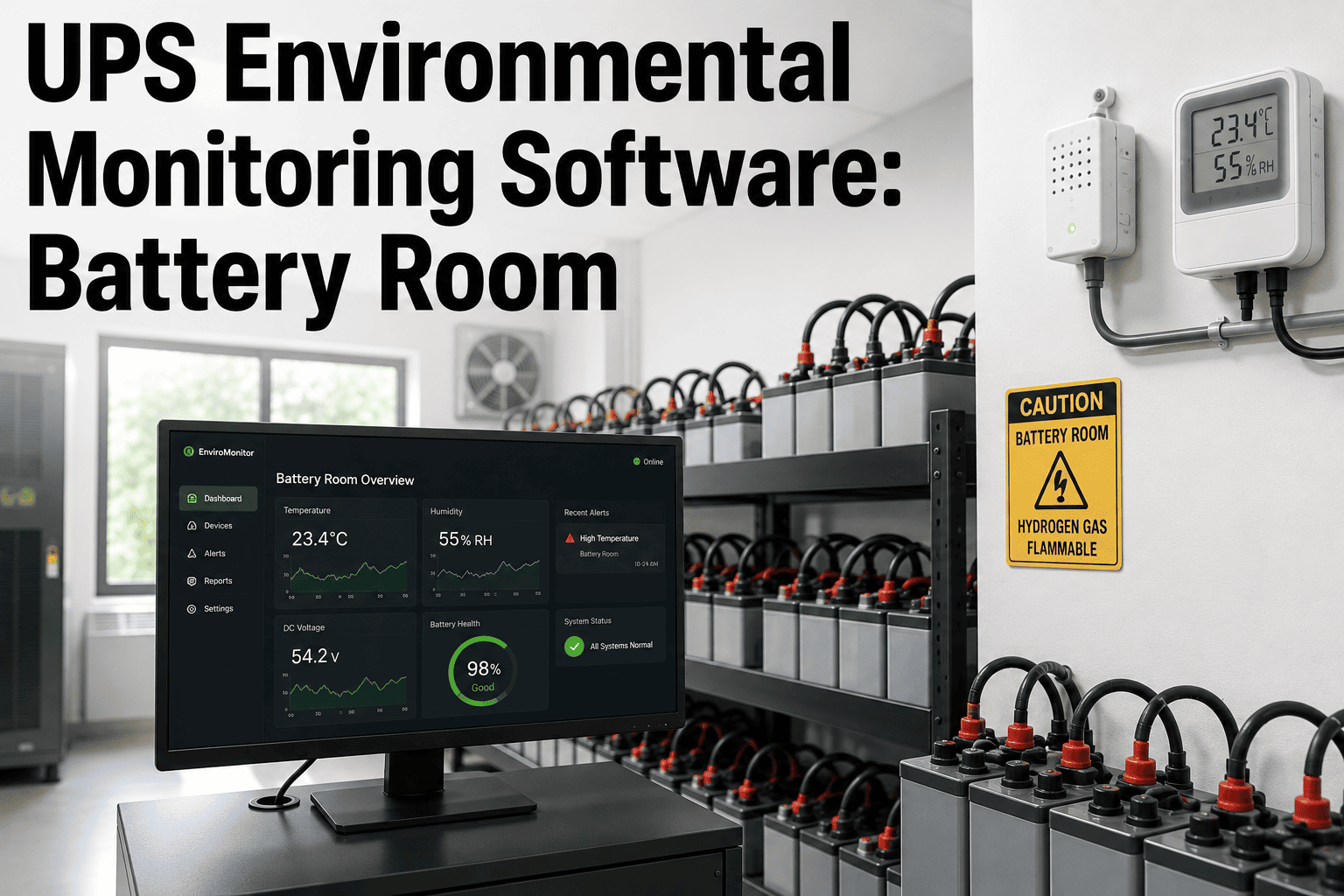
UPS environmental software is the fastest way to protect your battery room from the two things that kill UPS reliability: heat and hydrogen. When battery room temperature climbs just 10°C above the 25°C design point, VRLA battery life is cut roughly in half — and when hydrogen gas accumulates past 1% concentration, you have an explosion hazard that puts your entire facility at risk. The best UPS environmental CMMS platforms in 2026 combine IoT sensor monitoring, automated alerts, and compliance-grade reporting into a single dashboard so your team catches problems before they cascade into downtime. This guide breaks down exactly what to monitor, which thresholds matter, and how modern facility environmental CMMS tools like OxMaint turn raw sensor data into audit-ready maintenance workflows. If you're ready to see it in action, Start Free Trial and connect your first sensors in under an hour.
Is Your Battery Room Silently Destroying Your UPS Investment?
Every 10°C above 25°C halves VRLA battery life. Hydrogen above 1% LEL is an explosion risk. Yet most facilities still rely on weekly manual checks — if that. Here's what the top UPS environmental platforms track, and why it matters.
What Should a UPS Environmental Monitoring Platform Track?
A battery room is a controlled environment with four variables that directly determine whether your UPS system works when the power goes out — or fails catastrophically. The best battery room monitoring tools track all four continuously, not just during quarterly walkthroughs.
The single biggest factor in battery lifespan. IEEE 1187 and manufacturer specs both anchor to 25°C. At 35°C, a 10-year VRLA battery delivers roughly 5 years. At 40°C, closer to 2.5. A UPS environmental CMMS logs temperature every 60 seconds and triggers a work order when any rack exceeds 28°C for more than 15 minutes.
Lead-acid and VRLA batteries off-gas hydrogen during charging. NFPA 70 Article 480 and IEEE 1635 require ventilation that keeps H₂ below 1% by volume (25% of the Lower Explosive Limit). The best battery hydrogen CMMS platforms integrate fixed H₂ sensors with exhaust fan controls and auto-generate inspection tasks when levels trend upward.
Below 30% RH, static discharge risk climbs. Above 70%, condensation corrodes terminals and promotes ground faults. A facility environmental CMMS tracks relative humidity alongside temperature and flags sustained excursions — especially in rooms without dedicated HVAC, where seasonal swings of 30–80% RH are common.
Hydrogen dilution depends on continuous mechanical ventilation. If an exhaust fan fails at 2 AM, H₂ can reach dangerous concentrations within hours. Top UPS environment tools monitor fan run-status, differential pressure, and louver position — and escalate immediately if airflow stops while charging is active.
What Happens When You Don't Monitor: A $180K Lesson
A 400,000 sq ft distribution center in Texas ran two 500 kVA UPS systems with 192 VRLA batteries across four strings. Their battery room had no environmental monitoring — just a wall thermometer checked during monthly PM rounds.
An HVAC compressor failed on a Friday in July. By Monday, the battery room hit 47°C. Nobody knew. The batteries cooked at extreme temperature for 60+ hours. Post-incident testing showed 68% of cells had lost more than 40% of rated capacity.
Full battery replacement: $142,000. Emergency freight and labor: $18,000. Lost throughput during the 6-hour swap: $22,000. Total: $182,000 — from a $400 HVAC part.
They deployed a UPS environmental CMMS with wireless temperature sensors on every rack, H₂ detectors at ceiling level, and automated work orders triggered at 28°C. First alert came 3 weeks later when a door was propped open — caught in 4 minutes, zero damage. Annual platform cost: under $3,600.
"We spent $182K learning what a $3,600/yr platform would have prevented. The ROI math on environmental monitoring isn't close — it's not even a question."
Battery Room Alarm Thresholds: The Numbers That Matter
Setting the right thresholds is the difference between catching a problem early and drowning in false alarms. These are the industry-standard setpoints used by the top UPS environmental 2026 platforms, based on IEEE 1187, NFPA 70, and ASHRAE TC 9.9 guidelines.
| Parameter | Normal Range | Warning Threshold | Critical / Alarm | Standard Reference |
|---|---|---|---|---|
| Ambient Temperature | 20–25°C | >27°C for 15 min | >30°C or <15°C | IEEE 1187, OEM specs |
| Hydrogen (H₂) | <0.4% by volume | 0.8% (20% LEL) | 1.0% (25% LEL) | NFPA 70 Art. 480, IEEE 1635 |
| Relative Humidity | 40–60% RH | >65% or <35% | >75% or <25% | ASHRAE TC 9.9 |
| Exhaust Fan Status | Running (during charge) | Stopped >2 min | Stopped >5 min + H₂ rising | NFPA 70, IFC 608 |
| Differential Pressure | Negative to adjacent spaces | Neutral pressure | Positive pressure | OSHA 29 CFR 1910 |
| Electrolyte Spill / Leak | None detected | Any detection | Immediate containment | EPA 40 CFR 264 |
A best-in-class UPS climate platform doesn't just alarm — it creates a prioritized work order, assigns it to the on-call technician, and starts a compliance timestamp. That's the difference between monitoring and maintenance management.
Which Regulations Require Battery Room Environmental Monitoring?
If your facility has a UPS battery room, at least four regulatory frameworks apply. Fines for non-compliance range from $15,625 per OSHA violation to $70,117 for repeat offenses — and insurance carriers increasingly deny claims when environmental monitoring was absent.
Requires ventilation to prevent hydrogen accumulation above 1% by volume in battery rooms. Mandates that ventilation systems be monitored or alarmed. A battery hydrogen CMMS with continuous H₂ logging satisfies this requirement and generates the audit trail inspectors expect.
Covers battery charging areas: ventilation, eyewash stations, spill kits, and PPE. OSHA expects documented inspection records — a facility environmental CMMS with digital checklists and timestamped sensor logs provides exactly that, replacing binders of paper forms.
IEEE 1187 defines recommended practice for VRLA battery installation and maintenance, including ambient temperature requirements. IEEE 1635 covers ventilation and thermal management. Both anchor to the 25°C baseline and expect documented environmental conditions throughout battery service life.
ISO 55001 requires organizations to demonstrate systematic asset lifecycle management — including environmental conditions that affect asset performance. A UPS environmental platform 2026 with full audit trails, trend reports, and corrective action logs maps directly to ISO 55001 clauses 7.5 and 9.1.
See OxMaint Monitor Your UPS Environment in Real Time
Book a 30-minute demo and we'll show you live sensor dashboards, automated alert workflows, and compliance reporting — configured for your facility.
How OxMaint Solves UPS Environmental Monitoring
OxMaint isn't just a dashboard — it's a full AI-powered CMMS that turns environmental sensor data into maintenance action. Here's how the platform maps to each battery room challenge.
Connect wireless temperature, humidity, H₂, and differential pressure sensors via MQTT, Modbus, or REST API. OxMaint polls every 60 seconds, applies your threshold rules, and sends push/SMS/email alerts within 30 seconds of an excursion. Result: catch HVAC failures in minutes, not days — and prevent the $180K scenario above.
When temperature exceeds 28°C or H₂ crosses 0.8%, OxMaint auto-creates a prioritized work order, assigns it to the on-call tech, and attaches the sensor trend chart. No manual intervention needed. Facilities using trigger-based work orders reduce mean-time-to-respond by 65–80% compared to phone-tree escalation.
Every sensor reading, alert, work order, and corrective action is timestamped and stored in an immutable log. Generate NFPA 70, OSHA, or ISO 55001 audit reports in one click — with trend charts, excursion summaries, and resolution times. Facilities report cutting audit prep from 3 weeks to under 2 hours.
OxMaint's AI engine correlates environmental trends with battery impedance test results to predict end-of-life 6–12 months out. Track each battery string's full lifecycle — installation date, environmental exposure hours, test history, and warranty status — so you replace on condition, not on calendar. Extend average battery life 15–25%.
How to Set Up Battery Room Monitoring in 5 Steps
Most facilities go from zero to fully monitored in under two weeks. Here's the proven deployment sequence used by top UPS environmental platform 2026 implementations.
Map rack positions, HVAC vents, exhaust fans, and door locations. Identify hot spots (typically top racks near ceiling) and dead-air zones. This determines sensor placement — you need at minimum one temperature sensor per 4 racks and one H₂ detector at ceiling level per 500 sq ft.
Mount temperature/humidity combo sensors at rack height and ceiling level. Install H₂ detectors 12 inches below ceiling (hydrogen rises). Add differential pressure sensors across doorways. Modern wireless sensors take 15–20 minutes each — no conduit, no electrician needed for most models.
Pair sensors to a gateway (cellular or Wi-Fi) and connect to OxMaint via the built-in IoT integration. Configure your asset hierarchy: Facility → Battery Room → UPS System → Battery String → Individual Sensors. This takes 2–4 hours with OxMaint's guided setup wizard.
Configure warning and critical thresholds using the table above as a starting point. Set escalation rules: warning → notify on-call tech; critical → notify tech + facility manager + auto-create work order. Test each rule by simulating an excursion. Fine-tune over the first 2 weeks to eliminate false positives.
Set up automated weekly environmental summary reports and monthly compliance packages. Train technicians on the mobile app — how to acknowledge alerts, complete sensor-triggered work orders, and log corrective actions. Most teams are fully proficient within one shift.
What Does UPS Environmental Monitoring Actually Save?
The business case is straightforward. Here's the math for a typical mid-size facility with one battery room and 96 VRLA batteries.
| Savings Category | How It's Calculated | Annual Value |
|---|---|---|
| Battery life extension (25%) | $96K battery bank ÷ 10-yr life = $9.6K/yr → 25% longer = $2.4K/yr saved | $2,400 |
| Downtime avoided (1 event/yr) | 4 hrs × $8,500/hr avg. downtime cost × 60% probability reduction | $20,400 |
| Manual check labor eliminated | 15 min/day × 250 days × $42/hr loaded labor rate | $2,625 |
| Compliance prep time saved | 40 hrs/yr audit prep × $55/hr → reduced to 4 hrs | $1,980 |
| Total Annual Savings | $27,405 | |
| Platform + sensor cost | OxMaint subscription + 8 wireless sensors (amortized) | −$4,200 |
| Net Annual ROI | $23,205 (552%) |
Payback period: under 2 months. And this doesn't include the catastrophic scenario — a single thermal event like the $182K example above makes the ROI infinite.
UPS Environmental Monitoring: Your Questions Answered
The ideal temperature is 20–25°C (68–77°F), with 25°C as the design baseline per IEEE 1187 and virtually all VRLA manufacturer specifications. Every 10°C sustained above 25°C cuts expected battery life by approximately 50%. A UPS environmental CMMS tracks this continuously and alerts before damage occurs — not after.
A fully charging lead-acid battery produces roughly 0.42 liters of hydrogen per cell per hour. Hydrogen becomes dangerous at 4% concentration (the Lower Explosive Limit), but NFPA 70 requires ventilation to keep levels below 1% — 25% of LEL. Fixed H₂ sensors connected to a battery hydrogen CMMS provide the continuous monitoring and documentation that inspectors require.
Yes. Modern wireless IoT sensors cost $80–$250 each and install in minutes without wiring. A typical battery room needs 4–8 sensors (temperature, humidity, H₂) plus a $200–$400 gateway. Total hardware cost is usually under $2,000. Pair that with a CMMS like OxMaint and you have enterprise-grade monitoring for less than one emergency battery replacement. Book a Demo to see the exact sensor options for your setup.
A Building Management System (BMS) controls HVAC and logs building-level data, but it doesn't create work orders, track asset lifecycles, or generate maintenance compliance reports. A CMMS like OxMaint ingests the same sensor data but adds the maintenance layer: automated work orders, technician dispatch, corrective action tracking, and audit-ready documentation. The best setups use both — BMS for control, CMMS for maintenance management.
Most facilities are fully operational within 2 weeks. Sensor installation takes 1–2 days, CMMS configuration takes 2–4 hours, and threshold tuning takes about a week of live data. With OxMaint's guided setup and pre-built battery room templates, some teams go live in under 5 days. Start Free Trial and you can have your first sensors reporting before the end of the week.
Your Battery Room Is Talking. OxMaint Lets You Hear It.
Join thousands of facilities using OxMaint to monitor environmental conditions, automate maintenance workflows, and stay audit-ready — all from one platform.