The US facility management market crossed $1.2 trillion in total managed asset value in 2026, yet 64% of US facility managers still run maintenance tracking on shared spreadsheets or disconnected work order systems. In the UAE, where the facility management market is projected to reach $38 billion by 2030 at a 12.34% CAGR, Burj Khalifa's IoT platform alone cut maintenance hours by 40% after switching to integrated digital work orders. Work order is the fundamental unit of maintenance execution. Every preventive maintenance task, every reactive repair, every inspection, every contractor callout starts and ends as a work order. When work orders are managed through a structured CMMS, facility teams achieve 89% PM compliance rates, 30% lower work order cycle times, and audit-ready documentation without manual preparation. This guide covers the complete work order management lifecycle for facility teams in the US, UAE, UK, Canada, and Europe, including how leading platforms compare, what regional compliance requirements demand from your documentation, and why Oxmaint's unified CMMS delivers the fastest path from reactive chaos to structured, measurable operations. Book a demo to see Oxmaint's work order system configured for your facility type.
CMMS Guide
10-12 min read
42M
work orders generated through CMMS systems across North America in 2024, tracking 27 million assets across commercial, industrial, and facility portfolios
30%
reduction in work order cycle time achieved by facility teams adopting data-driven CMMS maintenance strategies in 2025-2026
4.8x
higher cost per repair event for reactive emergency maintenance versus planned work orders managed through a structured CMMS platform
64%
of US facility managers still use spreadsheets or disconnected work order systems as their primary maintenance tracking tool in 2026
Replace Spreadsheets with Structured Work Orders. Oxmaint Goes Live in Days, Not Months.
Work order creation, PM scheduling, technician assignment, SLA tracking, and audit-ready documentation across every facility site in one unified CMMS. Free to start. No implementation fees. Built for US and UAE facility operations.
The Work Order Lifecycle: 6 Stages Every Facility Team Must Manage
A work order is not just a task ticket. It is the documented record of every maintenance decision, labor hour, part consumed, cost incurred, and compliance obligation met across your facility. Managing this lifecycle well is the difference between a reactive maintenance programme and a structured operational system that generates defensible data.
01
Request and Creation
Work orders originate from four sources: tenant or occupant service requests, technician-identified conditions during inspections, automated PM schedules, and IoT sensor threshold breaches. A structured CMMS captures all four into a single queue with standardized fields so nothing is missed and every request is trackable from the moment it is submitted.
Manual, PM-triggered, or IoT-automated
02
Prioritization and Assignment
Priority levels (critical, urgent, standard, routine) determine response time SLAs. Assignment routes the work order to the correct technician or contractor based on skill set, location, shift schedule, and current workload. AI-assisted assignment in modern CMMS platforms reduces dispatch decision time from hours to seconds for 73% of routine work orders.
SLA-driven priority with skill-based routing
03
Parts and Resource Planning
Before a technician arrives at the asset, the work order should confirm parts availability in inventory, identify required tools, and flag any specialist access requirements (confined space, lockout/tagout, hot work permit). Work orders without pre-verified parts availability cause 28% of maintenance delays in facilities without inventory-linked CMMS platforms.
Inventory-linked before dispatch
04
Execution and Field Documentation
Technicians complete work orders on mobile devices at the asset location, capturing photos of conditions found and corrected, recording meter readings and condition scores, logging actual time and parts consumed, and obtaining digital signatures where compliance requires them. 74% of work orders in CMMS-deployed facilities are completed entirely on mobile with no paper involved.
Mobile-first with photo and signature capture
05
Review and Closure
Supervisor review verifies completion quality, confirms that corrective actions were completed not just attempted, updates asset condition scores, and triggers follow-up work orders for any deferred items. Closure data feeds MTTR calculations, PM compliance rates, and cost-per-asset-class reports that managers need for budget justification.
Supervisor review with deferred item tracking
06
Reporting and Compliance Export
Closed work orders become the compliance record. For OSHA inspections, Joint Commission surveys, UAE Federal Authority audits, or tenant SLA reviews, the work order history must be complete, timestamped, technician-attributed, and exportable on demand. Facilities with structured CMMS reduce audit preparation time by 84% versus manual record compilation.
Audit-ready export for any regulatory framework
CMMS Platform Comparison: Oxmaint vs Leading Competitors for Facility Work Order Management
Choosing the right CMMS for facility work order management depends on your portfolio size, regional compliance requirements, AI automation needs, and total cost of ownership. Here is how Oxmaint compares to the leading platforms in 2026 across the criteria that matter most for facility teams in the US and UAE.
| Feature Area |
Oxmaint |
MaintainX |
Fiix (Rockwell) |
UpKeep |
Limble CMMS |
| Work Order Creation |
Manual, PM-auto, IoT-triggered, and condition-based from one queue |
Manual and PM-triggered, strong mobile interface |
Manual, PM-auto, and PLC/sensor-triggered in manufacturing |
Manual and PM-triggered, polished mobile app |
Manual and PM-triggered, quick setup, user-friendly |
| AI Automation |
Built-in: predictive failure alerts, auto-assignment, condition scoring per asset, CapEx forecasting |
AI procedure generator for checklists; limited predictive maintenance depth |
Fiix Foresight AI analytics, strong in manufacturing; Professional tier required |
AI features lagging vs newer platforms; mobile UX is strongest differentiator |
Predictive maintenance available; analytics depth below enterprise platforms |
| Multi-Site Portfolio |
Unlimited sites, portfolio dashboard, FCI scoring, CapEx forecast across all sites |
Multi-site available at Enterprise tier; standardized procedures across locations |
Multi-site supported; stronger in industrial single-site deployments |
Multi-location supported; better for distributed assets than large portfolios |
Multi-site supported at higher pricing tiers |
| Compliance Documentation |
Audit-ready exports for OSHA, Joint Commission, CMS, UAE Federal Authority, NFPA, ASHRAE from same work order |
Strong audit trail; popular in regulated industries; compliance reporting at higher tiers |
Compliance tracking strong for manufacturing; facility-specific compliance needs add-ons |
Compliance reporting available; not optimized for healthcare or government frameworks |
Compliance features available; best suited to food production and construction |
| Asset Lifecycle and CapEx |
Condition scoring per asset, rolling 5-10 year CapEx forecast, FCI reporting built-in |
Asset tracking and history; CapEx forecasting not a core feature |
Strong asset management; CapEx forecasting not natively included |
Asset tracking strong; lifecycle forecasting limited vs enterprise platforms |
Asset management solid; CapEx modelling not a primary differentiator |
| Free Tier Available |
Yes, permanent free tier: work orders, asset registry, PM scheduling, mobile access, 50 assets |
Yes, limited free tier with basic work orders |
Yes, free plan covers basics; advanced AI requires Professional tier |
No free plan; starts at $45 per user per month |
Yes, starter plan available |
| Deployment Speed |
Live in 7-14 days, no IT project, no implementation consulting fees |
Live in 2-3 weeks with white glove implementation at Enterprise |
Live in 2-4 weeks for standard configurations |
Live in 2-4 weeks; implementation support available |
Live in 1-2 weeks; praised for fast onboarding |
| Best Fit |
Multi-site commercial and industrial portfolios in US, UAE, UK, Canada, and Europe requiring compliance documentation and CapEx forecasting |
Mobile-first frontline teams in regulated industries needing fast work order setup and team collaboration |
Manufacturing plants with Rockwell Automation systems wanting production-maintenance integration |
Small to mid-sized distributed asset teams wanting polished mobile field experience |
Smaller teams wanting fast, user-friendly CMMS without deep enterprise complexity |
Regional Work Order Management Requirements: US, UAE, UK, Canada, and Europe
Work order documentation requirements are not universal. Regulatory frameworks, tenant SLA obligations, and accreditation standards in each region impose specific documentation requirements on facility teams that a general-purpose task management tool cannot satisfy. Here is what each major region demands from your work order system.
| Region |
Primary Compliance Requirements |
Key Documentation Standard |
Oxmaint Regional Coverage |
| USA |
OSHA 29 CFR, Joint Commission EOC, CMS Conditions of Participation, NFPA fire and life safety, ASHRAE mechanical, ADA Title II for government |
Timestamped technician-attributed work orders, inspection records per asset class, audit-exportable PM history |
Pre-built PM templates mapped to OSHA, NFPA, Joint Commission, and CMS standards; audit export by regulatory framework |
| UAE |
UAE Federal Authority standards, Dubai Municipality compliance, UAE Industrial Strategy 2030 digital PM mandate, TRAKHEES for free zones, Civil Defence inspection requirements |
IS2030-compliant digital maintenance records, Civil Defence inspection logs, EHS emission equipment PM documentation |
IS2030-ready digital work orders, Arabic language mobile interface, Civil Defence and EHS inspection templates, multi-site UAE dashboard |
| UK |
Building Safety Act 2022, Health and Safety at Work Act, CIBSE maintenance guidance, NHS ERIC compliance for healthcare, SFG20 planned maintenance standards |
Documented maintenance regimes per SFG20, Building Safety Case records for higher-risk buildings, HSE-compliant inspection trails |
SFG20-aligned PM templates, Building Safety Act documentation support, HSE-compliant work order records, NHS-specific compliance module |
| Canada |
CSA Z305.5 for healthcare, provincial OHS regulations, National Building Code maintenance provisions, BOMA Canada standards for commercial properties |
Provincial OHS compliance records, BOMA performance documentation, CSA-aligned medical equipment PM records |
Provincial OHS template library, BOMA reporting integration, healthcare CSA compliance module, multi-province portfolio dashboard |
| Europe |
EU EPBD energy performance obligations, EN 13306 maintenance terminology standard, ISO 55001 asset management, GDPR data handling for maintenance records, national fire codes |
ISO 55001-aligned asset records, EPBD compliance energy maintenance documentation, GDPR-compliant technician data handling |
ISO 55001-mapped asset registry, EPBD-linked energy PM scheduling, GDPR-compliant data architecture, EU data residency for regulated deployments |
Oxmaint Delivers Regional Compliance Documentation as a Byproduct of Daily Work Orders Across the USA and UAE
Every work order closed in Oxmaint creates a compliance-ready record for your region's regulatory framework automatically. No separate documentation step. No manual compilation before audit. OSHA, Joint Commission, UAE IS2030, and more are covered from day one.
How Oxmaint Transforms Work Order Management for Facility Teams
Oxmaint is built specifically for multi-site commercial and industrial facility portfolios, delivering the work order management depth that generic task tools and entry-level CMMS platforms cannot match at scale.
AI-Automated Work Order Generation
Work orders generate automatically from three sources: PM schedule triggers (calendar, runtime hours, production cycles), IoT sensor threshold breaches via OPC-UA and REST API, and technician-submitted condition readings from mobile. No manual creation required for 73% of routine maintenance events. Every auto-generated work order includes asset context, assigned technician, required parts, and applicable compliance flag pre-populated.
SLA Tracking and Escalation Automation
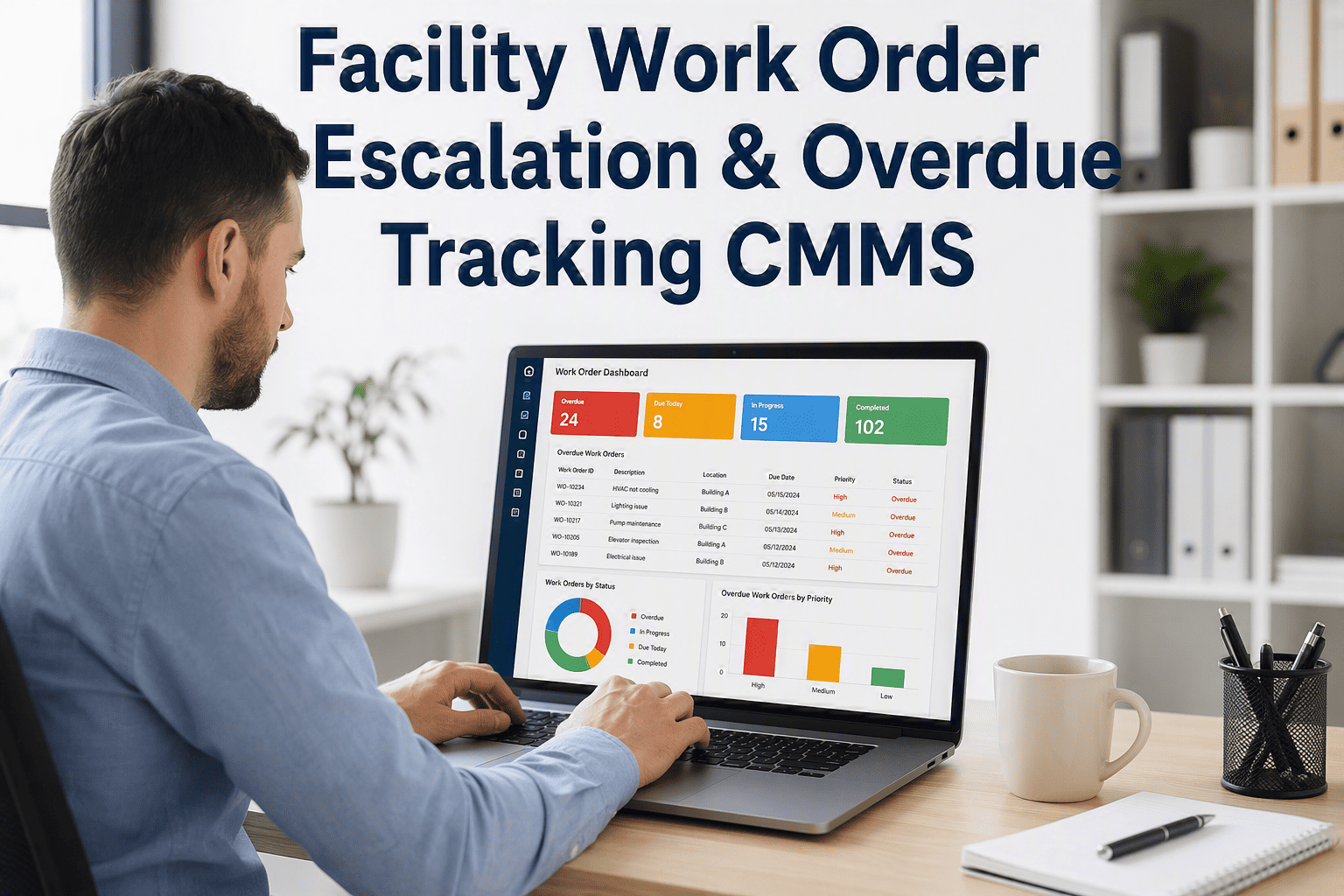
Configure response and resolution SLA targets per work order priority level and asset criticality class. Oxmaint tracks actual vs target times per work order and escalates automatically at configurable thresholds: 50% of SLA elapsed triggers a notification, 90% triggers supervisor alert, 100% elapsed triggers director escalation. SLA performance reports generate per technician, per building, and per portfolio level with no manual compilation.
Full Asset Registry with Condition Scoring
Every work order is linked to the specific asset in Oxmaint's full registry, updating the asset's condition score, maintenance cost history, and remaining useful life estimate as it closes. Facility managers see which assets are trending toward failure, which are generating disproportionate maintenance cost, and which are approaching economic replacement threshold before the equipment fails and the decision becomes reactive.
Mobile-First Field Operations with Offline Mode
Technicians access work orders, asset history, PM checklists, and inspection templates from mobile devices at the equipment. QR-tagged assets open the complete service record in under 3 seconds. Offline mode maintains full functionality in basement mechanical rooms, data centres, and remote sites without reliable connectivity, syncing automatically when connection restores. 74% of work orders in Oxmaint deployments are completed entirely on mobile.
Rolling CapEx Forecasting from Work Order Data
Actual maintenance cost per asset class, drawn from closed work order records, feeds Oxmaint's rolling 5-10 year capital replacement model automatically. The CapEx forecast tells directors which assets are approaching economic replacement threshold 18-36 months in advance, enabling budget submissions with data evidence rather than depreciation estimates. Capital requests backed by Oxmaint condition data achieve 88% approval rates.
Portfolio-Level Dashboard Across All Sites
Multi-site facility directors see PM completion rates, open work order backlog, SLA adherence, overdue inspection counts, and asset condition alerts across every facility in real time on one dashboard. Drill from portfolio view to individual building to specific asset in three clicks. No manual status reports, no weekly calls to collect building-level data. US, UAE, UK, and Canada sites all visible from one account.
Before and After: Reactive vs Oxmaint-Structured Work Order Operations
Reactive Work Order Management
XWork orders created via email and phone calls. No central queue, no priority standardization, no SLA visibility for anyone including the requester.
XPM schedules in spreadsheet tabs updated once a month. Overdue PMs discovered during annual inspection, not before equipment fails.
XTechnician work history exists in paper folders sorted by month. Retrieving the last three service records for a specific HVAC unit takes 20 to 40 minutes of manual searching.
XCompliance audit preparation requires 3-5 days of staff time manually compiling records from email, paper logs, and spreadsheets. Records are still incomplete when the auditor arrives.
XReactive emergency repair ratio above 40%. Budget overruns occur every quarter from unplanned events that structured PM would have prevented at 4.8x lower cost.
Oxmaint Structured Work Order Operations
VAll work orders enter a single prioritized queue from any source: tenant portal, mobile app, PM schedule, or IoT sensor. Every request is visible, assigned, and trackable from creation to closure.
VPM work orders generate automatically before due dates with escalating alerts at 30, 7, and 1 day. PM compliance rate reaches 89% across portfolio within 6 months of deployment.
VEvery asset's complete service history retrieves in under 10 seconds by asset ID, location search, or QR scan. Last 3 service records including technician, findings, and parts used display instantly.
VCompliance audit documentation exports from Oxmaint in under 4 hours with every work order, inspection record, and PM completion included. No missing records, no manual preparation.
VEmergency work order ratio reduces from 40%+ to under 17% within 12 months. Predictive and preventive maintenance replace reactive repairs, recovering the 4.8x cost premium on emergency events.
Frequently Asked Questions: Work Order Management for Facility Teams
QWhat is the difference between a work request and a work order in facility management?
A work request is an unverified submission from any source (tenant, technician, sensor). A work order is a verified, approved, resourced maintenance task with a priority, assigned technician, linked asset, and SLA. In Oxmaint, all requests convert to structured work orders automatically with asset context, parts availability check, and compliance flag pre-populated.
Sign up free or
book a demo to see the full request-to-work-order workflow.
QHow does Oxmaint handle work order compliance documentation for US OSHA and UAE Federal Authority requirements simultaneously?
Every work order in Oxmaint closes with a timestamped, technician-attributed, photo-evidenced digital record tagged to the applicable regulatory framework. OSHA, Joint Commission, UAE IS2030, and Civil Defence records all generate from the same work order system with region-specific export formats.
Book a demo to see the multi-region compliance module configured for your portfolio.
QCan Oxmaint manage work orders across multiple facility sites in different countries from one account?
Yes. Oxmaint supports unlimited sites under one account with site-specific PM schedules, compliance configurations, and SLA settings, while the portfolio dashboard aggregates all work order data, compliance status, and asset condition across every site in real time.
Sign up free and add your first sites within minutes.
QWhat is the ROI timeline for implementing a CMMS work order system in a US or UAE facility operation?
Within 30 days: PM compliance rate becomes measurable for the first time. Within 90 days: first prevented breakdown events identifiable, emergency repair ratio trending down. Within 12 months: emergency work order ratio typically reduces from 40% to under 17%, recovering the 4.8x reactive cost premium on every prevented event.
Book a demo for an ROI projection specific to your facility size and asset base.
QHow long does it take to deploy Oxmaint and get the work order system operational?
Oxmaint deploys in 7-14 days for standard commercial and industrial facilities. Asset registry, PM schedule configuration, work order workflows, and mobile app access are all operational within two weeks with no IT project and no implementation consulting fees required.
Sign up free today and the system is live before your next maintenance cycle.
42 Million Work Orders Tracked Through CMMS in North America Last Year. Most Facilities Still Use Spreadsheets. Which Side Are You On?
Oxmaint gives facility teams in the USA, UAE, UK, Canada, and Europe a structured work order system with AI automation, SLA tracking, regional compliance documentation, asset lifecycle management, and multi-site portfolio visibility. Free to start. Live in 7-14 days. No implementation fees.
Continue Reading
The guides below provide broader context for facility operations, compliance, and CMMS selection across key regions and industry verticals.
Net-Zero Buildings Roadmap for Facility Operations
The strategic energy and sustainability compliance guide for facility managers in commercial and industrial portfolios across the US, UAE, and UK.
Read the Roadmap
ESG Compliance and Sustainability Reporting for Facility Managers
How facility teams build the operational data infrastructure required for ESG disclosure, energy reporting, and regulatory compliance across portfolios.
Read the Guide
Building Performance Standards Compliance Guide
Navigating building performance standards across USA, UK, UAE, and Germany, the compliance frameworks that determine what your work order records must contain.
Read the Guide
Water Management for Facilities: Conservation and Monitoring
Water system work orders, Legionella management plan requirements, and conservation monitoring strategies for facilities in the USA and UAE.
Read the Guide
Work Orders Are the Foundation of Every Maintained Facility. Build Yours on a System That Scales.
Oxmaint delivers structured work order management, AI-automated PM scheduling, SLA tracking, regional compliance documentation, and multi-site portfolio visibility in one unified CMMS. Permanent free tier available. Paid tier unlocks unlimited assets, AI predictive maintenance, IoT integration, and full compliance reporting. No implementation project. No consulting fees. Live in 7-14 days.



.jpeg)