Commercial buildings waste an average of 30% of their treated water through undetected leaks, inefficient fixtures, and unmonitored distribution networks — and water damage now accounts for more than 50% of all commercial real estate insurance claims, costing the sector $16 billion annually in non-weather-related incidents alone. Sign up free on Oxmaint to connect smart water metering, leak detection sensors, and conservation workflows into a single CMMS platform, or book a demo to see how Oxmaint's Energy and Sustainability Module tracks WAGES KPIs, automates leak alerts, and ties water consumption directly to your ESG reporting targets. Facilities that deploy IoT-enabled water monitoring reduce consumption by 20% within the first year and cut water damage costs by up to 75% versus facilities relying on manual inspection and reactive repair. With tightening water conservation mandates under LEED v5, BREEAM 2026, the EU Green Deal, and local building performance standards across the USA, UK, UAE, Germany, and Australia, the cost of delayed adoption is no longer measured only in utility bills — it is measured in compliance penalties, insurance premiums, and capital replacement costs from water damage that was never detected early enough to prevent.
Blog
Water Management in Facilities: Conservation, Smart Leak Detection and IoT Monitoring
10 min read
Energy & Sustainability
30%
Of treated water globally lost through leakage in aging distribution networks — directly impacting facility operating costs and ESG targets
$16B
Annual cost of non-weather water damage in commercial real estate — more than 50% of all commercial property insurance claims
20%
Average water consumption reduction achieved by facilities deploying IoT monitoring and smart leak detection within the first year
75%
Reduction in water damage costs with early IoT detection versus traditional manual inspection methods in commercial applications
Oxmaint · Energy & Sustainability Module · Water Management
30% of Your Facility's Water Is Disappearing Before Anyone Notices. Oxmaint's IoT Integration Catches It in Real Time — Before It Becomes a $16B Insurance Claim.
20%Consumption reduction
93%Damage severity cut
46%Large facilities monitored
24 hrsMold onset after leak
Core Concepts
What Is Smart Facility Water Management — and Why Traditional Approaches Are Failing in 2026
Most facilities still manage water reactively — responding to visible leaks, reading sub-meters manually, and logging consumption into spreadsheets that are reviewed monthly at best. Smart water management replaces this model with continuous IoT monitoring, automated anomaly detection, and CMMS-integrated workflows that move from detection to corrective action without any manual step in between.
Sub-Metering and WAGES KPIs
WAGES — Water, Air, Gas, Electricity, Steam — is the standard KPI framework for facility resource management. Sub-metering installs flow meters at individual system or zone level, enabling consumption to be attributed per floor, process, or building area rather than read only at the utility boundary. Without sub-metering, 80% of commercial buildings cannot identify which system or zone is driving consumption anomalies.
IoT Leak Detection Sensors
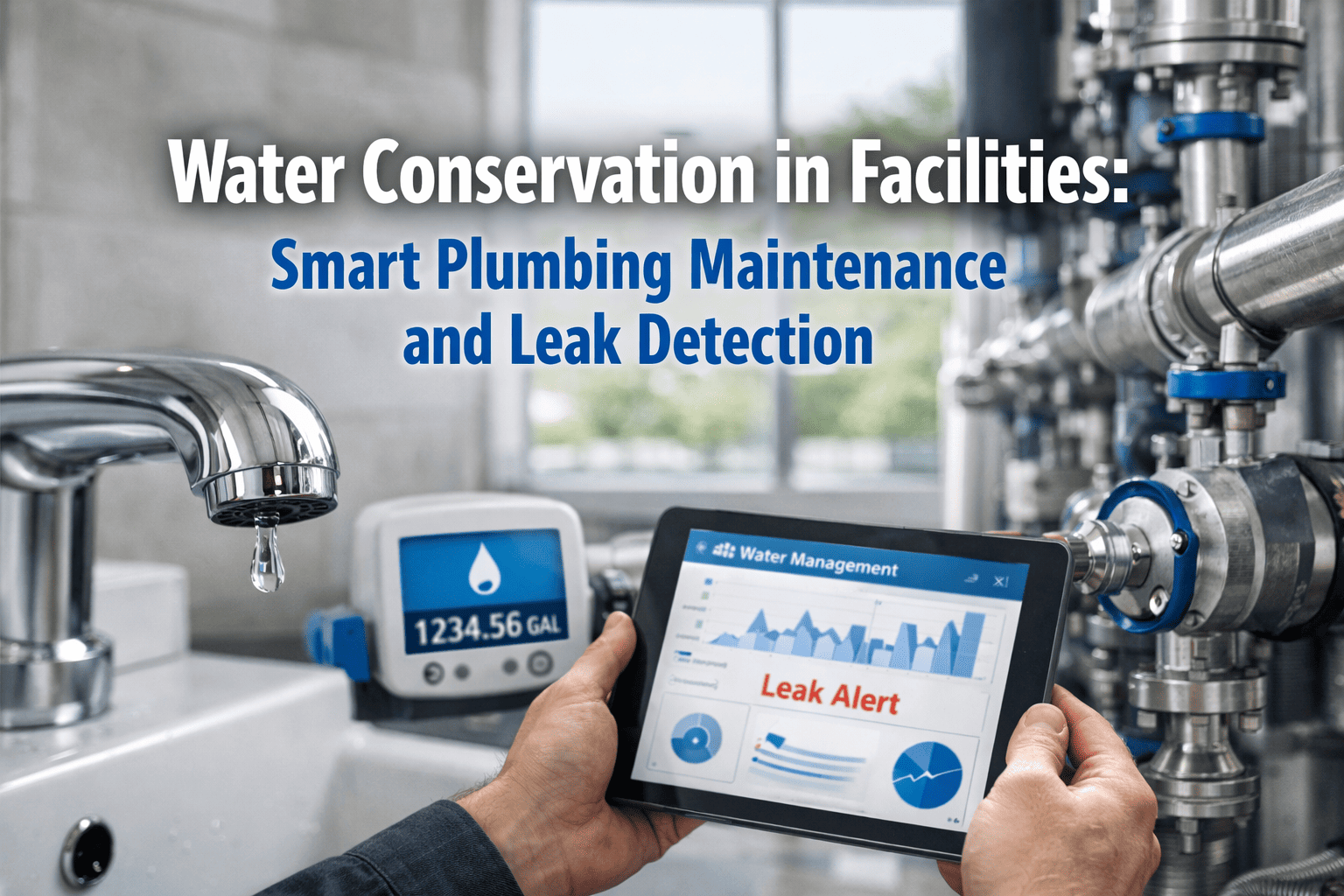
IoT water sensors monitor flow rate, pressure, moisture, and temperature continuously. Spot sensors detect standing water at risk points — under HVAC units, near pipe joints, in mechanical rooms — while flow-based sensors identify anomalous consumption patterns that indicate leaks too small for spot detection. Modern wireless IoT systems deploy within 24 hours without infrastructure modification or building downtime.
Automated Shutoff and Response
Advanced IoT systems integrate with automatic water shutoff valves that close on leak detection — preventing continued flow damage while technicians mobilize. Zone isolation valves shut off specific areas while maintaining service to unaffected sections. Even without automatic shutoff, rapid IoT alerting enables human response times that reduce damage severity by up to 93% versus traditional manual discovery.
Conservation Programme Management
Conservation moves beyond leak fixing to systematic optimisation — low-flow fixture upgrades, cooling tower efficiency improvements, irrigation scheduling, greywater recovery, and rainwater harvesting. CMMS platforms track each conservation measure as a work order with pre- and post-implementation consumption data, providing the documented evidence of water savings that LEED v5, BREEAM 2026, and ESG disclosure frameworks require.
8 Water Management Signals
8 Data Points That Reveal the Real Cost of Unmanaged Facility Water — and What IoT Monitoring Changes
$5.5B
Water Leak Detection Market in 2026
The global water leak detection system market reaches $5.55 billion in 2026, growing at 5.95% CAGR — driven by aging infrastructure, ESG mandates, and insurance requirements across commercial property.
54% of municipal pipes exceed 25 yearsIoT adoption: 44% of new installs in 2026
46%
Large Facilities With Leak Detection
Only 46% of commercial facilities above 50,000 sq ft have installed any water leak detection system — meaning more than half of large buildings remain entirely unmonitored for a risk that generates 50% of commercial property insurance claims.
54% of large buildings: no monitoringTarget: 100% monitored for LEED/BREEAM
24–48h
Time for Mold Onset After Water Exposure
EPA data: mold begins growing within 24–48 hours of water exposure in commercial buildings. Undetected leaks that remain unreported for days or weeks — common in reactive operations — routinely convert a $2,000 repair into a $40,000–$200,000 mold remediation project.
Reactive: leaks unreported for days/weeksIoT: detection within minutes of onset
93%
Damage Severity Reduction With Early Detection
Modern IoT-based systems reduce water damage severity by up to 93% through early detection versus traditional manual inspection approaches. The difference between a detected drip and a discovered flood is entirely a function of monitoring response time.
Traditional: discovered after damage peaksIoT: 93% severity reduction achieved
33%
Insurance Requirements Drive Adoption
33% of commercial building water leak detection adoption is now driven by insurance compliance requirements — insurers in the USA, UK, and Australia are increasingly making IoT leak monitoring a condition of commercial property coverage renewal for high-value portfolios.
No monitoring: rising premiums and exclusionsIoT monitored: lower premiums + coverage
20%
Annual Water Bill Savings From Proactive Detection
University of Arizona research: proactive leak detection and repair saves commercial facilities up to 20% on annual water bills. For a 500,000 sq ft commercial building with $180,000 in annual water costs, that is $36,000 per year in direct utility savings alone.
Reactive: 20% of water bill wastedIoT: 20% annual bill reduction documented
41%
Adoption Driven by Non-Revenue Water Reduction
41% of water leak detection system adoption globally is driven by non-revenue water reduction programmes — facilities paying for water they never use because it leaks before reaching its intended point of consumption in the building distribution system.
Non-revenue water: direct budget wasteSub-metering: 15–25% reduction in 18 months
12–15%
Annual Market Growth From Regulation
Regulatory pressure — LEED v5 water efficiency requirements, EU Green Deal mandates, BREEAM 2026 standards, and local building performance laws — is accelerating addressable leak detection adoption by 12–15% annually. Compliance is no longer optional in most regulated markets.
Non-compliant: fines and LEED credits lostCMMS-tracked: credits documented and filed
How Oxmaint Works
How Oxmaint Connects IoT Water Monitoring to Facility Operations — From Sensor Signal to Closed Work Order
The gap between a sensor detecting an anomaly and a technician closing the corrective work order is where most water management programmes fail. Oxmaint closes that gap by connecting sensor data, automated alerting, work order creation, and ESG reporting into a single unbroken workflow.
01
IoT Sensor Network and Sub-Meter Integration
Oxmaint integrates with IoT water sensors, smart sub-meters, and building automation systems via REST API and OPC-UA — connecting flow rate, pressure, moisture, and temperature data directly into asset records. Wireless IoT systems deploy within 24 hours without building downtime. Each sensor is mapped to an asset in Oxmaint's five-level hierarchy (Portfolio → Property → System → Asset → Component), enabling consumption anomalies to be attributed to the exact zone, floor, or system generating them rather than read only at the utility boundary meter. For LEED v5 and BREEAM 2026 compliance, this zone-level attribution is the data foundation that credit documentation requires.
REST API + OPC-UASub-meter integration24-hr deployZone-level attribution
02
Real-Time Anomaly Detection and Automated Leak Alerts
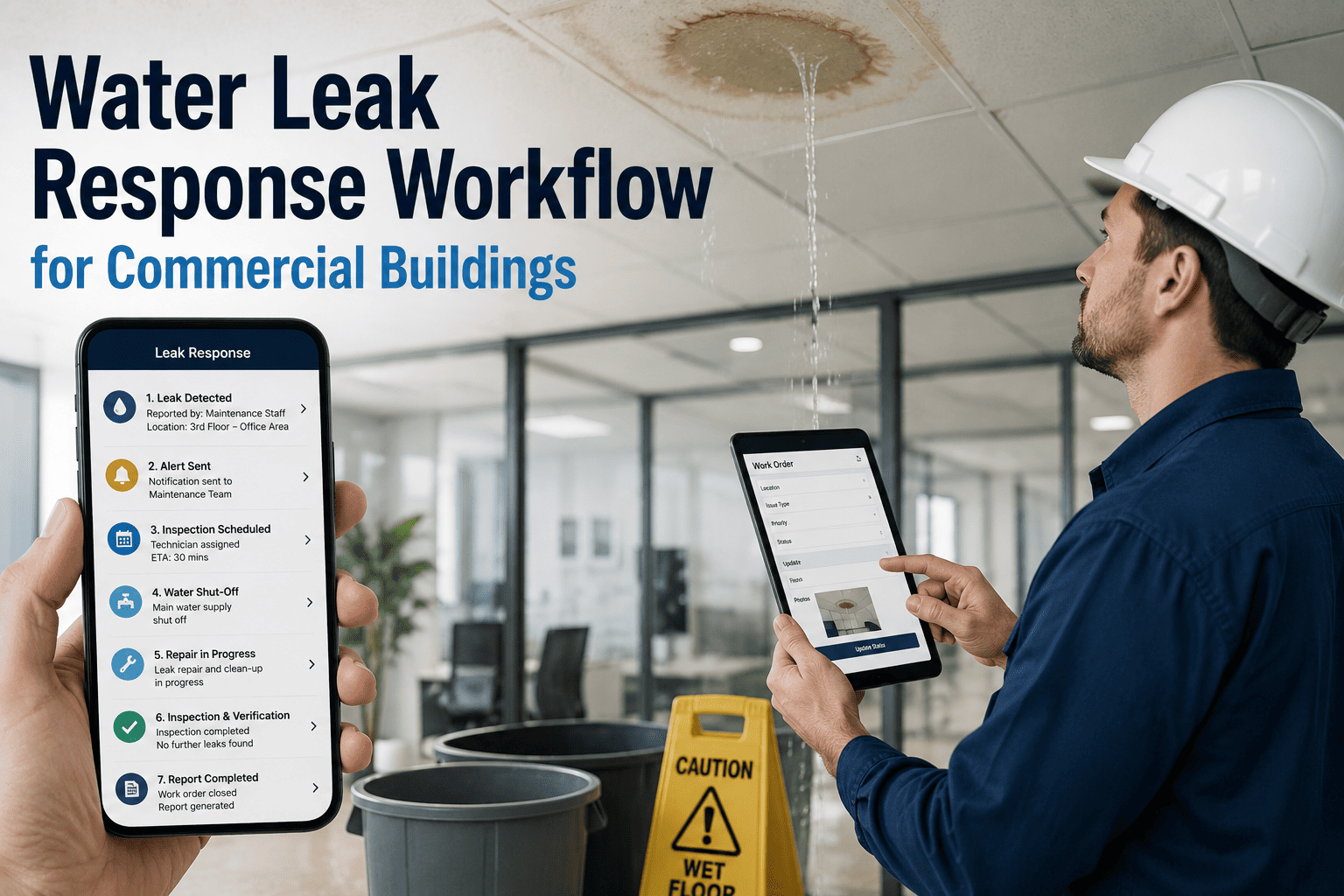
Oxmaint's monitoring engine compares live flow, pressure, and moisture readings against learned baselines for each asset and zone. When consumption deviates beyond configurable thresholds — indicating a leak, a stuck valve, an HVAC condensate drain failure, or an unusual overnight draw — an automated alert is generated and routed immediately to the responsible technician or facilities team. Alert severity is tiered: minor anomalies generate next-business-day work orders while major deviations trigger immediate mobile push notifications. For facilities with automatic shutoff valve integration, Oxmaint's alert can simultaneously trigger zone isolation, preventing continued water flow while technicians mobilize — the mechanism that enables the 93% damage severity reduction documented in 2026 commercial IoT deployments.
Baseline comparisonTiered alert severityMobile push alertsShutoff valve trigger
03
CMMS Work Order Creation and Corrective Action Tracking
Every water anomaly alert automatically generates a prioritised CMMS work order pre-populated with the asset record, sensor readings, alert history, and recommended diagnostic steps — removing the manual translation step that delays most reactive water repair programmes by 4–24 hours. Technicians access work orders on mobile, log findings with photo documentation, record repair actions, and close the work order with water consumption post-repair confirmation. The closed work order creates the paper trail that OSHA, ISO 50001, and ESG auditors require for documented corrective actions. For facilities in Germany under the EU Water Framework Directive or in the UK under the Water Industry Act, this documentation is a statutory requirement — not optional recordkeeping.
Auto work order creationPre-populated asset dataPhoto documentationISO 50001 compliant
04
WAGES KPI Dashboard and ESG Reporting Integration
All water consumption data, leak events, conservation work orders, and corrective action records feed automatically into Oxmaint's WAGES KPI dashboard — tracking Water, Air, Gas, Electricity, and Steam consumption as live performance indicators against sustainability targets. Portfolio-level dashboards compare water performance across all properties, identifying which buildings are consuming above benchmark and which conservation interventions have delivered measurable reduction. ESG reporting packages — formatted for GRI, TCFD, ENERGY STAR, and GRESB frameworks — are generated directly from CMMS data without any manual compilation. For UAE Vision 2030 smart building initiatives and Australian NABERS-rated properties, this automated reporting capability converts a historically manual 40-hour annual reporting process into a live dashboard output updated continuously from sensor data.
WAGES KPI trackingGRI / TCFD / GRESBPortfolio benchmarkingNABERS / ENERGY STAR
Strategy Comparison
Reactive Water Management vs. IoT-Enabled Smart Monitoring — Full Operational and Financial Comparison
Scroll right to view full comparison
Oxmaint · Energy & Sustainability Module
46% of Large Commercial Buildings Have No Water Monitoring. Oxmaint Deploys IoT Sensor Integration, Automated Leak Alerts, and ESG Reporting in Under 60 Days.
ROI and Results
What Smart Water Management Delivers — Documented 2026 Benchmarks
20%
Annual Water Bill Reduction
University of Arizona benchmark: proactive IoT leak detection and repair saves commercial facilities up to 20% on annual water bills. For a 500,000 sq ft building with $180,000 in annual water costs, this is $36,000 per year in direct utility savings before operational or damage cost avoidance is counted.
75%
Water Damage Cost Reduction
Addressable IoT systems reduce water damage costs by up to 75% versus traditional detection methods in commercial applications. Early detection prevents the $40,000–$200,000 mold remediation cycle that follows undetected leaks in walls, ceilings, and under-floor mechanical spaces.
93%
Damage Severity Reduction
Modern IoT-based commercial leak detection systems reduce damage severity by up to 93% through early detection — converting potentially catastrophic water incidents into minor repairs by catching anomalies before accumulation reaches structural or equipment thresholds.
15–25%
Consumption Reduction via Sub-Metering
Best-in-class facilities achieve 15–25% water consumption reduction through sub-metering alone within 18 months of installation — before any physical conservation measures are implemented — purely through the visibility that zone-level metering provides to consumption patterns and waste sources.
40 hrs
Annual ESG Reporting Time Saved
Facilities using Oxmaint's automated WAGES KPI dashboard eliminate the typical 40-hour annual process of manually compiling water consumption data for ESG reports. GRI, TCFD, GRESB, and NABERS-formatted reports are generated directly from live CMMS sensor data — updated continuously, not compiled annually.
12–15%
Annual Regulatory Adoption Growth
Regulatory pressure under LEED v5, BREEAM 2026, and the EU Green Deal is accelerating water leak detection adoption by 12–15% annually across commercial buildings. Facilities that implement now capture early-mover compliance advantages before mandates harden into penalties in 2027 and 2028.
Implementation Guide
5 Steps to Deploy Smart Water Management in Your Facility With Oxmaint
Most facilities cannot implement comprehensive water monitoring overnight. A phased approach builds monitoring coverage, data quality, and conservation programme depth progressively — delivering ROI at each stage rather than requiring full deployment before value appears.
01
Audit Current Water Systems and Establish Consumption Baseline
Register all water-using systems and distribution infrastructure in Oxmaint's asset hierarchy. Record current utility meter readings, identify all sub-meter locations, and map high-risk leak points — mechanical rooms, HVAC condensate systems, roof drainage, pipe joints in unconditioned spaces, and any system with water damage history. Establish the consumption baseline that LEED v5, BREEAM, and ESG frameworks require as the reference point against which all future reduction is measured. Without a documented baseline, conservation programme results cannot be credited or reported — making this step the prerequisite for every subsequent phase.
Asset mappingBaseline meteringRisk point identificationDays 1–14
02
Deploy IoT Sensors at Priority Risk Points and Connect to Oxmaint
Install wireless IoT moisture sensors at identified high-risk points — under AHUs and cooling coils, at pipe penetrations in mechanical rooms, near water heater connections, and beneath any rooftop drainage that feeds interior downspouts. Connect sensors to Oxmaint via REST API — flow, pressure, and moisture readings begin populating asset records immediately. For buildings in OSHA-regulated environments (USA), PSSR-regulated environments (UK), or under BetrSichV in Germany, sensor connectivity also satisfies the continuous monitoring documentation requirements for pressure system statutory inspection records — turning compliance recordkeeping into a byproduct of the monitoring programme rather than a separate administrative burden.
IoT sensor installREST API connectionPSSR/BetrSichV complianceDays 14–30
03
Configure Alert Thresholds and Automated Work Order Triggers
Set baseline consumption thresholds for each monitored zone and risk point in Oxmaint. Configure tiered alert rules: minor anomalies (5–15% above baseline) generate scheduled investigation work orders; significant deviations (above 15%) trigger immediate mobile alerts with auto-generated priority work orders; critical events (moisture sensor activation or pressure drop indicating rupture) trigger emergency notifications and, where integrated, automatic zone valve shutoff. Alert routing is configured per zone, floor, or system — routing to the correct on-call technician rather than broadcasting to the full team. For multi-site portfolios, escalation rules push unacknowledged critical alerts to the facilities director after a configurable timeout — eliminating the notification gap that allows overnight leaks to cause full-shift water damage before discovery.
Tiered alert rulesAuto work order triggersEscalation routingDays 30–45
04
Launch Conservation Programme and Track Reduction vs Baseline
With baseline established and leak sources addressed, initiate the conservation programme — low-flow fixture upgrades, cooling tower conductivity optimisation, irrigation scheduling adjustments, and any capital conservation projects identified in the facility water audit. Each intervention is created as a work order in Oxmaint with pre-implementation consumption data attached. Post-implementation sensor readings automatically calculate the consumption reduction achieved and store it against the work order record. This before/after documentation is the specific data structure that LEED v5 Water Efficiency credits, BREEAM Wat 01–04 credits, and GRESB water disclosure require — automatically generated from CMMS records rather than manually compiled from spreadsheet comparisons.
Conservation work ordersBefore/after meteringLEED / BREEAM creditsWeeks 6–12
05
Activate WAGES Dashboard and Integrate With ESG Reporting
Activate Oxmaint's WAGES KPI dashboard to display water consumption as a live performance indicator alongside air, gas, electricity, and steam — giving facilities directors and asset managers the cross-resource visibility needed to identify where water consumption interacts with energy performance (HVAC cooling load, steam leaks) and make integrated conservation decisions. Connect the WAGES data feed to your ESG reporting platform or export directly from Oxmaint in GRI, TCFD, GRESB, NABERS, and ENERGY STAR formats. For UAE Vision 2030 smart building certifications, Australian NABERS Water ratings, and UK Building Safety Act environmental performance requirements, this automated reporting output satisfies the documentation requirements that currently require 40 hours of manual annual compilation in most facilities without CMMS integration.
WAGES KPI liveESG reporting exportsNABERS / GRESBMonth 2+
Performance Benchmarks
Documented Outcomes for Facilities Deploying Oxmaint Smart Water Management
Reduction in water damage severity vs. traditional manual monitoring (2026 commercial IoT benchmark)93%
Annual water bill reduction from proactive IoT leak detection and repair20%
Water consumption reduction through sub-metering and zone attribution within 18 months25%
Reduction in water damage cost vs. addressable IoT detection vs. traditional methods75%
Large commercial facilities above 50,000 sq ft with at least one water leak detection system installed46%
Of commercial real estate insurance claims attributed to water damage — the primary driver of FM water investment50%
Frequently Asked Questions
Facility Water Management — What FM Leaders and Asset Managers Ask First
How much does IoT water leak detection cost for a commercial building — and what is the ROI?
Basic wireless IoT moisture sensors start at $50–$150 per point for spot detection at risk locations. A comprehensive floor-level coverage package for a 100,000 sq ft commercial building typically runs $8,000–$25,000 in sensors plus $3,000–$8,000 annually in platform and monitoring costs. Against this investment, a single prevented water damage event — which averages $40,000–$200,000 in remediation costs after mold onset — delivers full payback within the first incident avoided. Annual water bill savings of 20% on a $180,000 water budget generate $36,000 per year in direct utility reduction, providing complete payback within 12 months on sensor costs alone before damage avoidance is counted.
Sign up free to start with Oxmaint's sensor integration, or
book a demo to see a custom ROI calculation for your facility's water cost profile.
What are WAGES KPIs and why do facility managers need to track them in a CMMS?
WAGES — Water, Air, Gas, Electricity, Steam — is the standard resource KPI framework for commercial and industrial facility management. Tracking all five in a single CMMS platform enables cross-resource analysis that reveals how water and energy performance interact — for example, HVAC cooling tower water consumption is directly linked to electrical load, and steam leaks appear simultaneously in both water and energy KPIs. Without CMMS integration, WAGES data sits in separate utility bills, BMS exports, and spreadsheets that are never compared in real time. Oxmaint's WAGES dashboard updates continuously from IoT sensor feeds, enabling consumption anomalies to be detected and attributed to specific zones within hours rather than discovered during the monthly bill review.
Book a demo to see the live WAGES dashboard, or
sign up free to configure your facility's resource tracking today.
How does smart water monitoring help with LEED, BREEAM, and ESG water reporting requirements?
LEED v5 Water Efficiency credits and BREEAM Wat 01–04 credits both require documented consumption reduction versus a metered baseline — which is only achievable with sub-metered before/after data stored in a verifiable system. Without CMMS-integrated metering, most facilities cannot evidence the reduction required for certification credits even when the physical conservation measures have been implemented. Oxmaint stores baseline consumption data, records every conservation work order with pre- and post-implementation meter readings, and generates GRI, TCFD, GRESB, NABERS, and ENERGY STAR formatted reports directly from sensor data — converting what is currently a 40-hour manual annual compilation into a continuously updated dashboard output.
Sign up free to start building your water baseline, or
book a demo to see the ESG water reporting output for your building type.
Which regional water regulations apply to commercial facilities in the USA, UK, UAE, Germany, and Australia?
Regional requirements differ significantly. In the USA, OSHA 29 CFR 1910 covers workplace water safety, while LEED and local building performance standards (NYC LL97, California Title 24) increasingly mandate water monitoring and reporting. In the UK, the Water Industry Act and BREEAM certification requirements drive sub-metering and conservation documentation obligations. In Germany, the EU Water Framework Directive and KrWG circular economy regulations require systematic water use tracking for commercial facilities above defined thresholds. In the UAE, ESTIDAMA Pearl Rating System and the Dubai Green Building Regulations mandate water efficiency measures and metered consumption reporting for new and refurbished commercial buildings. In Australia, NABERS Water ratings and state-level building sustainability requirements drive metered water performance documentation for commercial property owners. Oxmaint configures compliance documentation for all six regions from a single platform deployment.
Book a demo to see regional compliance configuration, or
sign up free to get started.
How quickly can Oxmaint's water monitoring be deployed in an existing commercial building?
Wireless IoT sensor networks deploy within 24 hours for initial coverage without any building infrastructure modification or operational downtime. Full CMMS integration — connecting sensor data to asset records, configuring alert thresholds, and activating work order automation — typically completes within 2–4 weeks for a single building. Portfolio-wide rollout across multiple properties scales to 60–90 days total. Unlike traditional hardwired BMS integrations requiring 2–6 weeks of construction and commissioning work per building, Oxmaint's wireless IoT approach enables rapid deployment that begins generating ROI from the first week of operation rather than after a lengthy implementation project.
Sign up free to begin your deployment, or
book a demo to see a deployment timeline scoped for your building count and sensor coverage requirements.
Continue Reading
Connected resources in the Energy & Sustainability cluster
Pillar Resource
Net-Zero Buildings Roadmap for Facility Operations
The complete decarbonisation playbook for facility teams — energy reduction, electrification sequencing, renewable integration, and CMMS-driven progress tracking toward net-zero targets.
Read This Guide →
Core Resource
ESG Compliance and Sustainability Reporting for Facility Managers
How facility managers structure GRI, TCFD, GRESB, and ENERGY STAR compliance reporting from CMMS data — eliminating the 40-hour manual compilation cycle for annual ESG disclosures.
Read This Guide →
Authority Resource
Building Performance Standards Compliance Guide
Navigate NYC LL97, California Title 24, BREEAM 2026, and EU Green Deal building performance mandates — with CMMS documentation strategies for each compliance framework.
Read This Guide →
Spoke Resource
LED Lighting Retrofit Guide for Facility Managers
Full ROI framework for LED retrofit projects — energy savings calculations, rebate capture, CMMS-tracked implementation, and post-retrofit performance measurement against LEED credit targets.
Read This Guide →
Oxmaint · Energy & Sustainability Module · Smart Water Management
30% of Your Facility's Water Is Being Lost. $16 Billion in Annual Commercial Water Damage Is Preventable. 46% of Buildings Still Have No Monitoring. Oxmaint Changes All Three — Free to Start.
IoT Sensor Integration
Automated Leak Alerts
WAGES KPI Dashboard
ESG Water Reporting
LEED/BREEAM Credits
Auto Work Orders