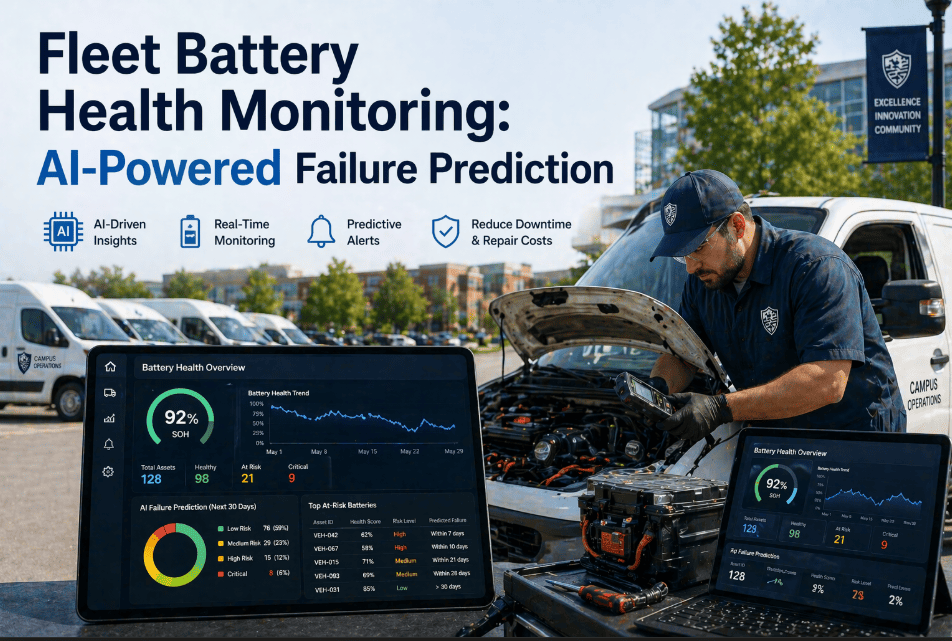
Engine failures don't happen without warning — they happen when warnings go unnoticed. AI engine health monitoring gives fleet managers real-time visibility into oil degradation, thermal stress, and component wear across every vehicle, catching failures before they happen rather than after. Start monitoring your fleet with Oxmaint and replace reactive breakdowns with predictive control.
Fleet Operations · AI Monitoring · 2026
AI Engine Health Monitoring: Prevent Costly Fleet Failures
Real-time IoT diagnostics, AI camera vision, predictive failure detection, and SAP integration — the complete guide for fleet managers eliminating reactive breakdowns across USA, Canada, UK, Germany, and Australia.
Why AI Monitoring — The Cost of Waiting
$15,000+
Average cost of a roadside engine failure — towing, rental, lost revenue, emergency labour
72%
of catastrophic engine failures are preceded by detectable signals at least 2 weeks before failure
8–10×
ROI on predictive maintenance versus reactive repair — industry-wide average across heavy fleet operators
35%
reduction in unplanned downtime reported by fleets using AI-based engine condition monitoring systems
Engine Failure Signal Timeline — What AI Catches and When
Weeks 4–6 Before
Oil viscosity shift detected by IoT sensors
Weeks 2–4 Before
Thermal anomaly flagged by AI camera vision
Week 1–2 Before
OBD fault codes escalate, vibration pattern change
Days 1–7 Before
AI alert generated — maintenance ticket auto-created
Day 0 — Failure
Without AI: Roadside breakdown. With AI: Already fixed.
The Technology Stack — How AI Engine Monitoring Works
AI Camera Vision
Thermal and optical cameras on engine bay detect overheating hotspots, oil mist discharge, and exhaust colour anomalies — all in real time, without contact sensors.
IoT Sensor Network
Oil pressure, coolant temp, vibration, and crankcase pressure sensors stream continuous data to the cloud. Anomalies trigger alerts before gauges register anything unusual.
OBD-II / J1939 Integration
Direct plug-in to the vehicle's diagnostic bus reads fault codes, torque data, fuel trim, and engine load in real time. Compatible with all modern commercial trucks and fleet vehicles.
AI Digital Twin
A virtual model of each engine runs alongside the real one — comparing actual sensor readings against expected behaviour, isolating deviations, and forecasting failure windows accurately.
SAP / ERP Integration
AI alerts flow directly into SAP PM, Oracle, or your existing ERP — creating maintenance orders, updating asset records, and triggering parts procurement without manual data entry.
PLC / SCADA Layer
For depot-based monitoring, PLC and SCADA integration enables automated engine-off commands, cooldown sequencing, and bay-level alerts when a vehicle arrives with flagged conditions.
What AI Monitors — The Six Engine Health Pillars
| Health Pillar | What AI Detects | Sensor / Method | Action Triggered |
|---|---|---|---|
| Oil Condition | Viscosity drop, oxidation, metal particles, contamination | Oil quality sensor, lab sample AI analysis | Early change alert, interval adjustment |
| Thermal Health | Overheating zones, coolant flow restriction, head gasket stress | Thermal camera, coolant temp IoT | Overheat alert, cooling system inspection order |
| Vibration Pattern | Bearing wear, imbalance, misfire, mount degradation | Accelerometer sensors on block and mounts | Component-specific inspection work order |
| Exhaust Signature | Blue smoke (oil burn), white smoke (coolant), black smoke (fuel) | AI camera vision at exhaust outlet | Targeted diagnosis — DPF, rings, injectors |
| Electrical Load | Alternator output drop, parasitic drain, starter draw anomaly | OBD voltage monitoring, current clamp | Charging system inspection before failure |
| Fuel Efficiency | Efficiency degradation, injector drift, air/fuel ratio shift | OBD fuel trim, load vs consumption AI model | Injector service, air filter check, tuning review |
Understanding what to monitor is only half the equation — the other half is acting on it fast. Oxmaint auto-generates maintenance tickets the moment an anomaly is detected, so your team never has to manually translate a sensor alert into a work order.
Preventive vs Predictive — The Maintenance Strategy Shift
Reactive / Preventive Only
Fixed intervals — regardless of actual engine condition
Over-maintenance or under-maintenance, never right
No early warning — failure often happens on the road
Emergency towing, lost loads, driver stranded
Insurance and DOT liability after preventable failures
VS
AI Predictive Monitoring with Oxmaint
Condition-based — service when the engine actually needs it
AI forecasts failure window with 2–6 week advance notice
Repairs scheduled on your terms — no emergency dispatching
Automatic work orders sent to shop before truck arrives
Full audit trail for DOT, insurance, and compliance review
Who Benefits — Roles and What They Gain
Fleet Manager
Single dashboard — all engines, all alerts
Planned maintenance, zero surprises
Cost-per-mile trending by vehicle
DOT compliance documentation auto-generated
Maintenance Supervisor
Work orders arrive before the truck does
Parts pre-staged using AI failure forecast
Technician time spent on real problems
Shop throughput measurably improves
Technician
Exact fault description — no guessing
Mobile checklist with sensor context
Structured sign-off with photo capture
Auto-close to CMMS when complete
Compliance Officer
Full audit trail by VIN, date, and tech
Regulatory alerts before expiry
SAP / ERP sync for record integrity
One-click compliance report generation
Implementation Checklist — From Zero to AI Monitoring
Phase 1 — Setup (Week 1)
Connect OBD-II / J1939 dongle to each vehicle
Install IoT sensors at critical measurement points
Register all assets in Oxmaint by VIN
Set baseline thresholds per engine model and duty cycle
Phase 2 — Integration (Week 2–3)
Connect Oxmaint to SAP PM or existing CMMS
Mount AI camera units at engine bay entry points
Configure alert escalation paths by severity
Train maintenance supervisors on alert dashboard
Phase 3 — Go Live (Week 4+)
Review first AI-generated alert and trace to sensor
Verify DVIR-to-work-order loop is auto-closing
Run first 30-day fleet health report
Tune AI model thresholds based on real data
"We caught a head gasket failure six weeks before it would have happened on the highway. Oxmaint flagged a coolant temp anomaly, we inspected, and saved a $22,000 engine rebuild."
Frequently Asked Questions
Does AI engine monitoring work with older fleet vehicles?
Yes. OBD-II adapters work on all vehicles post-1996. IoT sensors and cameras are hardware-agnostic — they attach to any engine regardless of make, model, or year.
How accurate are AI failure predictions?
Industry benchmarks show 85–92% accuracy in flagging genuine fault conditions. False positive rates drop significantly after the AI model is calibrated to your fleet's specific duty cycle — typically within 30–60 days.
Will AI monitoring replace my existing CMMS or ERP?
No — it integrates with it. Oxmaint feeds alerts and work orders into your existing SAP, Oracle, or any CMMS via API. Your current system stays in place; AI monitoring makes it smarter.
What is an AI Digital Twin and do I need one?
A digital twin is a virtual model of each engine that runs in parallel with the real machine. It's most valuable for high-value assets (10+ years or $100K+ engines) — it reduces the need for physical inspection frequency while increasing diagnostic precision.
How soon will we see ROI after deployment?
Most fleets see measurable ROI within 60–90 days — typically a single prevented failure event covers several months of platform cost. Ask us for a fleet-specific ROI estimate.
Is data from IoT sensors and cameras stored securely?
Yes. All data is encrypted in transit and at rest on ISO 27001-compliant cloud infrastructure. Role-based access controls ensure only authorised personnel see vehicle health data.
Track AI Engine Health on Oxmaint
Oxmaint monitors engine oil degradation, thermal anomalies, and OBD fault codes across your entire fleet — alerting your team weeks before failure and generating maintenance work orders automatically.