Every commercial vehicle on US roads requires a driver holding the correct CDL class with the right endorsements and a current medical certificate — and FMCSA enforces these requirements with escalating penalties that can disqualify individual drivers, shut down fleet operations, and generate Driver Fitness BASIC violations that stay in your SMS profile for 24 rolling months. Yet 31% of fleet compliance violations documented during roadside inspections in 2024 were related to driver qualification failures — expired medical certificates, missing endorsements, operating outside CDL class restrictions, or documentation gaps that should have been caught before the driver left the yard. The CDL regulatory framework is not complex because regulators enjoy paperwork — it is complex because commercial vehicles kill 5,700+ people annually in the US, and the licensing system is designed to ensure every driver operating a 80,000-pound vehicle has demonstrated the knowledge, skills, and physical capability to do so safely. For fleet managers and safety directors, understanding CDL classes, endorsement requirements, medical certification rules, knowledge and skills testing standards, and the disqualification triggers that can remove drivers from service is not optional regulatory awareness — it is the operational foundation that keeps trucks moving legally. Fleets using digital driver qualification file management report 89% fewer Driver Fitness violations, 100% medical certificate currency compliance, and elimination of the manual tracking chaos that makes every DOT audit a staffing emergency.
CDL Requirements and Regulations: Complete 2026 Guide
Everything fleet managers need to know about commercial driver's license classes, endorsements, medical certification, knowledge tests, FMCSA disqualification rules, and how digital driver qualification tracking prevents the violations that damage your safety rating.
Track Driver Qualifications Digitally — Never Miss an Expiration
OxMaint tracks CDL expirations, medical certificate dates, endorsement requirements, and driver qualification files across your entire fleet — with automated alerts before anything lapses.
What Is a CDL and Who Needs One?
A Commercial Driver's License is a federally-mandated credential required for any driver operating a commercial motor vehicle as defined by FMCSA. The CDL system was established by the Commercial Motor Vehicle Safety Act of 1986 to create uniform licensing standards across all 50 states — replacing a patchwork of state requirements that allowed drivers to hold multiple licenses and hide disqualifying violations across jurisdictions. Today, a single CDL is required per driver, issued by their state of domicile, and recorded in the Commercial Driver's License Information System that all states share.
You need a CDL if you operate any vehicle with a GVWR over 26,001 pounds, any combination vehicle where the towed unit exceeds 10,000 pounds GVWR, any vehicle designed to transport 16 or more passengers including the driver, or any vehicle required to display HazMat placards. Fleet managers must verify CDL validity for every driver before dispatch — and a single driver operating without the correct CDL class or endorsement generates violations that impact your fleet's Driver Fitness BASIC score for 24 months. Want to see how OxMaint tracks driver qualifications across your fleet — start a free trial or book a demo to walk through digital DQ file management.
CDL Classes: What Each License Covers
CDL classifications determine which vehicle types a driver is authorized to operate. Assigning a driver to a vehicle outside their CDL class is a violation for both the driver and the carrier — and one of the most common compliance failures found during DOT audits.
Any combination of vehicles with a GCWR of 26,001+ pounds, provided the towed vehicle has a GVWR exceeding 10,000 pounds. Covers tractor-trailers, truck and trailer combinations, tanker vehicles, flatbeds, and livestock carriers.
Any single vehicle with a GVWR of 26,001+ pounds, or any such vehicle towing a unit not exceeding 10,000 pounds GVWR. Covers straight trucks, large buses, segmented buses, box trucks, and dump trucks.
Any vehicle that does not meet Class A or Class B definitions but is designed to transport 16+ passengers including the driver, or is used to transport hazardous materials requiring placarding.
A Class A CDL holder can operate Class B and Class C vehicles — provided they hold the required endorsements. A Class B holder can operate Class C vehicles. Class C holders cannot operate Class A or B vehicles under any circumstances.
CDL Endorsements and Restrictions
Endorsements authorize specific vehicle types or cargo that require additional knowledge or skills testing beyond the base CDL class. Restrictions limit operating conditions. Both are printed on the CDL and both are verified during roadside inspections.
Required to pull double or triple trailer combinations. Knowledge test required. Class A CDL holders only.
Required for vehicles designed to transport 16+ passengers. Knowledge and skills test required on a passenger vehicle.
Required for vehicles designed to transport liquid or gaseous materials in bulk tanks with 119+ gallon capacity. Knowledge test required.
Required for vehicles transporting HazMat in quantities requiring placarding. Knowledge test plus TSA security threat assessment and fingerprinting required. Must renew every 5 years.
Combined endorsement for drivers hauling HazMat in tank vehicles. Requires both H and N testing. Common for fuel tanker and chemical transport operations.
Required for school bus operation. Knowledge and skills test on a school bus. Includes passenger endorsement requirements plus additional school bus-specific competencies.
Common CDL Restrictions
Driver did not pass air brake component of skills test. Cannot operate any CMV equipped with air brakes. Restriction removed by passing air brake test.
Driver passed skills test in vehicle with air-over-hydraulic brakes only. Cannot operate CMV with full air brakes.
Driver passed skills test in automatic transmission vehicle. Cannot operate CMV with manual transmission. Common restriction for newer CDL holders.
Driver is restricted to intrastate commerce only — cannot cross state lines while operating a CMV. Applied based on medical certification or age requirements.
Medical Certification Requirements
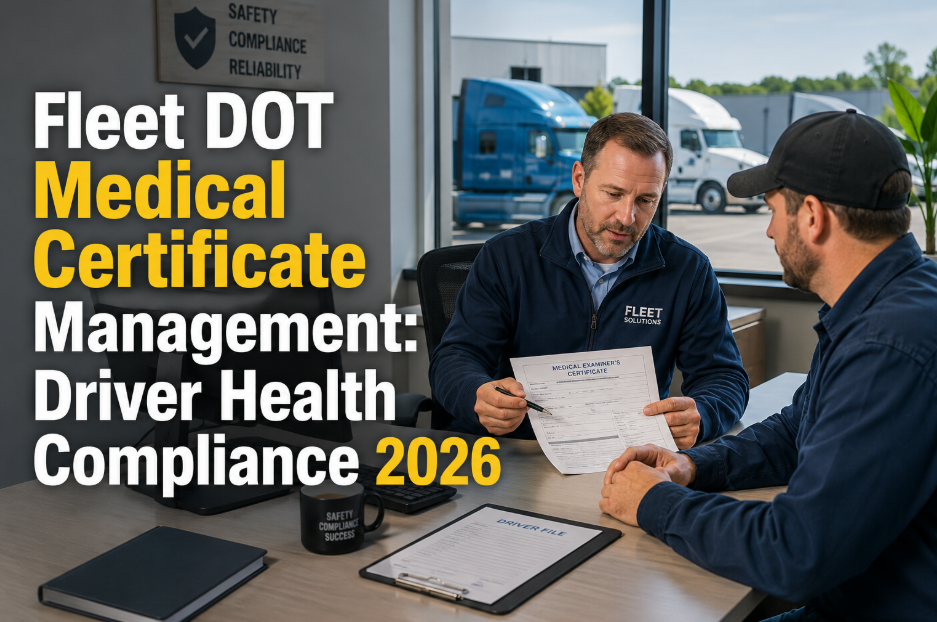
Every CDL holder operating in interstate commerce must hold a valid Medical Examiner's Certificate issued by a provider listed on the FMCSA National Registry of Certified Medical Examiners. An expired medical certificate is the single most common Driver Fitness violation — and one of the most preventable with digital tracking.
Standard DOT physical examination valid for 24 months. Covers vision (20/40 acuity, 70-degree peripheral), hearing (forced whisper at 5 feet), blood pressure (Stage 1 hypertension or below for full term), and absence of disqualifying conditions.
Issued for drivers with controlled conditions — treated hypertension, insulin-treated diabetes (with FMCSA exemption), or other monitored medical issues. Requires annual or semi-annual recertification based on condition severity.
Interstate non-excepted (requires DOT physical), interstate excepted (exempt from physical), intrastate non-excepted (state medical requirements), intrastate excepted. Most commercial fleet drivers fall into interstate non-excepted.
Carriers must maintain a copy of each driver's current medical certificate in their DQ file. Dispatching a driver with an expired medical certificate generates violations against both the driver and the carrier — impacting your Driver Fitness BASIC for 24 months.
OxMaint tracks medical certificate expiration dates for every driver in your fleet and generates alerts at 90, 60, 30, and 14 days before expiration — ensuring no driver is dispatched with an expired certificate. The system maintains digital copies of certificates in each driver's qualification file, accessible on demand during DOT audits. Experience this for your fleet — start a free trial or book a demo to see driver qualification tracking in action.
CDL Knowledge and Skills Testing Standards
CDL issuance requires passing both knowledge (written) and skills (driving) examinations specific to the CDL class and endorsements sought. Understanding what these tests cover helps fleet managers evaluate driver competency and identify training needs.
50-question exam covering vehicle inspection, basic control, safe driving practices, cargo handling, and federal regulations. Minimum passing score: 80%. Required for all CDL classes before skills testing.
Additional 20-question exam covering coupling and uncoupling, combination vehicle air brakes, and rollover prevention specific to articulated vehicle operation.
25-question exam covering air brake system components, dual air brake systems, inspecting air brakes, and air brake operating procedures. Failure results in L restriction (no air brakes).
Pre-trip vehicle inspection (demonstrate systematic inspection procedure), basic vehicle control (straight line backing, offset backing, alley docking), and on-road driving (turns, intersections, highway, railroad crossings). Must be conducted in the class of vehicle for the CDL sought.
FMCSA Disqualification Rules: What Gets Drivers Off the Road
FMCSA disqualification rules remove drivers from CMV operation for specific violations. Fleet managers must understand these rules because dispatching a disqualified driver generates carrier violations with severe consequences.
Operating a CMV under the influence of alcohol or controlled substances, leaving the scene of an accident involving a CMV, using a CMV in commission of a felony, operating a CMV with a revoked/suspended CDL, causing a fatality through negligent CMV operation. HazMat violations extend to 3-year minimum disqualification.
A second conviction for any major offense results in lifetime disqualification from operating a CMV. FMCSA allows application for reinstatement after 10 years if certain rehabilitation conditions are met — but reinstatement is not guaranteed.
Two serious traffic violations within 3 years: 60-day disqualification. Three within 3 years: 120-day disqualification. Serious violations include excessive speeding (15+ over), reckless driving, improper lane changes, following too closely, and CMV traffic violations in connection with fatal crashes.
First violation: 60-day minimum. Second violation within 3 years: 120-day minimum. Third violation within 3 years: 1-year minimum. Includes failure to slow, failure to stop, insufficient clearance, and failure to obey traffic control devices at railroad crossings.
How OxMaint Prevents Driver Qualification Violations
Six capabilities designed to keep your Driver Fitness BASIC clean and your fleet operating with 100% documented compliance — without the spreadsheet chaos that makes every DOT audit an emergency.
CDL copies, medical certificates, MVRs, application forms, road test certificates, and annual reviews — all stored digitally per driver with expiration tracking and version history. No more filing cabinets to search during audits.
Automated alerts for CDL expiration, medical certificate expiration, endorsement renewal, MVR pull dates, and annual review deadlines. Dispatchers see real-time qualification status before assigning loads.
System validates that assigned drivers hold the correct CDL class and endorsements for each vehicle type and cargo. HazMat loads only assigned to H-endorsed drivers. Tank vehicles only assigned to N-endorsed drivers.
Generate complete driver qualification file packages per driver or fleet-wide for DOT compliance reviews. Every document timestamped, organized by regulatory requirement, and exportable in standard format.
See how many drivers are current, approaching expiration, or non-compliant across your entire fleet. Drill down to individual drivers for full qualification detail and document status.
Driver qualification and vehicle maintenance in one platform. DVIR completion, PM schedules, and driver compliance tracked together — because FMCSA evaluates your Driver Fitness and Vehicle Maintenance BASICs simultaneously.
Manual vs. Digital Driver Qualification Management
The difference between fleets that pass DOT audits without stress and those that spend weeks assembling paperwork comes down to how they manage driver qualification files.
Fleets managing 20+ drivers cannot maintain 100% DQ file compliance with manual methods — the document volume and expiration frequency make spreadsheet tracking a statistical certainty for compliance gaps. Digital tracking eliminates the gaps and produces the documentation trail that DOT audits require. See how OxMaint handles this for your fleet size — start a free trial or book a demo to see driver qualification management in action.
Frequently Asked Questions
What documents must be in a driver qualification file?
How does the Entry-Level Driver Training (ELDT) requirement affect hiring?
What is the difference between CDL downgrade and disqualification?
How does OxMaint handle multi-state CDL compliance?
One Expired Certificate Can Cost You 24 Months of SMS Pain
Every driver qualification gap — expired medical certificate, missing endorsement, overdue MVR — generates violations that stay in your SMS profile for two full years and impact your Driver Fitness BASIC score at every monthly update. OxMaint eliminates these preventable violations with automated expiration tracking, endorsement matching, and audit-ready DQ file management. Most fleets are fully live with complete driver qualification tracking within 7 days of signup.