
Fleet operators losing sleep over their FMCSA safety rating are not paranoid — they are paying attention. A single Conditional or Unsatisfactory rating triggers shipper contract cancellations, insurance premium spikes of 20-45%, and the kind of regulatory scrutiny that turns routine roadside inspections into full compliance reviews. The CSA Safety Measurement System evaluates carriers across seven BASICs — Unsafe Driving, Hours-of-Service Compliance, Driver Fitness, Controlled Substances, Vehicle Maintenance, Hazardous Materials, and Crash Indicator — and each category carries intervention thresholds that can put your authority at risk before you even realize scores have deteriorated. Yet 73% of fleet managers surveyed in 2025 admitted they check their SMS scores reactively, after a problem surfaces, rather than monitoring them continuously. The difference between fleets that maintain Satisfactory ratings year after year and those that scramble through corrective action plans comes down to one thing: structured, documented, and digitally tracked maintenance and compliance programs that produce the evidence FMCSA wants to see — automatically, not assembled under pressure. Fleets using CMMS-driven compliance documentation report 62% fewer vehicle maintenance violations during roadside inspections, 41% faster DataQs challenge resolution, and the elimination of the paper-trail chaos that turns every audit into a multi-week emergency project.
How to Improve Your FMCSA Safety Rating in 2026
A step-by-step operational guide to understanding SMS scores, addressing violation categories, filing DataQs challenges, building corrective action plans, and using digital maintenance tracking to keep your fleet Satisfactory — permanently.
Track Fleet Compliance and Maintenance in One Platform
OxMaint gives fleet operators digital DVIR, PM scheduling, inspection-ready documentation, and violation tracking — so your safety rating improves from daily operations, not audit panic.
Understanding Your FMCSA Safety Rating and SMS Scores
Your FMCSA safety rating is not a single number — it is a composite evaluation across multiple compliance dimensions. The Safety Measurement System assigns percentile scores in each BASIC category based on your fleet's roadside inspection results, crash data, and investigation findings over a rolling 24-month window. Scores above the intervention threshold — 65th percentile for most carriers, 50th for HazMat — trigger warning letters, targeted inspections, and potential compliance investigations. Understanding how each BASIC is calculated, which violations carry the highest severity weights, and how time-weighting affects your scores is the foundation of any improvement strategy. Want to see how OxMaint tracks these metrics for fleet operators — start a free trial or book a demo to see fleet compliance dashboards in action.
The 7 BASICs: What Each Category Measures
Each BASIC carries different violation severity weights, different intervention thresholds, and different operational implications. This breakdown shows what FMCSA evaluates and which violations hit your score hardest.
Speeding, reckless driving, improper lane changes, cell phone use. Violations here carry the highest severity weights — a single speeding-related crash can push a small fleet above the intervention threshold.
HOS log violations, driving beyond allowed hours, false log entries. ELD mandate has reduced paper log fraud but increased electronic log form-and-manner violations that many carriers overlook.
CDL validity, medical certificate currency, endorsement requirements. A single driver operating with an expired medical card generates a violation that stays in your SMS for 24 months.
Drug and alcohol testing compliance, possession violations, impaired driving. This BASIC has zero tolerance — any violation here triggers immediate investigation priority regardless of fleet size.
Brake adjustment, lighting, tire condition, DVIR deficiencies. This is the BASIC most directly improved by structured CMMS programs — 78% of vehicle maintenance violations stem from preventable PM failures.
Placarding, shipping papers, packaging, HazMat endorsement. Lower threshold means HazMat carriers face intervention at percentile scores that non-HazMat carriers would pass easily.
DOT-reportable crash involvement — fatalities, injuries, tow-away crashes. Crash data is weighted by severity and cannot be challenged through DataQs unless the crash record itself contains factual errors.
SMS applies time-weighting — violations from the last 6 months carry 3x the weight of violations from 18-24 months ago. This means recent improvement shows up in your scores faster than most carriers realize.
Why Vehicle Maintenance Is Your Highest-Leverage BASIC
Of the seven BASICs, Vehicle Maintenance is the category most directly controllable through operational discipline — and the one where structured CMMS implementation produces the fastest, most measurable improvement. Unlike Unsafe Driving (which depends on individual driver behavior) or Crash Indicator (which includes factors outside your control), Vehicle Maintenance violations are almost entirely preventable through documented PM programs, pre-trip and post-trip inspections, and timely defect correction.
Fleets that digitize their DVIR process, automate PM scheduling by mileage and engine hours, and maintain documented repair records see Vehicle Maintenance scores improve within 2-3 SMS update cycles. This is not theoretical — it is the most proven path to overall safety rating improvement. See how OxMaint automates this for fleet operations — start a free trial or book a demo to walk through fleet PM configurations.
The 5-Step Safety Rating Improvement Roadmap
Improving your FMCSA safety rating is not a one-time fix — it is a structured operational program. This roadmap is drawn from real fleet improvement programs and produces measurable SMS score reduction within 90 days.
Pull your full SMS report from FMCSA's Safety Measurement portal. Identify which BASICs are above intervention thresholds and which specific violations carry the highest severity weights. Document every violation in the rolling 24-month window — you need to know exactly what is dragging your scores before you can fix it.
Review every violation for factual errors — wrong vehicle, wrong carrier, incorrect violation code, or violations that should not have been recorded. File DataQs Request for Data Review for each challengeable violation. 38% of fleets that systematically review their violation data find at least one challengeable error per quarter. Each successful challenge removes severity points from your BASIC score.
Replace paper DVIRs with digital pre-trip and post-trip inspections that auto-generate maintenance work orders for any deficiency found. Automate PM scheduling based on mileage intervals and engine hours — not calendar guesses. OxMaint tracks each vehicle's PM compliance and flags overdue inspections before they become roadside violations.
Document your corrective actions for each elevated BASIC — driver training programs for Unsafe Driving, ELD compliance audits for HOS, PM completion rate targets for Vehicle Maintenance. FMCSA looks favorably on carriers that demonstrate systematic corrective programs rather than one-off fixes. A documented CAP can influence the outcome of compliance investigations.
SMS scores update monthly. Monitor your percentile changes after each update cycle. Every clean roadside inspection adds positive data to your profile. Time-weighting means 6 months of clean inspections will noticeably improve scores even while older violations are still in the 24-month window. Consistency is the strategy.
Paper-Based vs. CMMS-Driven Fleet Compliance
The difference between fleets that pass roadside inspections consistently and those that accumulate violations comes down to documentation quality and maintenance execution — both of which collapse under paper-based systems.
How OxMaint Protects Your Safety Rating
Six capabilities designed for fleet operators who cannot afford a single preventable violation — because every violation stays in your SMS for 24 months.
Drivers complete digital inspections from their phone before dispatch. Any deficiency auto-creates a maintenance work order with severity classification. No more paper DVIRs lost in the cab or filed without review.
PM schedules triggered by actual mileage and engine hour readings — not calendar guesses. Brake inspections, oil services, tire rotations, and DOT annual inspections all tracked per unit with overdue alerts.
Dashboard view of your fleet's BASIC percentile positions with severity-weighted violation detail. Identify which violations are driving your scores highest and which are approaching the 24-month drop-off window.
Every repair documented with photos, parts used, technician identification, and digital signature. When an inspector questions a repair, the documentation is on your phone — not in a filing cabinet 200 miles away.
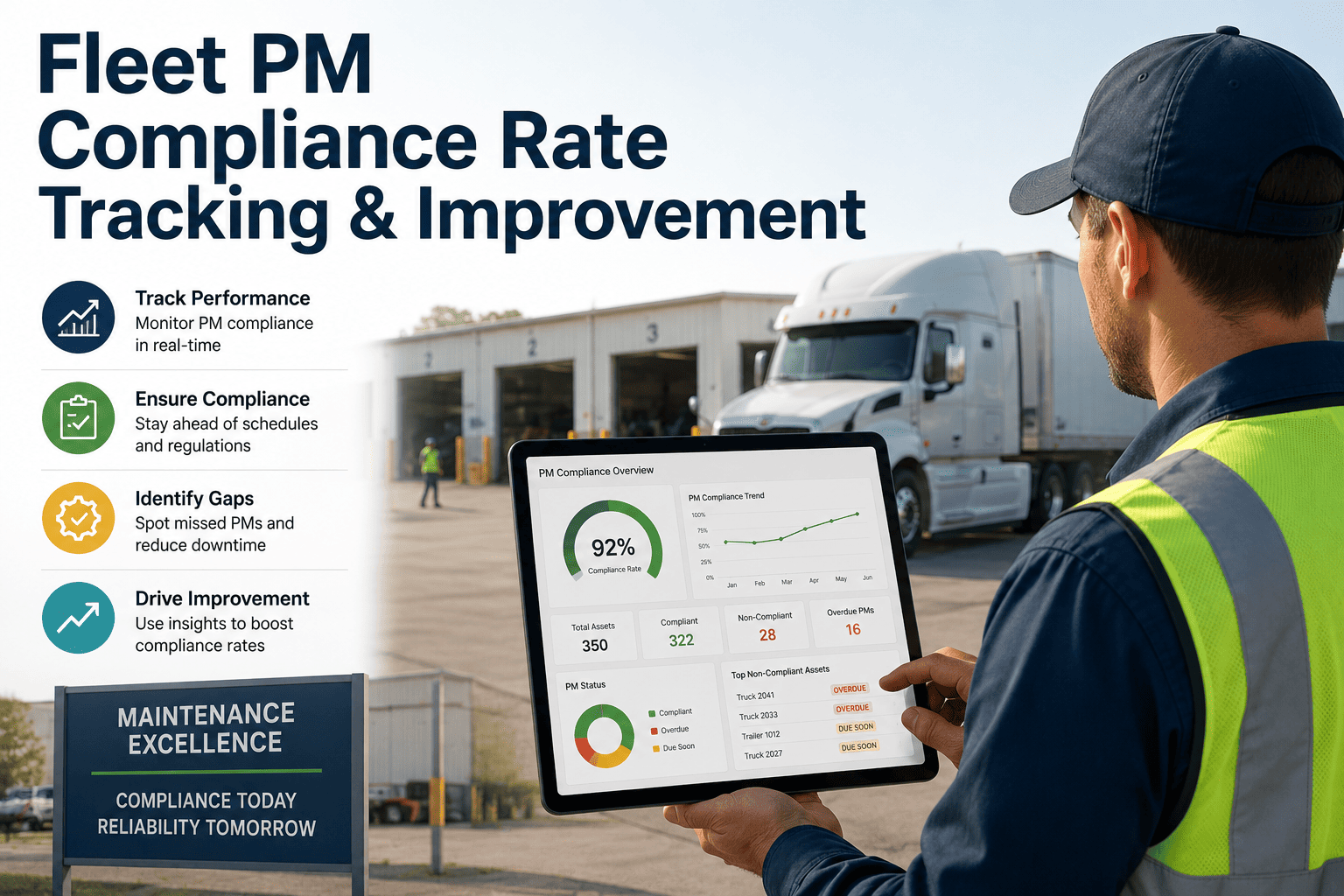
See PM compliance percentage, overdue units, upcoming DOT annual inspections, and driver DVIR completion rates across your entire fleet from a single screen. No unit falls through the cracks.
Generate complete maintenance history by unit, date range, or repair type in minutes. FMCSA compliance reviews, insurance audits, and shipper qualification packages assembled from daily operations data — not from emergency record reconstruction.
DataQs Challenges: The Underused Score Improvement Tool
The FMCSA DataQs system allows carriers to challenge inspection violations that contain factual errors — wrong carrier USDOT number, incorrect violation codes, violations recorded against the wrong vehicle, or inspections where the inspector made a procedural error. Yet only 12% of eligible carriers file DataQs challenges regularly, leaving correctable violations in their SMS profiles for the full 24-month window.
Violation recorded under your USDOT number for a vehicle you do not own or operate. Common with leased equipment and intermodal operations.
Inspector cited a brake adjustment violation when the actual deficiency was a brake component issue — different severity weight, different BASIC impact.
Wrong VIN, wrong unit number, or violation recorded against a trailer that was not part of the inspected combination.
Deficiency was repaired prior to the inspection date but the violation was still recorded — documented repair records in OxMaint provide timestamped evidence.
OxMaint's maintenance records provide the timestamped, photo-documented evidence needed to support DataQs challenges — repair dates, parts used, technician identification, and before-and-after photos that prove a deficiency was corrected before it was cited. Explore how this works for your fleet — start a free trial or book a demo to see fleet documentation capabilities.
Frequently Asked Questions
How often do SMS scores update and how quickly will improvements show?
What happens if our safety rating is downgraded to Conditional?
How does OxMaint help with DOT annual vehicle inspections?
Can we use OxMaint maintenance records to support a DataQs challenge?
Your Safety Rating Should Not Depend on Luck at the Scale
Every roadside inspection is either adding clean data to your SMS profile or adding violations that stay for 24 months. OxMaint gives fleet operators the digital DVIR, automated PM scheduling, violation tracking, and audit-ready documentation that turns safety compliance from a reactive scramble into a daily operational advantage. Most fleets are running digital DVIRs and automated PM schedules within their first week of deployment.


.png)