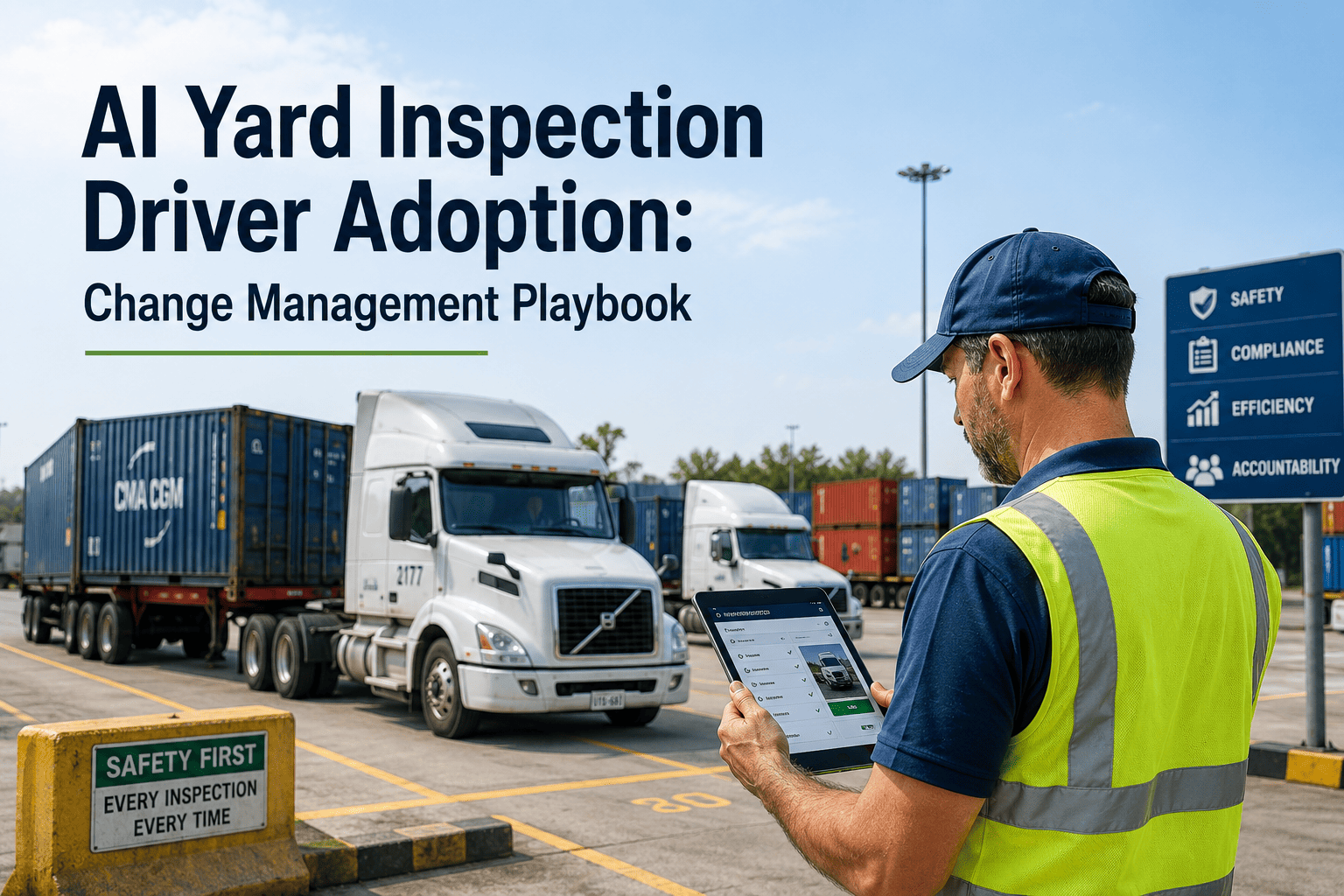
Most AI yard inspection rollouts don't fail because the technology is inaccurate — they fail because drivers quietly decide the app is a surveillance tool built to catch them out, not help them. When that belief takes hold in week one, adoption stalls at 50-60% and never recovers, no matter how good the defect-detection engine is underneath. Fleets that hit 90%+ adoption within 60 days do something different from day one: they treat the rollout as a change-management project with drivers at the center, not a software deployment with drivers as an afterthought. This playbook breaks down exactly how those fleets structure the first 60 days, the fairness and appeal mechanics that build trust, and the specific signals that tell you adoption is on track or quietly failing. Sign up for OxMaint to run your rollout on a platform built around driver trust from day one, or explore the framework below first.
Driver Adoption · Change Management · AI Yard Inspection · OxMaint
90% Driver Adoption in 60 Days. Not Luck. A Playbook. Turn AI Inspection From a Gotcha Tool Into the App Drivers Actually Trust and Use Every Shift.
OxMaint's rollout framework combines transparent detection logic, a built-in appeal workflow, driver-champion onboarding, and adoption analytics that show fleet managers exactly where trust is building or breaking — before a stalled rollout becomes a shelved project.
70-80%
driver adoption reached within 30 days by fleets that run a structured rollout with a real pilot phase and hands-on training
50-60%
is where adoption typically stalls and declines when fleets skip the pilot phase or compress training into a single session
Weeks 1-4
is the critical habit-formation window — the period where drivers decide whether the app is a help or a threat
4-6x
Fleets that involve drivers in tool selection and pair them with peer champions during rollout consistently out-adopt fleets that simply mandate the app from a memo. Driver resistance to AI inspection almost never comes from technology aversion — research shows no meaningful link between driver age and how fast someone adopts a digital tool when training is hands-on rather than video-only. What actually predicts stalled adoption is whether drivers believe the system is fair, whether they were part of the decision, and whether there's a real channel to challenge a flagged result. OxMaint's rollout playbook is built around exactly those three levers.
The 60-Day Driver Adoption Timeline — Four Phases That Build Trust in Order
Days 1-7 — Pilot
Small Group, High Visibility, Zero Punishment
Start with 10-15% of drivers, chosen partly for influence within the yard, not just tenure. Run the AI inspection alongside the existing paper or manual process for the first week so nothing a driver reports through the app can be used against them yet. The goal of week one isn't compliance — it's proof. Every driver in the pilot should be able to point to at least one moment where the app caught something faster than the old process, or protected them from a defect dispute.
Sign up for OxMaint to configure a shadow-mode pilot group before full rollout.
What to Measure This Phase
Inspection completion time — app vs. paper, tracked per driver
Pilot driver sentiment — quick pulse check at end of week one
Champion identification — which pilot drivers are helping peers unprompted
Signals Adoption Is Already at Risk
Pilot group treated as punishment duty rather than early access
No shadow-mode grace period — findings used for discipline in week one
Days 8-21 — Rollout
Fleet-Wide Launch With Champions Embedded in Every Shift
Expand to the full fleet, but keep at least one pilot champion on every shift and yard location so new users have a peer to ask instead of a help desk ticket to file. Training should be hands-on and under 30 minutes per driver — video-only onboarding consistently produces slower adoption than a five-minute guided walkthrough on their own vehicle. This is also the phase to formally launch the appeal process, so every driver knows exactly how to contest a flagged result from day one of real use.
What to Measure This Phase
Daily active usage rate — percentage of scheduled inspections completed in-app
Support ticket volume — should decline week over week, not plateau
Appeal requests filed and resolution time per request
Signals Adoption Is Already at Risk
Training compressed into a single classroom session instead of on-vehicle practice
No visible champion presence on night shifts or satellite yards
Day 30 — Checkpoint
The Make-or-Break Adoption Audit
By day 30, structured rollouts should be sitting at 70-80% adoption. If the number is meaningfully lower, this is the point to diagnose why before it hardens into a permanent ceiling — not to push harder with the same tactics. Pull usage data by driver, by shift, and by yard location to find exactly where the gap lives, then run a short listening session with the lowest-adoption group rather than a fleet-wide announcement. Most gaps at day 30 trace back to one shift or one supervisor, not the whole driver population.
What to Measure This Phase
Adoption rate segmented by shift, yard, and vehicle type
False-positive rate reported by drivers versus confirmed by technicians
Appeal outcomes — percentage overturned, and average time to resolve
Signals Adoption Is Already at Risk
Leadership treats a low day-30 number as a driver problem instead of a rollout gap
No segmented data — only a single fleet-wide adoption percentage is tracked
Days 31-60 — Habit Lock
Making the App the Path of Least Resistance
The final phase is about removing every remaining reason to fall back to the old process. Retire the paper backup entirely, fold inspection completion into existing driver scorecards alongside safety and on-time metrics, and publicly recognize drivers whose reports catch defects early — not just drivers who complete the most inspections. Fleets that reach day 60 with a real appeal process, visible champions, and retired paper forms consistently land at 90%+ adoption and hold it, rather than sliding back once initial enthusiasm fades.
What to Measure This Phase
Sustained adoption rate at day 60 and day 90, not just day 30
Defect catch rate trend — should keep improving as trust in reporting grows
Voluntary usage beyond scheduled inspections — a strong trust signal
Signals Adoption Is Already at Risk
Paper backup quietly kept "just in case," giving drivers a permanent off-ramp
Recognition program rewards volume of inspections, not quality of reporting
OxMaint AI · Driver Adoption Rollout
Champions on Every Shift. A Real Appeal Process. Adoption Data Segmented by Yard, Shift, and Driver. A Rollout Framework Built for Trust, Not Just Deployment.
OxMaint gives fleet managers the transparency tools, appeal workflow, and adoption analytics that turn a mandated app into a tool drivers choose to use — well past the first 60 days.
Three Trust Mechanics Behind Every High-Adoption AI Inspection Rollout
Why Some Fleets Hit 90% and Others Stall at 50%
Mechanic · Transparency
Drivers Can See Why the AI Flagged Something
A flag with no explanation reads as arbitrary and breeds suspicion fast. OxMaint shows the driver the same photo evidence and detection confidence the fleet manager sees, so a flagged result is a shared fact both parties can look at — not a black-box verdict handed down from a system nobody trusts.
Outcome: Disputed flags drop sharply once drivers can see the underlying evidence
Mechanic · Fairness
A Real Appeal Path, Not a Complaint Box
Every flagged inspection in OxMaint routes to a documented appeal workflow with a defined reviewer and resolution timeline, rather than an informal conversation that may or may not go anywhere. Drivers who know they have a fair hearing engage with the system honestly instead of working around it.
Outcome: Fleets with a documented appeal process report far higher voluntary usage
Mechanic · Recognition
Reporting Protects Drivers Instead of Exposing Them
When a driver's inspection report is the documented record that shows a defect was flagged and escalated on time, it becomes the driver's protection in any post-incident review — not evidence used against them. OxMaint frames every report this way in driver-facing messaging and dashboards from day one of rollout.
Outcome: Drivers begin using the app proactively, beyond scheduled inspection windows
Driver Resistance Points — Where Rollouts Actually Break Down
High Risk — Trust
"This Is a Surveillance Tool"
The single biggest driver of resistance is the belief that the app exists to build a discipline case, not to catch defects. OxMaint's transparent flagging and driver-visible evidence directly counter this belief instead of asking drivers to simply trust management's word.
High Risk — Fairness
No Way to Contest a Wrong Flag
A single unfair flag with no recourse can undo weeks of goodwill. Without a defined appeal path, drivers stop reporting borderline issues altogether to avoid the risk of a disputed flag sticking to their record.
High Risk — Rollout Design
Training Compressed Into One Session
Video-only or classroom-only onboarding consistently produces slower, shakier adoption than a short hands-on walkthrough on the driver's own vehicle. Skipping this step is one of the most common and most avoidable causes of a stalled rollout.
Elevated — Culture
Leadership Treats Resistance as a Discipline Issue
When low adoption is met with warnings instead of listening sessions, drivers disengage further rather than re-engaging. Safety and technology culture research consistently shows that adoption recovers fastest when leadership treats resistance as a signal, not a violation.
Elevated — Pressure
Departure Windows Turn Inspections Into Formality
If drivers feel dispatch pressure to leave the yard, even a fast AI inspection gets rushed or skipped. Rollouts that pair the app with realistic departure-time targets see far higher genuine engagement than rollouts that ignore this scheduling pressure.
Elevated — Champions
No Peer Champion on Off-Peak Shifts
Night shifts and satellite yards without a visible champion consistently show the lowest adoption numbers at the day-30 checkpoint. Coverage gaps here are one of the easiest issues to fix once identified in segmented adoption data.
90%+
adoption reached within 90 days by fleets running a structured rollout with pilot, champions, and appeal process in place
60 min
or less spent per driver on hands-on training in high-adoption rollouts — well under the one-hour threshold that separates fast and stalled rollouts
Day 30
is the checkpoint that predicts whether a rollout reaches 90% or stalls near 50-60% — the earliest reliable signal available to fleet managers
Adoption that stalls at day 30 almost never recovers on its own. The fleets that hit 90% by day 60 caught the gap early and fixed the rollout design, not the drivers.
Shadow-mode pilots. Peer champion tracking. A documented appeal workflow. Segmented adoption analytics by shift and yard. OxMaint is built to get your rollout past the day-30 wall.
Our first attempt at AI inspection stalled at maybe 55% adoption after two months — drivers just quietly went back to paper whenever they could. The second time around we ran a real shadow-mode pilot, put a champion on every shift including nights, and built in an actual appeal process so a flagged result wasn't the final word. By day 60 we were above 90% and it held. The technology hadn't changed between attempt one and two. The rollout had.
— Fleet Operations Director, Regional Truckload Carrier · 140 Drivers · OxMaint user since 2023
Frequently Asked Questions — AI Inspection Driver Adoption
How long does it actually take to get drivers using an AI inspection app consistently?
With a structured rollout — pilot, hands-on training, and champions — most fleets reach 70-80% adoption within 30 days and 90%+ within 90 days. Skipping the pilot phase or compressing training typically stalls adoption near 50-60%.
Book a demo to see OxMaint's rollout timeline mapped to your fleet size.
Do drivers actually resist AI inspection technology, or is that overstated?
Resistance is real but rarely about the technology itself — it's almost always about trust, fairness, and whether training was rushed. Drivers who get hands-on onboarding and a real appeal path tend to prefer digital inspection to paper within the first few weeks.
What should happen when a driver disputes an AI-flagged defect?
Every flag needs a documented appeal path with a named reviewer and a resolution timeline, not an informal conversation. OxMaint routes disputed flags through a structured appeal workflow so drivers see a fair, evidence-based outcome.
Sign up for OxMaint to configure your appeal workflow before rollout begins.
Is driver age a real factor in how fast an AI inspection tool gets adopted?
Research consistently finds no meaningful link between driver age and adoption speed when training is hands-on rather than video-only. Rollout design, not driver demographics, is what predicts adoption success or failure.
What's the earliest signal that a rollout is going to stall?
The day-30 checkpoint is the most reliable early signal. Fleets sitting well below 70-80% adoption at that point rarely recover without a change in rollout approach, usually around training, champion coverage, or appeal fairness.
Drivers Don't Reject AI Inspection. They Reject Feeling Watched Without a Voice. Fix the Trust Gap and Adoption Follows.
Shadow-mode pilots, hands-on onboarding, a real appeal process, and adoption analytics segmented by shift and yard — OxMaint gives fleet managers everything the 60-day playbook needs to turn a mandated app into the tool drivers choose every shift.