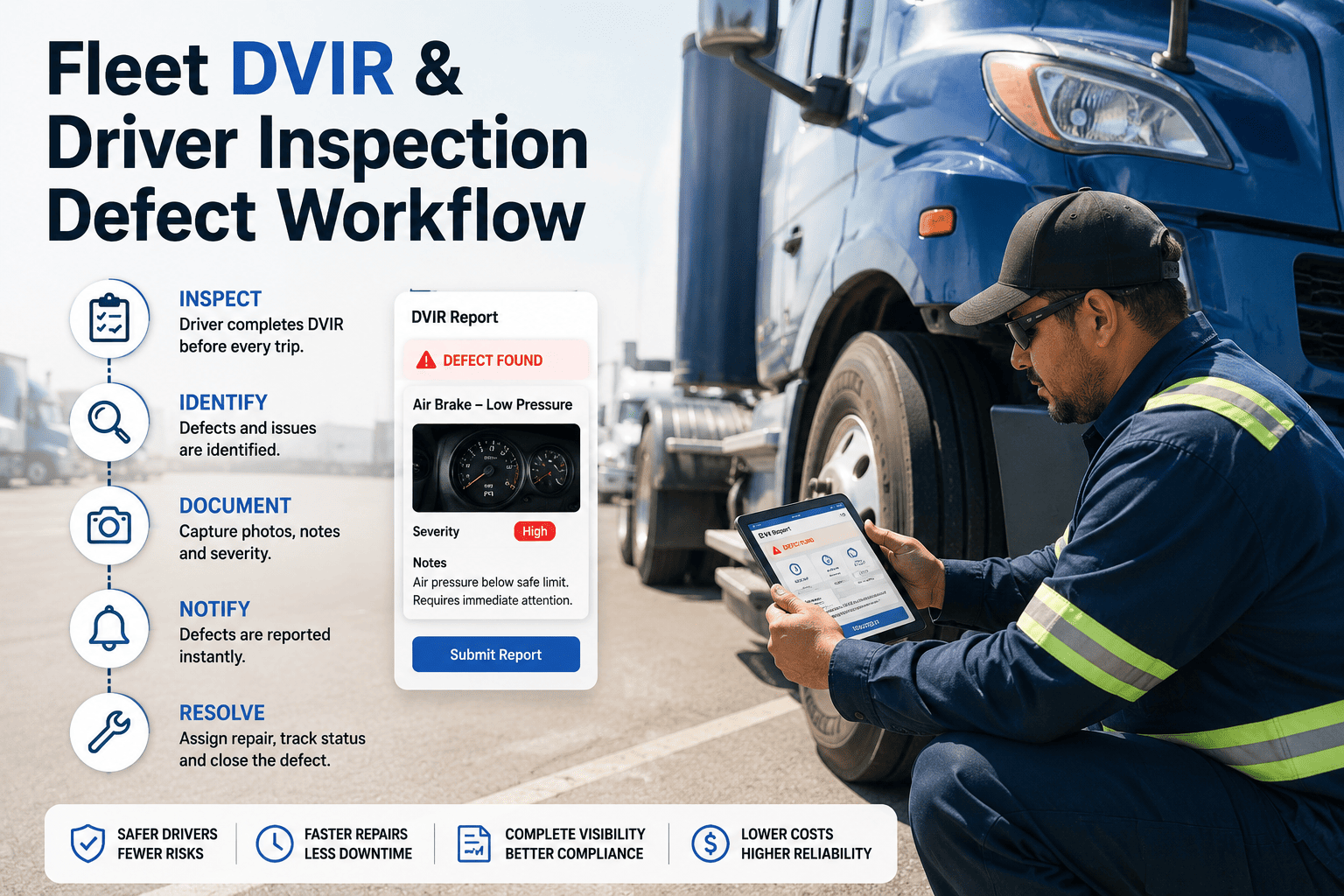
A DVIR that reports a defect nobody fixes is not a safety record — it is a documented admission that your fleet knew about a problem and dispatched the vehicle anyway. Every day, drivers across the country write down cracked lights, worn tires, and leaking air lines on inspection forms that get folded into a clipboard and forgotten before the vehicle ever reaches a technician. The defect does not disappear because it was written down. It just moves from a driver's report to a roadside citation, or worse, to an accident investigator's file. Fleet DVIR and driver inspection defect workflow is the process that decides which of those two outcomes happens, and most fleets have never actually designed it — they inherited a paper habit. If your DVIR process ends at "form submitted" instead of "defect repaired and verified," book a demo with OxMaint to see how the loop actually closes.
Fleet DVIR Workflow · Driver Inspection Reports · Defect-to-Repair Routing · OxMaint AI
Every Defect Routed to a Work Order. Every Repair Verified Before Dispatch. Every Signature Captured Automatically. DVIR Workflow That Closes the Loop Instead of Filing the Problem.
OxMaint turns the Driver Vehicle Inspection Report from a compliance form into a working safety pipeline — auto-routing every driver-reported defect to a maintenance work order, enforcing the three-signature chain FMCSA requires, blocking dispatch on unresolved safety defects, and producing audit-ready DVIR records the moment a reviewer asks for them.
89%
of FMCSA compliance reviews audit Driver Vehicle Inspection Report records — the single most-cited document category in DOT reviews
7%
of motor carriers pass a DVIR-focused compliance review without a single citation, according to industry audit data
90 days
minimum retention FMCSA requires for a DVIR that documented a repairable defect, under 49 CFR 396.11
3
A DVIR is not one signature — it is three, arranged in a sequence that only closes when the next driver acknowledges the repair. The driver signs to report the defect. The mechanic signs to certify the repair, or certify that the repair is unnecessary for safe operation. The next driver signs to confirm they reviewed that certification before taking the vehicle out. Break any one link in that chain and it is a separately citable violation under 49 CFR 396.11 or 396.13 — and a missing signature is consistently the top finding in DVIR compliance reviews. OxMaint enforces the full chain digitally, so dispatch is blocked until every signature exists.
The Five-Step DVIR Workflow OxMaint Automates
01
Driver Completes Post-Trip Inspection
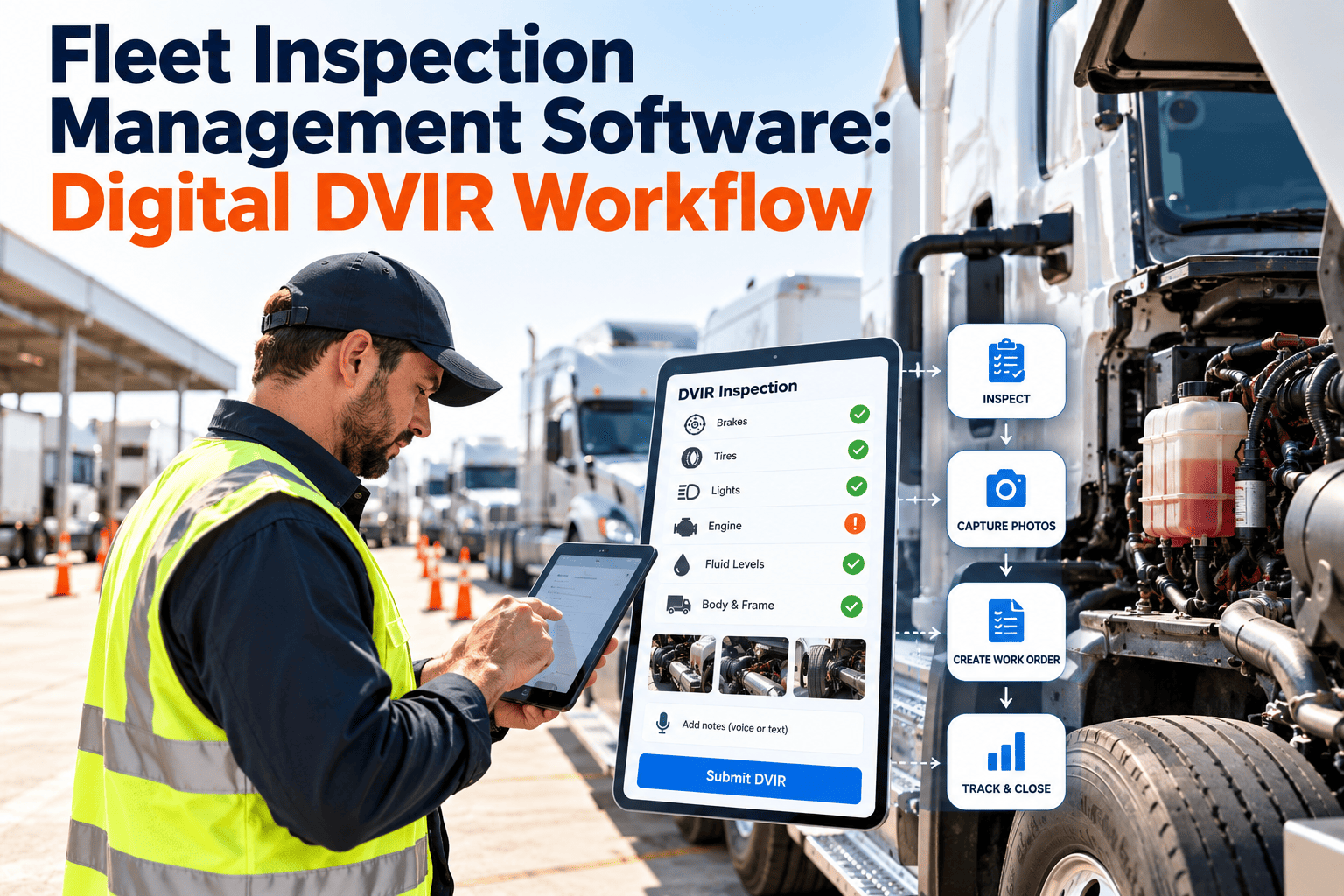
The driver inspects the vehicle across the categories required under 49 CFR 396.11(a)(1) — brakes, coupling devices, lights, steering, tires, and the rest — and documents anything that affects safe operation or could cause a breakdown. OxMaint's mobile DVIR mirrors the required categories exactly, so nothing is skipped and nothing is added that slows the driver down.
02
Defect Documented and Signed
If a defect exists, the driver records it with a description, signs with name, date, and timestamp, and submits. If no defect exists on a property-carrying vehicle, no report is required under current FMCSA rules — OxMaint applies that no-defect logic automatically so drivers and fleet managers are not buried in paperwork that regulation does not require.
03
Defect Auto-Routed to a Work Order
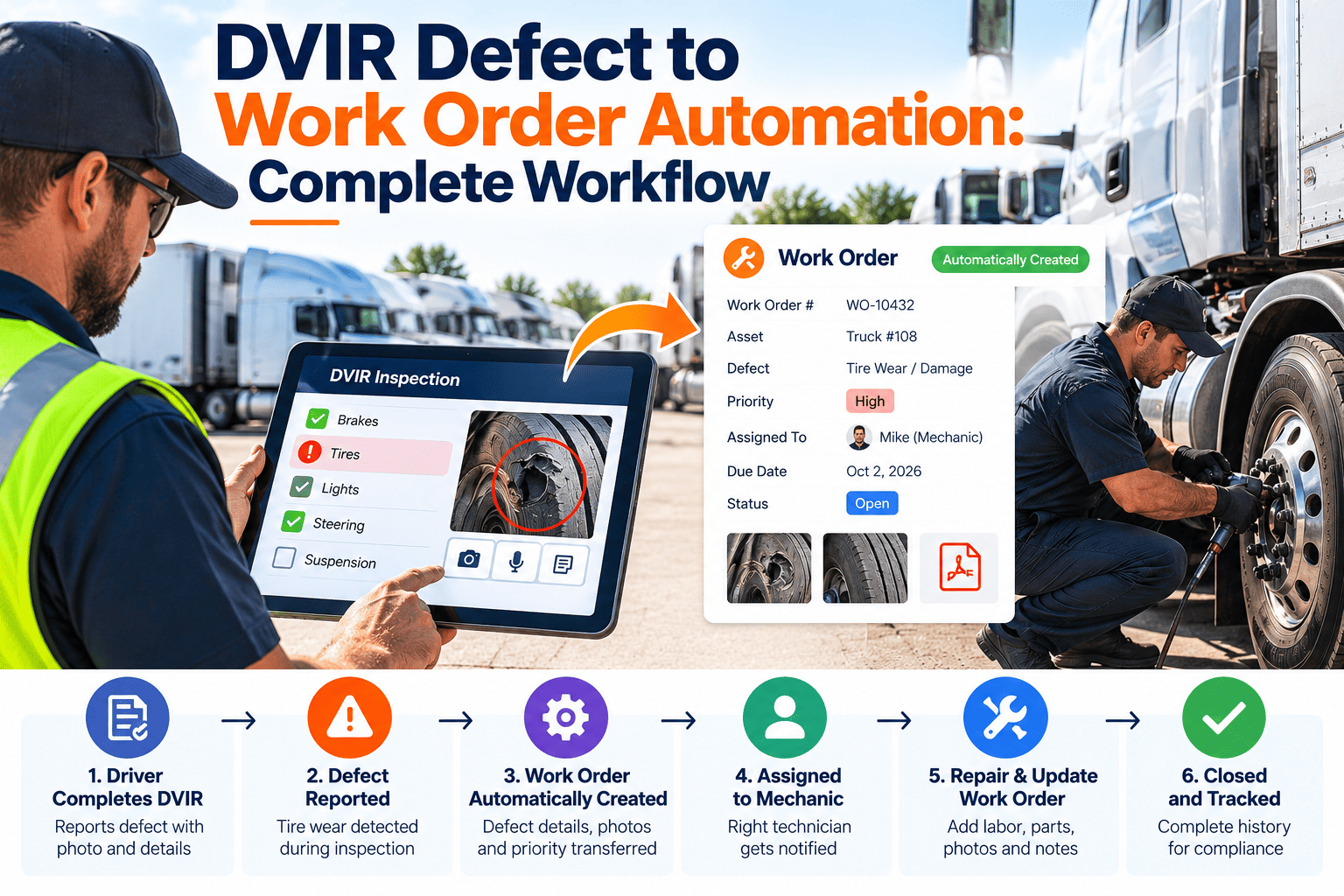
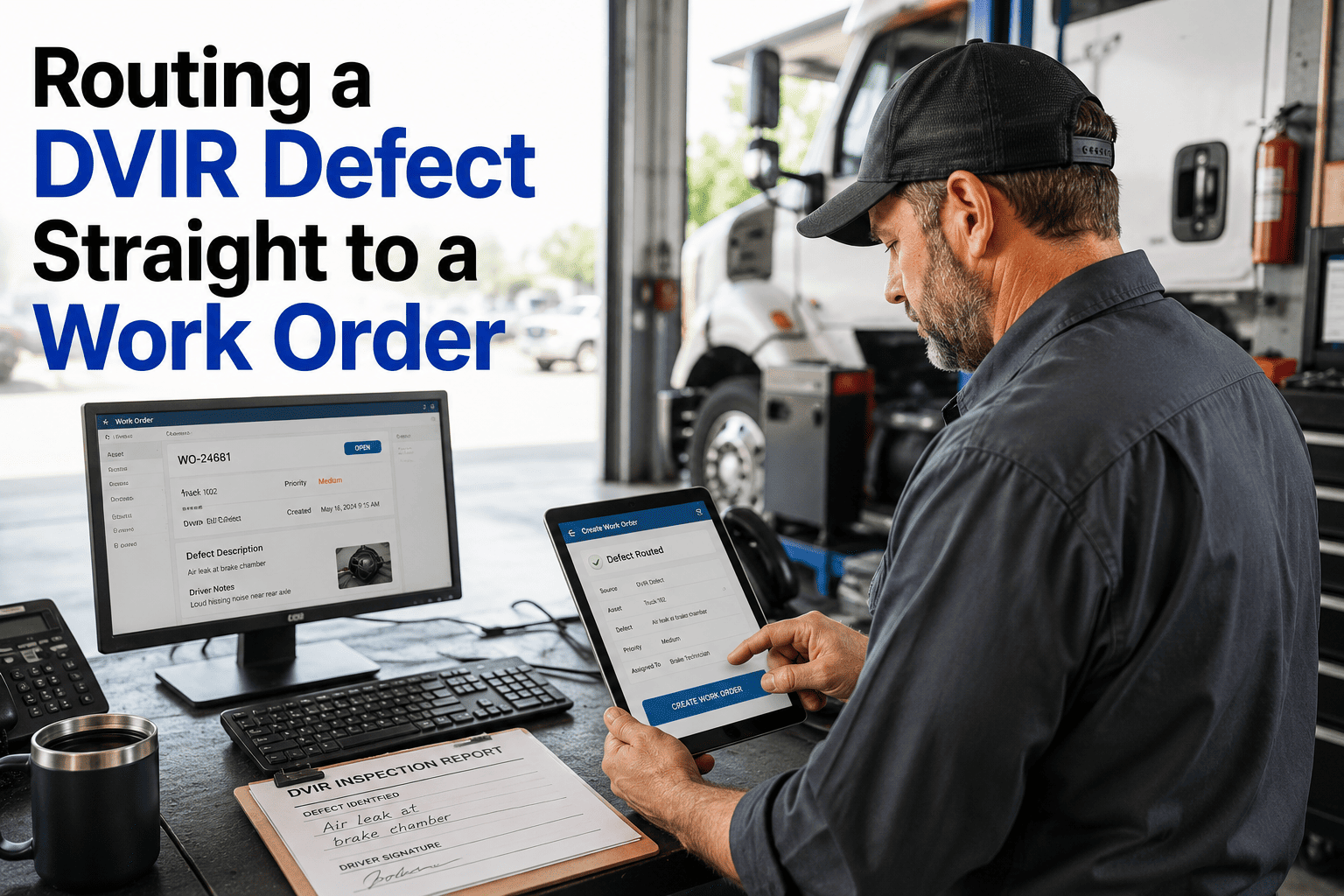
This is the step most paper-based fleets never build. A submitted defect in OxMaint does not sit in a form — it generates a maintenance work order automatically, assigned by defect severity and shop capacity, and the vehicle is flagged for a dispatch hold if the defect is safety-critical.
04
Repair Completed and Certified
A technician repairs the defect, or certifies in writing that repair is not necessary for safe vehicle operation, and signs the DVIR to close that work order. OxMaint requires this certification field to be completed before the work order can close — an empty certification cannot be saved.
05
Next Driver Reviews and Acknowledges
Before operating the vehicle, the next driver must review the prior DVIR and any certification of repair, per 49 CFR 396.13. OxMaint presents this record on the driver's device and requires acknowledgment before the trip can start, closing the three-signature chain digitally and automatically.
OxMaint AI · DVIR Defect Workflow
Stop Losing Defects Between the Driver's Report and the Shop Floor
OxMaint connects every step of the DVIR chain — inspection, defect, work order, repair certification, and driver acknowledgment — into one auditable record instead of five disconnected paper trails.
DVIR Risk Register — Where Fleets Get Cited and Sued
Critical — Violation
Vehicle Dispatched With an Unrepaired Safety Defect
Operating a vehicle after a driver reported a safety-affecting defect, without repair or written certification that repair was unnecessary, is a direct violation of 49 CFR 396.11. OxMaint blocks dispatch assignment automatically until the work order tied to that defect is closed.
Critical — Compliance
A Missing Link in the Three-Signature Chain
One skipped signature — driver, mechanic, or next driver — is a separately citable finding and the most common issue auditors flag. OxMaint requires every signature digitally before the record is considered complete.
Critical — Liability
DVIR Records Not Retained for the Required Period
A DVIR documenting a defect must be retained for a minimum of three months, and post-accident, missing or destroyed records read as evidence of a negligent maintenance programme. OxMaint retains and exports every record instantly.
Elevated — Pattern
The Same Defect Reported by Multiple Drivers
A defect reported, "repaired," and reported again within weeks usually means the repair certification was signed without the fix actually being verified. OxMaint's defect history view flags repeat reports on the same component for review.
Elevated — Documentation
Passenger-Carrying CMV Missing a Daily DVIR
Unlike property-carrying vehicles, passenger-carrying CMVs require a DVIR every day regardless of whether a defect was found. OxMaint applies the correct no-defect rule automatically based on the vehicle's registered class.
Elevated — Process
Paper DVIRs Lost Between Cab and Office
A paper DVIR left in a truck cab for days delays repair by exactly that long. OxMaint's mobile DVIR submits the moment the driver signs, so the maintenance queue sees the defect in real time, not at the next fuel stop.
FMCSA DVIR Requirements — OxMaint Coverage by Regulation
Documented Outcomes — Fleets Running DVIR Through OxMaint
Zero
missing-signature findings across three-signature DVIR chains after fleets moved to OxMaint's enforced digital sign-off sequence
Same-day
defect-to-work-order routing time, replacing multi-day delays common with paper DVIR forms sitting in a cab or office tray
Minutes
to produce a complete, exportable DVIR history for any vehicle during an FMCSA compliance review, instead of searching paper files
Our old process was a clipboard in the truck and a filing cabinet in the office. A driver would write down a defect, and by the time the paper reached the shop, three or four days had gone by — sometimes the truck had already run another route. After we moved DVIR onto OxMaint, every defect became a work order the same shift it was reported. Our last compliance review was the first one where the reviewer didn't flag a single missing signature.
— Director of Safety and Compliance, Regional Truckload Carrier · 140 Units
Frequently Asked Questions — Fleet DVIR and Driver Inspection Defect Workflow
Does every vehicle need a DVIR filed every day, even with no defects found?
No — for property-carrying commercial vehicles, a no-defect DVIR has not been required since 2014. A DVIR is required only when a defect is discovered or reported. Passenger-carrying vehicles still require a daily DVIR regardless of defects.
Sign in to OxMaint to configure the correct rule by vehicle class.
What happens if a driver reports a defect and it never reaches a mechanic?
The vehicle is at risk of being dispatched with an unrepaired safety defect, which is a direct violation under 49 CFR 396.11 and a serious liability exposure if an accident follows. OxMaint closes this gap by auto-routing every reported defect straight into a maintenance work order the moment it is submitted.
How does OxMaint capture the three signatures a DVIR legally requires?
The driver signs digitally when reporting the defect, the technician signs when repairing or certifying the repair unnecessary, and the next driver signs to acknowledge review before operating. OxMaint blocks dispatch until all three signatures exist.
Book a demo to see the chain enforced live.
How long does OxMaint retain DVIR records for compliance reviews?
OxMaint retains every DVIR record well beyond the FMCSA minimum of three months, keeping the full history searchable for the vehicle's operational life. A complete export for any vehicle is available in minutes during an audit or investigation.
Can OxMaint route different defect types to different technicians automatically?
Yes. Defect category and severity determine routing — a brake or steering defect can be flagged as safety-critical with an immediate dispatch hold, while a minor cosmetic issue routes to the next scheduled service.
Sign in to OxMaint to configure defect routing rules for your fleet.
Your Drivers Are Already Finding the Defects. The Question Is Whether Your Workflow Fixes Them Before an Auditor or an Accident Investigator Does.
Mobile DVIR built around the required inspection categories. Automatic defect-to-work-order routing. An enforced three-signature chain. Audit-ready records on demand. OxMaint turns your DVIR from a form drivers fill out into a workflow that actually protects your fleet.