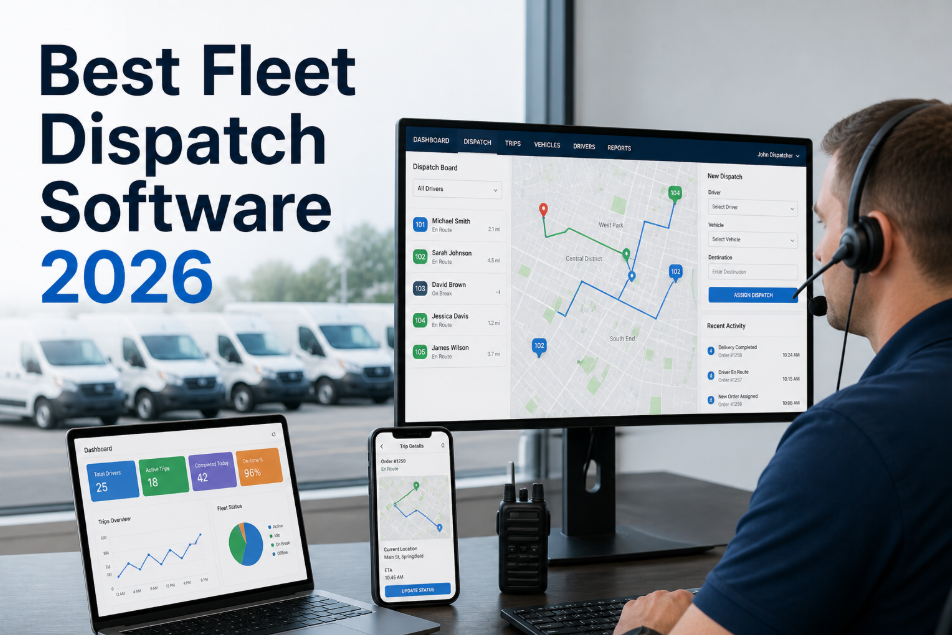
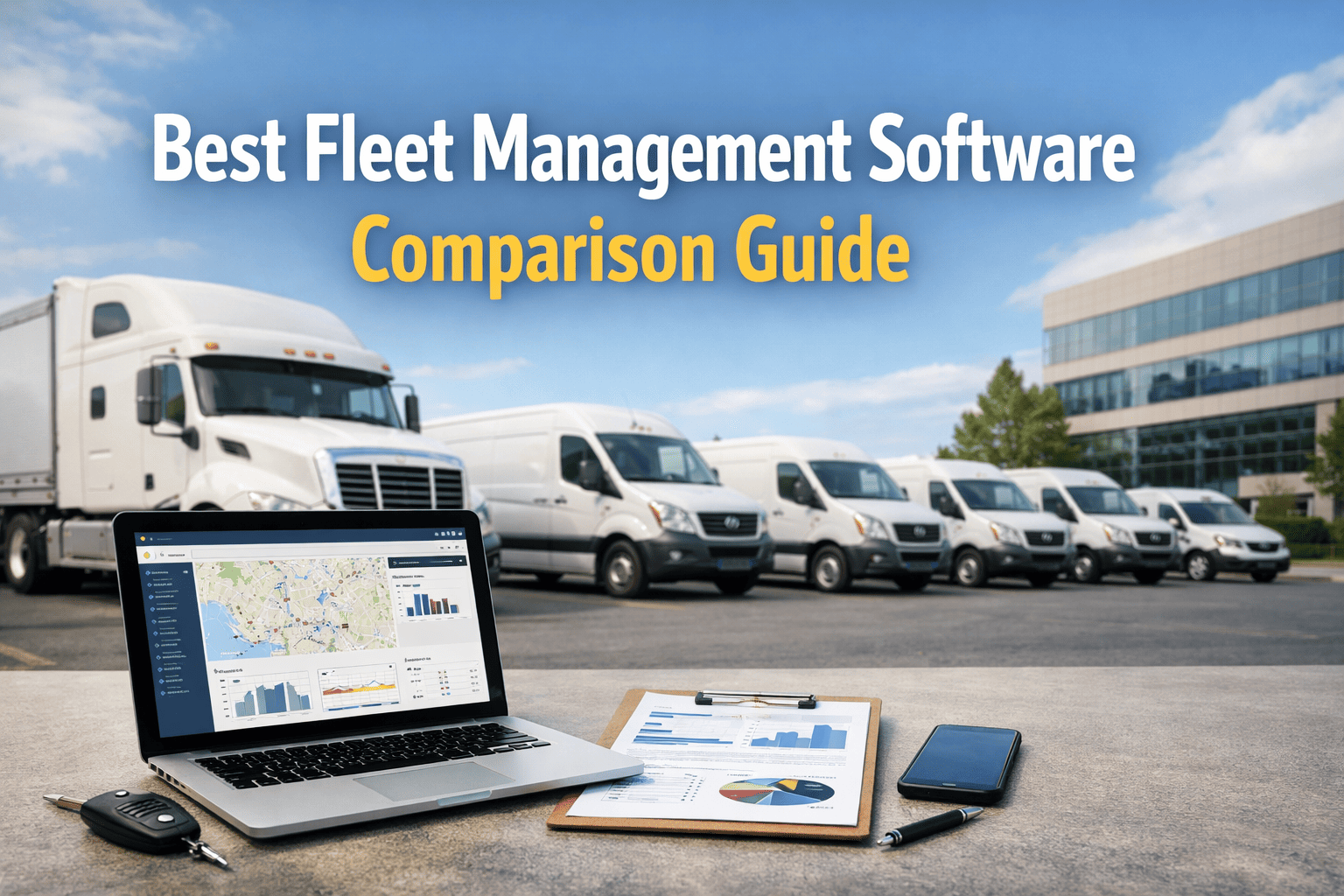
Fleet dispatch is where the operation either runs or falls apart. The wrong job sent to the wrong driver, a missed delivery window because of poor route visibility, a breakdown with no maintenance record to explain it — every one of these is a systems failure before it's a people failure. Fleet dispatch software connects your vehicles, drivers, routes, and maintenance status in one live operational picture. This guide ranks the platforms worth evaluating in 2026 for real-world dispatch operations — covering trucking, field service, and last-mile delivery fleets. For dispatch teams that also want maintenance scheduling and asset tracking in the same platform, start a free trial with Oxmaint or book a demo to see the full operations platform.
Fleet Dispatch / Route Planning / Real-Time Operations / 2026 Comparison
Best Fleet Dispatch Software 2026: Ranked for Trucking, Field Service, and Delivery Fleets
Evaluated on real-time vehicle visibility, route optimization, driver communication, integration with maintenance records, and total operational fit — reviewed for dispatch managers, fleet coordinators, and operations directors running multi-vehicle, multi-route operations.
23%
average fuel cost reduction from route optimization in commercial fleets
$71B
annual cost of fleet vehicle downtime to North American commercial operators
40%
of fleet dispatch delays are caused by poor vehicle condition visibility at assignment time
3.2x
faster issue resolution for fleets with real-time dispatch-to-maintenance integration
Oxmaint Operations Platform
Dispatch That Knows Which Vehicles Are Actually Ready to Roll
When your dispatch system is connected to your maintenance records, you stop sending vehicles with open defects, overdue PMs, or service flags. Oxmaint connects asset condition, work order status, and operational scheduling in one platform — so every dispatch decision is made with full vehicle health context. No more dispatching a truck that should be in the shop.
What Fleet Dispatch Software Needs to Do in 2026
Fleet dispatch software has moved beyond simple load assignments and GPS dots on a map. In 2026, the platforms worth using integrate real-time vehicle location with driver availability, route conditions, customer delivery windows, and — critically — vehicle maintenance status. Dispatching a truck with an overdue PM or an open safety defect isn't a dispatch problem; it's a systems failure. The best platforms surface maintenance flags at the dispatch decision point, not after an incident. For fleet operations that manage both dispatch coordination and vehicle maintenance in one system, productivity gains compound significantly: dispatchers make better vehicle assignments, maintenance teams get better utilization data, and operations directors get a single source of truth. Start a free trial with Oxmaint to see how dispatch and maintenance integrate, or book a demo to walk through the platform for your fleet type.
The Fleet Dispatch Workflow — Where Software Makes the Biggest Difference
1
Vehicle Availability Check
Before any dispatch decision: which vehicles are serviceable, which have open defects, which have a PM due within 48 hours? Systems without maintenance integration skip this — and the result is dispatching vehicles that shouldn't move.
40% of dispatch delays trace to poor vehicle availability visibility
2
Driver and Load Assignment
Match the right driver (hours, certification, location) to the right load and vehicle. Route restrictions, load type, customer delivery windows, and legal driving hour limits all factor in at this stage.
Manual assignment takes 15–25 min per load; automated matching under 60 seconds
3
Route Optimization and Dispatch
Optimal route generated accounting for traffic, fuel stops, weight restrictions, and time windows — then dispatched directly to the driver's mobile device with turn-by-turn navigation and delivery instructions.
Route optimization reduces fuel spend by 15–23% on multi-stop routes
4
Real-Time Monitoring and Exception Handling
Live GPS tracking with geofence alerts, ETA monitoring, and exception flags for route deviations or delays. Dispatcher intervenes only when the system escalates — not monitoring every vehicle manually.
Exception-based dispatch reduces supervisor monitoring time by up to 60%
Top 6 Fleet Dispatch Software Platforms — 2026 Rankings
Ranked on real-time tracking quality, route optimization depth, driver communication tools, maintenance integration, and fit for commercial fleet operations. Assessed for 2026 capabilities.
01
Oxmaint closes the gap between dispatch and maintenance that every other platform leaves open. Vehicle condition scoring, PM scheduling, work order status, and asset service history are all visible at the dispatch decision point — so dispatchers know which vehicles are truly road-ready before assignment. Multi-site operations benefit from portfolio-level visibility: fleet managers see availability, condition, and utilization across all depots in one dashboard. IoT and SCADA integration adds real-time vehicle health data for operations running connected assets.
Dispatch + maintenance unified
Asset condition at dispatch
Multi-site portfolio view
IoT integration
Mobile-first technician + driver
No heavy onboarding
Best For: Multi-depot operations, asset-heavy fleets, operations where vehicle condition drives dispatch decisions
02
Samsara delivers outstanding real-time GPS tracking, driver behavior monitoring, dashcam integration, and electronic HOS logging — all tightly integrated with its dispatch module. Route-level visibility is excellent. Strong for large trucking fleets where driver compliance and real-time location are the primary dispatch priorities. The maintenance module exists but is secondary to the telematics core, and hardware costs add up quickly at scale.
Real-time GPS excellence
HOS compliance
Dashcam integrated
Hardware-dependent
Best For: Large trucking fleets prioritizing driver compliance and real-time location
03
Verizon Connect (formerly Fleetmatics) is a comprehensive telematics and dispatch platform with strong enterprise-tier capabilities — route replay, detailed driver scoring, fleet utilization reporting, and customer ETA notifications. Best suited to large commercial fleets with significant IT support capacity. Implementation complexity and contract structures make it a poor fit for mid-market or fast-moving operations.
Enterprise-grade reporting
Driver scoring
Long-term contract
High implementation complexity
Best For: Enterprise fleets with dedicated IT resources and long implementation timelines
04
Fleet Complete covers GPS tracking, dispatch, driver management, and basic asset monitoring for mixed-use fleets — including light vehicles, trucks, and trailers. A solid mid-market option for Canadian and North American fleets. The platform lacks depth in maintenance scheduling and CapEx forecasting, positioning it as a strong dispatch tool but not a full fleet lifecycle management solution.
Mixed fleet support
Canadian market strong
Basic maintenance tools
Mid-market pricing
Best For: Mid-size Canadian and North American fleets managing mixed vehicle types
05
Onfleet is purpose-built for last-mile delivery operations — clean dispatcher interface, automatic route optimization, real-time driver tracking, proof-of-delivery capture, and customer notification messaging. Excellent for e-commerce, food delivery, and courier fleets. Limited applicability outside last-mile delivery; no heavy vehicle compliance, no asset lifecycle management, no maintenance scheduling depth.
Last-mile specialist
Auto route optimization
POD capture
Customer notifications
Best For: E-commerce, food, and courier last-mile delivery operations
06
Route4Me specializes in multi-stop route optimization and is one of the strongest pure-route-planning platforms available. Handles territory management, time window constraints, and vehicle capacity optimization well. Strong for distribution and field service routing but operates as a routing layer, not a full dispatch or fleet management platform — vehicle tracking, maintenance, and compliance are outside its scope.
Best-in-class routing
Territory management
Multi-stop optimization
Routing-only scope
Best For: Distribution and field service operations where routing is the primary constraint
4 Dispatch Problems That Cost Fleets the Most — and How Software Solves Them
01
Dispatching Vehicles Without Knowing Their Condition
When dispatch and maintenance operate in separate systems, dispatchers have no visibility into which vehicles have open defects, overdue PMs, or service flags. The result is vehicles dispatched on jobs they shouldn't run — creating safety incidents, breakdowns mid-route, and compliance exposure for the operator.
02
Manual Route Planning Bleeding Time and Fuel
Dispatchers manually building routes for multi-stop loads spend 15–25 minutes per assignment versus under 60 seconds with automated optimization. Beyond time waste, manual routing consistently produces routes 15–23% longer than optimized equivalents — adding significant fuel cost per vehicle per shift across the fleet.
03
No Real-Time Visibility Into Delays and Exceptions
Without live tracking and geofence-based exception alerts, dispatchers spend the shift monitoring every vehicle manually rather than managing by exception. A delivery 40 minutes behind schedule should trigger an automatic notification — not require a phone call from the driver or a customer complaint to reveal the delay.
04
Driver Hours and Compliance Managed Manually
Dispatching drivers without real-time HOS (Hours of Service) visibility risks regulatory violations, driver fatigue incidents, and penalties from FMCSA, DVSA, or state regulators. Digital HOS tracking integrated with dispatch ensures assignments are made within compliant driving windows — not estimated from paper logs or memory.
Reactive Dispatch vs. Connected Dispatch — The Operational Gap
| Dispatch Scenario |
Manual / Reactive |
Oxmaint-Connected Dispatch |
Outcome Difference |
| Vehicle assignment decision |
Based on driver availability only — no vehicle condition check |
Asset condition score and PM status visible at assignment |
Defect-flagged vehicles never dispatched |
| Route planning time |
15–25 min per load manually planned |
Under 60 seconds with optimization engine |
Dispatcher capacity increased 10–15x |
| Fuel cost per route |
Manual routing adds 15–23% excess distance on average |
Optimized routing minimizes distance and idle time |
23% fuel cost reduction per route |
| Delay management |
Driver calls in or customer complains — reactive response |
Geofence alerts and ETA drift trigger exception flags |
60% reduction in supervisor monitoring time |
| Compliance visibility |
Paper HOS logs checked after the fact |
Real-time HOS data integrated at dispatch decision |
Zero compliance-driven violations from dispatch |
| Maintenance coordination |
Separate system — maintenance and dispatch never communicate |
Work order status surfaces in dispatch dashboard |
3.2x faster issue resolution across departments |
What Integrated Dispatch and Maintenance Management Delivers
23%
Average fuel cost reduction through route optimization
Consistent across multi-stop commercial fleet operations after implementing automated route optimization vs. manual dispatch planning
40%
Fewer dispatch delays from vehicle condition visibility
Dispatchers with real-time asset condition data stop sending vehicles with maintenance flags — eliminating the most preventable category of mid-route breakdown
3.2x
Faster issue resolution when dispatch + maintenance are connected
When a vehicle is pulled off route for a breakdown, integrated systems create the work order, update dispatch availability, and reroute remaining loads simultaneously
60%
Reduction in dispatcher manual monitoring time
Exception-based alert systems replace constant manual tracking — dispatchers focus on exceptions and new assignments, not watching GPS dots move in real time
Frequently Asked Questions
What is the difference between fleet dispatch software and fleet management software?+
Fleet dispatch software focuses on the operational layer — assigning jobs to drivers, routing vehicles, monitoring delivery status, and communicating with drivers in real time. Fleet management software covers the full vehicle lifecycle including maintenance scheduling, work orders, service history, and CapEx forecasting. Platforms like Oxmaint integrate both: dispatch decisions are made with full maintenance context, and maintenance operations are informed by utilization and route data from dispatch.
Start a free trial to see the integration in action.
Can fleet dispatch software work for both trucking and field service fleets?+
Yes, though the capability priorities differ. Trucking dispatch prioritizes HOS compliance, load management, weigh station routing, and multi-drop efficiency. Field service dispatch prioritizes technician skill matching, customer appointment windows, parts availability at the van level, and real-time job status updates. Oxmaint's work order and asset management core makes it particularly strong for field service operations where vehicle dispatch and job assignment are the same decision.
Book a demo to see dispatch configured for your fleet type.
How does dispatch software integrate with maintenance management?+
In a properly integrated system, dispatch checks vehicle condition status before confirming an assignment — surfacing any open defects, overdue PMs, or service holds automatically. When a vehicle is taken off the road for maintenance, the dispatch system updates availability in real time. Oxmaint provides this integration natively: asset condition scores, work order status, and PM schedules are visible within the operational dashboard used for dispatch decisions.
What fleet size does dispatch software make sense for?+
Dispatch software delivers measurable ROI at 5 vehicles and above — at that point, manual route planning and job assignment consumes meaningful dispatcher time that software can recapture. For fleets above 20 vehicles or running multi-stop routes, the route optimization alone typically covers the software cost in fuel savings within the first quarter. Multi-site and multi-depot operations benefit from portfolio-level visibility that is impossible to replicate manually at any vehicle count.
Fleet Dispatch and Maintenance — Oxmaint
Dispatch Smarter. Know Which Vehicles Are Actually Ready.
Vehicle condition at dispatch, automated route optimization, real-time exception alerts, multi-site fleet visibility, and maintenance-connected operations — all in one platform. Stop dispatching blind. Start dispatching with full asset context.
23%
Fuel cost reduction from route optimization
40%
Fewer dispatch delays from condition visibility
3.2x
Faster issue resolution with integrated systems
60%
Less manual dispatcher monitoring time