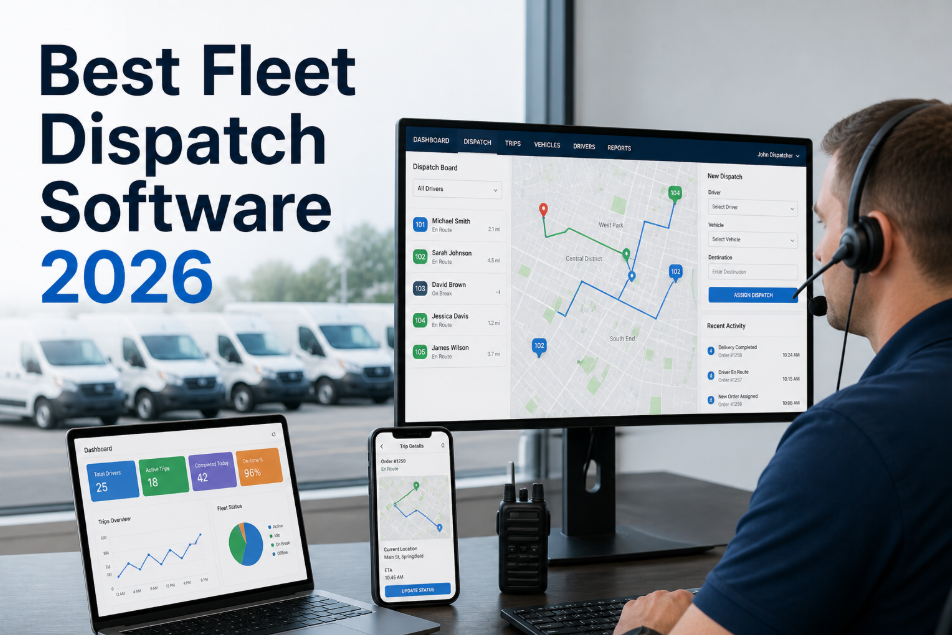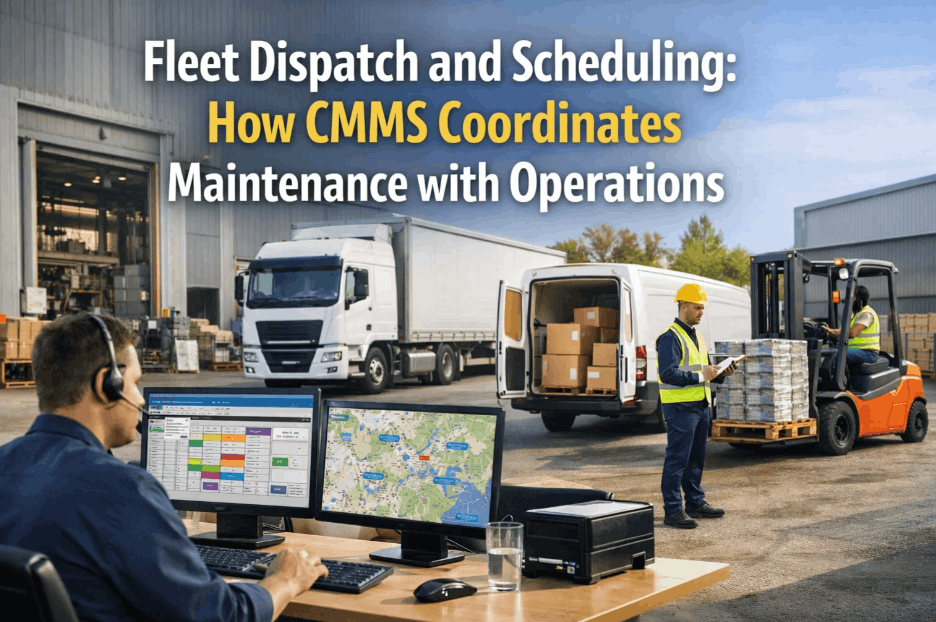
Fleet dispatch is the operational nerve center of any commercial fleet — the point where vehicles, drivers, routes, and time windows either come together efficiently or fall apart expensively. In 2026, the gap between fleets using modern dispatch software and those still relying on phone calls, whiteboards, and spreadsheets has widened to the point where it is measurable in dollars per vehicle per day. Fleets using intelligent dispatch platforms report 22% fewer empty miles, 31% faster response times on urgent jobs, and driver utilization rates 18 percentage points higher than those using manual dispatch processes. The right fleet dispatch software does not just assign drivers to jobs — it optimizes routes in real time, integrates with GPS telematics, automates driver communication, tracks job status without phone calls, and feeds completed job data directly into maintenance records. When dispatch integrates with a CMMS like Oxmaint, vehicle availability is always accurate — dispatchers never assign a vehicle that is in the shop, and maintenance teams never pull a vehicle that is mid-route. This guide compares the top 10 fleet dispatch software tools for 2026 across the features that matter most to operations managers: GPS integration depth, mobile app quality, route optimization capability, pricing transparency, and CMMS connectivity. Want to see how Oxmaint connects dispatch-ready vehicle status to your maintenance workflow? Start a free trial or book a demo today.
Top 10 Fleet Dispatch Software Tools for 2026: Features and Pricing
GPS integration, route optimization, mobile app ratings, pricing tiers, and CMMS connectivity — everything operations managers need to choose the right dispatch platform for their fleet in 2026.
What to Look for in Fleet Dispatch Software in 2026
Fleet dispatch software has matured significantly — the baseline expectation in 2026 is real-time GPS integration, mobile driver apps, and automated job assignment. What separates the platforms on this list is how well they handle the harder problems: dynamic re-routing when a job runs long, vehicle availability that reflects actual maintenance status, driver hour-of-service compliance built into the assignment logic, and two-way communication that does not require the dispatcher to make phone calls.
The most overlooked integration in fleet dispatch is CMMS connectivity. A dispatch platform that does not know which vehicles are in the shop, which are due for service in the next 48 hours, and which have open safety defects is working from an incomplete picture of fleet availability. Oxmaint's CMMS integration ensures vehicle availability in dispatch always reflects real maintenance status — dispatchers see which vehicles are cleared for assignment and which are flagged, without checking a separate system. Start a free trial or book a demo to see this integration in action.
The Top 10 Fleet Dispatch Software Tools for 2026
Ranked and reviewed based on GPS integration quality, route optimization, mobile app ratings, pricing, and CMMS connectivity. Each platform reviewed for commercial fleet operations specifically.
Oxmaint uniquely combines fleet dispatch with full CMMS — meaning vehicle availability in dispatch always reflects actual maintenance status. When a vehicle enters a shop for unplanned repair, it is automatically removed from dispatch availability. When it is cleared, it returns to the available pool without manual update. Dispatch managers see real-time GPS location, maintenance status, open defects, and service due dates for every vehicle on one screen. Route optimization accounts for vehicle capacity, driver HOS remaining, and job time windows simultaneously. Mobile driver app delivers turn-by-turn navigation, electronic proof of delivery, and job status updates with offline sync for areas without connectivity.
Samsara is a telematics-first platform with strong dispatch capabilities built on top of its industry-leading GPS infrastructure. Real-time vehicle tracking at 2.5-second intervals feeds dispatch with the most accurate live fleet picture of any platform on this list. Its dispatch module handles job assignment, route optimization, and driver communication effectively — though the interface complexity increases proportionally with fleet size. Works best for fleets already using Samsara telematics who want to consolidate dispatch into the same ecosystem. CMMS integration requires a third-party connector or custom API work — maintenance status does not natively appear in dispatch views.
Verizon Connect has one of the most mature dispatch platforms on the market — built on decades of commercial fleet GPS experience. Its compliance integration is the strongest on this list: HOS tracking, ELD integration, DVIR status, and DOT compliance data all feed directly into dispatch assignment logic so dispatchers cannot inadvertently assign a driver who has exceeded their hours or a vehicle with an open safety defect. The platform's enterprise pricing and complexity make it most appropriate for regulated fleets with 50+ vehicles where compliance risk management justifies the cost. Smaller fleets will find the implementation overhead and per-user licensing structure expensive relative to outcomes.
Fleetio is the most user-friendly platform on this list for fleets in the 10–100 vehicle range — clean interface, transparent pricing, and genuinely useful mobile apps for both drivers and dispatchers. Its CMMS module is more developed than most pure-play dispatch tools, providing maintenance history, service scheduling, and inspection tracking alongside dispatch. The route optimization engine handles standard multi-stop optimization effectively but lacks the dynamic re-routing sophistication of Samsara or Verizon at scale. For service businesses, utilities, and municipal fleets managing mixed assets without enterprise-level complexity, Fleetio strikes the best balance of capability and usability in the mid-market segment.
WorkWave Route Manager is the strongest pure route optimization tool on this list — its algorithm handles complex multi-vehicle, multi-stop, time-window-constrained scheduling better than any generalist dispatch platform. For fleets where route efficiency is the primary KPI — delivery, field service, pest control, HVAC service — WorkWave consistently reduces total miles driven by 15–25% compared to manually planned routes. Its weakness is the dispatch side: job assignment automation is more limited than dedicated dispatch platforms, and the CMMS integration is minimal. Fleet maintenance status does not feed into vehicle availability — dispatchers must check a separate system for vehicles in service.
Onfleet is purpose-built for last-mile delivery operations — its customer-facing features (real-time delivery tracking links, automated ETA SMS notifications, photo proof of delivery, and customer rating collection) are the best on this list. For fleets where customer experience during delivery is the top priority, Onfleet delivers measurably. Its limitations are scope: it is not built for mixed commercial fleets, heavy equipment dispatch, or service-industry workflows. No meaningful CMMS integration, no HOS compliance awareness, and no support for vehicle-type routing constraints. Works brilliantly for what it is designed for — last-mile consumer delivery — and struggles with everything else.
RTA Fleet Management comes from the opposite direction of most platforms on this list — it is a CMMS-first solution that added dispatch functionality rather than a dispatch tool that added maintenance. This means its vehicle maintenance data quality is among the best on this list, and its dispatch module benefits from that foundation — maintenance status is genuinely visible in vehicle availability. The trade-off is dispatch sophistication: the dispatch interface is more basic than purpose-built dispatch platforms, and route optimization is standard rather than advanced. Strong in government fleets, utilities, and public works operations where maintenance documentation compliance is the primary concern.
Fleet Complete is a strong regional player — particularly dominant in the Canadian commercial fleet market — with a solid combined telematics and dispatch offering at competitive per-vehicle pricing. Its AI-assisted dispatch recommendations and driver performance scoring are differentiating features not found on most platforms at this price point. The platform handles fleets of 5–200 vehicles effectively and includes asset tracking beyond vehicles — trailers, equipment, and tools. CMMS integration is basic: service due date warnings appear in the vehicle profile but do not feed into dispatch assignment logic. For North American SMB fleets wanting one affordable vendor for GPS, dispatch, and basic maintenance tracking, Fleet Complete is a strong option.
Teletrac Navman has a particularly strong presence in Australia, New Zealand, and the UK — markets where its compliance and fatigue management features align closely with local fleet regulations. Its dispatch module integrates tightly with its telematics hardware and handles electronic work dockets, driver fatigue monitoring, and multi-site dispatch effectively. The platform's reporting depth for compliance documentation is among the best for international fleets operating under non-US regulatory frameworks. Weaknesses include an interface that feels dated compared to newer competitors and a mobile app that has received mixed reviews for stability on Android devices. CMMS integration requires API configuration work.
DispatchTrack is specifically strong for white-glove and large-item delivery operations — furniture, appliances, medical equipment — where scheduled delivery windows, customer communication, and delivery crew coordination are the primary dispatch challenges. Its AI-assisted delivery scheduling and predictive ETA accuracy are marketed as its differentiating features, with claimed ETA accuracy within 30 minutes for 96% of deliveries. For general commercial fleet dispatch, the platform is limited — no meaningful telematics integration beyond basic GPS, minimal CMMS connectivity, and pricing that is consumption-based (per delivery, not per vehicle) making cost difficult to predict at scale.
Side-by-Side Feature Comparison
How all 10 platforms stack up across the five features that matter most for commercial fleet dispatch decisions.
| Platform | GPS Integration | Route Optimization | Mobile App | CMMS Integration | Starting Price |
|---|---|---|---|---|---|
| Oxmaint | Native real-time | Dynamic multi-stop | iOS + Android, offline | Native — same platform | Free tier available |
| Samsara | 2.5-sec refresh | Standard multi-stop | Highly rated | API required | ~$27/vehicle/mo |
| Verizon Connect | Real-time native | Multi-constraint | Dated UI | Limited API | ~$35/vehicle/mo |
| Fleetio | Partner telematic | Standard | Highly rated | Built-in, basic | From $4/vehicle/mo |
| WorkWave | Partner | Best-in-class | Good | Not native | From $49/mo |
| Onfleet | Real-time driver | Last-mile only | Excellent UX | Not available | From $500/mo |
| RTA Fleet | Partner | Basic | Legacy UI | Native CMMS | Custom |
| Fleet Complete | Native telematics | AI-assisted basic | Good | Alerts only | ~$25/vehicle/mo |
| Teletrac Navman | Native hardware | Standard | Mixed stability | API required | Custom |
| DispatchTrack | Basic location | AI delivery-focused | Good | Not available | Per-delivery |
Buyer Decision Framework: Which Platform Fits Your Fleet?
Fleet type, size, and primary operational challenge determine which dispatch platform delivers the most value. Use this framework to narrow your shortlist.
The Measurable ROI of Modern Fleet Dispatch Software
Frequently Asked Questions
What is the most important feature to evaluate in fleet dispatch software for 2026?
How long does fleet dispatch software implementation typically take?
Can fleet dispatch software integrate with existing GPS hardware?
Is fleet dispatch software worth the investment for fleets under 20 vehicles?
Stop Dispatching Vehicles That Are in the Shop
The most expensive dispatch mistake is assigning a vehicle that maintenance already knows is unavailable — because dispatch and maintenance are in separate systems that do not talk. Oxmaint unifies fleet dispatch and CMMS maintenance in one platform, so vehicle availability is always accurate, routes are always optimized, and your fleet is never sending a driver to pick up a truck that is on a lift. Most fleets are up and dispatching within their first week.