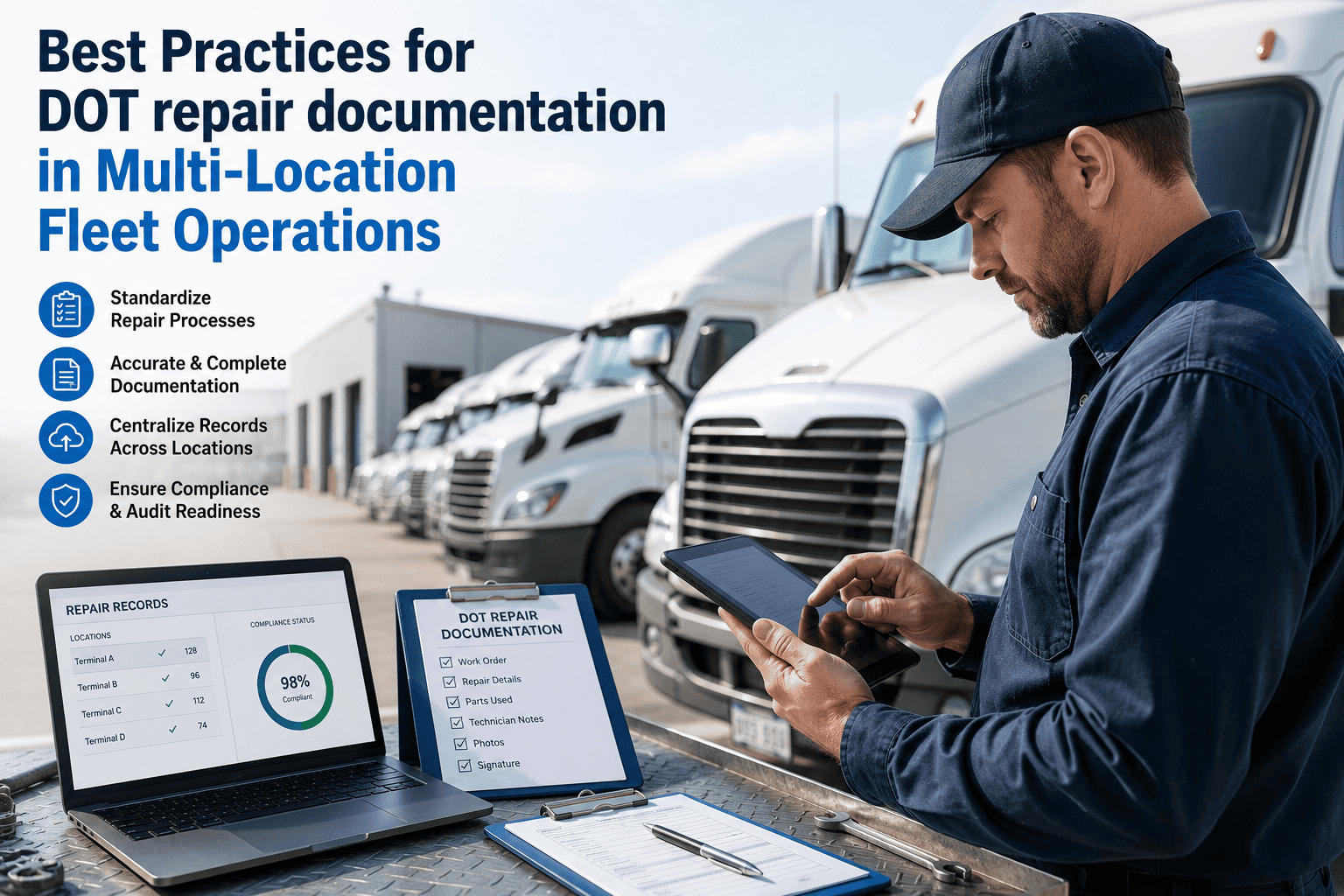
Running a fleet PM compliance dashboard across multiple locations is where most fleet programs quietly fall apart. What works at a single yard — shared spreadsheets, phone call sign-offs, a whiteboard schedule — creates dangerous blind spots the moment a second or third location enters the picture. Maintenance directors managing 3 to 30+ sites consistently report the same problem: they can tell you the overall PM completion rate, but they cannot tell you which location is dragging the average down until a roadside inspection or DOT audit exposes the gap. A centralized fleet PM compliance dashboard gives every location manager real-time visibility into their own performance while giving the fleet director a cross-site view that makes accountability impossible to avoid. If your multi-location fleet is still stitching together PM records from multiple systems, start a free trial with OxMaint or to see what unified compliance looks like.
Fleet PM Compliance · Multi-Location Operations · 2026
Best Practices for Fleet PM Compliance Dashboards in Multi-Location Operations
One dashboard. Every location. Zero excuses. Here is the operational framework that turns scattered PM records into a single source of truth — and the practices that separate high-performing multi-site fleets from the ones that fail audits they never saw coming.
The Multi-Location Gap
Why Multi-Site Fleets Fail PM Compliance at Scale
1
Inconsistent PM Intervals
Different location managers interpret PM schedules differently. One site services at 10,000 miles, another at 12,500. Without a centralized standard, your compliance rate is actually an average of different standards.
2
Siloed Work Order Systems
Repairs completed at Location B are invisible to the fleet director at headquarters. Vehicles transferred between sites carry maintenance history gaps that neither location knows about.
3
No Cross-Site Accountability
When a DOT violation is traced back to a missed PM, the question becomes: whose responsibility was it? Without a dashboard that timestamps every action to a named individual at a specific location, the answer is no one.
4
Delayed Escalation Paths
A past-due PM at a remote location may sit unresolved for days before it reaches someone with authority to act. A compliance dashboard escalates automatically — no waiting for a weekly report.
Numbers That Drive Decisions
What Multi-Location PM Gaps Actually Cost
43%
of multi-location fleets report inconsistent PM completion rates across sites
$22K
average cost of an unplanned breakdown that a missed PM could have prevented
3x
more likely to receive an unsatisfactory DOT rating without centralized documentation
68%
of fleet managers say visibility across sites is their top operational challenge
Best Practices Framework
8 Best Practices Every Multi-Location Fleet PM Dashboard Must Follow
Standardize PM Intervals Across All Sites
The dashboard should enforce a single PM schedule template that applies fleet-wide. Location managers can view their schedule but cannot modify the interval triggers. Any deviation from the standard requires director-level approval and is logged as an exception — visible on the cross-site dashboard.
Configuration
Build Location-Level Scorecards Into the Dashboard
Each site should have a PM compliance score calculated from the same formula: PMs completed on time divided by PMs due in the period. When every location sees its own score benchmarked against the fleet average, under-performing sites become self-aware — and over-performing sites become internal proof points.
Accountability
Require Vehicle History to Travel With the Asset
When a vehicle moves from Location A to Location B, its full PM history should be instantly available to the receiving location's maintenance team. This eliminates the dangerous assumption that "someone else already handled it" and ensures no PM interval resets to zero due to a transfer.
Asset Tracking
Automate Escalation for Past-Due PMs
A PM that is 24 hours past due should notify the location manager. At 48 hours, it should notify the regional director. At 72 hours, it should flag the vehicle as overdue on the fleet-wide dashboard and restrict dispatch authorization. Escalation logic built into the dashboard removes the human lag from a critical compliance process.
Automation
Capture Parts and Labor at Every Location Consistently
Cost-per-mile and cost-per-vehicle comparisons between locations are only valid when every location records the same data fields. Require part numbers, labor hours, technician ID, and service mileage on every work order across every site — no exceptions for "small" repairs.
Documentation
Separate View Permissions by Role and Location
A mechanic at Location C should see only their assigned work orders. The Location C manager should see all of Location C's records. The fleet director sees everything. Role-based access ensures that sensitive data stays contained while giving each level of authority exactly the visibility it needs to act.
Access Control
Run Weekly Cross-Site PM Completion Reports
A weekly automated report showing PM compliance by location — delivered to the fleet director every Monday — replaces the need for manual check-ins, status calls, and spreadsheet submissions. The dashboard generates this report automatically from live data, not from what location managers chose to report.
Reporting
Use AI to Surface Location-Specific Risk Patterns
OxMaint's AI predictive maintenance layer identifies patterns that manual review misses — a particular vehicle model failing brake components faster at Location D than at other sites, or a technician whose completed PMs correlate with higher repeat-failure rates. These insights are only visible when data from all locations flows into a single analytical engine.
AI Insights
OxMaint Multi-Location Dashboard
All 8 practices above are built into OxMaint — fleet-wide PM standards, location scorecards, AI risk detection, and one-click audit exports.
Before vs After
Multi-Location Fleet Management: Fragmented vs Centralized
| Area |
Fragmented Approach |
Centralized Dashboard |
| PM Scheduling |
Each location sets its own intervals |
Fleet-wide standard enforced automatically |
| Compliance Visibility |
Weekly email reports from each site |
Live cross-site dashboard, updated in real time |
| Vehicle Transfers |
History lost or manually transferred |
Full history travels with the asset automatically |
| Audit Preparation |
Days of manual record collection |
Full audit export in under 60 seconds |
| Overdue PMs |
Discovered after a breakdown or inspection |
Escalation alerts at 24, 48, and 72 hours |
| Cost Analysis |
Inconsistent data makes comparisons invalid |
Apples-to-apples cost-per-vehicle by location |
AI Predictive Maintenance
How AI Changes Multi-Location PM Compliance
When AI predictive maintenance runs across a unified multi-location dataset, patterns emerge that no single-site analysis could detect. OxMaint's predictive layer learns from every vehicle, every repair, and every location — and turns that learning into proactive work orders that prevent the defects that cause roadside failures and DOT violations.
A
Fleet-Wide Failure Pattern Detection
AI identifies when a specific vehicle model or component is failing faster at one location than across the fleet — surfacing environmental, route, or load factors that humans miss in manual review.
B
Location-Specific PM Interval Optimization
A vehicle on a mountain route at Location F may need brake service more frequently than the same vehicle model on flat highway routes at Location A. AI adjusts PM triggers based on real usage data, not generic OEM schedules.
C
Proactive Compliance Record Building
Every AI-generated work order creates a repair record with the same documentation depth as a defect-triggered repair. This builds a compliance history that shows DOT auditors a systematic, data-driven maintenance program — not just reactive repairs.
Common Questions
Fleet PM Dashboard for Multi-Location Operations — What Teams Ask Most
How does OxMaint handle PM compliance across locations that use different third-party repair shops?+
OxMaint supports external shop assignments on any work order at any location. The shop completes the repair, and the location manager logs completion with invoice documentation attached — creating a single audit trail regardless of who performed the service.
Start a free trial to configure your shop network.
Can location managers see other sites' data in OxMaint?+
Access is fully role-based. Location managers see only their own site's data by default. Fleet directors and corporate administrators have cross-site visibility. Permissions can be customized per user — so a regional manager overseeing three sites sees exactly those three.
Book a demo to see access controls in action.
What happens to a vehicle's PM history when it transfers between locations?+
The full maintenance history travels with the vehicle record in OxMaint — no manual transfer, no data loss. The receiving location sees the complete PM history, open work orders, and upcoming service due dates from the moment the vehicle is reassigned in the system.
How long does it take to set up OxMaint across multiple locations?+
Most multi-location fleets complete initial setup in 30 to 60 minutes per site. OxMaint's onboarding imports existing vehicle records, sets up user roles, and configures PM schedules with guided templates.
Start your trial and see how fast your team can be live.
Does OxMaint generate location-level compliance reports for DOT audits?+
Yes. OxMaint generates both site-specific and fleet-wide compliance reports exportable to PDF. For a DOT audit, you can pull a full inspection and repair history for any vehicle at any location, timestamped and formatted for investigator review, in under 60 seconds.
OxMaint · Multi-Location Fleet PM Compliance
Every Location. One Dashboard. Zero Compliance Gaps.
OxMaint gives multi-location fleet directors real-time PM compliance visibility across every site — with fleet-wide standards, AI predictive maintenance, location scorecards, and audit-ready exports. Stop managing compliance through email threads and spreadsheets. See the whole fleet from a single screen.