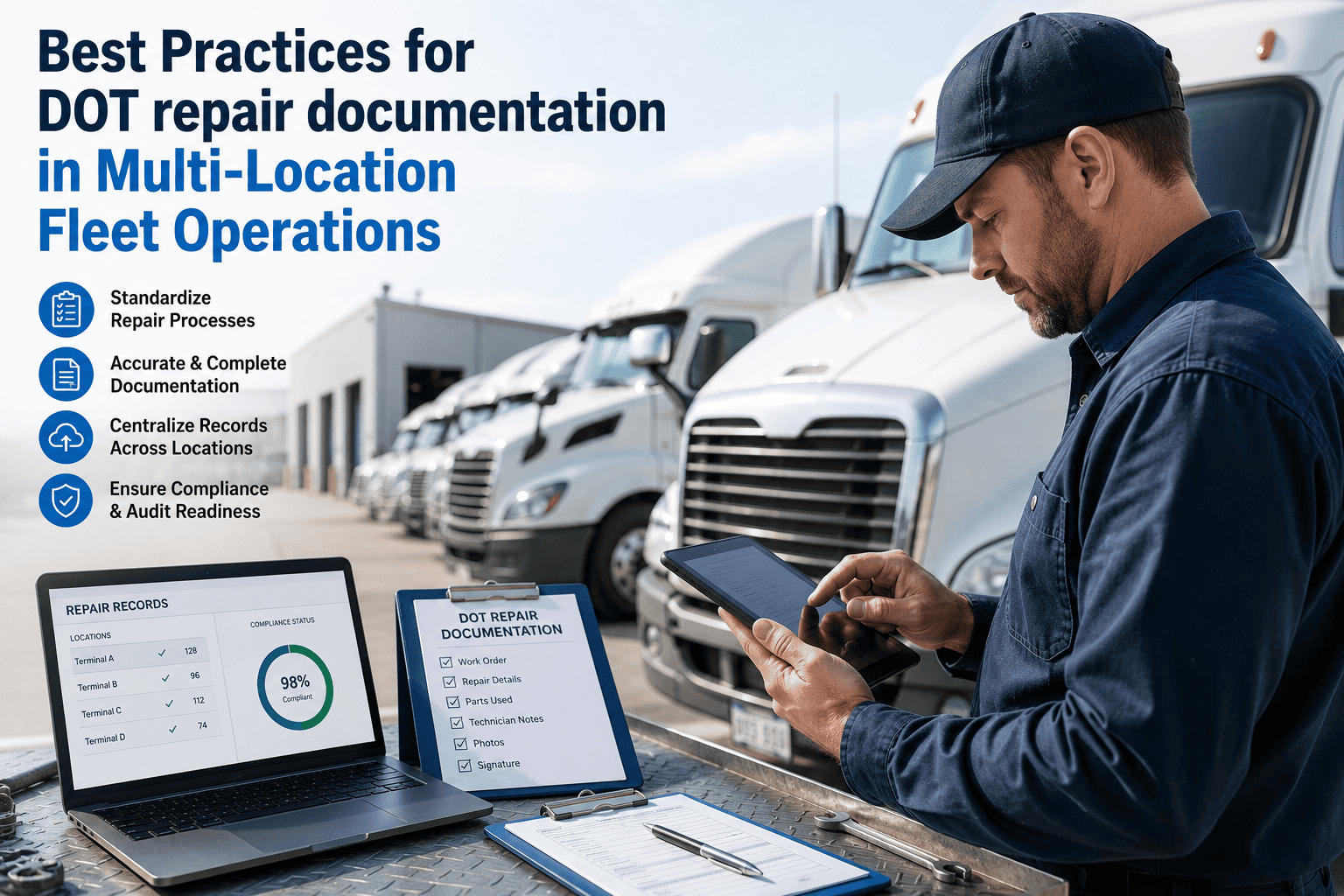
Running maintenance across multiple depot locations introduces a coordination problem that single-location fleets never face: the same repair looks completely different in your data depending on which location did the work order. One depot calls it "brake service," another calls it "brake job," and a third logs it under "safety inspection." By the time that data reaches fleet management, there is no way to compare maintenance spend, downtime rates, or PM compliance across locations — because the underlying work order data is not comparable. Work order coding best practices in multi-location operations are what solve this. Standardized codes, consistent field requirements, and a single shared code library across every depot turn fragmented local data into a unified fleet view that actually drives decisions. Oxmaint's multi-location fleet CMMS is built to enforce exactly this kind of consistency across locations without removing the autonomy depot managers need to run their day-to-day operations efficiently.
Best Practices for Fleet Work Order Coding in Multi-Location Operations
How leading fleet operations standardize work order coding across depots, regions, and vehicle types — so every location feeds comparable data into one centralized reporting view.
Why Multi-Location Coding Breaks Down
The problems that undermine work order coding in multi-location fleets are predictable. Knowing them in advance lets you design around them.
Each depot develops informal shorthand for common repairs. Over 6–12 months, the same repair type has 8 different descriptions across 8 locations. Cross-depot comparison becomes impossible without manual re-coding.
When coding quality is measured at the fleet level, no individual depot manager feels responsible. Poor coding at one location drags down the quality of fleet-wide reports without any depot-level consequence.
Multi-location fleets often use different repair vendors per region. Each vendor has their own description format. Without a standard for vendor-to-CMMS data entry, external repair costs never get coded consistently.
When a vehicle moves from one depot to another, its maintenance history often stays in the sending depot's system. The receiving depot has no context on recent repairs, open faults, or upcoming PMs — and the risk of missed maintenance compounds.
Without central oversight, depot managers adjust PM intervals to fit their schedule rather than the vehicle's actual needs. The same vehicle class runs on 3 different PM schedules depending on which depot it operates from — and nobody notices until failure rates diverge.
Without comparable data, fleet management cannot identify which depots are running proactive maintenance programs and which are purely reactive. The best-performing depot's practices never get shared because they are invisible in aggregate reporting.
8 Best Practices for Multi-Location Work Order Coding
The code library — system codes, fault codes, cost categories — must be controlled centrally and deployed identically to every depot. Individual depots can request additions but cannot create local codes. Any change to the shared library requires central review and simultaneous deployment across all locations. This single rule prevents code drift more effectively than any training program.
Every work order must include a depot or location code that auto-populates based on where the work was performed — not where the vehicle is registered. This enables location-level cost reporting, PM compliance tracking per depot, and the ability to filter any fleet-wide report by geography without manual segmentation.
Define the five fields any vendor invoice must include before your team enters it into the CMMS: asset ID, system code, fault description, labor hours, and parts cost. Build this requirement into your vendor contracts and PO terms. One page of minimum data standards, enforced at invoice approval, is worth 100 hours of data cleaning per year.
Maintenance history must travel with the vehicle, not stay behind at the depot that did the work. When TRK-041 transfers from Depot A to Depot B, its complete coded work order history, open PMs, and fault code log must be immediately visible to Depot B technicians. Asset-level history prevents repeat repairs and missed PM events at the receiving depot.
PM intervals should be set by vehicle class and route type at the fleet level, then locked so depot managers cannot adjust them without central approval. Depots can flag when a vehicle is operating in unusual conditions that warrant a different interval — but that exception requires a formal review, not an informal adjustment in the CMMS settings.
Every month, publish a depot scorecard showing five metrics: work order coding compliance rate, PM compliance rate, unplanned downtime hours per vehicle, cost per mile by asset class, and repeat fault rate. Share this with all depot managers — including rankings. Visibility creates accountability without confrontation, and high-performing depots become a reference model for others.
The most reliable compliance mechanism is a system that will not allow a work order to close without all required coding fields completed. No workarounds, no empty submissions accepted. When this is enforced at the CMMS level rather than through policy, compliance rates across locations typically reach 95%+ within 60 days without any additional enforcement effort from fleet management.
Completion compliance (all fields filled) and accuracy compliance (correct codes used) are different metrics. A quarterly audit samples 50 closed work orders per depot and verifies that the system code and fault code actually match the work performed. Accuracy errors — often from technicians selecting the first available code to satisfy a required field — undermine pattern analysis even when completion rates are high.
Oxmaint's multi-location fleet CMMS enforces your shared code library across every depot, keeps vehicle history at the asset level, and gives you a live depot scorecard without any manual reporting work.
Single-Location vs Multi-Location Coding: Key Differences
| Coding Element | Single Location | Multi-Location (Without Standards) | Multi-Location (With Oxmaint) |
|---|---|---|---|
| Code library control | Manager-defined, one source | Each depot manages locally, drift occurs | Central library enforced fleet-wide |
| Vehicle history on transfer | N/A | Stays at origin depot | Follows the asset across all locations |
| PM interval management | Single standard | Varies by depot manager preference | Fleet-defined, change-controlled |
| Cross-location comparison | N/A | Not possible without re-coding | Instant, filterable by depot or region |
| Vendor invoice coding | Entered by one team | Each location enters inconsistently | Minimum field requirements enforced |
| Depot performance visibility | N/A | Buried in aggregate | Monthly scorecard, auto-generated |
Frequently Asked Questions
How do we roll out a unified code library to existing depots without disrupting operations?
Should each depot have its own CMMS instance or one shared system?
How do we handle locations that use third-party maintenance providers?
What is a realistic timeline to achieve consistent coding across 5 or more depots?
Can Oxmaint generate depot-level reports automatically without manual data pulls?
Oxmaint gives multi-location fleet operations a shared code library, asset-level history, depot benchmarking, and centralized reporting — without removing the autonomy your depot managers need to run their operations day to day.