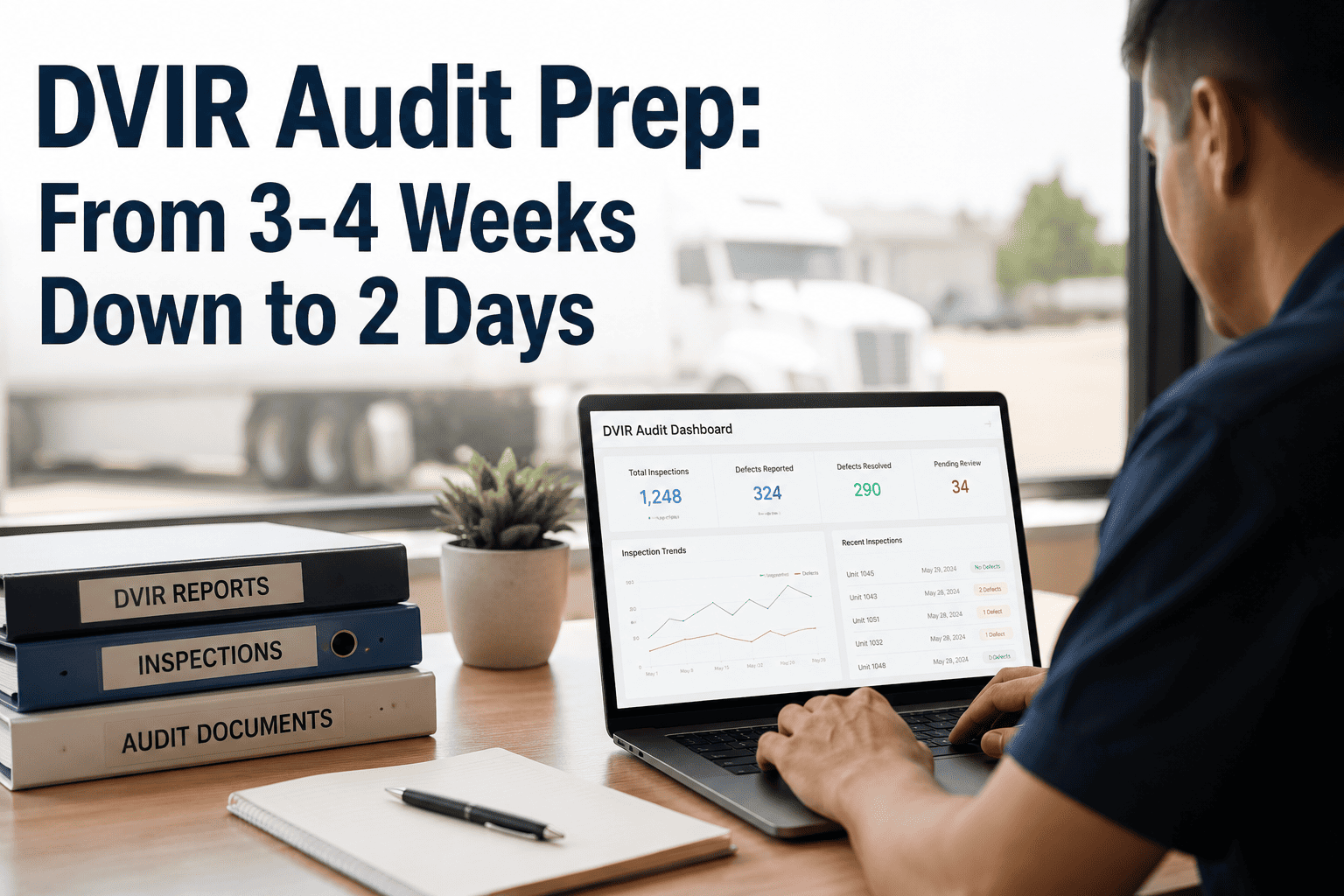
A DOT audit request for Driver Vehicle Inspection Reports typically arrives with less than 48 hours of notice, demanding records spanning 90 days to a full year — and the difference between a clean pass and a conditional rating often comes down to how fast you can produce a complete, unbroken certification chain. Paper-based fleets spend 3–4 weeks pulling files from yard cabinets, reconciling mechanic notes against driver signatures, and reconstructing evidence that may already be lost or mismatched. Digital DVIR fleets using Oxmaint compress that same response to roughly 2 hours by linking every defect, photo, GPS timestamp, and repair certification into a single exportable record. You can Start Free Trial today or read on to see exactly how the three-part audit prep workflow works.
Can your fleet answer a DOT audit request in 48 hours — without reconstructing a single signature?
For paper-DVIR operations the honest answer is no: retrieval alone runs 3–4 weeks, and broken certification chains surface only when it's too late to fix them. Digital DVIR fleets close the same audit response in 2 hours to 2 days, with every supporting record already linked and exportable.
A 48-hour window is not enough time to rebuild 90 days of paper
When the audit letter arrives, the clock starts immediately. Auditors typically request DVIR records covering a specific 90-day window, but they can legally ask for 6–12 months of history depending on the investigation scope.
For a 120-truck operation still running paper DVIRs, a single audit request means pulling roughly 10,800 individual inspection forms (120 vehicles × 90 days), cross-referencing each driver signature against employment records, and matching mechanic repair certifications stored in a separate cabinet. In practice, 8–12 percent of paper DVIR chains arrive broken: a driver signed but the mechanic didn't certify, a defect note exists with no corresponding repair order, or a form simply went missing between yard and office. Each break is a potential violation the auditor will flag — and by the time you find it, you're already past the deadline.
What a 3-week audit prep actually costs — and what 2 days looks like instead
The gap between paper and digital DVIR systems is not incremental. It is the difference between a project that consumes three full-time weeks and a task that finishes before lunch.
| Audit Response Factor | Paper DVIR Fleet | Digital DVIR (Oxmaint) |
|---|---|---|
| Record retrieval time | 3–4 weeks across multiple yards | 2 hours to 2 days, single dashboard |
| Signature certification chain | Reconstructed manually, often broken | Digitally linked, immutable, time-stamped |
| Supporting evidence (photos, GPS) | Rarely attached, stored separately | Embedded in each DVIR record |
| Repair-to-defect linkage | Cross-referenced by hand from mechanic logs | Auto-linked from defect note through certification |
| Audit export format | Manual PDF compilation or physical binders | One-click FMCSA-formatted PDF or CSV |
| Broken-chain exceptions visible | Discovered during the audit itself | Surfaced year-round on compliance dashboard |
| Labor cost per audit response | ~$4,800–$7,200 in staff time | Under $200 in staff time |
The cost figure is conservative: a compliance manager earning $32/hour spending three full weeks on audit retrieval alone accounts for roughly $3,840 — and that excludes the dispatcher, yard lead, and mechanic time spent locating and validating forms. A single conditional rating can also push insurance premiums up 12–18 percent for a mid-size fleet, turning a paperwork problem into a recurring six-figure cost.
Three layers that make audit prep a non-event
Audit readiness in a digital-DVIR fleet is not something you build when the letter arrives. It is a byproduct of how records are created, monitored, and exported every other day of the year.
Ongoing hygiene at the point of creation
The CMMS enforces DVIR completion operationally — a driver cannot close a trip without submitting the inspection, and a mechanic cannot close a defect without certifying the repair. Records are complete the moment they're created, never reconstructed at audit time. The certification chain builds itself.
Standing audit-ready reporting
A live compliance dashboard shows current DVIR completion rate, chain-break exceptions, and any records that fall short of audit standards. Issues are visible 365 days a year — not on the day an auditor requests evidence. You fix gaps in real time, not under deadline pressure.
Audit response toolkit
Pre-built export formats exist for FMCSA audit requests, insurance auditor requests, and litigation discovery requests. The response is a few clicks, not a project. Every DVIR-related record for the specified date range exports with all supporting evidence attached in FMCSA-required format.
A 180-tractor regional fleet cut audit prep from 22 days to 4 hours
Before switching to Oxmaint, this fleet's safety manager spent 22 working days assembling a single 6-month DVIR audit response — pulling forms from three yard locations, reconciling 9,700 driver signatures against HR records, and manually matching 1,400 repair orders to defect notes. Roughly 11 percent of chains arrived broken.
What the 2-day audit response actually looks like, hour by hour
A digital-DVIR audit response is not just faster — it follows a predictable sequence that any safety manager can execute without overtime, outside help, or crossed fingers.
Audit notice received
DOT requests DVIR records for a 90-day window. Safety manager logs into Oxmaint instead of driving to the yard.
Dashboard review and exception triage
Compliance dashboard confirms 99.4 percent DVIR completion for the requested range. Three chain-break exceptions are identified and resolved with linked repair records before export.
FMCSA-formatted export generated
One-click export produces a PDF containing every DVIR in the date range, each with driver signature, GPS/timestamp, defect photos, mechanic certification, and repair order linked.
Response delivered, audit passes clean
Records submitted well within the 48-hour window. Auditor finds no broken chains, no missing certifications, no unmatched defects. Fleet retains a Satisfactory rating.
The real cost of staying on paper another year
Fleets often delay digital DVIR adoption because "paper has always worked." The math tells a different story — especially once you factor in audit labor, conditional ratings, and insurance impact.
Staying on paper DVIRs
- − 3 audit responses × $4,800 labor each
- − 11 percent broken-chain violations per audit
- − 12–18 percent insurance premium uplift risk
- − 3 weeks of safety manager downtime per audit
Switching to Oxmaint digital DVIR
- + 3 audit responses × under $200 labor each
- + Zero broken chains — certification enforced at creation
- + Insurance documentation ready on demand
- + Safety manager freed for proactive work
The audit letter used to mean three weeks of panic and overtime. Now it means fifteen minutes of clicking export. That's not an incremental improvement — it's a different operating model.
DVIR audit prep — what fleets actually ask
How quickly can Oxmaint produce records after a DOT audit request?
Most audit exports complete within 15 minutes of the request. The safety manager filters the compliance dashboard to the requested date range, reviews any chain-break exceptions flagged by the system, and clicks export. The output is an FMCSA-formatted PDF or CSV containing every DVIR with signatures, GPS timestamps, photos, and linked repair certifications attached.
What happens if the auditor asks for 6–12 months of DVIR history?
The response time is the same whether the request covers 90 days or 12 months. Every DVIR is stored in searchable digital format from the moment it's created, so a wider date range simply means more records in the same export — not more retrieval time. You can Start Free Trial and test a 12-month export yourself before your next audit.
Can Oxmaint handle multiple audit request formats — FMCSA, insurance, litigation?
Yes. The audit response toolkit includes pre-built export formats for FMCSA compliance audits, insurance underwriter requests, and litigation discovery. Each format packages the same underlying DVIR records with the evidence structure required by that specific request type, so you're not rebuilding the export from scratch for each audience.
How does the system prevent broken certification chains in the first place?
The CMMS enforces completion at the operational level. A driver cannot close a trip without submitting the DVIR, and a mechanic cannot close a defect ticket without certifying the repair and linking it back to the original inspection. The chain builds itself as work happens — it is never reconstructed after the fact from separate paper records.
What if my fleet is mid-transition from paper to digital — can I import old records?
Historical paper DVIRs can be scanned and attached to the corresponding vehicle and date in Oxmaint, though they won't carry the same immutable chain-of-custody metadata as digitally native records. Most fleets run a 30–60 day parallel period; from the cutover date forward, every new DVIR is audit-ready by default. Book a Demo to see the import workflow.
Stop rebuilding DVIR records under a 48-hour deadline
Oxmaint makes every DVIR audit-ready the day it's created — with full chain of custody, GPS evidence, and one-click FMCSA-formatted exports. Your next audit response should take minutes, not weeks.
Free 14-day trial · No credit card






.png)