Failing a DOT or FMCSA safety audit does not happen because of one catastrophic mistake — it happens because dozens of small documentation gaps, expired records, and missed inspection cycles accumulate invisibly until an auditor surfaces them all at once. FMCSA civil penalties for HOS violations reach $16,000 per incident, and a CSA Vehicle Maintenance BASIC score above the 65-point intervention threshold follows your carrier authority for 24 months. This annual fleet safety audit checklist covers every category FMCSA, DOT, and OSHA reviewers examine — driver qualification files, vehicle inspection records, HOS compliance, maintenance documentation, and safety program governance. If you want a platform that keeps all of it audit-ready automatically, Sign Up Free and see how Oxmaint manages DOT compliance documentation across your entire fleet. Fleet managers preparing for a formal safety review can also Book a Demo to map their current documentation gaps against FMCSA requirements.
Make Every Audit a Pass — Automatically
Oxmaint keeps DOT, FMCSA, and OSHA compliance documentation current across your entire fleet — DVIRs, driver files, PM records, and inspection certificates all exportable in under 2 minutes.
Section 1 — Driver Qualification Files
CDL License Validity Verification
Confirm every commercial driver holds a valid CDL with appropriate endorsements (HazMat, tanker, doubles/triples) for their assigned vehicle class. Expired or mismatched CDLs are among the most cited DQ file violations in FMCSA compliance reviews.
MVR (Motor Vehicle Record) Annual Pull
FMCSA requires a current MVR for every driver, pulled within the preceding 12 months. Review for disqualifying offenses including DUIs, reckless driving convictions, and suspended license history. Sign Up Free to automate MVR expiration tracking with alerts.
Medical Certificate Currency (DOT Physical)
DOT medical examiner certificates must be current and on file. Drivers with conditions requiring annual examinations must have documentation showing the most recent physical. Certificates from non-FMCSA-registered examiners are non-compliant.
Driver Application and Employment History (3-Year)
Each DQ file must include a completed driver application with a verified 3-year employment history and a 10-year commercial driving history. Missing verification signatures or gaps in employment history are common audit findings.
Annual Review of Driving Record
49 CFR 391.25 requires an annual review of each driver's driving record, with a signed certification that the review was completed. The reviewing supervisor's signature and date must be documented and retained in the DQ file.
Road Test Certificate or Equivalent
Document confirming the driver completed and passed a road test administered by the carrier, or a certificate of road test from a prior employer accepted in lieu. Must be vehicle-class specific — a van road test does not cover Class 8 operations.
Pre-Employment Drug Test Results
Federal clearinghouse query results and pre-employment drug screen results must be retained. Verify that no driver began commercial operations before a negative result was received and documented. Book a Demo to see how Oxmaint indexes DQ file records for instant audit retrieval.
Section 2 — Vehicle Inspection Records & Annual DOT Inspection
Annual DOT Inspection Certificates (49 CFR 396.17)
Every commercial vehicle operated must have a current annual inspection performed by a qualified inspector. Certificates must be on the vehicle or retrievable from fleet records. Inspection date, inspector credentials, and passing status must all be documented.
Daily DVIR (Driver Vehicle Inspection Report) Retention
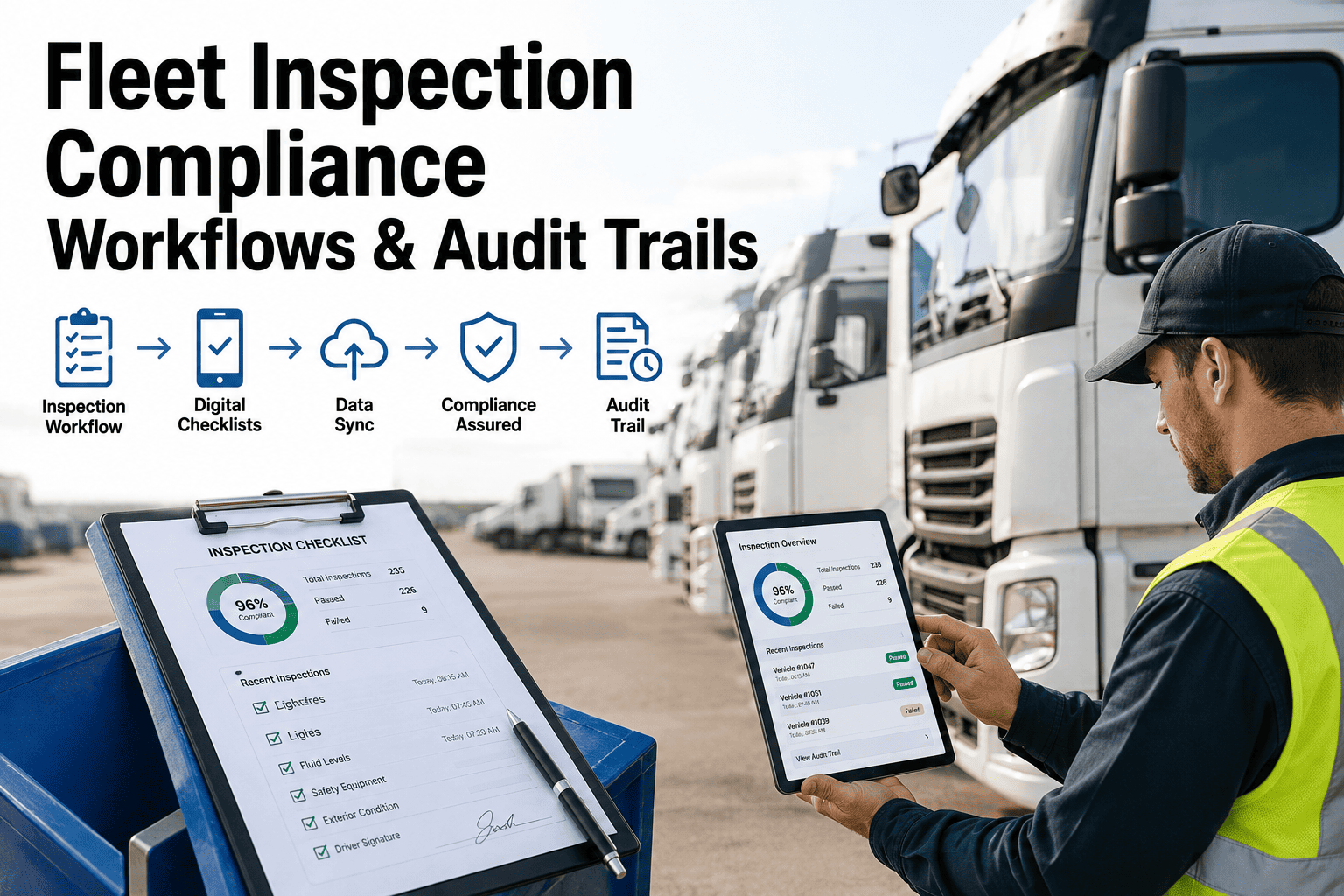
FMCSA requires DVIR records to be retained for a minimum of 3 months. Audit your DVIR archive for completeness — every operating day must have a completed pre-trip and post-trip report. Digital DVIR via mobile closes the gap that paper logs leave.
Defect Documentation and Repair Certification
Any defect noted on a DVIR must have a corresponding repair record and a mechanic's certification that the repair was completed before the vehicle returned to service. Gaps between a reported defect and a documented repair are high-severity audit findings.
Brake System Inspection Documentation
Brake adjustment and lining wear records must be current. Out-of-adjustment brakes are the leading cause of DOT out-of-service orders. Verify that brake inspection intervals meet 49 CFR Part 393 specifications for your vehicle classes and gross vehicle weights.
Tire and Wheel Inspection Logs
Document tread depth checks, inflation pressure logs, and sidewall condition inspections. For regulated vehicles, tire condition records demonstrate that vehicles were not operated with tires below federal minimums — a critical defense in post-accident litigation and roadside inspections.
Lighting and Reflector Compliance Check
All required lighting equipment — headlamps, brake lights, turn signals, clearance lamps, and retroreflective sheeting — must be functional and documented as inspected. Lighting violations are consistently among the top 5 roadside inspection violations cited by FMCSA. Sign Up Free to digitize inspection checklists with photo evidence capture.
Section 3 — Hours of Service (HOS) & ELD Compliance
ELD Mandate Compliance Verification
Confirm all vehicles requiring ELDs under 49 CFR 395.8 are equipped with FMCSA-registered devices. Verify the ELD provider remains on the FMCSA registered device list — registrations can be revoked. Paper or AOBRD systems are non-compliant for most operations.
HOS Violation Review — 60/70-Hour Rule Adherence
Pull 6-month HOS data and audit for 60-hour/7-day or 70-hour/8-day cycle violations. Review for false log entries, duty status manipulation, and off-duty time authenticity. Each qualifying HOS violation carries civil penalties up to $16,000.
Sleeper Berth and 30-Minute Break Documentation
Verify that sleeper berth split provisions are applied correctly and that 30-minute break requirements are documented where applicable. Incorrect application of HOS exemptions is a common auditor finding that turns partial compliance into full violations.
HOS Exemption Documentation
Short-haul, agricultural, and construction-zone exemptions must be documented with the exemption basis clearly noted in driver records. Operating under an exemption without documentation negates the exemption and creates violations retroactively.
Supporting Documents Retention (Fuel Receipts, Toll Records)
FMCSA requires retention of supporting documents that verify ELD duty status entries for 6 months. Fuel receipts, toll records, dispatch records, and customer delivery receipts must be indexed and matched to corresponding log periods. Book a Demo to see Oxmaint's compliance document indexing.
Section 4 — Preventive Maintenance & Maintenance Record Audit
PM Schedule Compliance Documentation
49 CFR 396.3 requires carriers to systematically inspect, repair, and maintain all vehicles. Your maintenance records must demonstrate a written PM schedule and evidence of adherence. Missed PM intervals without documentation are treated as missing compliance, not late compliance.
Complete Maintenance History Per Vehicle (12 Months Minimum)
Each unit must have a retrievable maintenance record showing all services, repairs, and inspections completed in the past year. Auditors look for continuity — a vehicle with 3 months of records but 9 months of operation has a gap that requires explanation.
Work Order Completion and Mechanic Certification
Every repair work order must include the date, technician identifier, parts used, labor performed, and a certification that the repair meets federal safety standards. Digital work orders with technician sign-off create a defensible audit trail that handwritten tickets cannot match.
Out-of-Service Vehicle Return-to-Service Documentation
Any vehicle placed out of service — by a roadside inspector, an internal mechanic, or a DVIR defect — must have a documented return-to-service certification before re-entering operations. Missing return-to-service records are automatic violations if the vehicle was operated.
Odometer and Engine Hours Tracking Continuity
PM intervals triggered by mileage require documented odometer readings at each service. Gaps or inconsistencies in mileage tracking — particularly when telematics data contradicts paper service records — raise credibility issues during audits. Sign Up Free to connect telematics feeds directly to Oxmaint maintenance records.
Third-Party Repair Vendor Documentation
Work performed by outside vendors — tire shops, dealerships, roadside repair services — must be captured in your maintenance records. Invoices alone are insufficient; the repair scope, parts replaced, and return-to-service status must be indexed against the vehicle's compliance file.
Section 5 — Drug & Alcohol Program Compliance
Random Testing Program Documentation and Pool Records
FMCSA requires a minimum 50% random drug testing rate and 10% alcohol testing rate annually. Document your testing consortium membership, random selection methodology, and percentage of drivers tested. Failure to meet minimum rates is a standalone violation independent of individual test results.
Federal Drug Clearinghouse Query Records
Annual limited queries must be run for all CDL drivers through the FMCSA Drug and Alcohol Clearinghouse. Full queries must be run at hiring. Retain query results and driver consent records. Clearinghouse non-compliance is increasingly the first item FMCSA auditors check.
Return-to-Duty Protocol Documentation
Any driver who tested positive must complete a Substance Abuse Professional (SAP) evaluation, comply with the RTD program, and pass a return-to-duty test before resuming safety-sensitive functions. Each step must be documented and retained in the driver's compliance file.
Supervisor Reasonable Suspicion Training Certificates
All supervisors who oversee CDL drivers must have documented reasonable suspicion training — at minimum 60 minutes on drug recognition and 60 minutes on alcohol misuse recognition. Training certificates must be current and retained. Book a Demo to see how Oxmaint tracks training certification expiration for your entire team.
Section 6 — OSHA Fleet Safety & Workplace Compliance
OSHA 300 Log and Recordkeeping Compliance
Fleet operations with 11 or more employees must maintain OSHA 300, 300A, and 301 records. Audit your injury and illness recordkeeping for completeness — omitted recordable incidents and late entries are independently citable. The 300A summary must be posted February through April annually.
Hazard Communication (HazCom) Program and SDS Availability
Maintenance shops must have a written HazCom program, a current SDS library for all chemicals in use, and documented employee training. SDS for fuels, lubricants, solvents, and battery chemicals must be accessible at the point of use — not only in a binder in the office.
Lockout/Tagout (LOTO) Procedures for Fleet Maintenance
Written LOTO procedures for each type of energy-isolating maintenance task performed on fleet vehicles must be documented and available. OSHA 1910.147 compliance requires machine-specific procedures, authorized employee lists, and documented annual inspections of LOTO procedures.
Personal Protective Equipment (PPE) Assessment and Training Records
A written PPE hazard assessment must document the hazards present in your maintenance environment and the controls selected. Employee PPE training records — including the specific PPE covered and the date of training — must be retained per OSHA 29 CFR 1910.132.
Accident Investigation Records and Corrective Action Documentation
OSHA expects evidence of a systematic accident investigation process. Each recordable incident must have a root cause analysis and documented corrective actions. FMCSA also reviews accident register entries for the preceding 12 months during compliance reviews — align both records. Sign Up Free to centralize incident reporting and corrective action tracking in Oxmaint.
Section 7 — Fleet Safety Program Governance
Written Fleet Safety Policy — Current and Signed
A documented fleet safety policy signed by executive leadership demonstrates organizational commitment and provides the governance framework auditors expect to see. Policies should cover HOS, distracted driving, incident reporting, vehicle inspection obligations, and drug and alcohol prohibitions.
CSA BASIC Score Monitoring and Corrective Action Records
Review your current CSA BASIC scores across all seven categories. Document any scores approaching or above intervention thresholds and the corrective actions underway. FMCSA auditors treat elevated scores as evidence of systemic non-compliance — your response plan must be in writing.
Driver Safety Training Records — Annual Refresher Documentation
Annual safety training records — defensive driving, cargo securement, hazmat handling where applicable, and distracted driving policy review — must be signed by each driver and retained. Training content must be documented, not just attendance. Book a Demo to see Oxmaint's compliance training tracking module.
Vehicle Registration and Operating Authority Currency
Confirm that USDOT number registration is current and that MC authority (where required) is active. Audit registration and apportioned plate expiration dates for all vehicles. Operating under lapsed authority or with expired registrations invalidates your insurance coverage for incidents during that period.
Insurance Compliance Documentation — MCS-90 and BMC-91
Minimum financial responsibility filings must be current and accessible. The MCS-90 endorsement must reflect current coverage limits for your hazard classification. Verify that your insurer's filings with FMCSA are active — a lapse in the insurer's filing, not just your policy, creates a compliance gap.
Audit-Ready in Under 2 Minutes — Every Time
Oxmaint stores driver qualification files, vehicle inspection records, DVIR archives, maintenance histories, and compliance certificates in one indexed platform. When FMCSA calls, your complete audit package is ready before they finish the first question.
Frequently Asked Questions
How often does FMCSA conduct compliance reviews for motor carriers?
FMCSA can initiate a compliance review at any time, triggered by elevated CSA BASIC scores, roadside inspection patterns, accident involvement, or complaints. New entrant carriers face a mandatory compliance examination within 12 months of receiving operating authority. Conducting an annual internal audit against this checklist keeps you perpetually review-ready.
What is the difference between a DOT compliance review and an FMCSA safety audit?
A DOT compliance review is a comprehensive examination of all safety management practices, records, and driver/vehicle compliance — it results in a safety fitness rating. An FMCSA new entrant safety audit is specifically for carriers in their first 18 months of operation and focuses on whether safety management systems exist. Both require the same core documentation this checklist covers.
How long must vehicle maintenance records be retained under FMCSA regulations?
Under 49 CFR 396.3, inspection, repair, and maintenance records must be retained for the period the vehicle is in operation and for 1 year thereafter. Annual inspection records must be retained for 14 months. Driver qualification files must be retained for 3 years after the driver leaves the company. Oxmaint maintains retention schedules automatically.
Can Oxmaint generate the documentation package needed for an FMCSA compliance review?
Yes. Oxmaint exports complete compliance packages — vehicle maintenance histories, DVIR archives, inspection certificates, driver file summaries, and PM schedule adherence reports — in under 2 minutes from any device. Carriers using Oxmaint report 100% documentation completion rates during FMCSA reviews.
What are the highest-risk areas that cause fleets to fail DOT safety audits?
The four most common causes of unsatisfactory safety ratings are: incomplete or expired driver qualification files, missing DVIR or defect repair documentation, HOS violations or ELD non-compliance, and inadequate vehicle maintenance records demonstrating a systematic inspection program. This checklist addresses each category in sequence.
Does OSHA have jurisdiction over commercial fleet operations?
Yes. OSHA covers fleet maintenance facilities, loading and unloading operations, and worker safety in any fleet-related workplace activity. DOT regulates the vehicle and driver on the road; OSHA regulates the workplace environment where maintenance and operations personnel work. Both agencies may be present in a comprehensive fleet safety audit.
Stop Managing Compliance Manually — Start Your Free Trial
Oxmaint automates DOT inspection scheduling, digital DVIR capture, PM compliance tracking, driver file expiration alerts, and CSA score monitoring — everything on this checklist, managed in one platform. No manual tracking. No missed deadlines. No audit surprises.

-compliance-checklist.png)