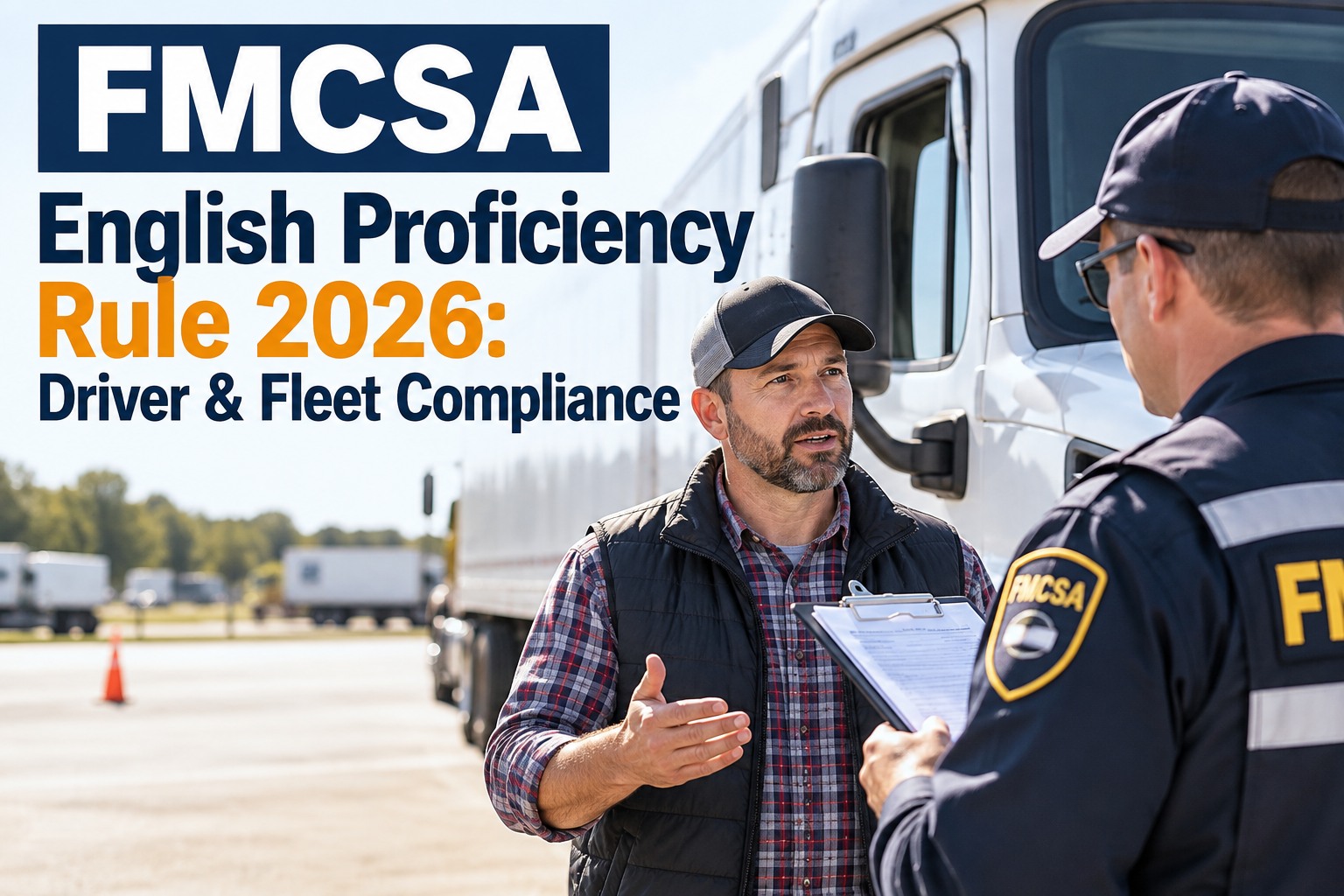
The fleets getting caught out by FMCSA's English Language Proficiency enforcement aren't the ones with unqualified drivers — they're the ones who never checked before the roadside did. With ELP now an out-of-service condition and enforcement operations running nationwide in 2026, the difference between a clean inspection and a stranded load is preparation done weeks earlier. This guide is a readiness playbook: how to self-assess your fleet, prepare drivers for the two-step roadside test, train where there are gaps, and keep the proof on file. It also shows how OXMAINT AI tracks ELP readiness per driver, with a live demo.
FMCSA Compliance · ELP Readiness · Fleet Preparation · 2026
FMCSA ELP Roadside Enforcement 2026: Fleet Preparation Guide
Enforcement is live and it's an out-of-service condition — but a driver stopped at the roadside is a preparation failure that happened weeks earlier. OXMAINT AI tracks ELP readiness per driver, flags the gaps before an inspector does, and keeps your verification on file — so you prepare once instead of scrambling every stop.
Self-assess
→
Prepare drivers
→
Train the gaps
→
Document & stay ready
Ready before the roadside
ELP readiness scored per driver
Gaps flagged before inspection
Verification & training on file
Fleet-wide readiness at a glance
~500
drivers OOS in one 3-day Jan 2026 operation
Live
nationwide OOS enforcement, since Jun 2025
2 steps
the roadside test to prepare for
Weeks
before a stop is when readiness is won
First: Score Your Fleet's ELP Readiness
You can't prepare what you haven't measured. Before anything else, run every driver against the four things the roadside test checks — the same four duties in 49 CFR 391.11(b)(2). Green on all four is ready; any red is a gap to close now, not at the roadside. Start free and score each driver's ELP readiness in OXMAINT.
01
Can converse with the public in English
Basic job-related conversation — not fluency, functional communication.
Interview
02
Understands U.S. highway signs & signals
Regulatory, warning and guide signs — plus electronic message boards.
Sign test
03
Responds to official inquiries in English
Answers an inspector or officer directly, without a translation aid.
Interview
04
Makes legible entries on records
Logs, inspection reports and paperwork completed in English.
Records
The standard is functional communication, not fluency — and ELP is a driver-qualification requirement the carrier is responsible for verifying. Score honestly now so the roadside only confirms it.
Prepare Drivers for the Two-Step Roadside Test
Drivers prepare best when they know exactly what's coming. The roadside assessment is two steps, and no translation aids are allowed — interpreters, I-Speak cards, cue cards, smartphone apps and phone interpretation are all prohibited. Walk each driver through both steps before they ever face one. Book a demo to see readiness tracked per driver.
Step 1 · Prepare for
The Driver Interview
The inspection opens in English. Expect questions about the driver, the trip, cargo, duty status and documents. Practice answering these directly in English — a driver who reaches for a phone app to respond will not pass.
Prep: rehearse trip / cargo / HOS / document questions in English, no aids.
Step 2 · Prepare for
Highway Sign Recognition
If the interview is passed, the inspector shows common U.S. traffic signs — including dynamic electronic message boards, per the FHWA's MUTCD — and asks the driver to identify and explain each. Practice with the real sign catalog, not guesswork.
Prep: drill regulatory, warning & guide signs plus message-board text.
Not allowed during the test — so don't let drivers rely on them
Interpreters
I-Speak cards
Cue cards
Smartphone apps
Phone interpretation
A translating passenger
Preparation Is Cheaper Than a Stranded Load.
An out-of-service order strands the freight, dents the carrier's CSA profile, and can lead to driver disqualification. All of it is avoidable weeks earlier — a readiness score, a little targeted practice, and the verification on file. OXMAINT AI tracks ELP readiness per driver and flags the gaps before an inspector finds them, so preparation becomes routine instead of a fire drill.
Train the Gaps — Practically
Where the readiness score shows red, close it with focused, respectful practice — not a one-size test. Functional communication improves fastest when it's built around the actual roadside situation. Here's where to put the effort. Sign up free and log training against each driver's file.
Roadside Conversation Practice
Run mock interviews using real inspector-style questions about the driver, trip, cargo and documents — answered in English, without aids.
MUTCD Sign Drills
Work through the federal sign catalog by category — regulatory, warning, guide — plus dynamic message-board phrasing drivers meet on the road.
Records & Paperwork in English
Practice completing logs, inspection reports and required entries legibly in English, so the fourth duty isn't the one that trips a driver up.
Dispatch Early-Warning Habits
Train dispatchers to notice and document communication difficulty in daily contact — the earliest signal a driver needs more prep.
Know the Stakes You're Preparing Against
Preparation only feels worth it when the downside is clear. An ELP failure at the roadside isn't a warning anymore — it stops the driver and follows the carrier. This is what you're preparing to avoid. Book a demo to see OOS events logged per driver.
Immediate Out-of-Service
The driver is stopped at the roadside and can't operate until the situation is resolved.
Stranded Load
Freight sits until recovery is arranged — lost time, recovery cost, a missed delivery window.
CSA Score Impact
The violation lands on the carrier's safety profile, raising inspection and audit exposure.
Possible Disqualification
When warranted, FMCSA can move to disqualify the driver from interstate commerce.
The Fleet Readiness Checklist
Pull it together into a repeatable routine. These six steps take a fleet from "hope no one gets stopped" to "ready, and able to prove it." OXMAINT AI holds each as a tracked record so readiness doesn't decay between audits. Sign up free and build this checklist into your DQ workflow.
1
Score every driver against the four ELP duties and flag any gaps.
2
Verify at qualification and document it in the driver's DQ file.
3
Prepare drivers for both steps of the roadside test — no reliance on aids.
4
Train the gaps with mock interviews and MUTCD sign drills.
5
Track inspection outcomes per driver so a citation never repeats blind.
6
Keep proof current and stay on top of guidance and border-zone changes.
Where OXMAINT AI Fits: Readiness You Can Prove
Preparation only counts if you can show it — a readiness score, a verification, a training record, an inspection history. OXMAINT AI keeps all of it per driver, so your fleet is ready before enforcement arrives and can prove it the moment it does. Sign up free and get your first drivers on file.
Per-Driver Readiness Score
Each driver scored against the four ELP duties, so you see who's ready and who needs prep — before a roadside stop makes the call for you.
ELP Verification on Record
Document that each driver's proficiency was assessed at qualification, retrievable in seconds when an auditor or inspector asks.
Training & Prep Log
Record mock interviews, sign drills and refreshers against the driver, so gap-closing is tracked, not just intended.
Roadside Inspection Tracking
Log every inspection and outcome per driver, so citations and OOS events are visible and trend over time.
Fleet-Wide Readiness View
Safety leadership sees readiness and inspection status across every terminal on one screen — no folder-by-folder hunt.
Audit-Ready Export
Pull a driver's full compliance and readiness record on demand — the evidence a DOT audit or new-entrant review asks for.
"
We stopped treating ELP as something that happens at the roadside and started treating it as something we prepare for. We scored every driver in OXMAINT, ran mock interviews and sign drills for the handful who needed it, and logged all of it against their files. When enforcement operations ramped up, we weren't nervous — we already knew where every driver stood, and we could prove it. That shift from reacting to being ready is the whole point.
Director of Safety & Compliance · Regional Carrier
Frequently Asked Questions
How do I prepare my fleet for FMCSA ELP enforcement?
Score every driver against the four ELP duties, verify and document proficiency at qualification, prepare drivers for both steps of the roadside test without translation aids, train where there are gaps, and keep the proof on file. Preparation happens weeks before a stop, not at it.
What does the roadside English test involve?
A two-step assessment: a driver interview in English about the driver, trip and cargo, then — if that's passed — a highway-sign recognition check using MUTCD signs and electronic message boards. Fail the interview and the inspector stops there. No interpreters, apps or cue cards are allowed.
Does a driver have to be fluent in English?
No — the standard is functional communication, not fluency. A driver must hold a basic conversation, understand and respond to roadside officials, read standard U.S. traffic signs, and make legible entries on records. Prepare drivers to that bar, not to perfection.
Can driver training prevent ELP out-of-service orders?
Targeted practice helps drivers meet a functional standard they may already be close to — mock roadside interviews and MUTCD sign drills build exactly the skills the assessment checks. Pair training with verification at qualification so readiness is both improved and documented.
How does OXMAINT help a fleet stay ready?
It scores ELP readiness per driver, logs verification and training against each file, tracks every roadside inspection outcome, and shows fleet-wide readiness on one view — so gaps surface before an inspector finds them and your preparation is provable on demand.
Be Ready Before Enforcement Arrives.
A stopped truck is a preparation gap that showed up weeks late. Score readiness, prep drivers and keep the proof in OXMAINT AI — so the roadside only confirms what you already know. Start free — no credit card, unlimited users.