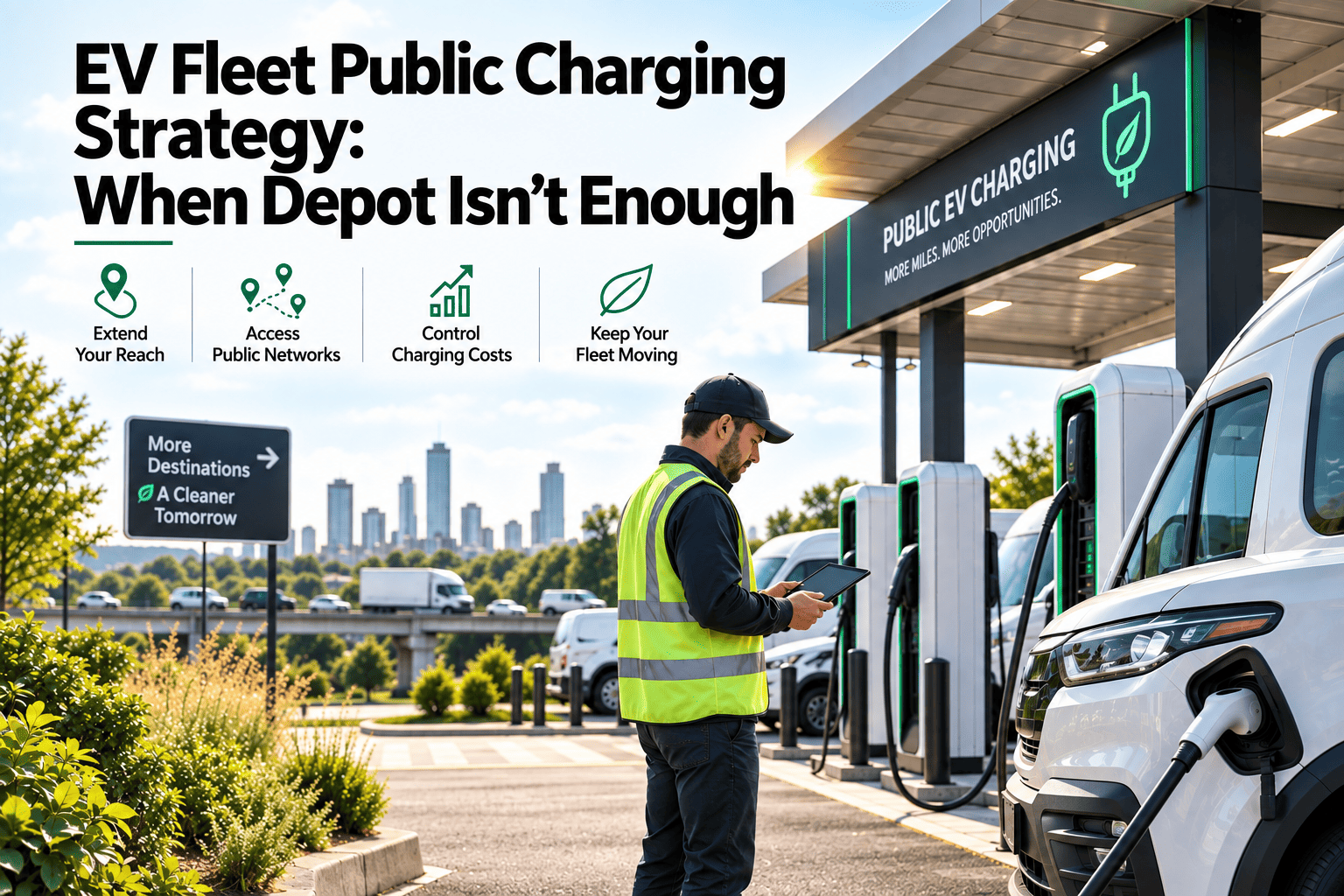
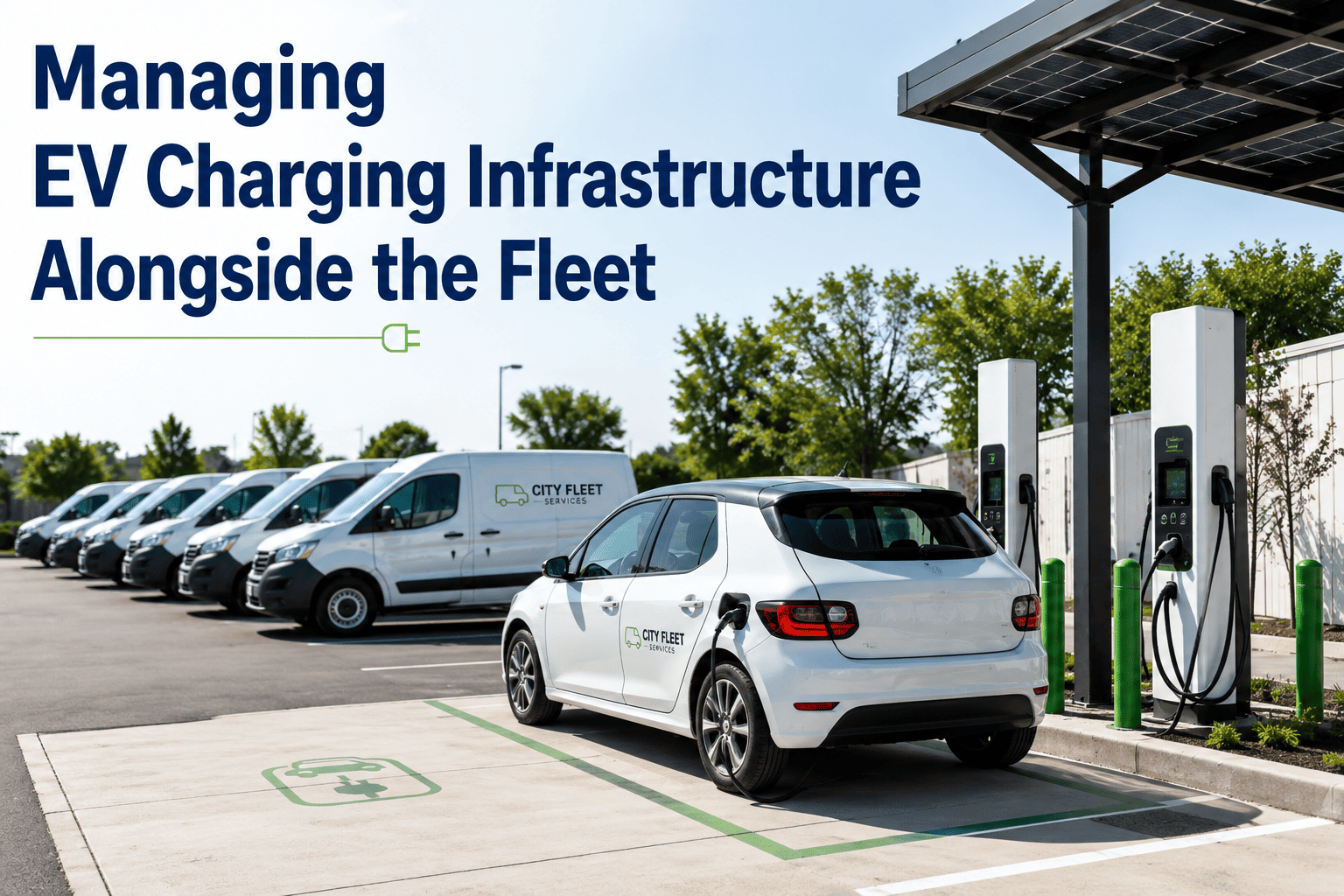
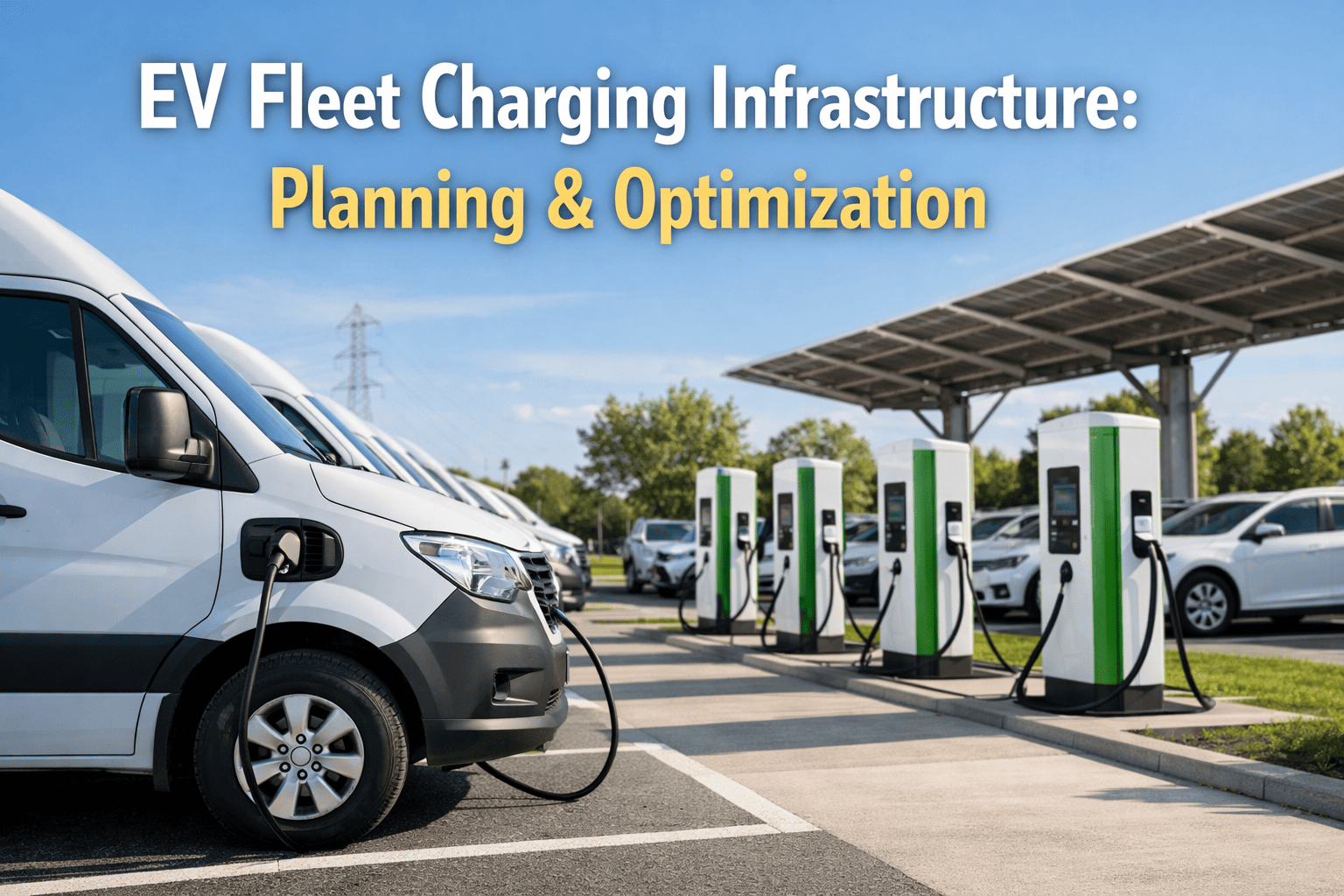
Planning and deploying EV charging infrastructure for a commercial fleet in 2026 is one of the most consequential capital decisions a fleet operator will make this decade — and most organizations are making it without a structured framework. The variables are genuinely complex: depot layout constraints, utility service capacity, demand charge exposure, charging speed requirements by vehicle class, software integration with fleet management systems, and the incentive landscape that can reduce net infrastructure cost by 30-70% depending on jurisdiction and application timing. Fleet operators who deploy charging infrastructure without addressing all of these variables simultaneously discover the problems in sequence — an undersized transformer that costs $180,000 to upgrade after installation, demand charges that add $2,400 per month to operating costs that were never modeled, or charger placement that creates depot flow bottlenecks during shift changes. Fleet organizations using integrated platforms like OxMaint that connect EV charging infrastructure management to work order tracking, preventive maintenance scheduling, and asset lifecycle documentation are avoiding the reactive cost spiral that hits fleets managing charging infrastructure as an afterthought. A properly planned charging infrastructure deployment pays back its total installed cost in fuel and maintenance savings within 3.8 years at current diesel prices — but only when the planning process is rigorous enough to avoid the hidden cost traps that derail poorly structured implementations. Want to see how OxMaint manages fleet EV infrastructure maintenance alongside your broader asset portfolio, start a free trial or book a demo.
EV Fleet Charging Infrastructure Planning 2026
The complete framework for planning and deploying depot EV charging infrastructure for commercial fleets — covering site assessment, charger selection, utility coordination, smart charging software, demand charge management, and incentive capture that reduces net installation cost by up to 70%.
Phase 1 — Fleet Load Assessment: How Much Power Does Your Depot Actually Need?
Every charging infrastructure deployment starts with a load calculation — and most get it wrong by modeling peak demand incorrectly. The common mistake is multiplying vehicle count by charger kilowatt rating and assuming that is the required service capacity. The actual required capacity depends on your charging window, vehicle dwell time, and how charging sessions overlap during shift changes.
A fleet of 30 light-duty EVs averaging 80 miles per day at 0.35 kWh/mile requires 840 kWh of daily charging capacity. This is the energy floor — but it does not define power requirements. Whether you deliver that 840 kWh over 8 hours or 12 hours determines whether you need 105 kW or 70 kW of simultaneous charging capacity.
A demand factor of 0.6-0.75 reflects that not all vehicles charge simultaneously at full rate due to battery state variations and charging session staggering. Smart charging software lowers the demand factor further — allowing more vehicles to charge from the same service capacity by throttling individual session power during peak periods.
Charger Selection: Matching Level to Fleet Operation Type
Not every fleet needs DC fast charging. The right charger level is determined by your vehicle dwell time — how long vehicles sit at the depot between routes. Selecting the wrong level wastes capital on charging speed you cannot use, or creates range deficits when dwell time is insufficient for slower charging. Here is the decision framework for each fleet operation type.
Ideal for fleets with 8-12 hour overnight dwell periods — urban delivery vehicles, school buses, utility fleets. A 19.2 kW Level 2 charger delivers 60-115 miles of range per hour, sufficient to fully charge most light-duty EVs during a standard overnight window at a fraction of DCFC installed cost.
Fleets running two daily shifts with 4-6 hour midday or overnight dwell windows. Smart-managed Level 2 at 11.5 kW delivers 30-45 miles of range per hour — adequate for typical urban route mileage when vehicles return to depot predictably between shifts. Requires smart charging software to prioritize vehicles by departure time.
Required when vehicle dwell time is under 90 minutes or when route mileage demands daily charging above the Level 2 delivery window. A 150 kW DCFC delivers 150-400 miles of range per hour depending on vehicle acceptance rate. Demand charges are the critical cost variable — smart charging and utility time-of-use rates must be actively managed to avoid $3,000-$8,000 monthly demand peaks.
Depots operating both light-duty and medium-duty EVs with varied dwell times benefit from a mixed charging architecture — Level 2 for the majority of vehicles with overnight dwell, plus 1-2 DCFC ports for priority charging of vehicles that return outside the overnight window or require rapid turnaround. This architecture minimizes demand charge exposure while providing operational flexibility.
Utility Coordination: The Step Most Fleets Get Wrong
Utility coordination is the longest lead-time item in any depot charging deployment — and the most commonly underestimated. Service upgrades, transformer replacements, and new service applications can take 6-18 months from application to energization depending on utility queue depth and local grid conditions. Starting the utility process after equipment selection is the single most common cause of EV fleet deployment delays.
Contact your utility's commercial or large-load team before finalizing any charging equipment specifications. Request a pre-application meeting to discuss your projected peak demand, potential service upgrade requirements, and available rate structures. Most utilities offer EV fleet rate riders with reduced demand charges during off-peak charging hours — but these must be enrolled proactively.
Request a written service capacity assessment from the utility confirming available amperage at your service entrance and the upgrade path required to support your projected peak load. This document is essential for permit applications, incentive applications, and accurate cost modeling. Without it, you are guessing at one of the largest cost variables in your infrastructure budget.
Most commercial utilities offer time-of-use rates with significantly lower energy charges during off-peak hours — typically 9 PM to 6 AM. Shifting 80% of fleet charging to off-peak windows reduces energy cost per mile by 35-55% compared to unmanaged daytime charging. Smart charging software automates this shift — your utility pre-application is the opportunity to confirm the rate structure and calculate the savings potential.
Over 180 US utilities now offer commercial EV fleet programs including make-ready infrastructure contributions, demand charge waivers during enrollment periods, and managed charging incentives. Pacific Gas and Electric, Southern California Edison, Xcel Energy, and Duke Energy all offer programs that can reduce net infrastructure cost by $5,000-$25,000 per charging port before federal and state incentives are applied.
Demand Charge Management: The Hidden Cost That Kills EV Fleet ROI
Demand charges are billed based on your peak 15-minute power draw during the billing month — and unmanaged fleet charging creates exactly the kind of sharp, simultaneous power spikes that trigger maximum demand charges. A depot where 20 vehicles return from morning routes and plug in simultaneously at noon creates a demand spike that can add $2,000-$4,500 to the monthly utility bill — recurring every month regardless of how efficiently the fleet operates the rest of the time.
| Charging Scenario | Peak 15-Min Demand | Monthly Demand Charge | Annual Demand Cost |
|---|---|---|---|
| 20 vehicles plug in simultaneously at shift return (unmanaged) | 280 kW peak | $3,920 at $14/kW | $47,040 |
| Smart charging with 15-minute staggered session starts | 145 kW peak | $2,030 at $14/kW | $24,360 |
| Smart charging with overnight off-peak scheduling (80% of fleet) | 68 kW peak | $952 at $14/kW | $11,424 |
| Smart charging + battery energy storage buffer | 42 kW peak | $588 at $14/kW | $7,056 |
Demand charge rates vary by utility and rate structure. The $14/kW rate used above is representative of mid-range commercial demand charges in the US. Some utilities charge $8/kW — others exceed $22/kW in high-cost markets. Confirm your utility's demand charge rate during the pre-application meeting and model demand charge exposure as a primary line item in your infrastructure ROI calculation.
Smart Charging Software: What It Does and What to Require
Smart charging software is not optional for commercial fleet deployments — it is the mechanism that converts a charging infrastructure investment from a cost center into a managed, optimized operational system. Here is what fleet-grade smart charging software must do, and the specific capabilities that separate adequate platforms from genuinely useful ones. OxMaint integrates with smart charging platforms to provide unified asset management across your entire fleet infrastructure — see how the integration works by booking a demo or starting a free trial.
Automatically distributes available depot power across active charging sessions based on vehicle priority, departure time, and current state of charge. Prevents demand spikes by throttling individual session power when aggregate depot load approaches the configured demand threshold.
Accepts vehicle departure schedules from fleet dispatch and calculates the optimal charging start time and rate for each vehicle to reach required state of charge before departure — without charging earlier than necessary. This maximizes off-peak charging utilization while guaranteeing operational readiness.
Provides dispatcher and fleet manager visibility into every active and queued charging session — current state of charge, projected completion time, charger status, and session energy delivery. Identifies charger faults, communication failures, and vehicles not achieving expected charge rate before they affect morning vehicle readiness.
Bidirectional data exchange between smart charging software and fleet management or CMMS platforms — pushing charger fault alerts into maintenance work order queues, syncing vehicle charging history to vehicle maintenance records, and triggering preventive maintenance tasks based on charging cycle counts or battery thermal events.
2026 Incentive Landscape: Reducing Net Infrastructure Cost by Up to 70%
The combined federal, state, and utility incentive stack available for commercial EV charging infrastructure in 2026 is the most favorable it has ever been — but capturing the full stack requires coordinating multiple application processes simultaneously, with strict timing requirements relative to construction start dates. Missing the application window for a single incentive tier can cost $15,000-$80,000 in foregone funding.
Covers 30% of qualified EV charging equipment purchase and installation costs for commercial properties in low-income or non-urban census tracts. Properties outside qualifying census tracts receive 6%. Bonus rates apply for prevailing wage compliance during installation. Claimed on federal corporate tax return for the year installation is placed in service.
NEVI funding flows through state DOTs to eligible applicants — primarily public-facing fast charging along designated Alternative Fuel Corridors. Commercial depot charging is not typically eligible, but fleet operators serving public transportation or providing charging access to third parties may qualify under community charging provisions. Application through your state DOT NEVI coordinator.
EPA's Clean School Bus Program provides up to $375,000 per electric school bus plus associated charging infrastructure for qualifying school districts. DERA grants fund heavy-duty fleet replacement and charging infrastructure for municipal, tribal, and nonprofit fleet operators. Both programs accept applications through EPA's SmartWay portal with annual grant cycles.
California (HVIP), New York (NYSERDA), Colorado (CDOT), Washington (WSDOT), and 22 additional states offer commercial fleet charging incentives ranging from equipment rebates to interest-free financing for make-ready infrastructure. California's HVIP also provides vouchers of $95,000-$150,000 per heavy-duty electric vehicle purchased — stackable with federal Section 30C and utility program incentives.
Charging Infrastructure Maintenance: The Operational Layer That Gets Ignored
Charging infrastructure is physical equipment that degrades, fails, and requires preventive maintenance — but most fleet electrification plans treat chargers as set-and-forget installations. A depot with 30 charging ports where 4 are offline at any given time due to maintenance backlog effectively has 13% less charging capacity than planned — directly impacting vehicle readiness for morning dispatch. OxMaint manages EV charging infrastructure as tracked assets with PM schedules, fault work orders, and lifecycle cost documentation alongside your broader fleet and facility asset portfolio. Start a free trial or book a demo to see the charging asset PM workflow.
Visual inspection of charging connectors for physical damage, pin corrosion, and cable jacket wear. High-frequency connection cycles — commercial chargers average 4-8 connect/disconnect cycles per day — accelerate connector wear. Damaged connectors that pass voltage but fail communication cause session authentication failures that appear as charger faults in smart charging software.
Infrared inspection of electrical terminations within the charging unit enclosure, distribution panel, and service entrance. Loose terminations under high-current EV charging loads generate thermal signatures that precede arc faults and equipment damage. DCFC units operating at 100-150 kW are particularly vulnerable to termination heating under continuous commercial load cycles.
OCPP protocol updates, charger firmware patches, and cybersecurity updates require scheduled application and post-update functional testing. Unpatched charger firmware is an increasing cybersecurity exposure for commercial depot charging networks — firmware vulnerabilities have been exploited to manipulate charging sessions and access fleet management integrations in documented incidents.
Comprehensive testing of actual power delivery versus rated capacity, communication latency with smart charging software, ground fault protection testing, and GFCI breaker operation verification. Documents charger performance degradation over time — useful for warranty claims on units delivering below rated power and for capital planning when charger replacement becomes more economical than continued maintenance.
Infrastructure ROI Summary: What the Numbers Look Like at Scale
The business case for EV charging infrastructure investment becomes quantifiable once all cost and savings variables are modeled accurately. These figures represent a 30-vehicle light-duty commercial fleet at a single depot in a representative US metropolitan market at 2026 energy and diesel prices.
Frequently Asked Questions
How long does a complete depot charging infrastructure deployment take from planning to first vehicle charging?
Should we install more charging capacity than we currently need to accommodate fleet growth?
What OCPP version should we require for commercial depot charging equipment in 2026?
How does OxMaint help manage EV charging infrastructure alongside other fleet and facility assets?
Your Charging Infrastructure Plan Is Only as Good as the Data Behind It
Fleet electrification infrastructure decisions made without accurate load modeling, utility coordination, and incentive capture routinely cost 40-60% more than necessary and deliver operational performance below expectations. OxMaint gives fleet operators the asset management framework to plan charging infrastructure with documented data, maintain it with structured PM schedules, and track its lifecycle cost against the ROI model that justified the investment. Start building your fleet electrification asset management foundation today.