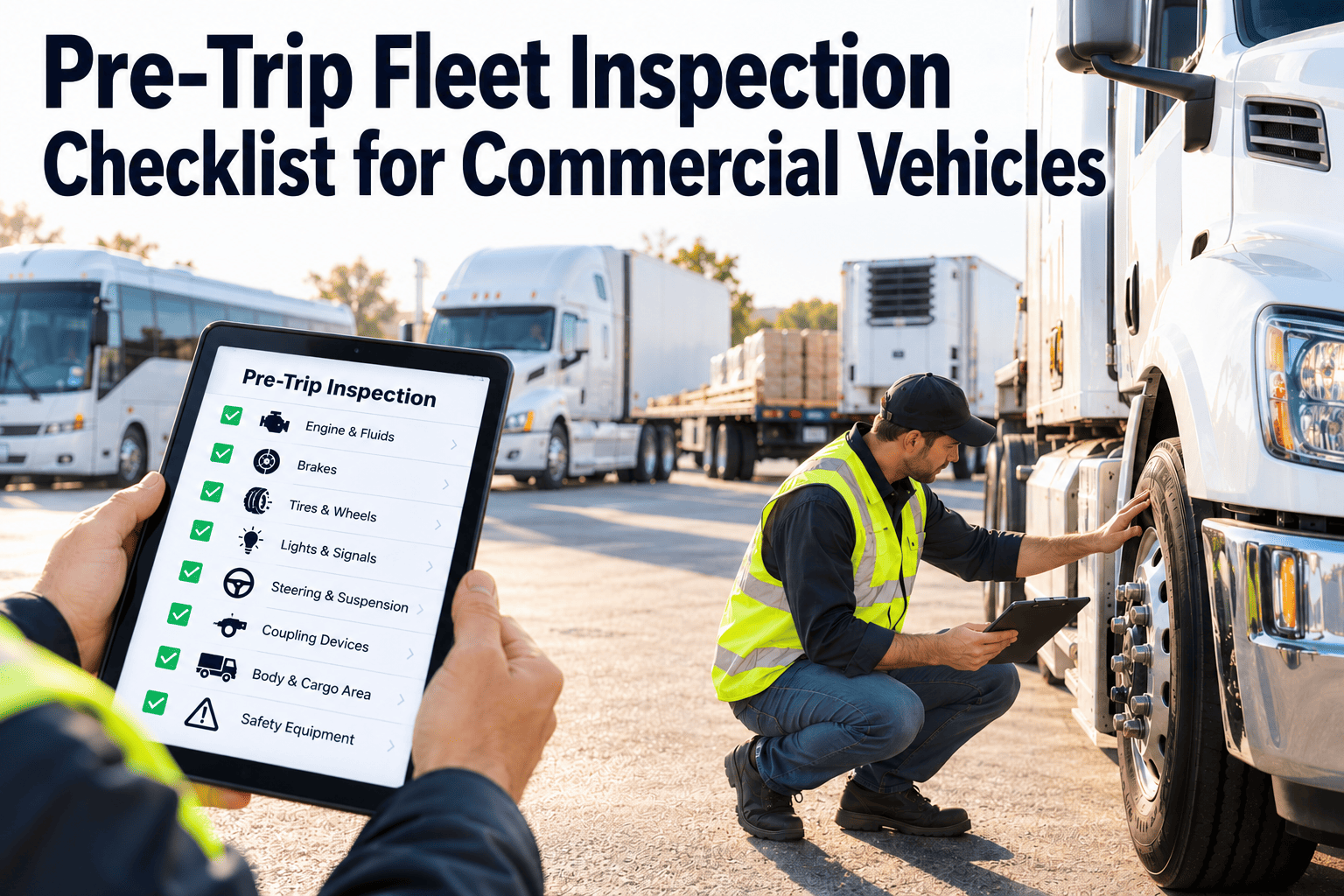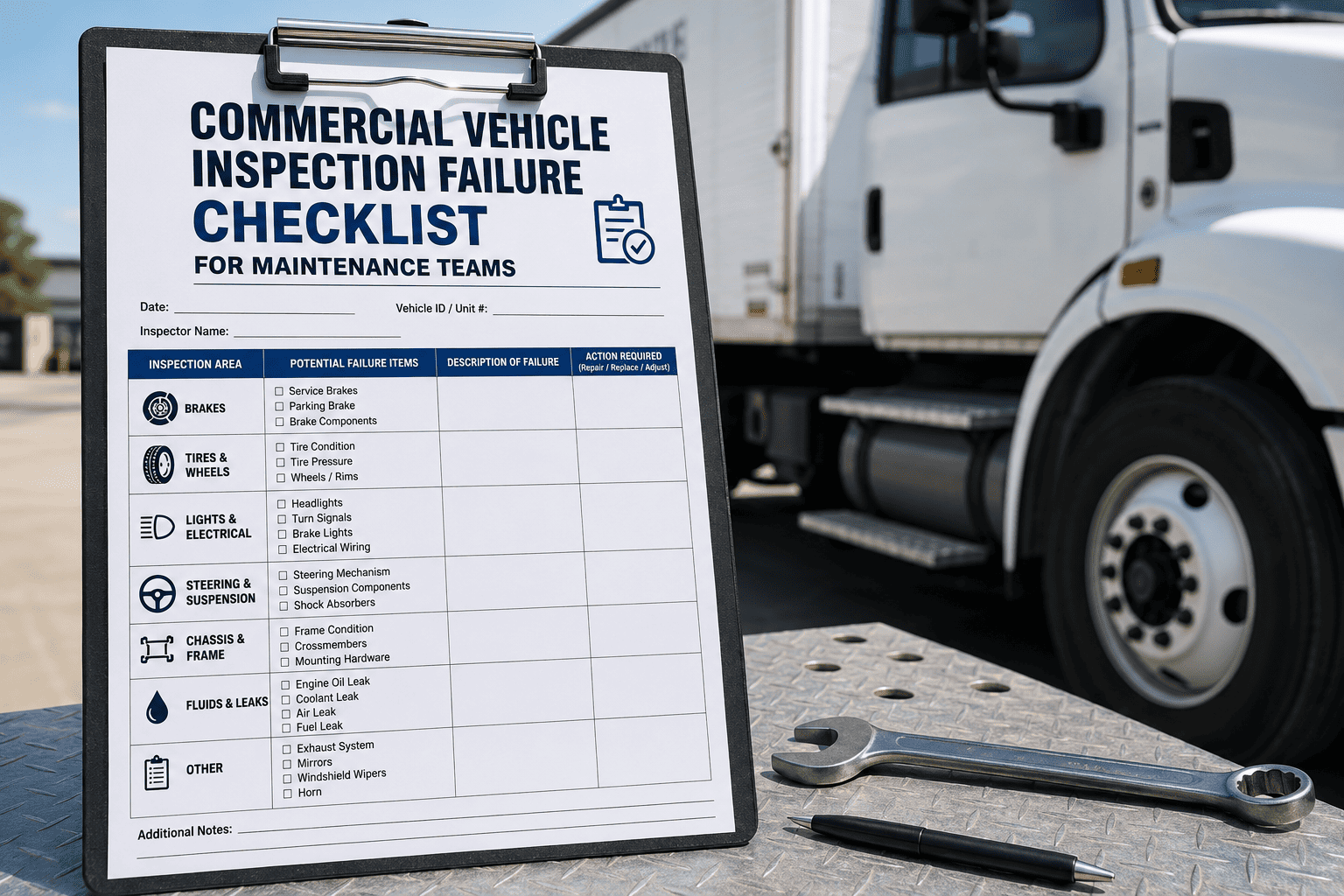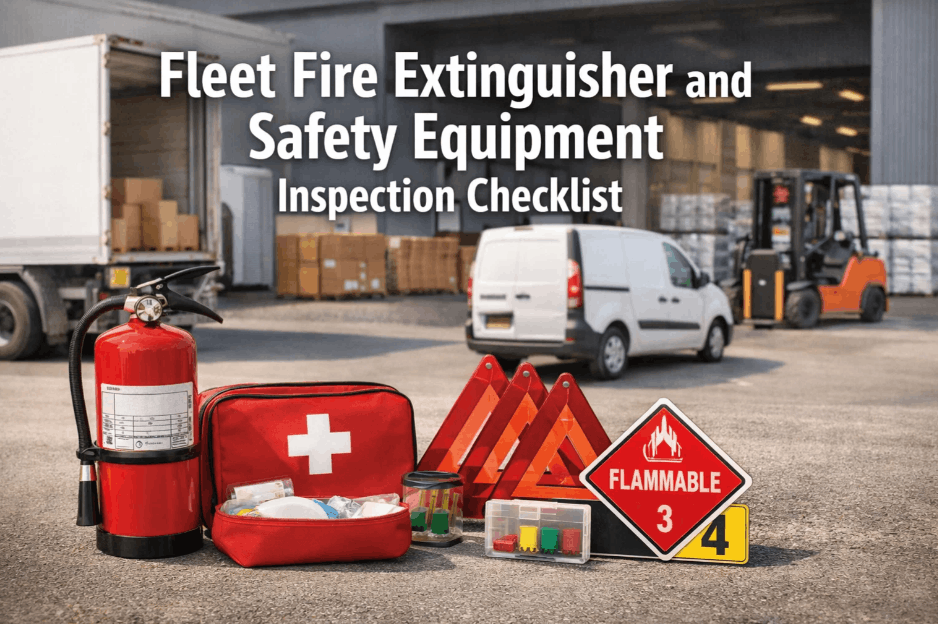
A fire extinguisher that cannot discharge when needed — because the charge has bled below minimum, the pin is corroded, or the agent has compacted — is not safety equipment. DOT §393.95 requires every CMV to carry a serviceable extinguisher, and "serviceable" means the unit's actual condition on the day it is inspected — not just the date on the tag. The same principle applies to every other safety item on the vehicle. Oxmaint tracks safety equipment certification dates, condition findings, and replacement schedules per vehicle — alerting compliance teams 30 days before any item expires.
Required Safety Equipment — Compliance Requirement Matrix
Every CMV has a minimum set of required safety equipment under FMCSA, DOT, and OSHA regulations — and the requirements vary by cargo type, vehicle class, and route type. The matrix below shows which items are required, their regulatory source, inspection frequency, and whether they are OOS conditions at roadside inspection.
Technology Supporting Safety Equipment Compliance
Safety equipment inspections are the most commonly deferred compliance task in fleet operations — because a missing triangle or an expired extinguisher tag does not cause a breakdown and is invisible until a roadside inspection. Three technologies make safety equipment tracking automatic, verifiable, and exception-driven. Oxmaint connects all three into one safety equipment compliance workflow.
1. Fire Extinguisher Inspection Checklist
A serviceable fire extinguisher under DOT §393.95 means the unit is charged, accessible, has an unbroken tamper seal, and is mounted securely. A unit that meets all four criteria on paper but has been bouncing in a broken bracket for 6 months may have compacted agent that prevents discharge. Record extinguisher inspection results and certification dates in Oxmaint per vehicle.
Pressure gauge — needle in green zone
Any reading outside the green zone (over- or undercharged) requires immediate service — the unit is not serviceable. OOS — out of green zone
Safety pin — present and tamper seal unbroken
A broken tamper seal indicates prior discharge or tampering — service the unit before the vehicle is dispatched. OOS — broken seal
Annual certification tag — within 12 months
An expired certification tag is an enforcement defect even if the gauge reads green — professional service is required annually. Defect — expired tag
Nozzle and hose — undamaged and unobstructed
Any crack, split, or blockage in the nozzle or hose makes the unit inoperable when it matters most — replace on any defect. Defect — cracked or blocked nozzle
Body and cylinder — corrosion, dents, and physical damage
Any dent, corrosion through the casing, or physical damage to the cylinder body requires immediate withdrawal from service. OOS — structural damage
Mounting bracket — secure, correct position, and accessible
The unit must be in a secure bracket within easy driver reach — if it takes more than 5 seconds to access, it will not be retrieved in a cab fire. Defect — loose or inaccessible mount
Rating — 5 BC minimum for standard CMV, 10 BC for flammable cargo
Verify the unit's BC rating on the label meets the §393.95 minimum for the vehicle type and cargo being carried. OOS — below required rating
Agent compaction — invert and shake the unit
Dry chemical extinguishers compact from vibration — invert and firmly shake to verify agent flows freely before returning to the bracket. Defect — compacted agent
AI Camera tip: Oxmaint's AI-assisted inspection scans the extinguisher gauge and certification tag through the cab camera during the pre-trip walkaround — flagging low pressure or expired tags before the driver signs off, without requiring the technician to physically handle every unit on every vehicle. See Oxmaint's AI-assisted safety equipment scan.
2. Warning Triangles, Fuses and Emergency Equipment Checklist
Warning triangles, spare fuses, and emergency equipment are the items most commonly missing or incomplete at roadside inspection — because they are rarely used and infrequently checked. An FMCSA inspector does not care that the triangles were there last year. Track warning triangle condition and spare fuse inventory in Oxmaint per vehicle.
Three warning triangles — present, undamaged, and complete set
All three reflective triangles must be present — a set of two is an OOS condition. Verify all legs are straight and the reflective surface is clean and undamaged. OOS — fewer than 3 triangles
Triangle reflectivity — clean and fully retroreflective
Dirty or faded reflective surfaces that no longer retroreflect are non-compliant — clean with soapy water or replace. Defect — non-reflective surface
Spare electrical fuses — one of each rating used in the vehicle
FMCSA §393.95(g) requires one spare fuse for each ampere rating used in the vehicle — not just a general assortment. Verify against the fuse panel legend. Defect — missing rated fuse
First aid kit — stocked with unexpired contents
Open the kit and verify all dressings, gloves, and medications are within their expiry date — an expired first aid kit is a defect. Restock all used or expired items at every annual service. Defect — expired contents
Seat belts — all positions functional and undamaged
Test every seat belt latch for positive engagement and verify the webbing is free of cuts, fraying, or chemical contamination — any damage is an OOS condition. OOS — any damaged belt
Emergency escape hammer and window breaker — fitted and accessible
Where fitted, verify the escape hammer is in its mount and accessible from the driver's seated position without unbuckling. Defect — missing or inaccessible
3. Hazmat Placarding and Documentation Checklist
Hazmat placarding violations are among the most serious CMV enforcement actions — carrying federal fines up to $93,933 per violation per day. A placard that does not match the cargo class, a placard that is unreadable, or a placard missing entirely when the load threshold is exceeded are all equal violations under 49 CFR Part 172. Link hazmat documentation and placard requirements to vehicle records in Oxmaint.
Placard class matches cargo manifest — verified before departure
The placard class and UN number must match the shipping document before the vehicle moves — incorrect placarding is an OOS condition with no grace period. OOS — class mismatch
Placard condition — readable, undamaged, and correctly oriented
Placards obscured by dirt, bent so the class is not visible, or upside down are all enforcement violations — clean or replace before dispatch. OOS — unreadable placard
All four sides placarded — front, rear, and both sides of vehicle
49 CFR §172.516 requires placards on all four sides of the vehicle and tank — a single missing side placard is the same violation as having none. OOS — missing placard side
Shipping papers — in driver's reach and current for this load
The shipping document must describe the hazmat correctly and be within driver's reach or in a door pocket — an expired or incorrect shipping paper is a separate violation from the placard. OOS — missing or incorrect document
Emergency response guide — 2024 ERG carried in cab
The current edition Emergency Response Guide must be carried in the cab during hazmat transport — an outdated edition is acceptable but the current edition is best practice. Defect — missing or outdated ERG
Hazmat endorsement — driver HME current on CDL
Verify the driver's CDL includes a current, unexpired HME (Hazmat Endorsement) before any hazmat dispatch — an expired HME is an OOS condition for the driver. OOS — expired HME
Digital Twin tip: Oxmaint's vehicle digital twin records all safety equipment certification dates, placard sets assigned to each vehicle, and first aid kit restock history — sending 30-day advance alerts for every expiry date so no safety item falls out of compliance between scheduled PM inspections. Book a demo to see Oxmaint's safety equipment compliance tracking.
We received three roadside citations in one quarter for fire extinguisher issues — expired tags and a missing tamper seal. After implementing Oxmaint's safety equipment tracking with automatic 30-day expiry alerts, our compliance team catches every issue in the workshop. We've had zero safety equipment citations in the 14 months since deployment.
Frequently Asked Questions
The most common questions from safety and compliance teams about fire extinguisher requirements, hazmat placarding, and DOT safety equipment enforcement.
5 BC for most CMVs. 10 BC is required for vehicles carrying flammable liquids or gas and for buses. The rating must appear on the unit's label — a unit without a readable rating label is non-compliant regardless of its actual capacity.
Annually by a certified fire equipment service company — this is the minimum under most state and federal requirements. Monthly driver or technician inspections are also required to verify gauge pressure, tamper seal, and physical condition between annual services.
Missing warning devices is an OOS condition under §393.95 — the vehicle cannot proceed until compliant emergency warning devices are provided. The driver also receives a violation that contributes to the carrier's CSA Vehicle Maintenance BASIC score.
When a vehicle carries a hazardous material in a quantity that meets or exceeds the reportable quantity under 49 CFR §172.504. Specific materials require placarding regardless of quantity — check the Hazardous Materials Table for each commodity carried. Placards must be displayed before the vehicle leaves the shipper's facility.
One spare fuse of each ampere rating used in the vehicle's electrical system — not a generic assortment. Map your fuse panel, identify every unique amperage rating, and carry one spare of each. A missing fuse of any specific rating is a defect.
Oxmaint maintains a complete safety equipment inventory per vehicle — extinguisher certification date, triangle count, fuse set status, first aid kit restock date — generating 30-day advance alerts for every expiry and embedding safety equipment checks into every PM inspection checklist so nothing is missed.