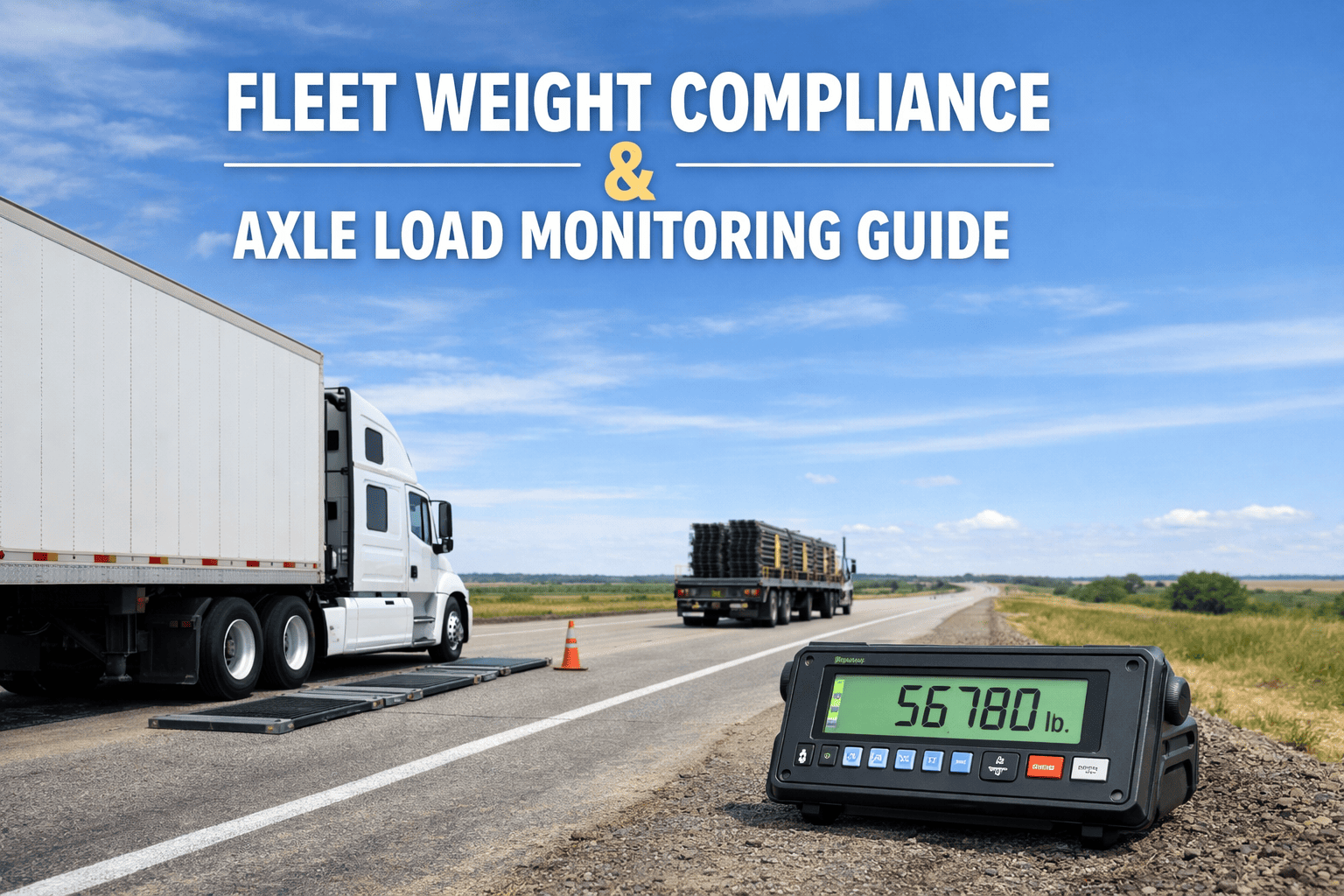
Every overweight violation your fleet receives is the visible end of a chain that starts with a payload decision made at the loading dock, travels through hundreds of miles of route, and ends at a DOT scale with a citation that carries fines, out-of-service orders, and compounding liability exposure. Fleet operators in the USA, Canada, UK, Germany, and Australia face weight compliance requirements that differ by jurisdiction, axle configuration, and road type — and the only way to manage that complexity reliably is through real-time axle load monitoring connected to an AI analytics platform that flags violations before the scale does. Activate OxMaint weight compliance monitoring to convert your payload data into a pre-scale compliance engine — or book a demo to see how AI-powered axle load analytics prevent overweight fines across your entire fleet.
Overweight Fines Start at the Loading Dock — Not at the Scale. OxMaint AI Catches Axle Load Violations Before Your Drivers Hit the Road.
Real-time axle load monitoring, DOT weight limit alerts, payload distribution analytics, and automated compliance documentation — one AI platform that eliminates overweight violations across every vehicle class and every route.
average DOT fine per overweight violation for commercial vehicles exceeding gross weight limits on federal highways
34%
of commercial vehicles inspected at permanent weigh stations receive weight-related citations annually in the USA
$0.01
per-pound overweight cost in some state fine schedules — 2,000 lbs over = $20,000 fine on a single trip
The FMCSA federal gross vehicle weight limit is 80,000 lbs on Interstate highways. Individual axle limits — 20,000 lbs single axle, 34,000 lbs tandem — are routinely exceeded even when gross weight is legal. OxMaint monitors each axle independently, not just total weight. Activate OxMaint to see per-axle load data across your fleet in real time.
Four Compliance Risk Zones OxMaint Monitors Continuously
GVW — Gross Vehicle Weight
Federal & State GVW Limit Monitoring
OxMaint compares live payload sensor data against federal Interstate limits (80,000 lbs USA), state-specific limits, and bridge formula requirements — generating pre-departure alerts when gross weight will exceed the legal limit for the planned route. Drivers see a clear go/no-go indicator before leaving the yard. Activate OxMaint to configure GVW thresholds for your fleet vehicle classes.
Key Analytics Generated
Live GVW vs route-specific legal limit comparison
State-by-state limit database — 50-state USA coverage
Pre-departure compliance alert — stop overweight trips before they start
Overweight trip history log — complete documentation per vehicle
Risk Signals
DOT citation exposure on every overweight mile driven
Vehicle suspension and frame accelerated wear from overloading
Insurance liability amplification — overweight = negligence signal
AXL — Per-Axle Load
Individual Axle Weight Monitoring & Distribution
Gross weight compliance does not guarantee axle compliance. A legally weighted truck can still violate single-axle (20,000 lbs) or tandem-axle (34,000 lbs) limits if cargo is distributed incorrectly. OxMaint monitors each axle independently using onboard load sensors, identifies front-heavy or rear-heavy loading patterns, and generates re-distribution guidance before departure. Book a demo to see per-axle load visualization in OxMaint.
Key Analytics Generated
Per-axle weight reading — steer, drive, and trailer axles independently
Load distribution heat map — front/rear/left/right balance
Bridge formula compliance check — wheelbase-weighted limit calculation
Re-stow guidance — specific load shift recommendation to achieve compliance
Risk Signals
Axle overload when gross weight appears legal — most common violation type
Tire blowout risk from single-axle overloading above rated capacity
Steering instability from front-axle overweight conditions
BRG — Bridge Formula
Bridge Formula Compliance & Route Weight Restriction
The federal Bridge Formula (Formula B) limits axle group weights based on axle spacing to protect infrastructure. Routes with posted weight restrictions — common in spring thaw season across northern USA, Canada, and Germany — require payload adjustment before departure. OxMaint integrates route weight restriction data and calculates Bridge Formula compliance for the specific vehicle configuration and route selected. Activate OxMaint to enable route-specific weight restriction alerts.
Key Analytics Generated
Bridge Formula B calculation per axle group configuration
Posted restriction route flagging — real-time route weight limit data
Seasonal restriction calendar — spring thaw and frost law tracking
Alternative route recommendation when restriction conflict exists
Risk Signals
Bridge damage liability — carrier held responsible for structural damage
Spring restriction violations — fine multipliers in northern states and Canada
Route-specific fines separate from gross weight citations
PLO — Payload Optimization
Payload Optimization & Revenue Load Maximization
Compliance is not just about avoiding overweight — it is about maximizing legal payload on every trip. Fleets that consistently run 5–8% under legal weight limits are leaving significant revenue on every route. OxMaint analyzes historical payload patterns, identifies routes where legal payload capacity is being underutilized, and provides loading guidance that maximizes revenue per trip while maintaining full compliance margin. Book a demo to see payload optimization analytics in OxMaint.
Key Analytics Generated
Payload utilization rate per vehicle and route — % of legal capacity used
OxMaint creates a digital twin of each vehicle — mirroring axle configuration, suspension ratings, and legal weight limits. Load sensor data updates the twin in real time, enabling accurate compliance prediction before the vehicle moves.
OBD-II Integration
Direct OBD-II connection reads suspension air pressure, axle strain gauge data, and load cell outputs — giving OxMaint weight readings without requiring standalone weigh-pad hardware for most modern commercial vehicle configurations.
SAP & ERP Integration
OxMaint connects to SAP TM, Oracle Transportation, and custom ERP systems — pulling manifest data automatically so weight compliance checks run against actual load content, not estimated weights entered by dispatchers.
PLC Dock Integration
Loading dock PLC systems feed real-time load data to OxMaint as cargo is placed on the vehicle. OxMaint tracks running axle weight during loading and signals the dock operator before the next pallet creates a violation.
AI Camera Vision
AI camera systems at loading docks visually verify load placement against the compliance plan — flagging cargo positioned in ways that will create axle imbalance even when total weight appears compliant on the dock scale.
Preventive Maintenance Link
Repeated overloading events automatically trigger suspension inspection work orders in OxMaint CMMS — connecting weight compliance violations to the preventive maintenance schedule before overloading damage becomes a repair bill.
DOT Weight Limits — Quick Reference by Jurisdiction
Jurisdiction
Max GVW
Single Axle
Tandem Axle
OxMaint Coverage
USA (Federal Interstate)
80,000 lbs
20,000 lbs
34,000 lbs
✓ Full monitoring
Canada (National)
63,500 kg
9,100 kg
17,000 kg
✓ Full monitoring
UK (Standard)
44,000 kg
11,500 kg
21,000 kg
✓ Full monitoring
Germany (EU)
40,000 kg
11,500 kg
21,000 kg
✓ Full monitoring
Australia (Standard)
42,500 kg
9,000 kg
16,500 kg
✓ Full monitoring
Violation Risk & Fine Impact Visualization
Citation Share by Vehicle Type
Class 8 Semis — 47%
Tankers — 30%
Flatbeds — 23%
Average Fine by Overweight Amount
1–500 lbs
$1,800
501–2,000 lbs
$5,200
2,001–5,000 lbs
$9,600
5,001–10,000 lbs
$16,000
10,000+ lbs
$25,000+
OxMaint Weight Compliance Workflow — Dock to Scale
01
Dock Loading
PLC dock sensors feed live axle weight to OxMaint as cargo loads
→
02
AI Compliance Check
OxMaint checks GVW, axle limits and Bridge Formula in real time
→
03
Go / No-Go Alert
Driver receives compliance confirmation or specific re-distribution guidance
→
04
Route Monitoring
En-route restriction alerts flag weight-restricted roads before approach
→
05
Compliance Record
Full trip weight log stored automatically for DOT audit documentation
Documented Outcomes — OxMaint Weight Compliance at Fleet Operations
92%
reduction in overweight violations after OxMaint pre-departure axle load monitoring within 60 days
$28,000
average annual fine avoidance per 50-vehicle fleet after OxMaint compliance monitoring deployment
6.2%
average payload utilization improvement — carrying closer to legal maximum without violations after OxMaint optimization
"Before OxMaint, we were guessing at axle weights at the dock. Our first month of real-time monitoring showed three vehicles that would have failed at the scale every week. The system paid for itself in avoided fines within 45 days."
— Fleet Safety Director, 85-vehicle regional distribution fleet, Midwest USA
80,000 lbs
Federal Interstate GVW limit — OxMaint alerts before you exceed it
50
USA state weight limit variations covered in OxMaint route compliance database
8–15%
insurance premium reduction achievable with documented weight compliance program evidence
3×
faster axle and suspension wear from consistently overloaded vehicles vs compliant equivalents
Your next overweight citation is forming at the loading dock right now — not at the scale.
OxMaint AI monitors every axle, every load, every departure — and stops violations before they start.
Does OxMaint require new hardware to monitor axle weights?
Most modern commercial vehicles can use existing OBD-II and suspension air pressure data. For older vehicles, OxMaint supports low-cost load cell integration — no full-scale weigh station hardware required.
How does OxMaint handle state-by-state weight limit differences across a multi-state route?
OxMaint uses the route plan to identify every state crossed and applies the most restrictive applicable limit — alerting dispatch if the planned load would violate any state on the route before the vehicle departs.
Can weight compliance data from OxMaint be used in DOT audits and safety reviews?
Yes. OxMaint generates timestamped, GPS-linked weight compliance records for every trip that serve as structured evidence during DOT safety fitness reviews and CSA audits.
Does OxMaint integrate with SAP or existing fleet management ERP systems?
OxMaint integrates with SAP TM, Oracle, and major fleet ERP platforms — pulling manifest weight data automatically so compliance checks run against real cargo content, not dispatcher estimates.
How quickly do fleets typically see fine reduction after deploying OxMaint weight monitoring?
Most fleets see measurable violation reduction within the first 30 days. Pre-departure compliance alerts stop overweight trips before they reach a scale — delivering immediate fine avoidance from day one.
Every Overweight Trip Is a Fine Waiting to Happen. OxMaint Stops It at the Dock.
AI axle load monitoring. Pre-departure compliance alerts. Full DOT audit documentation.