Motor carriers have carried the English-language requirement in their rulebook for decades but in 2026 it carries teeth. Since mid-2025, a driver who can't satisfy the English standard in 49 CFR 391.11(b)(2) at the roadside can be placed out of service, which makes driver qualification a live compliance exposure, not a filing-cabinet formality. For a motor carrier, the question is simple: can you prove every interstate driver meets the standard, and can you produce that proof on demand? This guide walks the rule, who it covers, how it's checked, and how to build defensible driver-qualification records — with OXMAINT AI, the AI-powered CMMS, holding the documentation behind it.
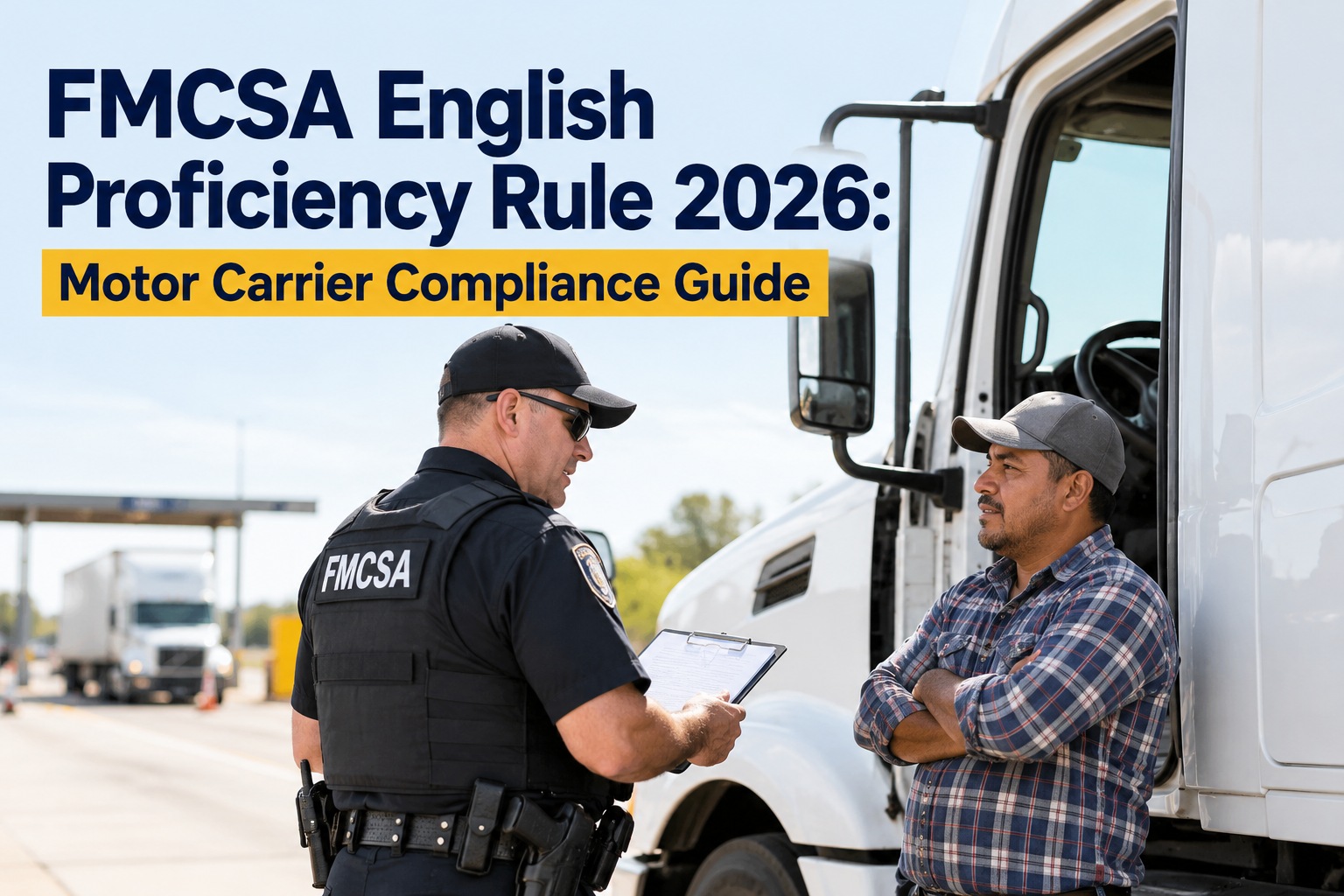
FMCSA English Proficiency Rule 2026: Motor Carrier Compliance Guide
Struggling to prove every interstate driver meets the English standard — and dreading the out-of-service order that follows a failed roadside check? OXMAINT AI keeps driver qualification defensible: DQ files, English-proficiency assessments and inspection history in one platform, tied to each driver and ready to produce for an auditor or an officer at the scale.
The Rule in One Screen
Strip away the noise and the rule is four abilities a driver must have. Everything else — the roadside test, the out-of-service exposure, your DQ file — flows from these. A driver must be able to read and speak English well enough to:
Start free and map these four to each driver's record in OXMAINT AI.
Who the Rule Covers
Not every driver in your yard sits under the same obligation. The 391.11 driver-qualification rules apply to interstate commercial drivers — so the first compliance step is knowing which of your drivers the standard reaches.
Book a walkthrough to segment your roster by obligation in OXMAINT AI.
- Drivers operating commercial motor vehicles across state lines
- Drivers subject to the federal driver-qualification file rules
- New hires and existing drivers alike — the standard is ongoing
- Intrastate-only drivers — state rules may differ from federal
- Specialized operations and exemptions specific to your authority
- Contractors and owner-operators under your motor-carrier number
Scope can turn on your operating authority and state rules. Treat this as a starting map, not a final determination — confirm each driver category against current FMCSA guidance and your state agency. This guide is informational, not legal advice.
How Proficiency Is Checked at the Roadside
Understanding the check is how you prepare drivers for it. Guidance describes a two-part assessment, and a driver who can't complete the first part doesn't move to the second — with no translation aids permitted at any point.
Start free and keep each driver's inspection record in OXMAINT AI.
The precise conduct of the assessment is set by FMCSA guidance and applied by individual inspectors. Use this as the general shape of the check, and verify specifics against current federal guidance before training drivers to it.
Compliance Isn't the Assessment. It's the Record Behind It.
A roadside officer tests the driver; an auditor tests the carrier. What protects your authority is a documented, standardized qualification record for every driver — the file OXMAINT AI keeps tied to each one, ready to produce.
The Driver-Qualification Lifecycle
Motor-carrier compliance isn't a one-time check — it's a lifecycle each driver moves through, and every stage should leave a record. Here's where English proficiency fits, and where the documentation lives.
Book a walkthrough of the DQ lifecycle in OXMAINT AI.
Compliance Readiness: A Quick Self-Check
Run your operation against these. Every "no" is an exposure worth closing before a roadside stop closes it for you.
Start free and turn these into tracked tasks in OXMAINT AI.
Myths vs. Facts
| What some assume | What the rule actually means |
|---|---|
| "This is a brand-new requirement." | The English standard is decades old — what changed in 2025 is that failing it is now an out-of-service violation. |
| "A translation app at the roadside is fine." | Interpreters, apps and cue cards are not permitted during the assessment — the driver must respond in English. |
| "It's only about speaking." | The standard also covers understanding signs and making entries on records — it's a four-part ability. |
| "Passing the CDL exam settles it." | The carrier still has to qualify and document each interstate driver against 391.11(b)(2). |
| "Compliance is the driver's problem." | The motor carrier carries the qualification and documentation burden — and the record follows the carrier. |
Frequently Asked Questions
Make Every Driver's Qualification Provable.
Turn the FMCSA English standard into a documented, defensible part of driver qualification — assessment, DQ files and inspection history in one place with OXMAINT AI, ready for the roadside and the audit alike.