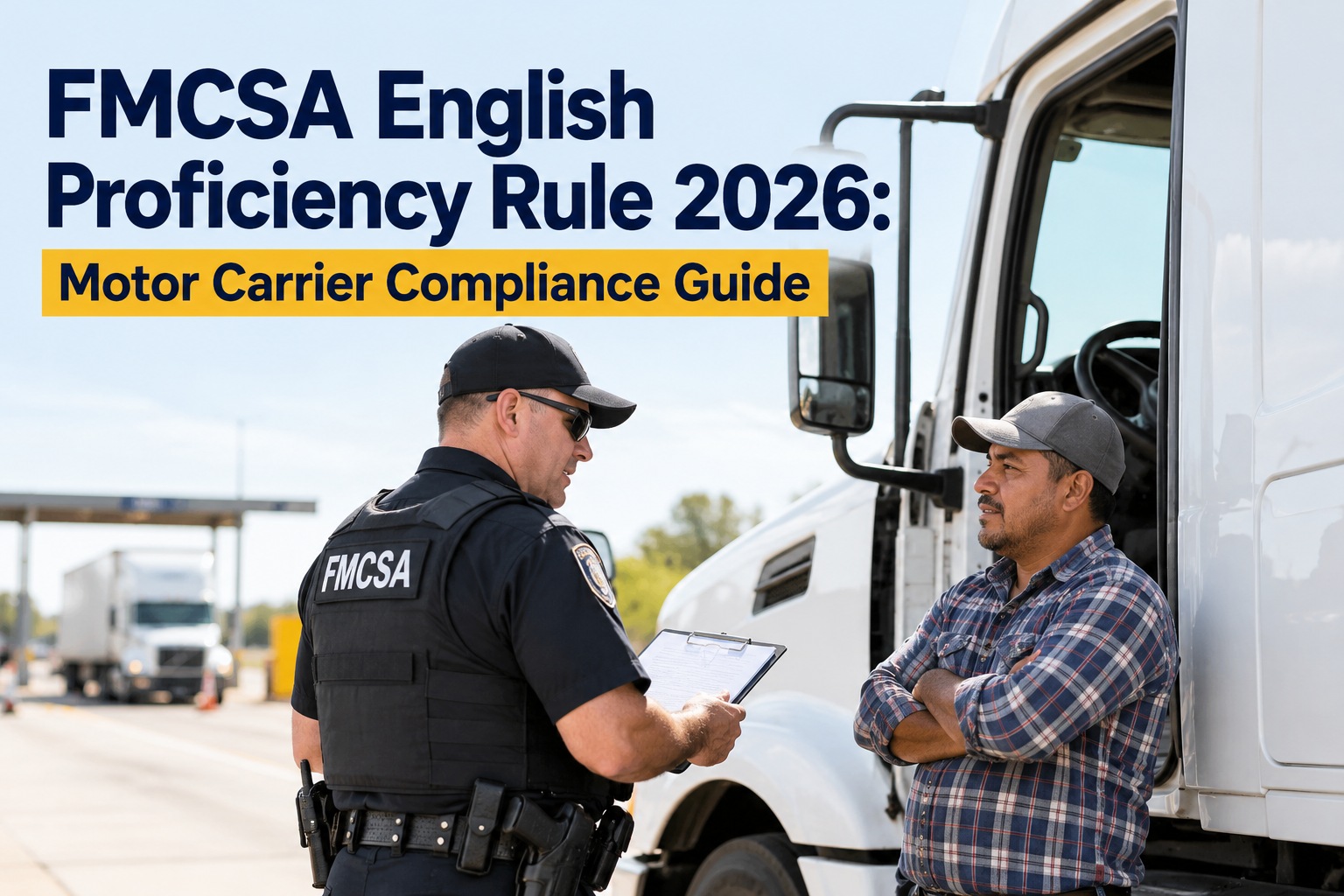
For nearly a decade, an English proficiency violation at a roadside inspection was a citation and little more. That changed on June 25, 2025, when the requirement returned to the out-of-service criteria — and in January 2026, a single three-day enforcement blitz put roughly 500 drivers out of service. A rule that once meant a warning now means a stopped truck and a stranded load. This guide breaks down what 49 CFR 391.11(b)(2) actually requires, how inspectors test it, what triggers an out-of-service order, and how fleets keep driver qualification files audit-ready. See how OXMAINT AI tracks it with a live demo.
FMCSA Compliance · Driver Qualification · ELP Enforcement · 2026
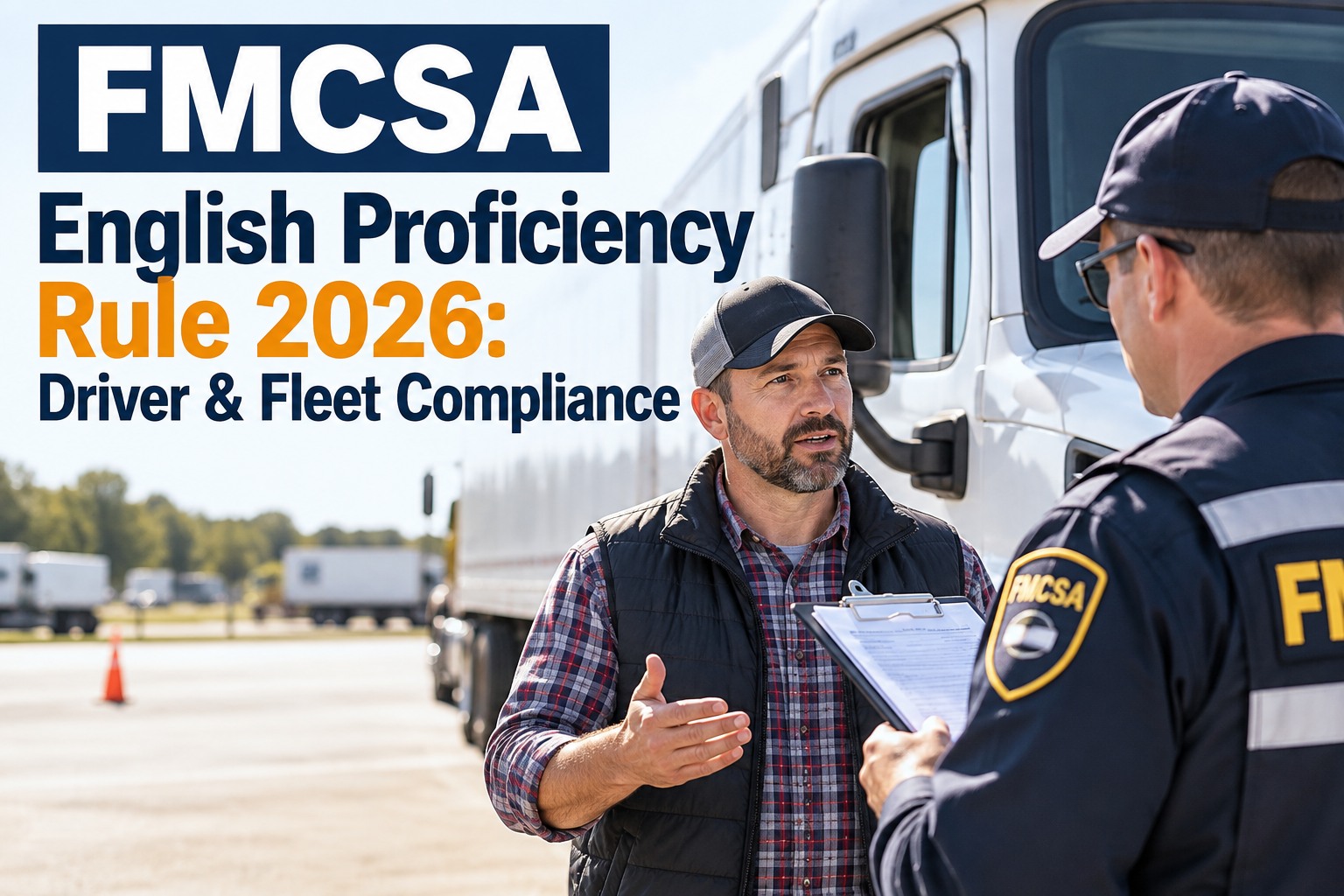
FMCSA English Proficiency Rule 2026: Driver & Fleet Compliance
English Language Proficiency is now an out-of-service violation — and enforcement is active nationwide. The rule itself hasn't changed; the consequence has. OXMAINT AI keeps every driver's qualification file, ELP verification and inspection history in one place, so a roadside stop never becomes a compliance surprise.
Driver qualification
→
ELP verification
→
Inspection tracking
→
Audit-ready DQ file
One record per driver
ELP verification on file, not in a binder
DQ file complete & audit-ready
Roadside inspection history tracked
OOS events logged against the driver
~500
drivers placed OOS in one 3-day Jan 2026 operation
Jun 25 '25
ELP restored to out-of-service criteria
2 steps
to the roadside ELP assessment
1936
the ELP requirement has existed since
What the Rule Actually Requires
The regulation isn't new and it isn't about fluency — it's a functional standard that's been on the books for decades. Under 49 CFR 391.11(b)(2), an interstate CMV driver must read and speak English well enough to do four specific things. Miss any one and the driver isn't qualified. Start free and record ELP verification in each driver's file.
01
Converse with the public
Communicate with the general public in the course of the job.
02
Understand highway signs & signals
Read and interpret U.S. traffic signs — including electronic message boards.
03
Respond to official inquiries
Answer an inspector or law-enforcement officer in English.
04
Make legible entries on records
Complete reports and records — logs, inspection reports, paperwork.
The standard is functional communication, not fluency. A driver must hold a basic conversation, understand roadside officials, read standard signs and complete records — that's the bar.
Why Now: The Enforcement Timeline
What changed in 2025–26 isn't the requirement — it's the enforcement consequence. The provision has moved in and out of the out-of-service criteria for twenty years, and it's now back, in print, as a permanent nationwide standard. Here's how it got here. Book a demo to see how OXMAINT AI tracks compliance status.
2005
CVSA adds 391.11(b)(2) violations to the out-of-service criteria.
2015
CVSA removes the provision from the OOS criteria.
2016
FMCSA adopts a softer approach — cite, but don't place out of service.
Jun 2025
FMCSA withdraws the 2016 policy; CVSA restores ELP as an OOS condition, effective June 25, 2025.
Apr 2026
FMCSA revises its roadside policy (MC-SEE-2026-0002), refining the sign assessment and border-zone treatment.
Aug 2026
FMCSA proposes codifying the OOS criteria (Docket FMCSA-2026-0826) — a proposal, not yet final.
How the Roadside Assessment Works: Two Steps
Inspectors follow a standardized two-step evaluation — and one rule shapes the whole thing: no translation aids. Interpreters, I-Speak cards, cue cards, smartphone apps and phone interpretation services are all prohibited, because they'd mask whether the driver can actually communicate in English. Sign up free and prep drivers with their ELP status on record.
Step 1
Driver Interview
The inspection begins in English. The inspector asks about the driver, the trip, cargo, duty status and documents, and evaluates whether the driver can understand and respond. It's conversational screening, not a formal exam.
Fail here → cited for 391.11(b)(2). The inspector does not proceed to Step 2.
→
Step 2
Highway Sign Recognition
If the driver passes Step 1, the inspector shows common U.S. traffic signs — including dynamic electronic message boards per the FHWA's MUTCD — and asks the driver to identify and explain each one.
Can't demonstrate proficiency across both steps → out-of-service order.
Prohibited during the assessment
Interpreters
I-Speak cards
Cue cards
Smartphone apps
Phone interpretation
A translating passenger
An OOS Order Isn't Just One Stopped Truck.
A driver placed out of service means a stranded load, a scramble to recover the freight, and a violation that lands on your CSA score and follows the carrier. The way to avoid the surprise is to verify ELP at qualification and keep the proof on file — not to find out at the roadside. OXMAINT AI holds each driver's qualification file, ELP verification and inspection history in one record, so compliance is documented before an inspector ever asks.
The Consequences — Driver and Carrier
An ELP failure isn't a paperwork ding anymore. It stops the driver on the spot and ripples outward to the carrier's safety record and operations. Here's what's actually at stake. Book a demo to see inspection outcomes tracked per driver.
Immediate Out-of-Service
The driver is stopped at the roadside and cannot continue operating the CMV until the situation is resolved.
Stranded Load
The freight sits until the carrier arranges recovery — lost time, recovery cost and a missed delivery window.
CSA Score Impact
The violation lands on the carrier's safety profile, where a pattern raises inspection and audit exposure.
Possible Disqualification
When warranted, FMCSA can move to disqualify the driver from operating CMVs in interstate commerce.
The Fleet Compliance Playbook
The rule puts verification on the carrier: ELP is a driver-qualification standard you're responsible for confirming. The fleets that stay clear of surprises treat it as a documented step in qualification and hiring, not a hope-for-the-best at the roadside. OXMAINT AI holds each step as a tracked record. Sign up free and build the ELP step into your DQ workflow.
1
Verify at qualification. Assess and document ELP as part of the driver-qualification process, the same way you handle other DQ-file requirements.
2
Keep proof in the DQ file. Record the verification against the driver so it's retrievable in seconds during an audit — not buried in a paper folder.
3
Train dispatch to notice. Dispatchers who spot and document communication difficulties give the fleet an early signal before a roadside stop does.
4
Log every inspection outcome. Track roadside results per driver so a citation or OOS event is visible, addressed and never repeated blind.
5
Stay current on guidance. The policy has changed repeatedly — keep the standard and border-zone treatment current in your compliance process.
Where OXMAINT AI Fits: DQ Files That Stay Audit-Ready
ELP is one more driver-qualification requirement that has to be verified, documented and retrievable — and that's exactly what a driver-management system is for. OXMAINT AI keeps every driver's file complete and every inspection on record, so compliance is a state you maintain, not a scramble you run before an audit. Sign up free and get your first drivers on file.
Complete Driver Qualification Files
Every DQ requirement — including ELP verification — tracked per driver, so files stay complete and audit-ready instead of half-filled binders.
ELP Verification on Record
Document that each driver's proficiency was assessed at qualification, with the proof retrievable in seconds when it's asked for.
Roadside Inspection Tracking
Log every inspection and its outcome against the driver, so citations and OOS events are visible and trend over time.
Document Expiry Reminders
CDL, medical card and other DQ documents tracked with renewal reminders, so nothing lapses and compounds a roadside problem.
Audit-Ready Export
Pull a driver's full compliance record on demand — the evidence a DOT audit or a new-entrant review asks for, without the hunt.
Multi-Terminal Visibility
Every terminal manages its own drivers while safety leadership sees fleet-wide DQ status and inspection outcomes on one view.
"
When ELP went back on the out-of-service criteria, our first question was simple: could we prove, for every driver, that we'd verified it? With paper DQ folders across three terminals, the honest answer was 'not quickly.' We moved the whole driver-qualification file into OXMAINT AI, made ELP verification a tracked step, and now a compliance review is a search, not a fire drill. The first roadside citation we caught early — before it became a pattern — paid for the switch.
Director of Safety & Compliance · Regional Carrier
Frequently Asked Questions
Is the FMCSA English proficiency rule new?
No. The requirement in 49 CFR 391.11(b)(2) has existed for decades — the ELP requirement dates back to 1936. What changed is enforcement: since June 25, 2025, failing it is again an out-of-service violation under CVSA's criteria, and a 2026 proposed rule would codify that consequence.
Does a driver have to be fluent in English?
No — the standard is functional communication, not fluency. A driver must hold a basic conversation, understand and respond to roadside officials, read standard U.S. traffic signs, and make legible entries on records. That's the bar the assessment measures.
Can a driver use a translation app during the inspection?
No. Interpreters, I-Speak cards, cue cards, smartphone apps, phone interpretation services and a translating passenger are all prohibited during the assessment — they would mask whether the driver can communicate in English without assistance.
What happens if a driver fails the ELP assessment?
The inspector cites the violation and places the driver out of service — the truck stops at the roadside. When warranted, FMCSA can also move to disqualify the driver from interstate commerce. The violation affects the carrier's CSA safety profile as well.
Whose responsibility is ELP compliance — the driver's or the carrier's?
Both. The driver must meet the standard, but ELP is a driver-qualification requirement the carrier is generally responsible for verifying. That's why documenting the verification in the DQ file matters — it's proof the carrier did its part.
Verify It Once. Prove It Anytime.
ELP compliance is a driver-qualification step you're responsible for — and now one with real teeth at the roadside. Keep every driver's verification and inspection history in OXMAINT AI, and turn audit day into a search instead of a scramble. Start free no credit card, unlimited users.