CSA Score Management: How Fleet Maintenance Impacts Your Safety Rating
By Alex Jordan on March 23, 2026
A single roadside inspection with an out-of-service brake violation can push a fleet from 65th percentile to alert status overnight — and that alert stays on your public FMCSA record for 24 months, visible to every shipper and broker you pitch. The Vehicle Maintenance BASIC accounts for 34–48% of all CSA points across fleet categories, making it simultaneously the most damaging and most controllable element of your safety rating. 73% of vehicle maintenance violations are PM-preventable. They are not surprise failures — they are gradual deteriorations that a scheduled PM programme, digital DVIR process, and CMMS-documented work orders from OxMaint would have caught weeks before the inspection. If your CSA score is underperforming, your maintenance programme is the first place to look and the fastest place to fix it.
Fleet Safety & Compliance — FMCSA CSA
CSA Score Management: How Fleet Maintenance Impacts Your Safety Rating
A complete guide to managing CSA scores through maintenance — Vehicle Maintenance BASIC, violation severity weights, roadside outcome data, CMMS documentation strategy, AI predictive compliance, OBD/J1939 integration, and SAP data flows for score improvement.
The 7 CSA BASICs — Why Vehicle Maintenance Dominates
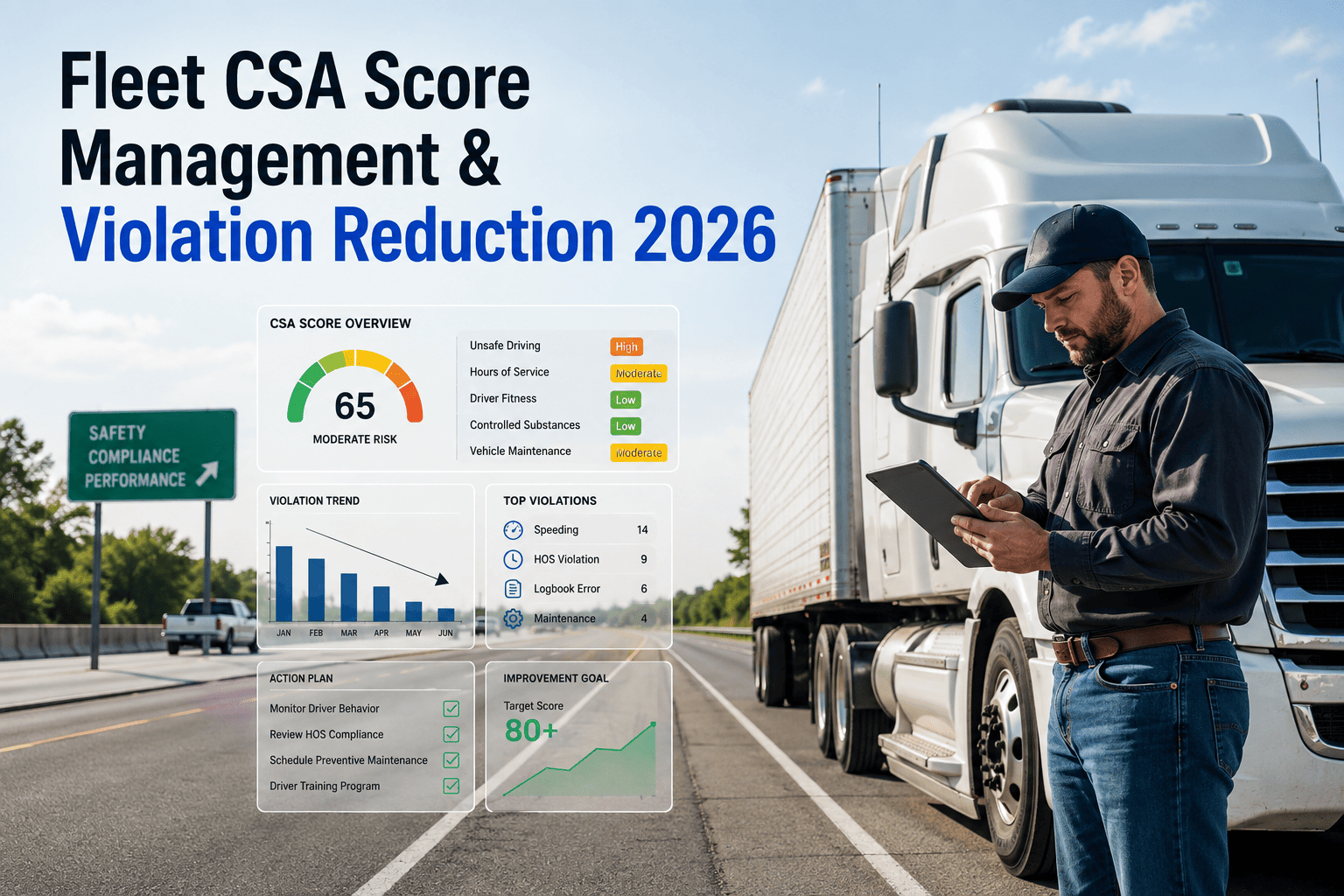
FMCSA scores every carrier across seven BASICs. Cross a threshold and you receive a warning letter, investigation, or a public alert visible to every shipper and broker checking your profile before awarding a load. Vehicle Maintenance is the highest-weight BASIC for most fleets — and the only one fully within your operations team's daily control. Every point in it traces to a missed PM, a deferred repair, or a driver defect report that wasn't acted on before dispatch. OxMaint documents every PM completion against the vehicle record, creating the audit trail that refutes disputed violations and demonstrates systematic compliance.
CSA BASIC Point Share — Typical Fleet Breakdown
Vehicle Maintenance
PM-preventable · Fully in your control
34–48%
Fix this first
Unsafe Driving
Driver behaviour — indirect maintenance link
22%
Secondary
HOS Compliance
Hours-of-service / ELD data
16%
ELD-driven
Driver Fitness + Other
CDL, medical, cargo, hazmat
~18%
HR/ops
Vehicle Maintenance is the only BASIC where a structured PM programme produces immediate, measurable score reduction. Start here.
Violation Severity: What Gets Fleets into Alert Status
FMCSA assigns severity weights from 1–10, and violations with out-of-service (OOS) criteria carry a 2× multiplier — meaning a single OOS brake defect scores as high as 20 points. The most damaging maintenance violations are not equipment failures in the traditional sense — they are gradual deteriorations that crossed a threshold without anyone acting on the warning signs. A fleet running a documented PM programme and OBD-linked condition monitoring through OxMaint would identify these conditions weeks before the roadside stop.
Without vs. With CMMS: The Real Difference at Roadside
The difference between a fleet in alert status and a fleet below threshold is rarely a different type of equipment — it is a different standard of documentation and follow-through. Inspectors find the same categories of defects in both cases. What changes is whether the defect existed at the time of inspection, and whether the fleet has the maintenance record to dispute it if the citation is wrong. OxMaint's CMMS creates a timestamped work order trail per vehicle that supports both prevention and DataQ challenge evidence.
Maintenance Approach — Impact on CSA Outcomes
Without Structured PM
Defects discovered at roadside — too late
No documentation to dispute incorrect citations
Vehicle Maintenance BASIC trending upward
Reactive repairs = higher cost, longer downtime
Insurers see alert status → $9,200 avg premium rise
With OxMaint CMMS PM
OBD flags brake/tyre wear before threshold — 30 days ahead
Timestamped work orders → DataQ challenge evidence ready
41% fewer Vehicle Maintenance violations on average
AI, OBD and Digital Twin: From Reactive to Predictive Compliance
Predictive compliance identifies vehicles trending toward violation conditions 30–60 days before the next inspection. OBD-II and J1939 streams provide continuous brake wear, tyre pressure, and lighting electrical health — the three highest-weight violation categories. AI digital twin modelling projects each component's wear trajectory against class averages and usage profiles, scoring each vehicle's violation risk weekly. When the risk score crosses a threshold, OxMaint automatically generates a scheduled work order — closing the gap between sensor signal and technician action before a DOT officer opens their clipboard.
Predictive Compliance Stack — Technology to Outcome
OBD-II / J1939
Live brake wear %, TPMS, lighting faults, fluid levels from ECU — streamed to CMMS daily
CSA Impact
Work order triggered before violation threshold — inspection passes clean
AI Digital Twin
30–60 day wear trajectory model per vehicle — violation risk score updated weekly, highest-risk units prioritised for PM
CSA Impact
Vehicles sorted by risk — limited shop time goes to the highest-threat assets first
AI Vision Camera
Depot walk-around scans detect tyre tread depth, lighting condition, and coupling defects before dispatch — visible defects the driver may miss
CSA Impact
OOS conditions caught before the vehicle leaves — eliminates citation at first point of contact
SAP / ELD Integration
PM completions post automatically to SAP QM; inspection history vs. violation audit trail; DataQ evidence packages auto-assembled
CSA Impact
DataQ challenge filed in hours, not days — with complete maintenance documentation pre-packaged
"
Our Vehicle Maintenance BASIC was in alert for 14 months. After implementing OxMaint and putting every vehicle on a documented PM schedule, we dropped from 82nd percentile to 44th in 7 months — without a single DataQ challenge. The violations just stopped appearing.
VP of Safety & Compliance — Regional LTL carrier, 94 power units, US Southeast
Build the PM Record That Defends Your CSA Score
OxMaint documents every PM completion, DVIR, and repair against the vehicle record — building the evidence trail that prevents violations and wins DataQ challenges. Free to start.
Improving a CSA score takes 90–180 days because SMS uses a 24-month rolling window — violations age off gradually while clean inspections build the denominator. The fastest route combines preventing new violations with filing DataQ challenges on historical violations that can be refuted with PM documentation. OxMaint's timestamped work orders are exactly the evidence FMCSA accepts in DataQ challenges — and they're generated automatically as part of normal CMMS operation.
90-Day CSA Score Improvement — Four Phases
01
Days 1–14
Audit & Baseline
Pull SMS profile — map all BASIC percentiles
Map each violation to vehicle and PM gap
Flag DataQ candidates with maintenance evidence
02
Days 15–30
Close PM Gaps
Configure CMMS PM per vehicle class
Clear overdue brake and tyre PMs first
Launch digital DVIR — pre and post trip
03
Days 31–60
Monitor & Challenge
Submit DataQ challenges with CMMS records
OBD anomaly alerts active fleet-wide
Weekly PM compliance % tracked and reported
04
Days 61–90
Score Improvement
Clean inspections build denominator
Oldest violations aging off the 24-month window
Target: 15–25 percentile point improvement
41%
Fewer violations with CMMS PM documentation
The single most effective CSA intervention in fleet operations — documented PM compliance.
24 mo
Every violation stays on your SMS record
Prevention is always cheaper than recovery — each violation costs you for two full years.
$9,200
Average insurance premium increase per CSA alert
One BASIC in alert status costs more annually in premiums than a full year of PM service.
73%
Of maintenance violations are PM-preventable
Brake, tyre, and lighting defects are slow deteriorations — every one is detectable before the roadside stop.
Frequently Asked Questions
How fast can a fleet realistically improve its CSA percentile?
Expect meaningful improvement in 90–180 days. Combine preventing new violations through documented CMMS PM with filing DataQ challenges on historical violations backed by work order records. Clean inspections improve your denominator each month, and violations age off after 24 months. OxMaint supports both simultaneously.
Which BASIC should a fleet prioritise first?
Vehicle Maintenance — it carries the highest point share and is fully within your control. Address brake and tyre PM first as they carry severity 8–10 with OOS multipliers. Once below threshold, turn to HOS or Unsafe Driving if those are also elevated.
Can CMMS work orders actually win DataQ challenges?
Yes — FMCSA accepts timestamped maintenance work orders, PM completion records, and technician signatures as DataQ evidence. A completed brake inspection 6 days before a brake defect citation is compelling. The challenge success rate is significantly higher with documented records than without. See OxMaint's DataQ evidence export in a demo.
Does OxMaint integrate with ELD systems and SAP for CSA compliance?
Yes. OBD/ELD condition data triggers CMMS work orders automatically. PM completion records sync to SAP QM for centralised compliance documentation. Full inspection history is exportable in FMCSA DataQ format. Start free to configure your integration today.
OxMaint turns your PM programme into the compliance record that keeps your Vehicle Maintenance BASIC below threshold — and wins DataQ challenges when violations appear.




.png)