.png)
Every motor carrier operating in the United States exists under the regulatory authority of the Federal Motor Carrier Safety Administration — and in 2026, the consequences of non-compliance have never been more severe. A single failed roadside inspection can trigger a cascade: elevated CSA scores, increased audit probability, higher insurance premiums, and in worst cases, an out-of-service order that grounds your fleet entirely. Yet the majority of compliance violations are not the result of negligence or bad faith — they stem from fragmented record-keeping, inconsistent inspection protocols, and a reactive approach to safety that waits for a problem to surface instead of preventing it systematically. The carriers that maintain spotless safety records share one trait: they treat compliance not as a regulatory burden but as an operational discipline embedded into every workflow, every maintenance cycle, and every driver interaction. This guide breaks down the entire FMCSA compliance framework into actionable components — from CSA scoring methodology and roadside inspection preparation to driver qualification file management and vehicle maintenance documentation. If your compliance strategy currently lives in filing cabinets and spreadsheets, it's time to upgrade. Sign up for Oxmaint's Safety Compliance platform and digitize your entire FMCSA program today.
Fleet Safety Compliance Management: Complete FMCSA Guide
The Real Cost of Non-Compliance
FMCSA violations don't just carry fines — they create a compounding cycle of financial damage. An elevated CSA score triggers higher insurance premiums, often 30–50% above baseline. A conditional safety rating causes shippers and brokers to refuse your loads. And an out-of-service order grounds your entire operation.
Research shows that carriers with unsatisfactory ratings pay up to $18,500 per vehicle annually in insurance — compared to $8,200 for satisfactory-rated carriers. For a 50-vehicle fleet, that's a $515,000 annual gap driven entirely by compliance status.
The most common violations are entirely preventable: brake adjustment defects, tire condition, HOS limits, lighting failures, and expired medical certificates. A structured compliance program built on digital tools eliminates these systematically.
The 7 FMCSA BASICs: Your Compliance Scorecard
The CSA program evaluates motor carriers across seven BASICs. Each generates a percentile score (0–100) where lower is better. Exceeding the intervention threshold triggers FMCSA scrutiny.
Unsafe Driving — Threshold: 65%
Speeding, reckless driving, improper lane changes, and seatbelt violations. Tracked via roadside citations and crash data. Telematics-based driver scorecards are the most effective countermeasure.
Hours-of-Service — Threshold: 65%
ELD compliance, driving time limits, mandatory break rules. The most common violation category — responsible for 30%+ of all roadside citations. Registered ELDs and proper backup RODS procedures are essential.
Driver Fitness — Threshold: 80%
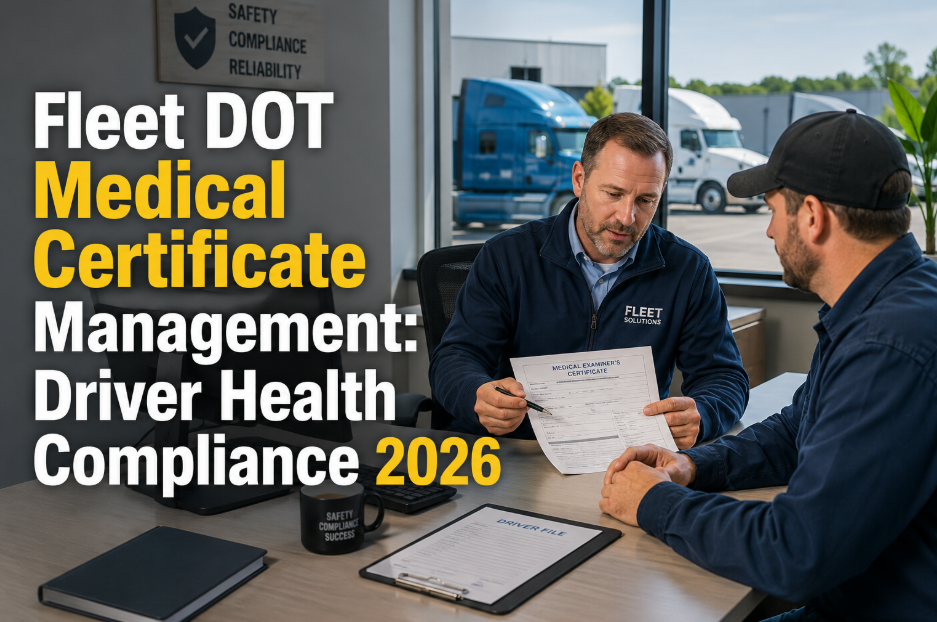
Medical examiner certificates, CDL validity, and complete driver qualification files. Incomplete DQ files are the #1 audit finding for small carriers. Annual MVR pulls and driving record reviews are mandatory.
Controlled Substances — Threshold: 80%
Drug & alcohol testing compliance, random pool rates (50% drug / 10% alcohol), FMCSA Clearinghouse registration, and return-to-duty protocols. Zero tolerance for positive results.
Vehicle Maintenance — Threshold: 80%
Systematic inspection, repair, and maintenance programs. Brake, tire, and lighting defects are the top three OOS violations nationwide. Oxmaint automates PM scheduling, DVIRs, and repair tracking for this entire BASIC.
HM Compliance — Threshold: 80%
Hazardous materials handling, placarding, shipping papers, and packaging compliance. Applies only to HM carriers but carries the most severe penalties including criminal prosecution for willful violations.
Crash Indicator — Threshold: 65%
Frequency and severity of DOT-reportable crashes. Not a behavioral BASIC — it measures outcomes. High crash rates trigger investigation even if other BASICs are clean. History stays on record for 24 months.
Stop Waiting for the Warning Letter
Join forward-thinking carriers who maintain spotless CSA records. Oxmaint digitizes your entire FMCSA compliance workflow — DVIRs, PM scheduling, DQ file tracking, and audit-ready reporting.
What Digital Compliance Management Means for Your Fleet
Pass Every Roadside Inspection
Automated PM scheduling and digital DVIRs ensure every vehicle meets inspection standards. Fleets using Oxmaint achieve 90%+ pass rates — compared to the 65% industry average.
Never Miss a Renewal
Automated expiration alerts for medical certificates, CDLs, annual inspections, and drug testing schedules. No more scrambling to find expired documents during an audit.
Audit-Ready in One Click
Every DVIR, work order, PM record, and inspection result is time-stamped and stored digitally. When FMCSA investigators arrive, export your complete compliance package instantly.
Cut Insurance Costs by 30–50%
A satisfactory safety rating saves $10,000+ per vehicle per year in insurance premiums. Maintaining clean CSA scores is the single highest-ROI activity in fleet management.
The Enforcement Cascade: What Happens When You Fail
FMCSA enforcement isn't binary — it's a graduated escalation. Understanding this cascade helps you recognize where your carrier sits and act before the next level hits.
FMCSA Compliance Checklist
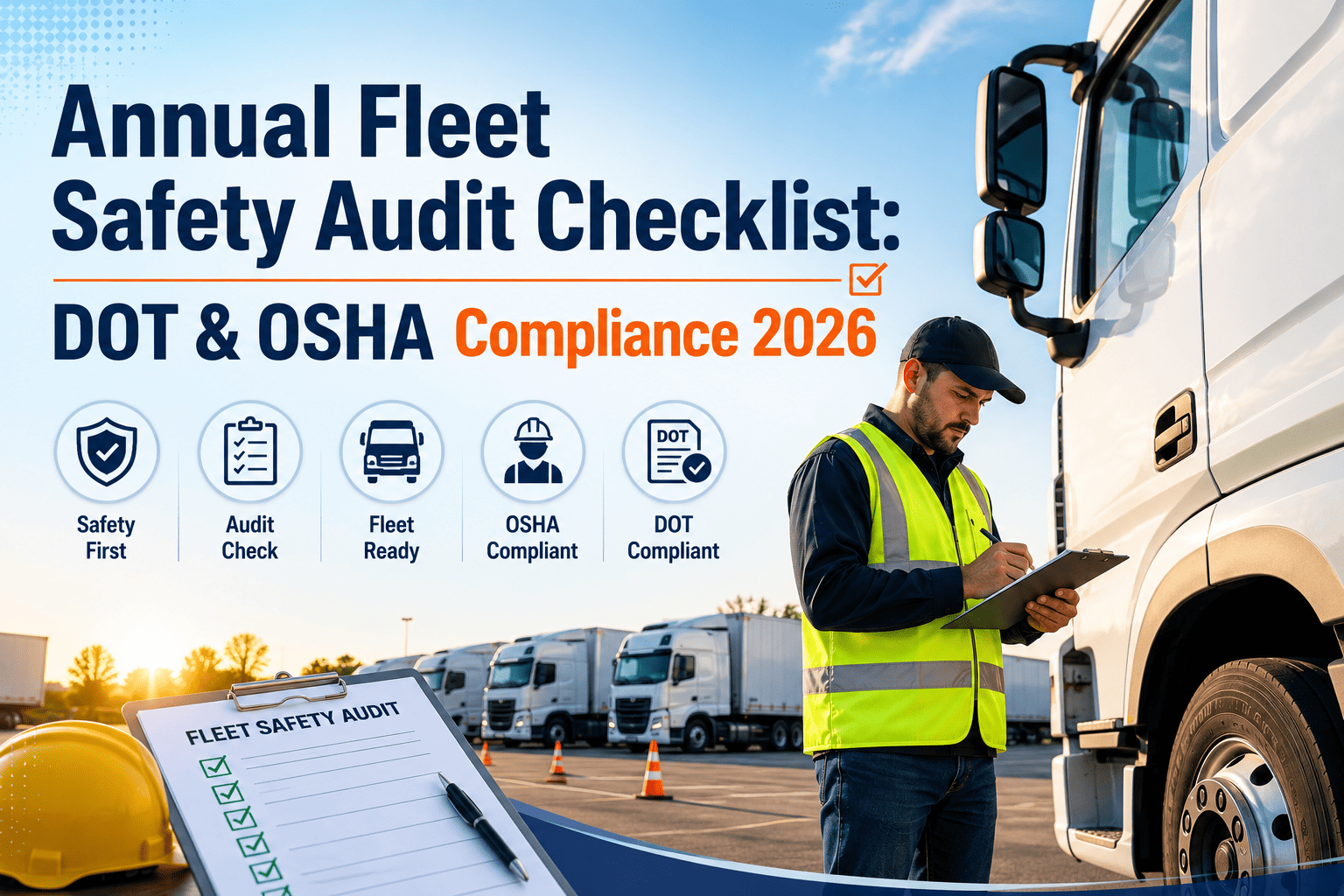
Every critical compliance area your motor carrier must maintain — use this as a quarterly self-audit framework
Driver Qualification Files
Valid CDL with endorsements, current medical certificate, annual MVR pull, 3-year employer verification, road test certificate, annual driving record review, signed drug & alcohol policy.
Vehicle Maintenance Records
Documented systematic inspection program, current annual DOT inspections for all units, daily DVIRs, 12+ month repair record retention, brake adjustment logs, tire condition tracking, lighting checks.
Hours of Service & ELD Compliance
Registered ELD for all CMV drivers, ELD user manual in every cab, roadside inspector instruction sheet, documented backup RODS procedure, 8-day supporting documents, 6-month ELD record retention.
Drug & Alcohol Program
FMCSA Clearinghouse registration, pre-employment testing, random pool at 50% drug / 10% alcohol, post-accident protocol, supervisor reasonable suspicion training, annual Clearinghouse query per driver.
Frequently Asked Questions
How often does FMCSA update CSA scores?
CSA scores are updated monthly using the most recent 24 months of roadside inspection and crash data. Violations carry more weight in the first 6 months and decay over time, so recent improvements show up relatively quickly in your scores.
Can I challenge a roadside inspection violation?
Yes. Submit a DataQs challenge through the FMCSA DataQs system. If the violation was recorded in error or you have evidence of compliance, the record can be corrected — positively impacting your CSA score at the next monthly update.
What's the difference between a DOT audit and a compliance review?
A compliance review is a comprehensive evaluation of your operations, management, and safety systems — the most thorough FMCSA investigation. A DOT audit may be more focused, targeting specific BASICs or responding to a complaint. Both can change your safety rating.
How long must I retain maintenance records?
FMCSA requires maintenance records for 12 months after the vehicle leaves your control, plus the current year. DVIRs must be retained for 3 months. Best practice: retain all records digitally for the life of the asset.
Does Oxmaint help with FMCSA compliance specifically?
Yes. Oxmaint automates PM scheduling to maintain your Vehicle Maintenance BASIC, digitizes DVIRs with GPS timestamps, tracks repair history, and provides compliance dashboards that flag overdue inspections and expiring certifications in real time.
What CSA score range is considered safe?
Scores below 40% are in the safe zone across all BASICs. The intervention threshold is 65% for Unsafe Driving and Crash Indicator, and 80% for all other BASICs. Aim to stay below 50% as a buffer against monthly fluctuations.
Ready to Make Your Fleet Audit-Proof?
Join the growing number of motor carriers who have eliminated compliance gaps and reduced CSA scores with Oxmaint's digital safety compliance platform.
No credit card required · Set up your fleet in under 10 minutes · Free forever plan available