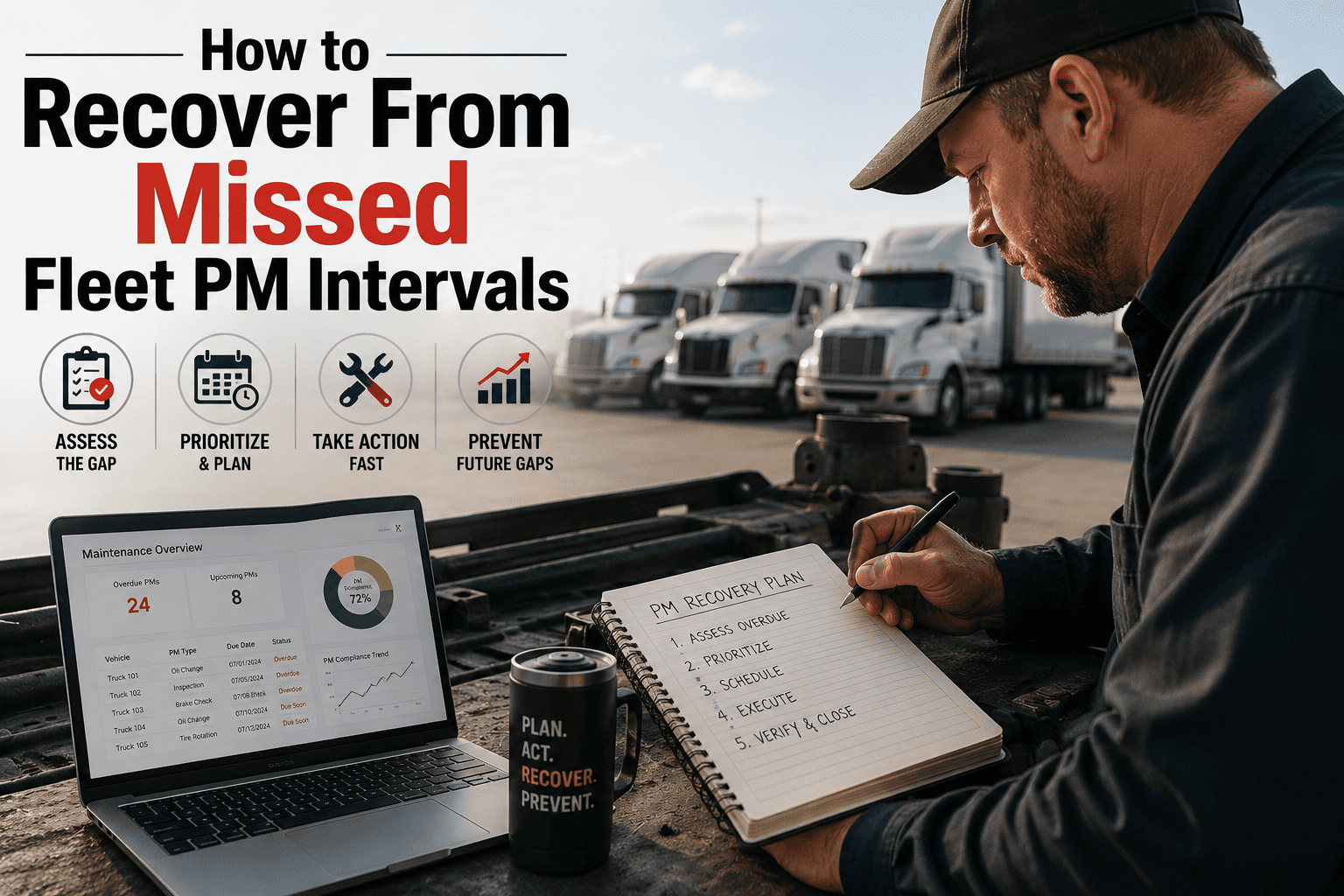
Recovering from missed fleet PM intervals is one of the most urgent challenges a fleet maintenance manager can face — and the recovery approach determines whether those missed PMs cascade into costly breakdowns or get contained and corrected. A missed PM interval fleet-wide quietly raises breakdown risk, voids warranty coverage, and creates compliance exposure that compounds with every passing week. The good news: with a structured fleet PM backlog recovery process, most fleets can restore full PM compliance within 30–90 days without disrupting daily operations. This guide walks you through exactly how to recover from missed fleet PM intervals — from triage and prioritization to documentation and prevention — and shows how a CMMS like OxMaint makes the entire process defensible and repeatable. If you're ready to close your PM gaps now, Start Free Trial and see how OxMaint tracks every missed PM automatically.
How Do You Recover From Missed Fleet PM Intervals Before They Become Breakdowns?
Missed preventive maintenance doesn't fix itself — it compounds. Fleets with a PM compliance rate below 80% face 2–3x higher unplanned downtime and significantly higher repair costs per vehicle. Here's the structured recovery process that gets your fleet back on track.
What Happens When Fleet PM Intervals Slip — And Why It Compounds
A single missed oil change on one truck is a minor issue. A pattern of missed PM intervals across a 50-vehicle fleet is a systemic risk. Industry data shows that deferred maintenance costs fleets an average of 4–5x the original PM cost when it results in a roadside breakdown — and that's before factoring in towing, driver downtime, missed deliveries, and CSA score impact.
The compounding effect is what makes fleet missed PM recovery so time-sensitive. Every week a PM stays overdue, the probability of a component failure rises — and so does the cost of the eventual repair. A missed brake inspection that would have cost $150 in labor becomes a $2,800 rotor-and-caliper replacement. A skipped coolant flush becomes a $12,000 engine overhaul. The math is brutal, and it favors fleets that act fast.
How to Recover From Missed Fleet PM Intervals: A 5-Step Catch-Up Plan
Fleet PM backlog recovery isn't about working harder — it's about working in the right order. This 5-step process is used by fleet managers who've successfully recovered from PM compliance rates as low as 55% back to 95%+ within 60–90 days.
Audit and Quantify the Backlog
Pull a complete report of every vehicle with an overdue or missed PM. Categorize by days overdue, PM type (safety-critical vs. routine), and vehicle criticality. You can't fix what you haven't measured — and most fleets are surprised to find their actual backlog is 20–40% larger than estimated.
Triage by Risk, Not by Age
Not all missed PMs carry equal risk. Prioritize safety-critical items first: brakes, tires, steering, lights, and coupling systems. Then address powertrain PMs (oil, coolant, transmission) on high-mileage or high-utilization vehicles. Routine items like cab filters and cosmetic checks can wait. This risk-based triage is the core of effective fleet PM interval recovery.
Schedule Catch-Up Work in Waves
Don't try to clear the entire backlog in one week — you'll overload your shop and disrupt operations. Instead, schedule catch-up PMs in weekly waves of 10–15% of the backlog. A fleet with 40 overdue PMs should plan 4–6 per week alongside normal scheduled maintenance. OxMaint's work order scheduling makes this wave-based approach automatic.
Document Everything for Compliance
Every catch-up PM must be documented with date, technician, parts used, and findings. This creates the audit trail that FMCSA inspectors, insurance auditors, and warranty providers require. Gaps in your PM history are far more defensible when you can show a structured recovery plan with dates and completion records.
Fix the Root Cause to Prevent Recurrence
Missed PMs are a symptom, not the disease. The root cause is usually one of: manual tracking (spreadsheets, whiteboards), understaffed shop, unclear PM schedules, or no automated alerts. A CMMS with automatic PM scheduling and overdue alerts eliminates the #1 cause — human memory and manual tracking.
Which Missed PMs to Catch Up First: A Risk-Based Priority Matrix
When you're staring at a backlog of 30, 50, or 100+ overdue PMs, the order you tackle them matters more than the speed. This priority matrix is based on FMCSA out-of-service criteria and real-world failure cost data.
| Priority | PM Category | Examples | Risk if Deferred | Catch-Up Window |
|---|---|---|---|---|
| P1 — Critical | Safety systems | Brakes, tires, steering, lights, coupling | Out-of-service violation, accident liability, CSA points | Within 7 days |
| P2 — High | Powertrain & fluids | Engine oil, coolant, transmission, differential | Component failure, warranty void, $5K–$15K repair | Within 14 days |
| P3 — Medium | Emissions & electrical | DPF service, batteries, alternator, wiring | Derate conditions, no-start events, failed inspections | Within 30 days |
| P4 — Routine | Comfort & cosmetic | Cab filters, wiper blades, interior checks, wash | Driver comfort, minor CSA exposure | Within 60 days |
A real-world example: a 120-vehicle regional trucking fleet discovered 67 overdue PMs during a quarterly audit. Using this matrix, they identified 12 P1 items (mostly brake inspections and tire checks) and cleared those in the first week. The remaining 55 were scheduled across 6 weeks. Total recovery time: 49 days. Zero breakdowns during the recovery period. Their PM compliance rate went from 71% to 96%.
See Your Real PM Compliance Rate in Under 5 Minutes
OxMaint automatically tracks every PM interval across your entire fleet — and flags overdue items before they become breakdowns. Book a 30-minute demo and we'll show you exactly where your fleet stands.
How OxMaint Turns Missed PM Recovery Into a Controlled, Auditable Process
Recovering from missed fleet PM intervals requires visibility, prioritization, and documentation — exactly what OxMaint's CMMS is built to deliver. Here's how four specific capabilities map to the recovery challenge:
Automatic PM Tracking & Overdue Alerts
OxMaint tracks every PM interval by mileage, engine hours, or calendar date — and sends automatic alerts when a PM is approaching or overdue. No more spreadsheets, no more surprises. Fleets using automated PM tracking reduce missed intervals by 85%+ in the first 90 days.
Catch-Up Work Order Scheduling
Create prioritized catch-up work orders and schedule them in waves alongside regular maintenance. OxMaint's drag-and-drop scheduler prevents shop overload while ensuring the highest-risk PMs get done first. Most fleets clear their backlog 40% faster with structured scheduling.
Compliance Documentation & Audit Trail
Every completed PM is logged with date, technician, parts, and findings — creating the defensible audit trail that FMCSA, insurers, and warranty providers require. When an auditor asks about a gap, you show the recovery plan and completion records, not excuses.
PM Compliance Dashboard & Analytics
Real-time dashboards show your fleet-wide PM compliance rate, overdue count by priority, and recovery progress. Fleet managers report saving 6–10 hours per week on manual tracking and reporting — time that goes back into actual maintenance.
How to Prevent Missed PM Intervals From Happening Again
Recovery is necessary. Prevention is cheaper. Fleets that maintain 95%+ PM compliance share three common practices — and none of them involve working harder.
Automate PM Scheduling
- Set PM intervals by mileage, hours, or calendar — whichever fits each asset
- Enable automatic work order generation when a PM comes due
- Configure escalation alerts at 7 days, 3 days, and 1 day overdue
- Eliminate spreadsheet tracking entirely — it's the #1 cause of missed PMs
Right-Size Your Shop Capacity
- Calculate your weekly PM workload: total annual PMs ÷ 52 weeks
- Ensure shop capacity exceeds PM demand by at least 20% for buffer
- Use mobile work orders so technicians update status in real time
- Track technician utilization — below 70% means scheduling problems, not staffing problems
Monitor Compliance Weekly
- Review PM compliance rate every Monday — catch slippage at 95%, not 75%
- Track "days overdue" as a KPI, not just "count overdue"
- Set a hard floor: no vehicle operates with a P1 PM more than 7 days overdue
- Report compliance trends to leadership monthly — visibility drives accountability
Frequently Asked Questions About Missed Fleet PM Recovery
What is a missed PM interval in fleet maintenance?
A missed PM interval occurs when a scheduled preventive maintenance task — like an oil change, brake inspection, or tire rotation — passes its due date, mileage threshold, or engine-hour trigger without being completed. Even a single missed interval on a safety-critical system can create compliance exposure and increase breakdown risk.
How long does it take to recover from a fleet PM backlog?
Most fleets can restore full PM compliance within 30–90 days using a structured catch-up plan. The timeline depends on backlog size, shop capacity, and how the catch-up work is prioritized. Fleets using a CMMS like OxMaint typically recover 40% faster because scheduling, tracking, and documentation are automated. Start Free Trial to see your real compliance rate today.
Does a missed PM void my vehicle warranty?
It can. Most OEM warranties require documented proof that PM intervals were followed. A gap in your PM history gives the manufacturer grounds to deny a warranty claim — especially for powertrain components. This is why documenting your catch-up work with dates, parts, and technician records is critical during recovery.
What PM compliance rate should a fleet maintain?
Industry best practice is 95% or higher on-time PM completion. Below 80% is considered high-risk by most auditors and insurers. If your fleet is below 80%, you likely have a systemic tracking or capacity problem — not just a busy month. A 30-minute demo of OxMaint will show you exactly where your fleet stands and how to close the gap.
Can a CMMS prevent missed PM intervals?
Yes — automated PM scheduling is the single most effective prevention. A CMMS tracks intervals by mileage, hours, or date and auto-generates work orders when PMs come due. Fleets that switch from spreadsheets to a CMMS reduce missed PMs by 85%+ in the first quarter because the system never forgets, never gets busy, and never loses a sticky note.
Stop Chasing Missed PMs. Start Preventing Them.
OxMaint gives your fleet automatic PM scheduling, overdue alerts, catch-up work orders, and the compliance documentation you need — all in one platform. See it on your fleet in a 30-minute demo.
Free 14-day trial · No credit card required · Set up in under 10 minutes