Many fleets pay for repairs that a manufacturer, parts supplier, or service contract should have covered. The cause is rarely bad faith. A failed part is replaced quickly, the install date is not in the repair record, and the old component is discarded before anyone asks about coverage. A defined warranty recovery workflow catches eligible failures at the work order, preserves evidence, and tracks each claim to a credit. This guide explains the steps and how Oxmaint can keep the maintenance records behind them.
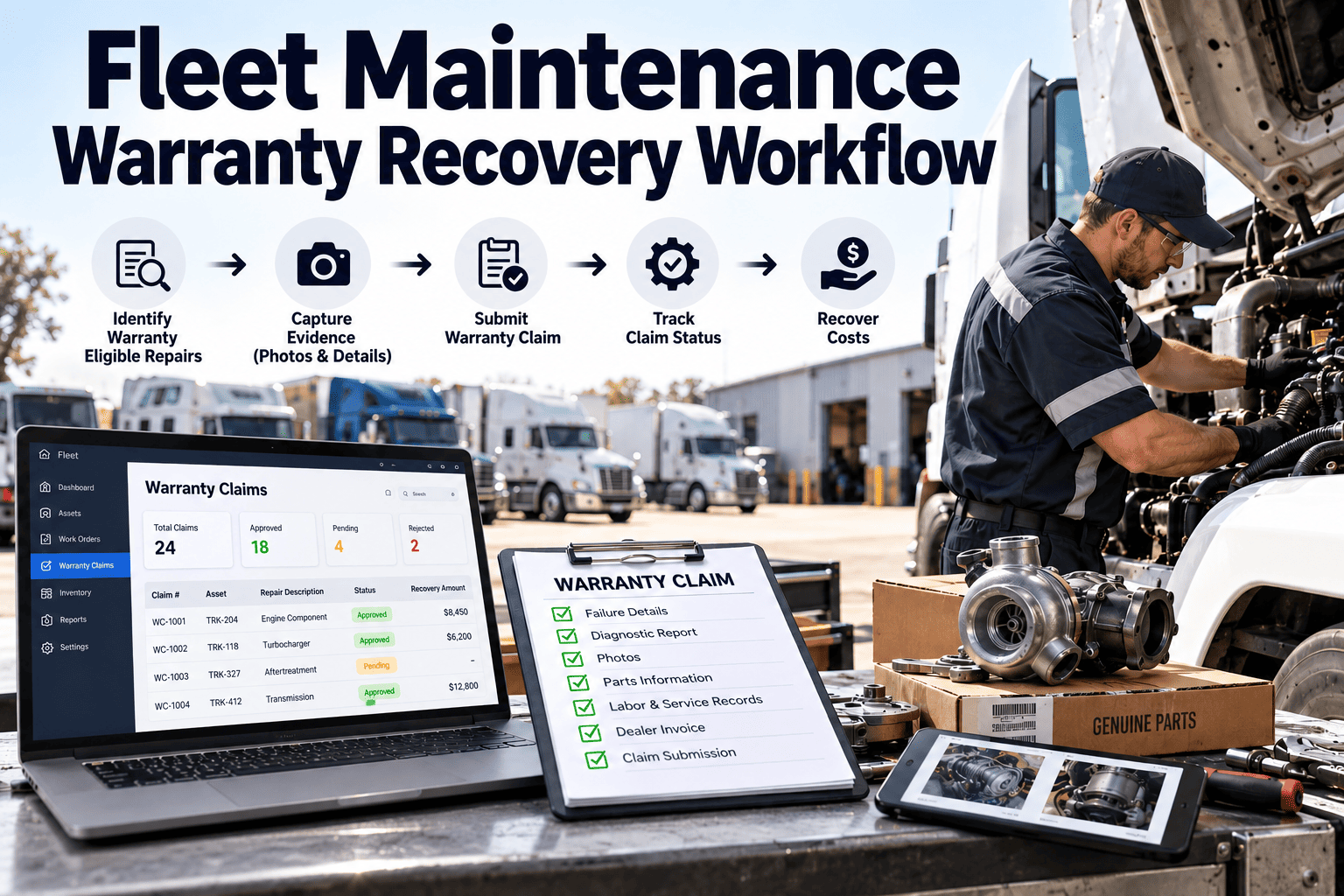
Fleet Maintenance Warranty Recovery Workflow
Turn eligible failures into recovered cost. Flag warranty candidates at the work order, collect the evidence once, and follow each claim until the credit is posted.
Why fleets leave warranty money unclaimed
Recovery fails at the shop floor long before it reaches a claim form. These four gaps account for most of the unclaimed value.
Eligibility is never checked
Technicians focus on getting the vehicle back in service. Without a prompt, nobody asks whether the failed part is still covered.
Evidence is missing
Install date, mileage, and the original invoice are scattered across systems, so the claim cannot be supported.
Filing happens too late
Claims have time limits. A repair finished weeks ago may fall outside the window by the time someone reviews it.
Claims are not followed up
A submitted claim with no owner can sit unanswered. Credits arrive without being matched to the original repair.
The warranty claim clock
Every claim moves through the same four stages. The sooner each stage starts, the stronger the claim and the lower the risk of missing a deadline.
Spot the candidate
Flag the failed part during diagnosis, before it is removed. Check install date, mileage, and coverage.
Capture the evidence
Photograph the failure, record findings, and retain the failed component until the claim decision.
File within the window
Send the claim with the work order, invoices, and technician notes to the right party.
Follow to credit
Track responses, handle denials, and match the credit to the work order.
Coverage types and what to verify
Different coverages have different rules. Record the coverage type on the asset or part so technicians know what applies before the repair starts.
| Coverage type | Typical scope | Verify before claiming | Common pitfall |
|---|---|---|---|
| Base vehicle warranty | Defects in factory components | In-service date, mileage, authorized repair rules | Work done outside required channels |
| Powertrain coverage | Engine, transmission, and drive components | Component list, service history, maintenance compliance | Missing preventive maintenance records |
| Emissions coverage | Emissions control parts and systems | Part and system terms, diagnostic codes | Unclear failure cause |
| Parts supplier warranty | Replacement parts bought from suppliers | Purchase date, part number, installed unit | No link between part and vehicle |
| Remanufactured components | Rebuilt units such as alternators or transmissions | Core return rules, install records | Core not returned in time |
| Tire coverage | Manufacturing defects and workmanship | Tread depth, tire serial, mounting date | Missing serial or position record |
| Extended service contract | Repairs under a purchased contract | Pre-approval rules, covered components | Repair started without approval |
| Recall or campaign | Safety or defect remedies | Campaign number, vehicle eligibility | Open campaigns not tracked |
The evidence packet every claim needs
A complete packet is the best defense against denial. Build it as the work is done, not afterward.
Vehicle and part evidence
- Unit number, VIN, and in-service date
- Meter reading at failure
- Part number, serial number, and install date
- Original purchase invoice or work order
- Photos of the failed part and failure point
- Statement of symptoms and diagnostic findings
Repair and claim evidence
- Linked work order and technician notes
- Labor hours and rate used
- Maintenance history showing required service
- Warranty terms or contract reference
- Claim submission date and contact
- Failed part storage location and return status
Capture warranty evidence while the repair is still open
Keep install dates, failure notes, and part records on the work order so every eligible claim is ready to submit.
Who does what in the recovery workflow
Clear ownership prevents claims from falling between departments. Each role has a short list of actions at specific moments.
A simple claim status board
Use a small set of statuses so everyone can see where each claim stands and what happens next.
- Identified claims that stay undocumented for too long are at risk of missing the window
- Submitted claims without a response should trigger a follow-up task with a named owner
- Resolved claims should record whether the result was full credit, partial credit, or denial
- Denied claims should be reviewed once for appeal potential and then closed with a recorded reason
- Closed claims should stay searchable by vehicle, part, and supplier so patterns can be seen later
Why claims get denied and how to prevent it
Denials are useful data. Group them by reason and fix the process step that caused each one.
| Denial reason | Prevention at the work order | Owner |
|---|---|---|
| Outside coverage period | Record in-service date and coverage end on the asset | Warranty coordinator |
| Missing maintenance records | Keep preventive maintenance history linked to the unit | Maintenance planner |
| Failed part not available | Require tagging and storage before disposal | Shop lead |
| Unauthorized repair location | Show authorized-repair rules on the work order | Supervisor |
| Incomplete documentation | Use a standard evidence checklist before submission | Warranty coordinator |
| Unclear failure cause | Record diagnostic steps and findings clearly | Technician |
KPIs for warranty recovery
Measure the process, not only the dollars. Early indicators show whether claims are being identified and filed on time.
Candidates flagged
Failures marked as possible warranty at diagnosis. A low count may signal missed eligibility.
Time to submission
Days from repair completion to claim filing. Shorter times protect deadlines.
Claim acceptance rate
Share of submitted claims paid in full or part. Shows evidence quality.
Recovered amount
Credits received compared with warranty-eligible repair cost.
Open claim age
How long unresolved claims have been waiting. Highlights stalled follow-up.
Denials by reason
Count of denials grouped by cause. Directs process fixes.
Records and compliance considerations
Warranty terms often require proof that the vehicle was maintained as specified. Good records support both claims and audits.
Maintenance proof
- Preventive maintenance performed on schedule with dates and meter readings
- Fluids, filters, and parts that meet required specifications
- Inspection records showing the condition before failure
Authorization proof
- Pre-approval for contract repairs where required
- Records of who approved the repair and when
- Quotes or estimates provided to the warranty party
Retention practices
- Keep claim documents for at least the coverage period and any audit period set by policy
- Store photos and notes with the work order rather than in personal files
- Record final outcomes so denials and credits can be reviewed later
Trends shaping warranty recovery in 2026
Warranty work is changing as vehicles gain more electronic systems and parts supply chains shift.
Electronic and software-related failures
More failures involve modules, sensors, and software. Diagnostic records become critical evidence for these claims.
More varied coverage
Fleets now manage base warranties, supplier warranties, and service contracts at the same time. Recording the coverage type per asset avoids confusion.
Digital submission portals
Many manufacturers and suppliers use online claim systems. Having structured data ready speeds entry and reduces errors.
Closer link to preventive maintenance
Because coverage can depend on maintenance compliance, a reliable preventive maintenance record is now part of warranty protection.
Operational impact of missed warranty recovery
Unclaimed warranty cost is a direct budget loss, but the effects reach further into planning and vendor relationships.
Budget effects
- Repair cost looks higher than it should for the same vehicle and component
- Maintenance budgets absorb costs that belong to a manufacturer or supplier
- Cost per mile comparisons are distorted by unrecovered repairs
Planning effects
- Replacement decisions rely on repair totals that include avoidable spend
- Part quality problems stay hidden because credits never reveal the pattern
- Supplier negotiations lack evidence of repeat failures
Team effects
- Staff repeat the same search for records on every claim
- Technicians stop flagging candidates when nothing happens afterward
- Finance cannot explain credits that arrive without references
Building the recovery workflow in four steps
Start small and make the first claims easy to file. Add complexity only after the basics run reliably.
Record coverage on the asset
Add in-service date, coverage type, and end terms to each vehicle and major component.
- Start with newer vehicles still under base coverage
- Add supplier and contract coverage as you find it
Add a warranty prompt to repairs
Make the work order ask whether the failure may be covered before parts are removed.
- Require a yes, no, or unsure answer on failure repairs
- Route unsure answers to the coordinator
Standardize the evidence packet
Use one checklist for every claim so staff know what to collect.
- Attach photos and notes to the work order
- Record where the failed part is stored
Review claims weekly
Hold a short weekly review of open claims by age and owner.
- Escalate claims close to their deadline
- Log denial reasons for monthly analysis
Handling special situations
Not every failure fits the standard path. Prepare for these cases so exceptions do not become lost claims.
Roadside repairs
Emergency repairs at outside locations still need evidence. Ask the vendor for the failed part, photos, and itemized invoice, then attach them to the breakdown work order.
Repeat failures
A part that fails again soon after replacement may support a stronger claim. Link repeat repairs so the history is clear.
Partial credits
Some claims pay parts but not labor. Record the split so future cost comparisons stay accurate.
Fleet-wide defects
When many units show the same failure, group the work orders and share the pattern with the manufacturer or supplier.
A weekly warranty review agenda
Fifteen focused minutes each week keep claims moving and show where the process needs attention.
Claims in progress
- Which candidates are flagged but not yet documented?
- Which claims are approaching their filing deadline?
- Which submitted claims have had no response?
- Which credits have arrived without a matching work order?
Process improvement
- Which denial reasons appeared this week?
- Which vehicle or part type shows repeat failures?
- Which coverage details are missing from asset records?
- Which technicians or shops need a reminder on evidence?
How Oxmaint supports warranty recovery
Oxmaint keeps the maintenance facts that warranty claims depend on in one place and ties them to each vehicle and repair.
- Asset records store in-service date, coverage notes, and repair history
- Work orders hold diagnostic notes, photos, labor, and parts used
- Preventive maintenance schedules prove required service was performed
- Inventory records link parts to the vehicles where they were installed
- Inspections capture condition before a failure becomes a repair
- Reports show repair cost by asset, part, and failure type
Practical benefits
- Technicians flag candidates while the failed part is still in hand
- Coordinators build claims from existing records instead of searching
- Managers see recovery results next to repair cost
- Finance matches each credit to a completed repair and the vehicle it served
- Supervisors see which warranty tasks are waiting and who owns them
Before and after a structured workflow
A structured process changes what happens at each step of a failure.
Without a workflow
- Failed parts are discarded after the repair
- Coverage is checked only when someone remembers
- Evidence is gathered from several systems
- Claims are filed late or not at all
- Credits arrive without a link to the work order
With a workflow
- Failed parts are tagged and stored as part of the repair
- Coverage prompts appear at diagnosis
- Evidence is built from the work order and asset record
- Claims are filed within the window with a named owner
- Credits are matched to the original repair and reported
Frequently asked questions
What is a fleet warranty recovery workflow?
It is a repeatable process for flagging eligible failures, collecting evidence, filing claims, and matching credits to work orders.
When should warranty eligibility be checked?
At diagnosis, before the failed part is removed or discarded, so evidence and deadlines are protected.
What records support a warranty claim?
Install date, mileage, part serial, maintenance history, photos, and technician notes. You can book a demo to see how they link.
How do I track claims to completion?
Give each claim a status and owner, and review open claims by age every week.
Can maintenance software help recover more cost?
It can by keeping asset history and repair evidence together. You can create an account to test it on one vehicle group.
Stop paying for repairs someone else should cover
Build a warranty recovery workflow on your work orders and asset records, and follow every eligible claim to a credit.