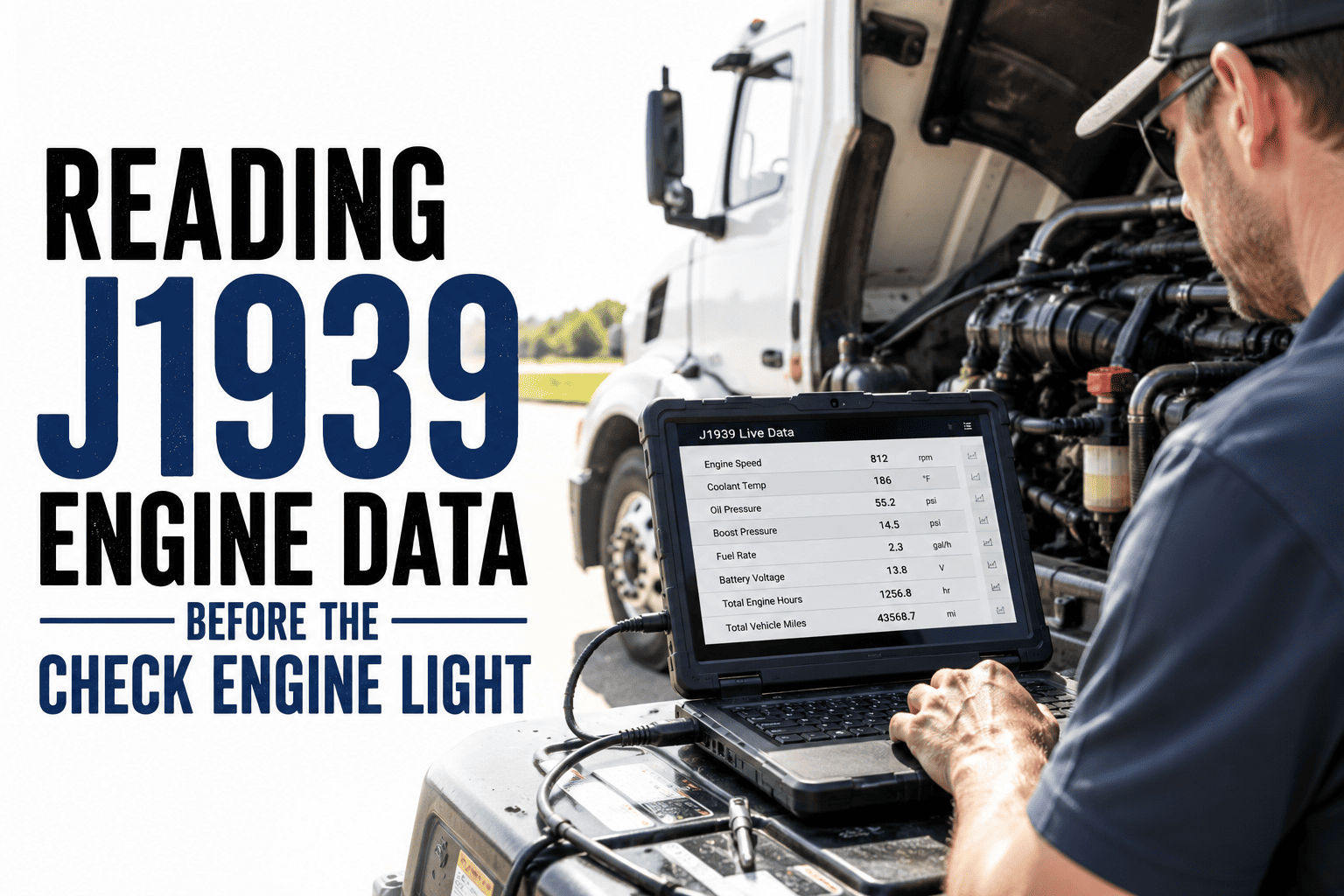
J1939 is the CAN-bus backbone that lets the engine ECM, transmission controller, ABS unit and aftertreatment system on virtually every Class 6–8 truck built after 2007 talk to each other in real time. A telematics gateway that reads that bus deeply doesn't just pull odometer — it streams over 200 engine parameters and every active SPN/FMI fault code straight into your maintenance system. The shops that act on that stream catch turbo underboost, DPF restriction and coolant creep weeks before a roadside failure, which is why fleets running full J1939 monitoring cut unplanned downtime by roughly a third. You can see exactly how that pipeline works when you Start Free Trial and connect your first vehicle in Oxmaint.
J1939 GUIDE · 2026
What if your shop knew about the turbo before the driver saw the light?
J1939 carries 200+ live engine parameters — RPM, oil pressure, boost, DPF differential pressure, DEF level and every SPN/FMI fault — the millisecond they fire. Reading that stream turns unplanned breakdowns into scheduled bay visits.
WHAT J1939 ACTUALLY CARRIES
One protocol, over 200 parameters, zero guesswork
SAE J1939 is the higher-layer CAN protocol that heavy-duty OEMs standardized for inter-controller communication. A connected gateway doesn't sample one signal — it reads the full parameter group model in real time.
RPM, oil pressure, coolant temp, boost, fuel rate, DEF, EGR position, DPF delta-P and more.
Standard on every EPA-compliant on-highway diesel from Freightliner, Kenworth, Peterbilt, Volvo, Mack, International.
Every fault arrives with its Suspect Parameter Number and Failure Mode Identifier — the same codes your shop scan tool reads.
NOT ALL J1939 DEVICES READ THE SAME DEPTH
OBD-II gives you the car subset. Full J1939 gives you the truck.
A $40 OBD-II dongle reads the SAE J1979 PID set designed for passenger cars — a thin slice of what a Class 8 truck actually broadcasts. Full-J1939 gateways from Samsara, Geotab, Motive and comparable providers unlock the complete data model and every manufacturer-extended parameter group.
| Capability | Basic OBD-II (J1979) | Full J1939 Gateway |
|---|---|---|
| Engine RPM & vehicle speed | Limited | Full PGN stream |
| Boost pressure / turbo status | Partial | Yes, with trending |
| DPF differential pressure | No | Yes |
| DEF level & dosing | No | Yes |
| EGR position | No | Yes |
| Transmission & ABS parameters | No | Yes |
| Active SPN/FMI fault codes | Generic only | Full manufacturer codes |
| Fault-to-CMMS auto-routing | No | Yes, in Oxmaint |
FAULT-TO-WORK-ORDER PIPELINE
From a code set on the highway to a bay ready in the shop
The moment a fault sets on the bus, it can flow straight into your CMMS — not wait for the driver to notice a dash lamp at the next fuel stop. Here's the path a single SPN 3251 DPF regeneration fault takes.
Fault sets on the bus
The aftertreatment controller broadcasts SPN 3251 FMI 11 — DPF regeneration incomplete due to fault. The J1939 gateway captures it in under one second.
Threshold check & severity routing
Oxmaint evaluates the code against your per-parameter rules. Severity 3 and above auto-generates a work order; lower-severity items log for trending.
Work order lands in the shop queue
The work order arrives with VIN, mileage, full SPN/FMI, active parameter snapshot and suggested parts — before the truck finishes its route.
Technician pre-stages the bay
Parts are pulled, the diagnostic laptop is loaded with the right ECM profile, and the regen bay is reserved — cutting a 6-hour diag-and-fix to roughly 90 minutes.
PREDICTIVE TRENDING — BEFORE FAILURE
Four signals that tell you what's about to break
Trending J1939 parameters against each vehicle's own baseline is where the real money sits. A single snapshot tells you nothing; a 90-day curve tells you everything.
Rising DPF differential pressure
A steady climb above the vehicle's clean-baseline delta-P predicts DPF cleaning or replacement 4–8 weeks out. Caught early, it's a $1,200 scheduled clean; ignored, it's a $4,000 roadside tow plus a $6,000 forced regen and filter swap.
Declining boost pressure
A 2–4 PSI drop in manifold boost at sustained highway load points at turbo wastegate or VGT actuator degradation — typically 3–6 weeks before a P0299 underboost code sets and derates the engine.
Coolant temperature creeping above baseline
A 6–10°F rise over a two-week window flags water pump impeller wear, a sticking thermostat or radiator fouling — long before an overheat boils the coolant and cracks a head.
Oil pressure decline under load
A gradual 3–5 PSI drop at governed RPM indicates main-bearing wear or oil pump relief creep — the earliest reliable signature of major engine bearing wear, months before a catastrophic spin.
What 14 unplanned breakdowns a year actually cost — and what killing them saves
Net annual avoidance: $87,750 — against a telematics-plus-Oxmaint spend of roughly $14,400. Payback inside the first quarter of deployment.
Stop finding faults at the fuel pump. Start catching them on the bus.
Connect a full-J1939 gateway and let every SPN/FMI code route itself into a ready work order.
J1939 FAQ
Five questions fleet managers ask before going live
Is J1939 the same thing as OBD-II?
No. OBD-II is the emissions-driven diagnostic standard for light-duty vehicles and reads a small SAE J1979 parameter set. J1939 is the heavy-duty CAN protocol used on Class 4–8 trucks and carries 200+ parameters plus full SPN/FMI fault classification across engine, transmission, ABS and aftertreatment controllers.
Which model years and truck classes support J1939?
Virtually every Class 6–8 on-highway diesel manufactured after 2007 — when EPA 2007 aftertreatment mandates took effect — broadcasts a standard J1939 data stream. Most Class 4–5 trucks from the same era are also J1939-equipped. If your shop scan tool talks to the ECM, a J1939 gateway will too.
How does Oxmaint turn a fault code into a work order?
You set per-parameter severity thresholds inside Oxmaint. When a code at or above your defined severity arrives over the J1939 stream, the platform auto-generates a work order against the correct vehicle record, attaches the SPN/FMI, an active-parameter snapshot and suggested parts, and drops it into the shop queue. You can see the full flow when you Start Free Trial.
How much warning do I really get before a failure?
It depends on the failure mode, but the typical windows are meaningful: rising DPF differential pressure predicts filter service 4–8 weeks out; declining boost predicts turbo or VGT issues 3–6 weeks out; coolant-temperature creep flags cooling-system faults days to weeks before an overheat. None of those signals appear on the dash until the component has already degraded to a derate.
Can I keep my existing Samsara, Geotab or Motive hardware?
Yes. Oxmaint ingests the J1939 data those full-protocol gateways already publish and streams it into vehicle records with configurable thresholds. If you'd rather walk through the integration live, Book a Demo and we'll map your current hardware to the workflow in 30 minutes.
Read the bus before the light comes on.
Full-J1939 streaming, automated SPN/FMI work orders, and 200+ parameters trending against every vehicle's own baseline — live in Oxmaint today.
Free 14-day trial · No credit card