Roadside Breakdown Response Playbooks: ROI Calculator Approach for Regional Delivery
By Oxmaint on December 15, 2025
It's 2:47 PM. Your delivery van throws a check engine light 45 minutes from the depot with 6 stops remaining. Your dispatcher digs through filing cabinets looking for that vehicle's service history. The driver waits roadside burning $79 every hour. A customer watches their delivery window expire. This chaos costs regional delivery fleets $448-$760 per vehicle per day in lost productivity—and it's completely preventable with the right system.
The fleets consistently hitting delivery windows aren't running newer vehicles or bigger budgets. They're running smarter systems that give instant access to every vehicle's maintenance history, automated alerts before failures happen, and documented response playbooks that turn breakdown chaos into coordinated 90-minute recoveries. The difference between your fleet absorbing breakdowns as minor disruptions versus spiraling into operational chaos comes down to one thing: having digital maintenance management in place.
Roadside Breakdown Response Playbooks: ROI Calculator Approach for Regional Delivery
The $110,000 Problem Hiding in Your Fleet Right Now
What One Breakdown Actually Costs You
Roadside assistance call$350-$700
Emergency repair premium (vs. scheduled)+45%
Driver waiting (lost productivity)$79/hour
Rerouting remaining deliveries$285
Customer compensation & lost business$245
Average Total Per Incident$1,847
25-vehicle fleet×1.5 breakdowns/vehicle/year
=
38 breakdown events annually
38 events×$1,847 average cost
=
$70,186/year in direct costs
Plus Hidden Costs You're Not Tracking:
Emergency parts premiums: $18,400Excess inventory "just in case": $12,500Customer churn from missed SLAs: $9,200
Total Annual Impact: $110,286
What if you could cut those 38 breakdowns to 15—and handle the remaining 15 in half the time?
Fleets using preventive maintenance software with automated scheduling report 50% fewer breakdowns and 32% reduction in unplanned downtime. That's not marketing—it's documented data from over 1,000 fleet operations.
Streamline Fleet Management Energy Performance with Connected Sensors
Modern telematics generates thousands of data points daily—engine temperature, oil pressure, battery voltage, brake wear, tire pressure. But raw data sitting in a dashboard doesn't prevent breakdowns. The transformation happens when that data automatically triggers maintenance actions before failures strand your drivers.
How Smart Fleets Turn Sensor Data Into Prevented Breakdowns
Telematics Alert
Sensor detects battery voltage dropping below threshold
Auto Work Order
System creates work order with battery specs and assigns technician
Mobile Alert
Technician receives notification with vehicle location
Breakdown Prevented
Battery replaced during scheduled stop—$1,847 saved
This automation is exactly what happens when you start using digital maintenance management for your fleet. When telematics integrates with your maintenance system, sensor alerts automatically generate work orders, notify technicians, and track completion—no manual intervention, no missed warnings, no roadside surprises.
65%
of breakdowns are from tires, brakes, and cooling—all predictable with proper monitoring
70%
of equipment failures can be predicted 2-4 weeks in advance with condition monitoring
20%
fewer downtime days for fleets with structured preventive maintenance programs
The 5-Phase Breakdown Response Playbook
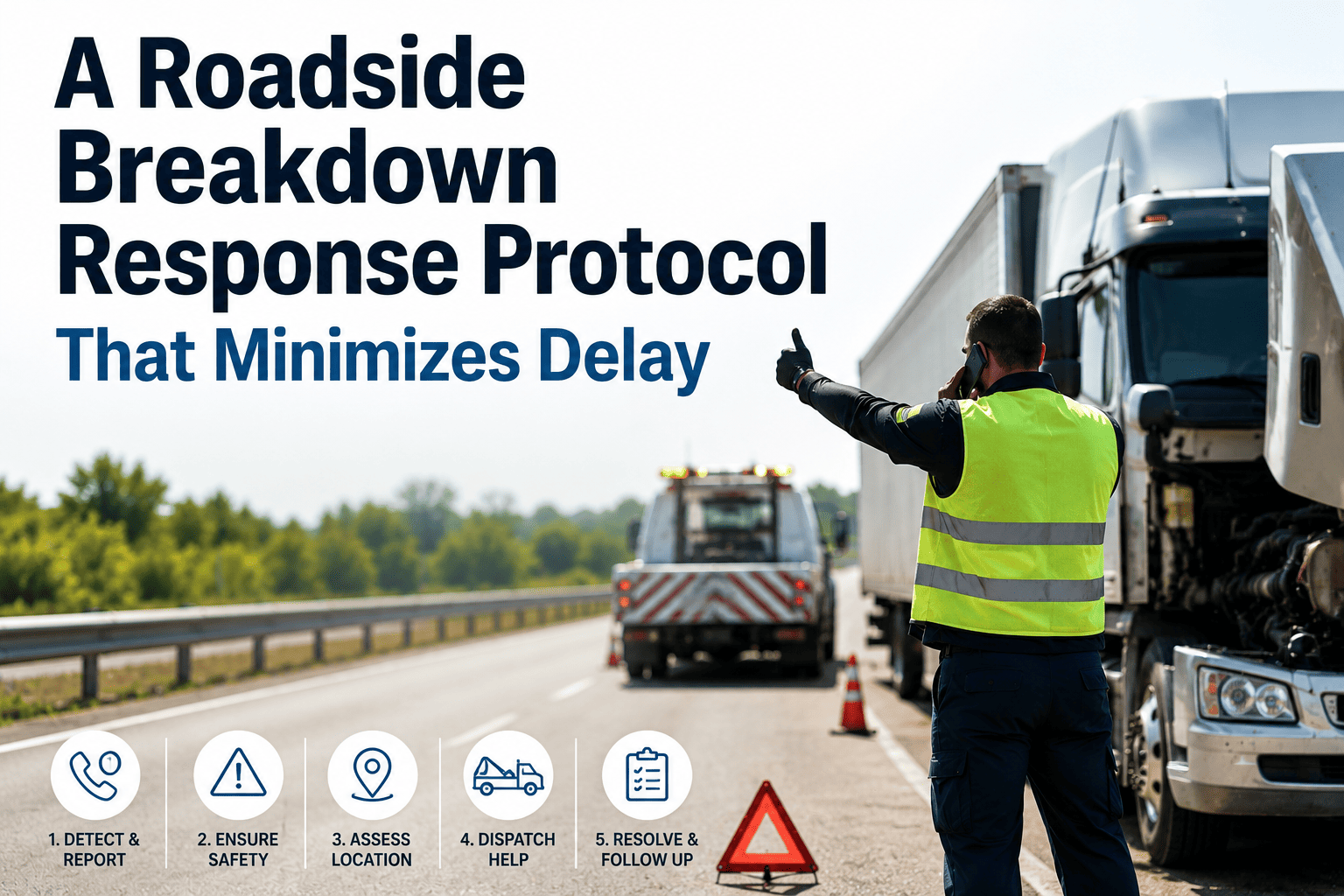
Even the best-maintained fleets experience occasional failures. The difference is how you respond. A documented playbook eliminates decision paralysis and ensures every team member knows exactly what to do—turning a crisis into a systematic 90-minute recovery instead of a 4-hour disaster.
From Roadside Alert to Route Recovery in 90 Minutes
1
0-5 min
Immediate Assessment
Driver activates hazard protocol, moves to safe location
GPS alert with diagnostic codes sent to dispatch automatically
System pulls vehicle's complete maintenance history instantly
With digital tracking: One tap logs the incident with GPS, photos, and fault codes—all timestamped for compliance.
2
5-15 min
Triage & Decision
Dispatcher classifies: Field-repairable vs. Tow-required
Mobile tech dispatched with pre-identified parts from inventory
Preferred vendor contacted with ETA confirmation
With digital inventory: Real-time stock levels show parts availability. Work order auto-assigns to nearest technician.
3
15-30 min
Load Recovery
Remaining stops reassigned to nearest available vehicle
Customer notifications sent for affected deliveries
Work order created with breakdown root cause documentation
With digital compliance: Complete audit trail documents every action for SLA reporting and DOT compliance.
4
30-60 min
Vehicle Resolution
Field repair completed OR vehicle transported to shop
Repair documented with photos, parts used, labor time
Vehicle status updated across all systems
With mobile work orders: Technician closes ticket on phone—parts auto-deducted from inventory, costs auto-calculated.
5
60-90 min
Analysis & Prevention
Incident logged for trend analysis and reporting
Similar vehicles flagged for preventive inspection
PM schedules adjusted based on failure pattern data
With analytics: Dashboard shows breakdown patterns. System auto-adjusts PM triggers to prevent repeat failures.
Trusted by 1,000+ Fleet Operations Worldwide
Stop Reacting to Breakdowns. Start Preventing Them.
Get automated PM scheduling, mobile work orders, real-time parts inventory, and analytics that prove your ROI—all in one platform your team can master in a day.
Designing a Data-Driven Program — A Fleet Management Blueprint with Analytics
The playbook framework only works when backed by data. Every breakdown generates information that should feed back into your prevention strategy. Without centralized tracking, you're guessing which vehicles need attention. With the right system, you're optimizing based on actual failure patterns and cost data.
What Your Fleet Dashboard Should Show You Every Day
94.2%
Vehicle Uptime
Target: 95%
91%
PM Compliance
Target: 95%
$0.18
Cost Per Mile
Industry Avg: $0.20
47 days
Mean Time Between Failures
Target: 60 days
Why This Matters: When PM compliance drops from 95% to 70%, breakdowns increase by 50%. Automated scheduling and mobile checklists keep compliance high without adding administrative burden—technicians complete inspections on their phones, and the system tracks completion automatically.
Fleet managers who see live analytics dashboards immediately understand why spreadsheets can't compete. Real-time visibility into every vehicle's status, upcoming maintenance needs, and cost trends transforms how you make decisions.
The ROI Calculator: Prevention vs. Reaction
Fleet managers often hesitate on software investments because costs are visible while savings feel theoretical. Let's make the math concrete for a typical 25-vehicle regional delivery operation.
Why costs drop dramatically: Automated PM scheduling catches 70% of potential failures before they strand drivers. Mobile work orders eliminate paperwork delays and ensure nothing falls through the cracks. Parts inventory optimization reduces carrying costs by 30%. And when breakdowns do happen, your documented response playbook cuts recovery time in half.
Create, assign, and track work orders from any device. When sensors detect issues, work orders generate automatically with the right parts, procedures, and technician assignments.
Result: 95% of maintenance teams report better planning and execution
Preventive Maintenance Scheduling
Schedule PMs based on mileage, engine hours, calendar dates, or IoT triggers. The system sends reminders, tracks compliance, and auto-escalates missed services.
Result: 50% reduction in breakdowns with 95% PM compliance
Mobile App for Technicians
Technicians receive assignments, access vehicle history, log repairs, and close work orders from their phones—even offline. Photos, signatures, and timestamps create audit-ready documentation.
Result: Field maintenance tracking from anywhere, anytime
Parts & Inventory Management
Track stock levels in real-time, get low-stock alerts, and auto-generate purchase orders. Parts used in repairs automatically deduct from inventory—no manual counting.
Result: 30% reduction in inventory costs, zero critical parts shortages
Analytics & Reporting
Customizable dashboards show equipment health, PM compliance, maintenance costs, and breakdown trends. Export reports for management reviews, insurance, and customer audits.
Result: Data-driven decisions that prove ROI to leadership
Safety & Compliance
Digital DVIRs, inspection checklists, and compliance tracking ensure DOT and OSHA requirements are met. Complete audit trails with timestamps and signatures protect your operation.
Result: Audit-ready documentation, zero compliance surprises
Expert Review: What Separates High-Performing Fleets
"
The fleets that consistently hit their delivery windows aren't the ones with the newest vehicles or the biggest budgets—they're the ones with the best systems. A documented breakdown response playbook combined with preventive maintenance automation transforms a 25-vehicle regional operation into something that runs like a 250-vehicle enterprise. The difference is visibility and automation.
— Based on operational data from 1,000+ fleet implementations
40%
Cost savings when moving from reactive to preventive maintenance
32%
Reduction in unplanned downtime with automated PM scheduling
37%
Increase in mean time between failures after CMMS deployment
250%
Average ROI from CMMS implementation within first 18 months
Your competitors are already preventing the breakdowns you're still reacting to.
Start Preventing Breakdowns Today
Join 1,000+ fleets that have cut downtime by 50%, reduced maintenance costs by 40%, and finally have the data to prove it. Setup takes under an hour. Results show within 30 days.
Rated 4.8/5 by fleet managers99.7% customer satisfactionUsed in 50+ countries
Conclusion: From Reactive Chaos to Predictive Control
Every regional delivery fleet faces the same fundamental challenge: vehicles must run reliably to meet customer commitments. Breakdowns aren't just maintenance problems—they're revenue problems, customer satisfaction problems, and competitive positioning problems.
The math is clear: reactive maintenance costs 3-5x more than prevention. Fleets with structured PM programs experience 50% fewer breakdowns. And the ROI on maintenance management software typically pays back within 90 days.
The technology exists. The frameworks are proven. The only variable is implementation. Start with your breakdown response playbook. Add the automated scheduling and tracking that makes compliance effortless. Build from there—and watch roadside chaos become a problem your competitors have, not you.
How quickly can I get started with digital maintenance management for my fleet?
Most fleets are up and running within 1 hour. The mobile app works on iOS and Android, and your team can start logging work orders immediately. The system is designed so maintenance teams can master it in a day without extensive training. Get started free today—no credit card required, no commitment.
What's the average cost of a roadside breakdown for regional delivery fleets?
The total cost averages $1,500-$2,000 per incident when accounting for all factors: roadside service ($350-$700), repair costs, lost driver productivity ($79/hour), rerouting expenses, and customer impact. Industry data shows vehicle downtime alone costs fleets $448-$760 per day per vehicle. For a 25-vehicle fleet experiencing 38 breakdown events annually, that's over $70,000 in direct costs—before counting emergency premiums and customer compensation.
How much can preventive maintenance actually reduce breakdown frequency?
Fleets with structured preventive maintenance programs consistently experience 50% fewer breakdowns compared to reactive approaches. Moving PM compliance from 70% to 95% correlates directly with this reduction. With predictive maintenance using sensor data, unexpected failures drop by up to 70% as issues are identified 2-4 weeks before component failure. Want to see how this works? Book a quick demo with a fleet specialist who can show you real examples.
Does this integrate with our existing telematics system?
Yes. The platform integrates with major telematics providers and IoT systems. When sensor thresholds are crossed, the system can automatically generate work orders, notify technicians, and track completion. This closes the loop between detection and action—turning raw telematics data into prevented breakdowns. See how integration works in a personalized demo for your specific fleet setup.
What ROI can I expect from implementing a digital maintenance system?
Fleets typically see 200-300% ROI within 12-18 months. Specific returns include: 40% reduction in repair costs by shifting from reactive to preventive maintenance, 30% reduction in parts inventory costs, 25-30% improvement in technician efficiency, and 20% fewer maintenance-related downtime days. For a 25-vehicle fleet, this translates to $50,000-$75,000 in annual savings against a software cost of approximately $3,600/year—a payback period of under 3 months.