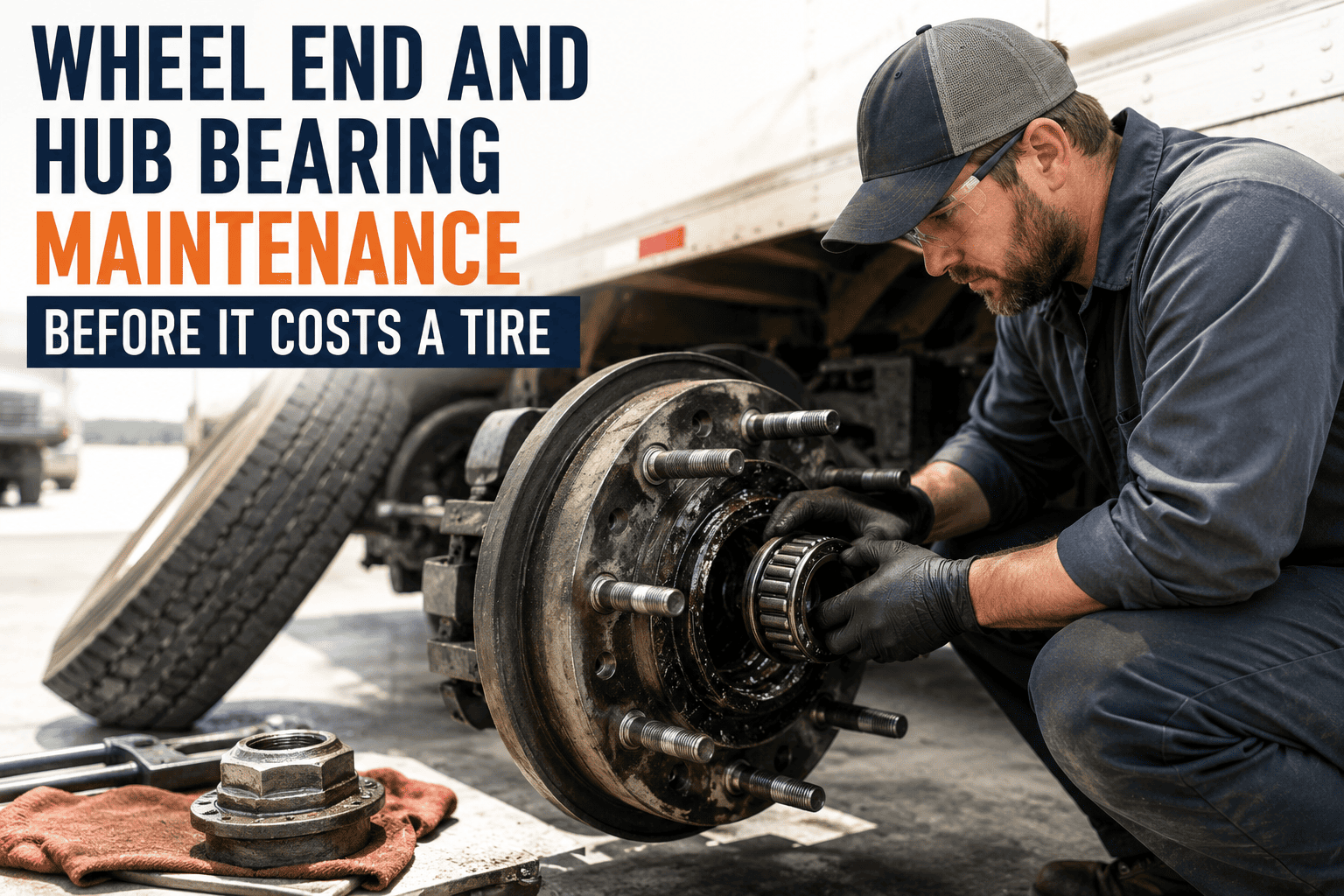
Wheel-off events are among the most catastrophic failures a commercial fleet can experience — a wheel and tire assembly separating at highway speed often causes serious injury or fatality when it strikes a passenger vehicle. Nearly every one of these incidents traces back to wheel-end maintenance failures: improperly torqued lug nuts, worn bearings, failed seals, or improper reassembly after a tire service. The wheel-end assembly (hub, bearing, seal, brake drum or rotor, and wheel) demands scheduled inspection on a mileage-based cycle, and the hub bearing is where premature tire wear quietly begins. Start Free Trial to put torque verification, mileage-based PM triggers, and full wheel-end history behind every asset in your fleet.
A loose wheel doesn't warn you. It leaves the vehicle at 65 mph.
Nearly every wheel-off incident traces back to wheel-end maintenance failures — under-torqued lug nuts, lost lubrication from a failed seal, or improper reassembly after a tire service. The window to catch it is small, and the cost of missing it is measured in lives, liability, and tire wear.
Four root causes behind nearly every wheel-off
Wheel-end failures rarely come from a single defect. They compound — a worn bearing runs hot, a seal weeps, lubrication drops, the race spalls, and the wheel departs the axle. Below are the four failure modes FMCSA data and fleet maintenance records point to most often, ranked by how frequently they initiate the chain.
Improper lug nut torque
Under-torqued nuts loosen over the first 50–100 miles of settling. Over-torqued nuts stretch studs to the yield point and snap them under load. The most preventable cause — and the easiest to fix with a calibrated torque wrench and a verified re-torque.
Worn wheel bearings
Excess bearing endplay lets the rotor drag, the tire scrub, and the hub run eccentrically. The result is irregular tire wear measured in tens of thousands of miles lost per position long before the bearing audibly fails.
Seal failure & lubrication loss
A failed hub seal lets oil or grease escape, starves the bearing of film, and accelerates spalling. A seal should be replaced any time the hub is disassembled — reusing a seal is a documented false economy.
Improper reassembly
Wrong bearing adjustment procedure, missing components, or skipped spindle-nut sequence after a tire service — all are reassembly errors. A torque-check label that makes the last verification visible is the cheapest defense.
The wheel-end service cycle, by mileage
A wheel-end is not a single component — it is a system (hub, bearing, seal, drum, wheel, and tire) that needs layered inspection. The timeline below maps the standard mileage triggers fleets use to keep the assembly in service and out of the breakdown lane.
Lug nut re-torque after any wheel service
Wheels settle in the first 50–100 miles after installation. A verified re-torque compensates for initial embedment and is the single highest-leverage step in preventing wheel-off. In Oxmaint, this step requires a timestamp and technician signature per wheel position.
Hub cap & lubricant inspection during DVIR
During the daily (or weekly for some fleets) Driver Vehicle Inspection Report, the driver or technician checks the hub cap for oil level, leaks, and discoloration — early indicators of bearing heat or seal weep before measurable endplay develops.
Seal inspection at every tire service
Every rotation or replacement touches the hub. This is the natural inspection point for seal integrity and bearing condition. If the hub is disassembled, the seal is replaced — no exceptions. Reusing a pressed seal risks lubrication loss within thousands of miles.
Bearing lubrication or repack (oil-bath hubs)
For oil-bath hubs, lubricant is refreshed or repacked at the 100,000–150,000-mile interval. Contaminated or degraded oil is the silent killer of tapered roller bearings — a $30 service that protects a $1,200 hub assembly and a $600 tire.
Full wheel-end inspection & endplay measurement
At every PM-C service, the full wheel-end is inspected — including bearing endplay measured with a dial indicator. Endplay outside the 0.001–0.005-inch range signals a bearing that is about to cost a tire, or worse.
What a $30 seal costs when it's ignored
When a wheel strikes a passenger vehicle, settlement costs and downtime routinely exceed six figures — before legal fees.
A hub running 0.008" out of spec scrubs the tire footprint continuously — shortening a 200,000-mile tire to under 150,000.
Scheduled repack = a few hours in the bay. Catastrophic bearing failure on the road = towing, spindle damage, and a week of lost revenue.
A 180-truck regional fleet running oil-bath hubs skips the 150,000-mile repack to save service time. Over a year, 12 trucks develop seal weep and bearing spalling — eight are caught at PM-C, four become road wheel-offs. The four incidents cost a combined $310,000 in towing, hub replacement, tire destruction, and one third-party property claim. The repack program they skipped would have cost roughly $21,600 ($120 per truck × 180). Payback was less than one avoided incident.
The hub bearing service formula
Fleet maintenance is a math problem disguised as a mechanical one. The formula below estimates the annual cost of ignoring a structured wheel-end program versus running one — useful when justifying the program to operations.
| Program scenario | Annual program cost | Avoided costs | Net annual savings | Payback |
|---|---|---|---|---|
| No structured wheel-end PM | $0 | $0 | — | — |
| Repack + seal replace at interval | $21,600 | $94,000 | $72,400 | ~11 weeks |
| Full program + torque verification | $38,400 | $288,000 | $249,600 | ~7 weeks |
Wheel-end PM checklist for technicians
Print it, laminate it, build it into the CMMS — but use it on every wheel-end touch. These are the inspection items that catch the failure chain before it leaves the bay.
At every wheel service
- Torque all lug nuts to spec with a calibrated wrench
- Apply torque-check inspection label per wheel position
- Schedule verified re-torque at 50–100 miles post-service
- Inspect seal for weep, hardening, or displacement
- Replace seal if hub was disassembled — no reuse
At PM-C service
- Measure bearing endplay with dial indicator (0.001–0.005")
- Inspect hub cap, oil level, and lubricant condition
- Check spindle nut and washer for wear or galling
- Inspect brake drum/rotor for heat-related distortion
- Log every touch to the asset's wheel-end history
Myth vs. reality in wheel-end maintenance
| Common belief | What actually happens |
|---|---|
| "If it's torqued once, it's torqued for good." | Lug nuts settle in the first 50–100 miles. Without a verified re-torque, ~15% of wheels run loose within the first week of service. |
| "An impact gun set to the right PSI is fine." | Impact guns vary wildly with air pressure, joint stiffness, and operator technique. A calibrated torque wrench is the only defensible tool. |
| "The seal looked okay, so we reused it." | A pressed seal is deformed on removal. Reused seals fail prematurely — replacement is cheaper than the bearing it protects. |
| "Bearing noise is the first sign of wear." | By the time a bearing is audible, the race is spalling. Endplay measurement catches the wear thousands of miles earlier. |
Stop logging wheel-ends on paper. Start catching them in the CMMS.
Oxmaint triggers wheel-end PM by mileage per position, requires timestamped torque verification, and tracks every wheel-end touch per vehicle — so the next failure is caught in the bay, not on the highway.
Wheel-end maintenance, answered
What mileage interval should I use for wheel bearing lubrication?
For oil-bath hubs, lubrication or repack at 100,000–150,000 miles is the industry-standard range. Grease-packed bearings may follow different intervals. The key is logging the service per position so no axle slips past the window — Oxmaint triggers the PM automatically by mileage per wheel position.
Why is a re-torque at 50–100 miles so critical after a wheel service?
Lug nuts embed into the wheel and drum surfaces in the first miles of operation, reducing clamp load. A verified re-torque at 50–100 miles restores the spec torque and catches any nut that has already loosened. Skipping this step is the most common precursor to a wheel-off event.
When should a hub seal be replaced versus inspected?
Inspect the seal at every tire service. Replace it any time the hub is disassembled — a pressed seal deforms on removal and will not reseal reliably. The seal costs a few dollars; the bearing it protects can cost over a thousand, plus the tire it ruins through irregular wear. Start Free Trial to enforce seal replacement rules in your PM workflow.
How does bearing endplay relate to tire wear?
Excess endplay lets the hub shift laterally under load, which tilts the tire footprint and causes irregular, scalloped, or edge wear. A bearing running 0.008" out of spec can reduce tread life by 25% or more before the driver notices any handling change. Measuring endplay at PM-C catches this early.
Can a digital system really prevent wheel-off incidents?
Yes — by enforcing the steps that paper logs miss. Oxmaint requires a timestamped torque verification and technician signature per wheel position, tracks full wheel-end history per vehicle, and flags any position overdue for PM. Book a Demo to see the audit trail in action.
Put every wheel-end under accountability.
Mileage-triggered PM, torque verification with signatures, and a complete wheel-end history per asset — built for fleets that can't afford a wheel-off.
Free 14-day trial · No credit card