
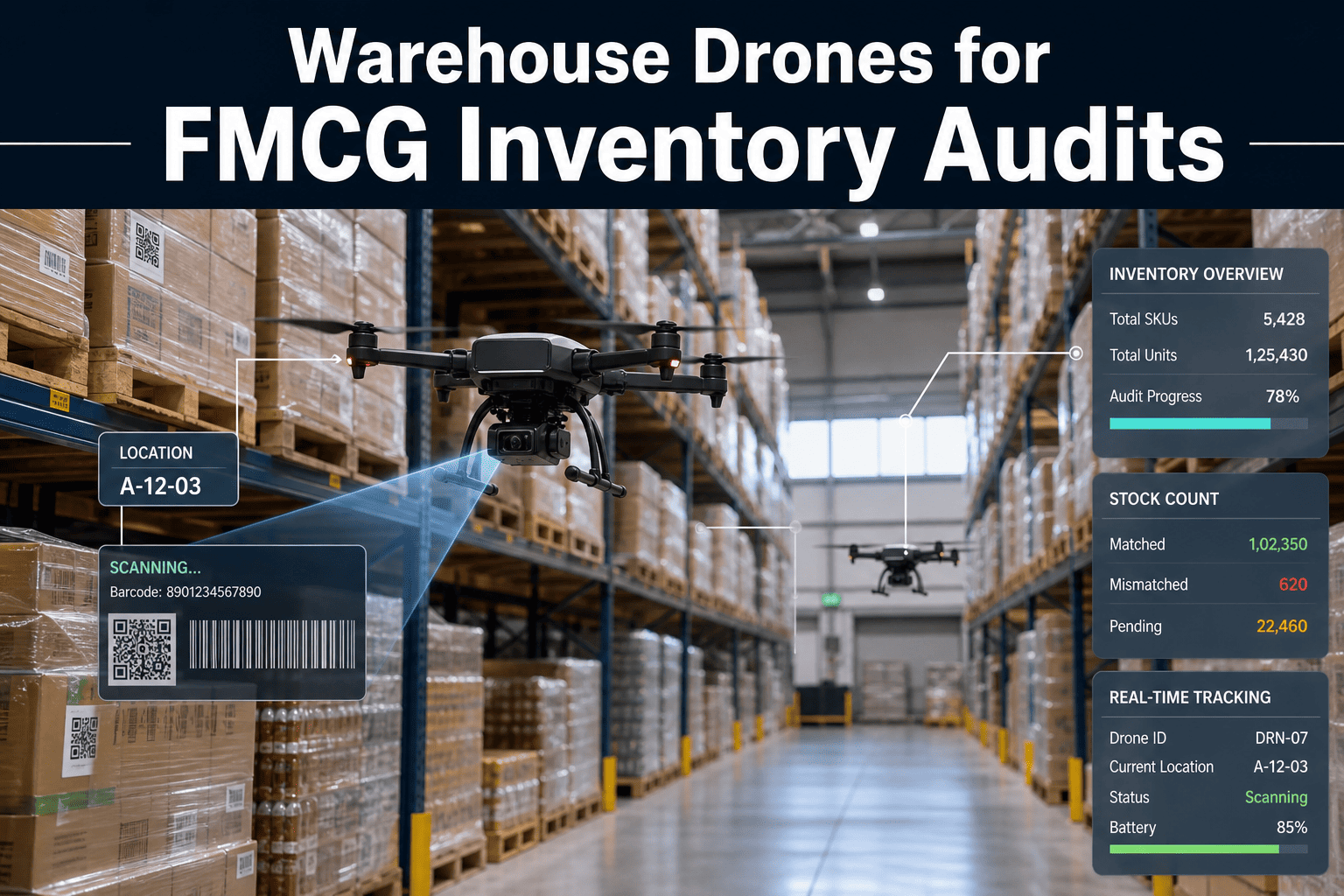
It's 2:00 AM in a 750,000 square-foot FMCG distribution center. The quarterly inventory audit begins—14 workers on scissor lifts and forklifts, spending the next 72 hours counting 180,000 SKUs stacked 40 feet high. By completion, the operation will cost $127,000 in labor, halt 23% of picking operations, and still achieve only 94% accuracy due to human error and inaccessible locations. Three workers will report near-miss incidents from elevated work.
This scenario repeats across FMCG supply chains where inventory accuracy directly impacts service levels, working capital, and customer satisfaction. The emergence of autonomous drone inventory systems promises to transform this calculus—completing the same audit in 8-12 hours with 99.5% accuracy, zero elevated work risks, and minimal operational disruption. But is drone deployment truly feasible for your warehouse environment?
This feasibility study examines the technical requirements, operational considerations, safety protocols, and ROI frameworks necessary to evaluate drone inventory audit deployment in large FMCG facilities. Organizations exploring this technology can start with free flight scheduling and safety checklist management to establish the operational foundation for drone integration.
Ready to evaluate drone inventory feasibility for your FMCG warehouse?
Build the operational foundation with flight scheduling and safety protocols before deployment.
Feasibility Assessment Framework
Evaluating drone inventory audit feasibility requires systematic analysis across four critical dimensions: facility compatibility, technical requirements, operational integration, and financial viability. Each dimension contains specific criteria that determine deployment success probability and expected ROI timelines.
Technical Requirements: Drone Selection & Sensor Configuration
FMCG warehouse drone inventory systems require specific hardware configurations optimized for indoor high-bay environments, barcode scanning accuracy, and operational safety. Sensor selection directly impacts inventory accuracy rates, scan speeds, and integration complexity with existing warehouse management systems.
| Drone Category | Payload Capacity | Flight Time | Best Application | Cost Range |
|---|---|---|---|---|
| Micro Indoor Drones | 50-150g | 15-20 min | Narrow aisles, light sensors only | $8,000-$15,000 |
| Standard Indoor Drones | 200-500g | 25-35 min | Most FMCG applications, balanced capability | $25,000-$45,000 |
| Heavy-Lift Indoor Drones | 500g-1.5kg | 20-30 min | Multiple sensor arrays, RFID readers | $50,000-$85,000 |
| Tethered Drone Systems | 1-3kg | Unlimited | Fixed-zone continuous scanning | $75,000-$120,000 |
Sensor Selection Matrix
Best for: Standard barcode/QR scanning in well-lit environments with consistent label placement
Best for: High-value FMCG items, pallet-level tracking, facilities with existing RFID infrastructure
Best for: Empty slot detection, volumetric measurement, navigation in complex environments
Best for: Temperature-sensitive FMCG, cold storage audits, equipment anomaly detection
Flight Path Planning & Autonomous Navigation
Efficient flight path planning determines audit completion time, battery utilization, and scanning coverage. FMCG warehouses require flight planning software that optimizes routes based on rack configurations, SKU density, and operational constraints while maintaining safety clearances from personnel and equipment.
Create 3D digital twin of warehouse using LiDAR scan. Map rack locations, aisle widths, obstacle positions, and no-fly zones. Typical FMCG facility requires 4-8 hours for initial mapping.
Divide warehouse into flight zones based on ceiling height, rack density, and operational areas. Each zone receives priority rating based on SKU velocity and audit frequency requirements.
Algorithm calculates optimal flight paths minimizing travel distance while maximizing scan coverage. Accounts for battery swap stations, charging locations, and return-to-base protocols.
Integrate flight schedules with warehouse operations calendar. Coordinate with shift changes, receiving windows, and picking operations to minimize interference with daily activities.
Onboard AI adjusts flight paths dynamically based on obstacle detection, personnel proximity, and changing conditions. Emergency landing protocols activate automatically when safety thresholds breach.
Safety Protocols & Compliance Checklists
Safety represents the primary implementation barrier for indoor drone operations. Comprehensive safety protocols must address personnel protection, equipment safeguards, emergency procedures, and regulatory compliance. Facilities implementing digital safety management through CMMS platforms achieve 94% higher compliance rates than paper-based systems.
Compliance Reality: OSHA does not currently have specific regulations for indoor commercial drones, but general duty clause obligations apply. Document all safety protocols, training records, and incident reports to demonstrate due diligence. Centralize safety documentation with digital checklists that create audit-ready compliance trails automatically.
Build your safety protocol foundation before drone deployment
Digital checklists ensure 94% higher compliance rates and create defensible audit trails.
ROI Analysis & Financial Modeling
Financial feasibility requires detailed analysis of current audit costs, projected savings, implementation investments, and ongoing operational expenses. FMCG facilities with high-bay storage and frequent inventory cycles typically achieve the strongest ROI profiles due to elevated manual audit costs and accuracy improvement opportunities.
Implementation Roadmap
Successful drone inventory implementation follows a structured 16-20 week deployment timeline from initial assessment through full production operation. Each phase includes specific deliverables, decision gates, and success criteria that must be validated before proceeding.
Complete feasibility scoring matrix assessment
Conduct facility survey and create 3D mapping specifications
Define technical requirements and vendor evaluation criteria
Develop business case with ROI projections for approval
Establish project governance and resource allocation
Issue RFP to qualified drone inventory solution providers
Conduct vendor demonstrations and reference checks
Negotiate contracts including SLAs and support terms
Order hardware, software licenses, and integration services
Begin operator training curriculum development
Install charging stations and control room infrastructure
Complete facility 3D mapping and flight path programming
Configure WMS integration and inventory update hooks
Implement safety protocols and digital checklist systems
Conduct operator certification training (40+ hours)
Execute limited-zone pilot audits with manual verification
Validate accuracy rates against established benchmarks
Refine flight paths based on operational learnings
Document issues and implement corrective actions
Develop production operating procedures and KPIs
Expand drone operations to full facility coverage
Transition to production audit schedule (weekly/monthly)
Establish ongoing maintenance and calibration routines
Implement continuous improvement feedback loops
Document ROI realization and plan multi-site expansion
Risk Assessment Matrix
Every drone implementation carries inherent risks that must be identified, assessed, and mitigated before deployment. The following matrix categorizes risks by probability and impact, providing mitigation strategies for each scenario.
Impact: Injury, regulatory action, program shutdown
Mitigation: Comprehensive training, redundant safety systems, flight zone restrictions, emergency protocols
Impact: Inventory data inconsistency, delayed ROI realization
Mitigation: Early integration testing, vendor collaboration, manual reconciliation fallback
Impact: Reduced ROI, continued manual verification required
Mitigation: Pilot validation, sensor upgrades, lighting improvements, label standardization
Impact: Slow adoption, workaround behaviors, cultural friction
Mitigation: Change management program, early stakeholder involvement, clear communication
Impact: Increased maintenance costs, audit delays
Mitigation: Spare units, preventive maintenance schedule, vendor support SLAs
Impact: Compliance requirements, operational modifications
Mitigation: Industry association monitoring, flexible system design, legal consultation
CMMS Integration: Inventory Update Hooks
Drone inventory data creates maximum value when integrated directly with maintenance management systems. Inventory update hooks enable automatic work order generation when discrepancies are detected, connecting scan results to asset tracking, spare parts planning, and compliance documentation.
Barcode/RFID/LiDAR capture
Image recognition, data validation
Analytics, discrepancy detection
Inventory record sync
Work orders, asset tracking
When drone detects damaged inventory, missing items, or location discrepancies, CMMS automatically creates investigation work orders with location data and photos attached.
Equipment and MHE assets tagged with RFID update their location records automatically during drone flights, improving asset utilization visibility.
Inventory levels of maintenance parts and consumables feed directly into spare parts planning systems, automating reorder point notifications.
Every scan creates timestamped compliance logs stored in CMMS, providing audit-ready documentation for food safety and regulatory inspections.
"We piloted drone inventory in our 650,000 square-foot facility last year. The technology works—we achieved 99.4% accuracy versus 93% with manual counts. But the real insight was operational. Our quarterly audits now happen monthly with less disruption. We catch shrinkage faster, cycle count exceptions dropped 67%, and we eliminated all elevated work injuries in inventory operations. The key is integration—standalone drone data has limited value. When scans flow directly into your WMS and CMMS, the entire supply chain benefits from real-time visibility. Don't underestimate the change management component. Our warehouse team needed significant reassurance that drones were augmenting their work, not replacing them."
Conclusion: Making the Feasibility Decision
Drone inventory audits represent a viable and increasingly mature technology for large FMCG warehouses with high-bay storage, frequent audit requirements, and committed safety cultures. Facilities scoring 70+ on the feasibility matrix should proceed to pilot planning, while those scoring 50-69 should address specific gaps before investment. The financial case is compelling—typical payback periods of 12-18 months with ongoing annual savings exceeding initial investment values.
Success requires more than technology procurement. Flight scheduling integration, comprehensive safety checklists, and inventory update hooks connecting drone data to maintenance workflows determine whether implementations achieve projected ROI or become expensive experiments. Start building your operational foundation with free flight scheduling and safety checklist tools to establish the systems infrastructure drone programs require.
Build the operational foundation for drone inventory success
Flight scheduling, safety checklists, and inventory hooks—start with the systems that make drone ROI achievable.
Frequently Asked Questions
Generally, facilities exceeding 200,000 square feet with significant high-bay storage (40%+ of locations above 15 feet) achieve the strongest ROI. Smaller facilities may still benefit if they conduct frequent audits, have challenging access conditions, or experience high shrinkage rates. The break-even calculation depends on current audit costs—if spending more than $60,000 annually on inventory counts, drone systems typically achieve positive ROI within 18-24 months regardless of facility size.
Modern drone inventory systems use multi-angle scanning approaches, capturing images from multiple positions as they traverse aisles. AI-powered image recognition can identify barcodes and products even when partially obscured or at non-standard angles. However, label standardization significantly improves accuracy—facilities achieving 99.5%+ accuracy typically have consistent label placement standards and adequate barcode size for camera resolution. RFID-tagged inventory eliminates many optical scanning challenges entirely.
Most drone inventory systems require 40-80 hours of operator training covering flight operations, safety protocols, emergency procedures, and basic troubleshooting. Operators don't need traditional pilot certification for indoor commercial drones (Part 107 exemptions apply to enclosed facilities), but should complete manufacturer certification programs. Ongoing proficiency requirements typically include quarterly recertification and documented flight hours. Organizations should plan for 2-3 certified operators per facility to ensure coverage and redundancy.
Advanced drone systems are designed for concurrent operation with warehouse activities, using zone-based scheduling and real-time obstacle avoidance. However, most facilities initially implement drone audits during reduced-activity periods (overnight shifts, weekends) while building operational confidence. Full concurrent operation requires sophisticated flight path management, comprehensive personnel notification systems, and mature safety protocols. Expect 6-12 months of operational experience before achieving true 24/7 concurrent capability.
Indoor commercial drone operations in enclosed facilities fall outside FAA Part 107 requirements since they don't operate in National Airspace. However, OSHA general duty clause obligations require employers to provide safe working conditions, meaning comprehensive safety protocols, training documentation, and incident response procedures are essential. Some insurance carriers have specific requirements for commercial drone operations—consult your risk management team early in feasibility assessment. Local fire codes may also impose restrictions on battery charging and storage.


-in-fmcg-implementation-guide-&-best-practices.png)
-for-last-mile-fmcg-delivery-benefits-and-challenges.png)
