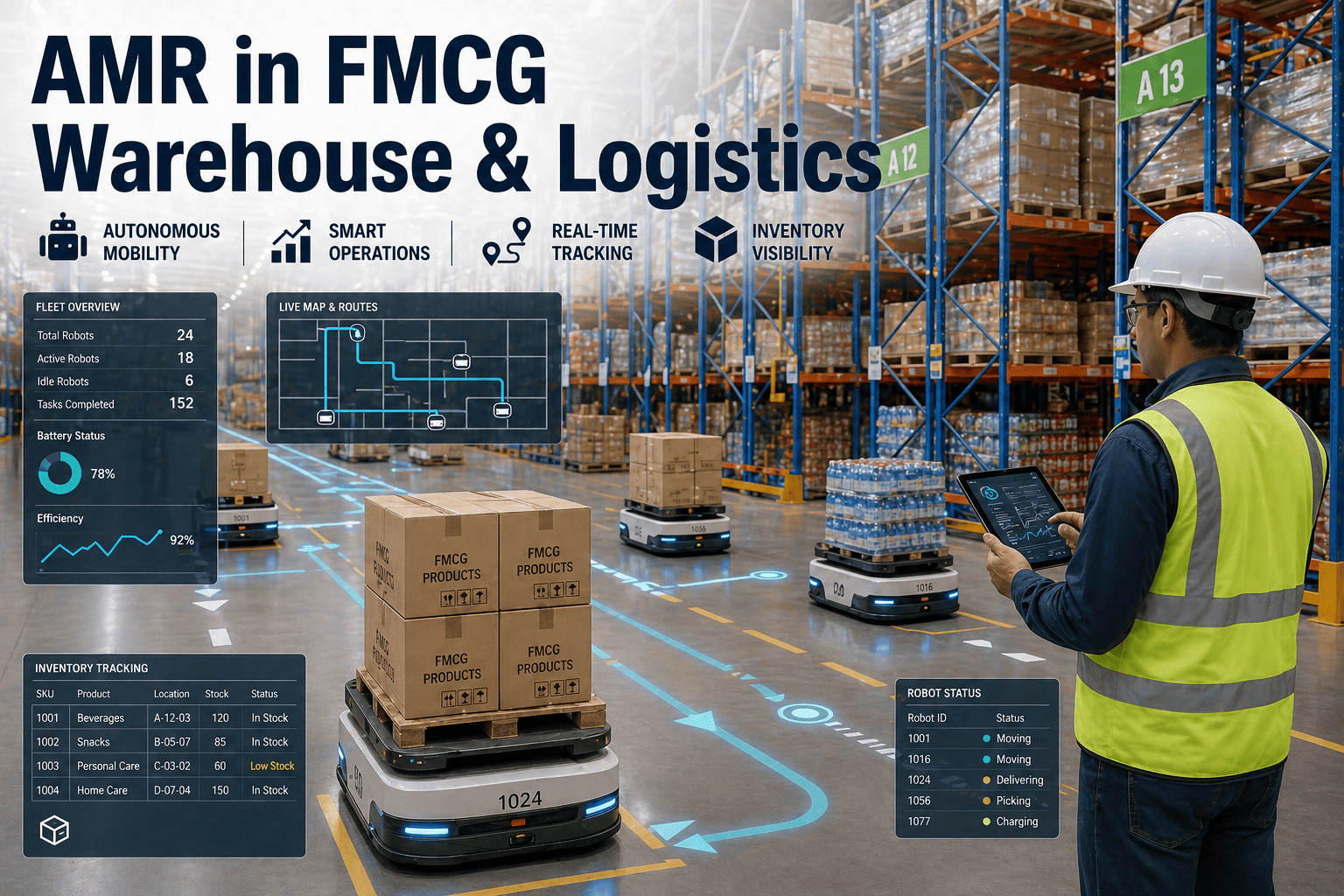
An FMCG distribution centre in Pune deployed 12 autonomous mobile robots to move raw materials from receiving to production staging — replacing forklift-dependent material delivery that averaged 22 minutes per request. The AMRs reduced material delivery time to 6 minutes, eliminated 4 forklift-related near-miss incidents per month, and freed 3 forklift operators for higher-value roles. Then, 4 months after deployment, AMR uptime dropped from 97% to 81% because nobody had built a maintenance programme for the robots. Wheel tread wear went unmonitored until units started slipping on the warehouse floor. LiDAR sensors accumulated dust that degraded navigation accuracy. Battery health declined 15% because charging protocols were not optimized. The AMR fleet was delivering transformational value — until maintenance neglect eroded it. This guide covers both sides: how AMRs eliminate the material handling bottlenecks that cost FMCG warehouses $200K–$600K annually in idle time and labour waste, and how to maintain AMR fleets at 97%+ uptime so the value is permanent. Start your free trial to track AMR fleet health alongside all your warehouse and production assets. Book a demo to see OxMaint's Robotics and Cobot Maintenance Tracking module managing AMR fleets.
Robotics & Cobot Maintenance Tracking
Your AMR Fleet Deserves the Same Maintenance Intelligence as Every Production Asset
OxMaint tracks AMR wheel wear, LiDAR health, battery cycles, navigation accuracy, and PM schedules in one unified dashboard — alongside forklifts, conveyors, and production equipment.
60–80%
reduction in material-related idle time when AMRs replace forklift-dependent delivery
97%+
AMR fleet uptime achievable with structured maintenance — vs 81% without it
$200K–$600K
annual savings from AMR deployment in a mid-size FMCG warehouse operation
The Problem AMRs Solve: Material Handling Is the Hidden Bottleneck
In most FMCG warehouses, production lines do not stop because equipment fails — they stop because materials arrive late. A filler waiting 22 minutes for the next pallet of preforms is not a filler problem. It is a material delivery problem. And that delivery depends on a forklift operator who is simultaneously servicing 3–5 other requests, navigating congested aisles, and taking mandatory breaks. The result: 45–90 minutes of material-related idle time per production shift, per line — time when equipment is ready to run but waiting for raw materials, packaging, or components that a human-driven logistics chain cannot deliver fast enough.
Average delivery time per request
22 min
6 min
Requests served simultaneously
1 per operator
Fleet-optimized routing
Idle time per line per shift
45–90 min
8–15 min
Safety incidents per month
3–6 near-misses
Near-zero
Night shift performance
30% slower (fatigue)
Identical to day shift
Scalability
Hire + train (6–8 weeks)
Deploy unit (1–2 days)
The 60–80% reduction in material-related idle time is the primary financial driver of AMR deployment. On a production line valued at $800–$1,200 per hour, recovering 45 minutes of idle time per shift translates to $200K–$400K in annual production value per line — from a fleet investment of $150K–$300K that pays for itself in 6–12 months. The secondary benefits — safety improvement, labour reallocation, and night shift consistency — add another $100K–$200K in annual value.
Five AMR Applications Transforming FMCG Warehouses
AMRs are not general-purpose vehicles — each application has specific payload, navigation, and integration requirements. These five applications account for 90% of AMR deployments in FMCG warehouse and distribution operations.
01
Raw Material to Production Staging
AMRs pick pallets from receiving and deliver to production line staging areas on demand. WMS triggers delivery automatically when staging inventory drops below threshold — eliminating the radio call to forklift operators and the queuing delay that follows.
Impact: 70% reduction in line-starve events
02
Finished Goods to Shipping Dock
AMRs transport completed pallets from end-of-line wrapping to shipping dock staging lanes. Continuous flow eliminates the bottleneck where finished goods accumulate at the wrapper faster than forklifts can clear them — preventing upstream line slowdowns.
Impact: 40% increase in dock throughput
03
Packaging Material Replenishment
Dedicated AMRs deliver cartons, labels, shrink film, and pallets to packaging lines on a continuous loop. Pre-staged materials arrive 10–15 minutes before the current supply runs out — preventing the changeover delay caused by "materials not ready."
Impact: 85% reduction in packaging material wait time
04
Spare Parts Delivery to Maintenance
When a CMMS work order is created, the AMR fleet automatically picks the required spare part from the storeroom and delivers it to the maintenance technician's location — reducing MTTR by eliminating the 15–25 minute walk-to-storeroom delay.
Impact: 25% MTTR reduction from eliminated parts retrieval time
05
Waste and Scrap Removal
AMRs collect reject bins, waste containers, and recyclable materials from production zones on scheduled loops — maintaining clean work areas without dedicating forklift capacity to non-productive material movement.
Impact: 100% forklift capacity freed from waste handling
The spare parts delivery application deserves special attention for maintenance leaders. When a bearing fails on Line 3 and the technician needs a replacement, the traditional path is: diagnose failure, walk to storeroom (8 min), locate part (5 min), sign out part (3 min), walk back (8 min) — 24 minutes of non-repair time before wrench time begins. With AMR-integrated CMMS, the technician creates the work order, selects the part, and the AMR delivers it to the line in under 6 minutes while the technician continues diagnostic work. That 18-minute reduction multiplied by 3–5 emergency repairs per week adds up to 4,700+ minutes of recovered wrench time annually.
CMMS + AMR Integration
Work Order Created. Part Picked. AMR Delivers. Technician Never Leaves the Line.
OxMaint integrates with AMR fleet management systems to automatically trigger spare part delivery when a maintenance work order is created — cutting MTTR by eliminating the storeroom walk entirely.
AMR Fleet Maintenance: The Six Components That Determine Uptime
AMRs are designed for 50,000+ operating hours — but only if they are maintained. The six component categories below account for 95% of AMR downtime events. A structured PM programme covering all six keeps fleet uptime above 97%. Without it, uptime degrades to 80–85% within 6 months as wear accumulates across wheels, sensors, and batteries simultaneously.
Drive Wheels
Tread wear causing traction loss on smooth or wet warehouse floors — leads to positioning errors and missed delivery windows
Tread depth measurement at 4 points per wheel, visual inspection for cuts and flat spots
Weekly
LiDAR Sensors
Dust accumulation on lens reducing detection range and accuracy — causes navigation hesitation, speed reduction, and path errors
Lens cleaning with lint-free wipes, detection range verification against known reference
Weekly
Battery Pack
Capacity degradation from suboptimal charging cycles — reduces operating range per charge and increases fleet idle percentage
Charge/discharge cycle logging, capacity test, contact cleaning, temperature monitoring during charge
Monthly
Safety Systems
Bumper sensor desensitization, emergency stop latch wear, safety-rated scanner degradation
Full functional test of all safety sensors, E-stop test, scanner zone verification
Weekly
Navigation Software
Map drift from warehouse layout changes (new racking, moved pallets), firmware bugs from missed updates
Map accuracy verification, firmware update check, path optimization review
Monthly
Lift / Payload Mechanism
Hydraulic or scissor lift wear, fork tine damage, pallet sensor misalignment causing failed picks
Lift cycle test at rated payload, fork alignment check, pallet sensor verification
Monthly
Wheel wear is the highest-frequency maintenance item and the one most plants neglect. A polyurethane drive wheel on a warehouse floor loses 0.5–1.0mm of tread per 1,000 operating hours. Below 60% of original tread depth, traction drops measurably — the AMR slips during acceleration and braking, positioning accuracy degrades, and the fleet management system compensates by reducing speed. This self-imposed speed reduction is invisible to operators but reduces fleet throughput by 15–25%. Weekly tread measurement and condition-based replacement maintains full speed performance throughout the wheel's service life.
The Economics: AMR Fleet ROI for FMCG Warehouses
Recovered production time
$285K/yr
Labour reallocation (3 FTEs)
$148K/yr
Safety incident reduction
$78K/yr
Night shift consistency gain
$62K/yr
MTTR reduction (parts delivery)
$38K/yr
AMR fleet (12 units) + integration$240,000
Annual value delivered$611K
2.5x ROI in Year 1 — Payback in 4.7 Months — Value Compounds as Fleet Expands
The ROI accelerates after year one because the fleet investment is fixed while the value compounds. Adding application #4 (spare parts delivery) and #5 (waste removal) to an existing fleet requires zero additional AMRs — only software configuration. Plants that start with raw material delivery typically expand to 3–4 applications within 12 months, increasing annual value from $611K to $800K–$1M without additional hardware investment.
Fleet Health Dashboard: What to Monitor in Real Time
AMR fleet management requires a different monitoring approach than traditional equipment. Instead of monitoring individual machines in isolation, fleet health monitoring tracks the collective performance of the robot fleet as a system — because a single underperforming unit affects the throughput of the entire fleet.
Fleet Uptime %
Target: 97%+
Percentage of fleet units available for tasking at any given moment. Below 95% indicates deferred PM backlog. Below 90% triggers fleet capacity review.
Avg Delivery Time
Target: <8 min
Mean time from task assignment to delivery completion. Rising trend indicates navigation degradation, wheel wear, or traffic congestion at intersections.
Battery Health Index
Target: 85%+ capacity
Average remaining battery capacity across fleet. Below 80% means units return to charge more frequently — reducing effective fleet size by 10–15%.
Navigation Accuracy
Target: ±10mm positioning
Pallet pick/place positioning error rate. Rising errors indicate LiDAR contamination, map drift, or wheel traction loss requiring immediate PM.
Safety Events / Week
Target: 0
Emergency stops, bumper contact events, and near-miss logs. Any non-zero count triggers root cause investigation — sensor degradation is the most common cause.
PM Compliance %
Target: 95%+
Percentage of scheduled fleet PM tasks completed on time. Below 90% predicts uptime decline within 30–60 days as deferred wear accelerates.
Implementation: 60-Day AMR Deployment + Maintenance Setup
Week 1–2
Warehouse Assessment and Application Selection
Map warehouse layout, measure aisle widths, identify material flow paths and traffic patterns. Select highest-ROI application (typically raw material to production staging). Size fleet: 1 AMR per 2–3 delivery points for continuous coverage.
Week 3–4
Fleet Deployment and Map Training
Install charging stations, deploy AMR fleet, drive mapping runs to build warehouse navigation map. Configure pick/drop locations, traffic rules, and intersection priorities. Integrate with WMS for automatic task triggering.
Week 5–6
Parallel Operation and PM Programme Build
Run AMR fleet alongside existing forklift operations for 2 weeks. Register every AMR unit as an individual asset in CMMS with model, serial, battery ID, and wheel specs. Build PM templates for all 6 component categories with weekly, monthly, and quarterly schedules.
Week 7–8
Full Cutover and Fleet Health Dashboard
Transition primary material flow to AMR fleet. Redeploy forklift operators to secondary tasks. Launch fleet health dashboard with 6 KPIs. First PM cycle completed. Baseline fleet uptime, delivery time, and battery health established for ongoing tracking.
Frequently Asked Questions
Robotics & Cobot Maintenance Tracking
Deploy AMRs. Maintain Uptime. Deliver Value Permanently.
60 Days
to full deployment
Trusted by FMCG warehouse and maintenance teams managing AMR fleets. No credit card required.