A warehouse manager discovers 14,000 units of a seasonal SKU sitting in the wrong aisle three days before a Walmart promotional deadline. A grocery distribution center ships 6% fewer cases than invoiced because the WMS count diverged from physical reality two weeks ago. A cosmetics fulfillment center writes off $380,000 in shrinkage that nobody can explain because the last full count happened in October. These are not edge cases — they are the daily reality of FMCG inventory management in facilities still dependent on annual physical counts and cycle-count teams that cover 2% of locations per week. Autonomous inventory robots scanning every aisle every night change this equation completely, delivering perpetual accuracy that manual methods cannot match. See how Oxmaint schedules and tracks robotic scan cycles — Book a Demo.
Inventory Accuracy Maturity
From annual counts to perpetual real-time visibility
Annual Physical Count
- Accuracy degrades daily after count
- Operations halted for 2-3 days
- Labor-intensive and error-prone
- Shrinkage discovered months late
Manual Cycle Counting
- 2-5% of locations counted weekly
- Relies on team availability
- Inconsistent scan quality
- Gaps in coverage across shifts
Autonomous Robot Scanning
- 100% of locations scanned nightly
- Zero labor hours consumed
- Consistent data quality every scan
- Shrinkage detected within 24 hours
The Business Case: Inventory Accuracy by the Numbers
Inventory inaccuracy is not an operations inconvenience — it is a direct profit leak. FMCG companies operating below 95% inventory accuracy experience higher stockout rates, increased expedited shipping costs, and retailer chargebacks that compound into millions of dollars annually. The gap between what the WMS says and what actually sits on the shelf is the gap between forecast and reality, and autonomous inventory robots close it permanently. Track scan coverage and accuracy trends in Oxmaint — Sign Up Free.
Global inventory distortion cost annually
Stockout reduction with perpetual accuracy
Shrinkage identified faster with nightly scans
Location accuracy achieved with autonomous robots
How Autonomous Inventory Robots Work
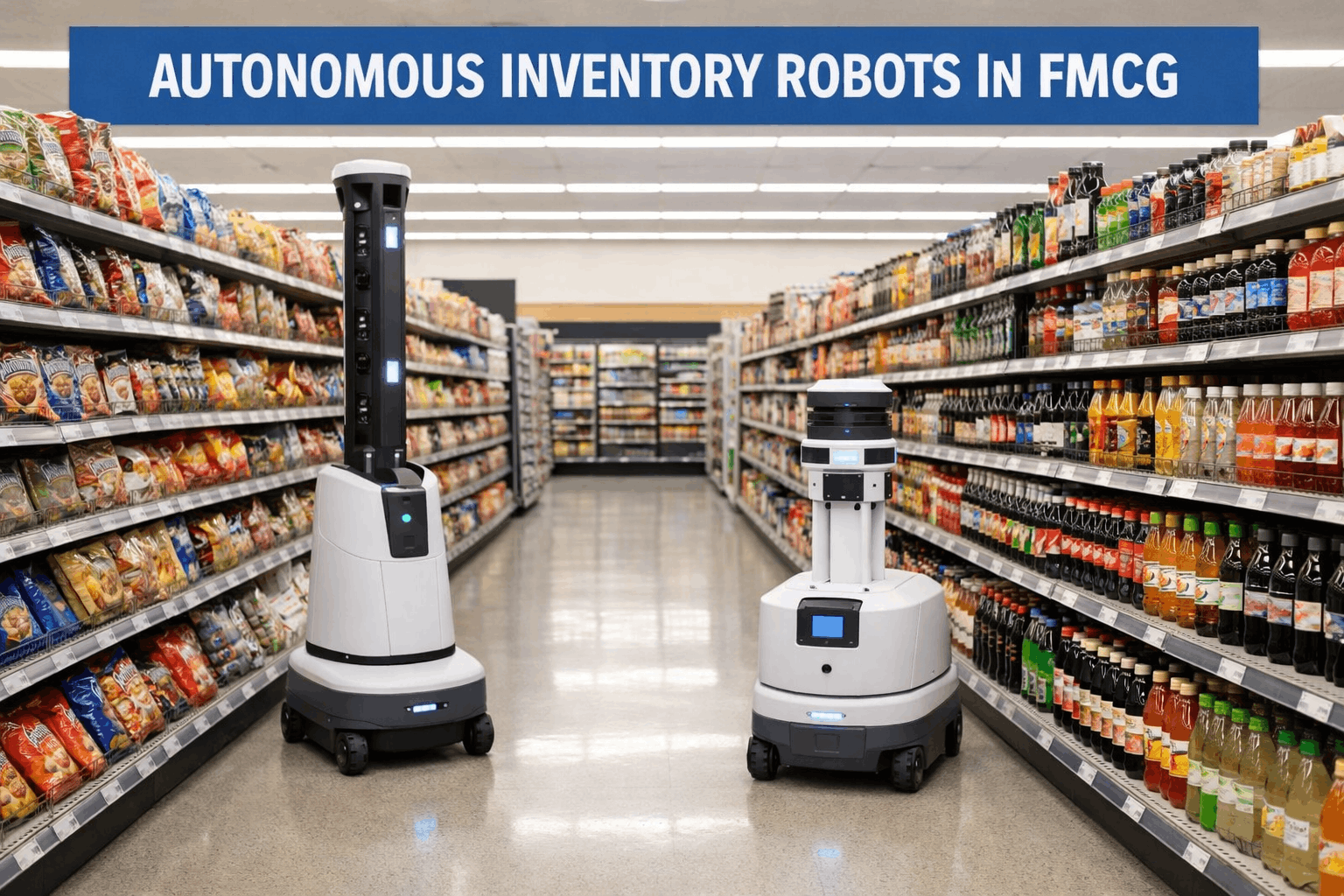
Autonomous inventory robots are not remote-controlled drones or scanner-on-a-stick devices pushed by associates. They are fully self-navigating platforms equipped with multiple sensor arrays — RFID readers, barcode scanners, depth cameras, and weight estimation sensors — that patrol warehouse aisles and retail floors on scheduled routes, capturing inventory data at a speed and consistency that human teams cannot replicate. Oxmaint manages robot scan schedules and maintenance — Book a Demo.
RFID Bulk Scanning
UHF RFID antennas read 500-1,000 tags per second while the robot moves at walking speed. Captures pallet-level and case-level inventory without line-of-sight requirements.
Computer Vision Shelf Audit
AI vision cameras photograph every shelf face and identify products by label, packaging shape, and planogram position. Detects out-of-stocks, misplaced items, and pricing errors.
3D Depth Mapping
LiDAR and structured-light sensors create volumetric maps of rack locations, estimating pallet fullness and case counts even for unlabeled or partially obscured inventory.
Autonomous Navigation
SLAM-based navigation maps the facility and replans routes dynamically around forklifts, pallets, and personnel. Operates safely during active warehouse hours or after close.
From Scan to Action: The Integrated Inventory Workflow
An autonomous robot that scans every aisle but cannot trigger replenishment, flag discrepancies, or generate investigation tickets is an expensive data collector. The value emerges when scan results flow directly into your WMS, ERP, and maintenance management system — creating a closed loop from detection to resolution. Oxmaint turns scan anomalies into tracked work orders — Sign Up Free.
Robot-to-Resolution Inventory Pipeline
Scheduled Scan
Robot patrols assigned zones on preset schedule — nightly, per-shift, or continuous
Data Capture
RFID, barcode, vision, and depth sensors capture multi-layer inventory snapshot
WMS Reconciliation
Scan data compared to WMS expected quantities — variances flagged automatically
Exception Routing
Stockouts trigger replenishment; shrinkage flags investigation; misplacement creates pick tasks
Shelf Audit Report
Compliance-ready reports with photographic evidence, timestamps, and variance history
Connect Robot Scans to Maintenance and Replenishment
Oxmaint integrates scan schedules, robot maintenance, and inventory exception workflows into one platform — so every variance becomes an actionable task, not a report nobody reads.
2026 Autonomous Inventory Robot Platforms for FMCG
The market has segmented into distinct categories: shelf-scanning robots for retail store environments, aisle-scanning robots for warehouse rack systems, and aerial drones for high-bay facilities. Each addresses a different FMCG environment with different scanning modalities, navigation strategies, and integration architectures. Oxmaint tracks robot uptime and scan coverage metrics — Book a Demo.
Leading Platforms by Environment
Simbe Tally (Retail Shelf Scanning)
Autonomous wheeled robot that navigates retail aisles capturing shelf images with computer vision. Identifies out-of-stocks, planogram compliance, and price tag accuracy. Deployed across grocery, pharmacy, and mass merchant formats. Scans a full store in 30-60 minutes during operating hours.
Zebra Symmetry (Retail + Backroom)
Ceiling-mounted system using fixed cameras and AI to monitor shelf conditions continuously without a mobile robot. Ideal for high-traffic stores where floor robots create congestion. Provides real-time planogram compliance and out-of-stock alerts without operational disruption.
Locus Robotics (Warehouse Scanning)
AMRs that combine order-picking workflows with opportunistic inventory scanning — capturing barcode and location data as they traverse aisles during normal fulfillment operations. Eliminates the need for dedicated scan robots in high-velocity distribution centers.
droneScan / Gather AI (Aerial Warehouse)
Indoor drones designed for high-bay racking environments where ground-level robots cannot read upper-rack barcodes. Fly aisle-by-aisle scanning pallet labels, RFID tags, and location codes up to 40 feet high. Complete a 500,000 sq ft facility scan overnight.
RFID-Equipped AMRs (Apparel & High-Value FMCG)
Wheeled platforms with UHF RFID antenna arrays that read tagged merchandise at case or item level. Achieve 99.5%+ read rates in tagged environments. Especially effective for health and beauty, spirits, and premium food categories where per-unit value justifies RFID tagging cost.
Expert Perspective on Inventory Automation
The single biggest mistake companies make with inventory robots is treating them as a scanning technology when they are actually a data infrastructure decision. The robot is the easy part. The hard part is connecting that scan data to your WMS, your replenishment engine, and your maintenance system so that a variance detected at 2 AM becomes a resolved exception by 7 AM. The facilities hitting 99% accuracy are the ones that built the integration layer before they deployed the first robot — and they track robot uptime as seriously as they track any other critical asset on the floor.
Build the WMS/CMMS data pipeline first. A robot scanning into a disconnected system generates reports, not results.
Robot downtime means scan gaps. Schedule preventive maintenance on navigation sensors, wheels, and RFID antennas.
Pilot in a single warehouse zone. Validate scan accuracy against manual counts before expanding to full facility.
Autonomous inventory robots are not a future technology — they are a 2026 operational reality deployed across thousands of FMCG retail stores and distribution centers. The facilities achieving perpetual 99%+ accuracy are those that treat robots as integrated components of their inventory and maintenance infrastructure, not standalone scanning tools. Oxmaint manages robot PM schedules and scan exception workflows — Sign Up Free.
Build the Foundation for Autonomous Inventory Accuracy
Before deploying scanning robots, you need a platform that can schedule scans, track robot maintenance, route inventory exceptions, and generate audit-ready shelf reports. Oxmaint provides that digital backbone.
Frequently Asked Questions
How accurate are autonomous inventory robots compared to manual cycle counting?
Autonomous robots achieve 95-99% inventory accuracy depending on scanning technology and environment. RFID-equipped robots in tagged environments reach 99.5%+. Computer vision shelf-scanning robots achieve 95-98% SKU identification accuracy in retail settings. By comparison, manual cycle counting typically maintains 85-93% accuracy with significant variability across counters and shifts. The consistency advantage is even more significant — robots deliver identical scan quality every pass, while human accuracy degrades with fatigue, distraction, and shift duration.
Can inventory robots operate during active warehouse or store hours?
Yes. Modern inventory robots are designed for human-occupied environments with multi-layered safety systems including 360-degree LiDAR, 3D depth cameras, and compliant bumpers. They comply with ISO 3691-4 for autonomous industrial vehicles. In retail, robots like Simbe Tally operate during store hours without disrupting shoppers. In warehouses, robots navigate around forklifts and personnel using dynamic path replanning. Many facilities run scans during off-peak hours (nights, weekends) to maximize coverage without any operational interference.
What is the ROI timeline for autonomous inventory robot deployment?
Most FMCG facilities report 8-14 month payback driven by three concurrent savings: labor reallocation from manual counting (typically 60-80% reduction in counting hours), stockout reduction (30-70% fewer out-of-stocks translate directly to recovered revenue), and shrinkage identification (catching losses within 24 hours instead of months). Facilities with high shrinkage rates or stringent retailer accuracy requirements see faster payback. Robot-as-a-service (RaaS) models reduce upfront investment and shift to operational expenditure.
Do inventory robots require RFID tags on every product?
No. RFID-based robots deliver the highest accuracy but require tagged inventory. Computer vision robots work with existing barcodes, shelf labels, and product packaging — no additional tagging infrastructure needed. Depth-mapping robots estimate quantities volumetrically without reading any labels at all. Most FMCG deployments use a hybrid approach: RFID for high-value categories, computer vision for retail shelf auditing, and depth sensing for bulk warehouse inventory estimation.
How do inventory robots integrate with existing WMS and ERP systems?
Leading inventory robot platforms provide REST APIs and pre-built connectors for major WMS platforms (Manhattan, Blue Yonder, SAP EWM) and ERP systems (SAP, Oracle, Microsoft Dynamics). Scan data pushes structured inventory snapshots including location ID, SKU, quantity, confidence score, and timestamp. Variances between robot counts and WMS expected quantities are flagged automatically and can trigger replenishment orders, investigation tickets, or cycle-count verification tasks through connected systems like Oxmaint.