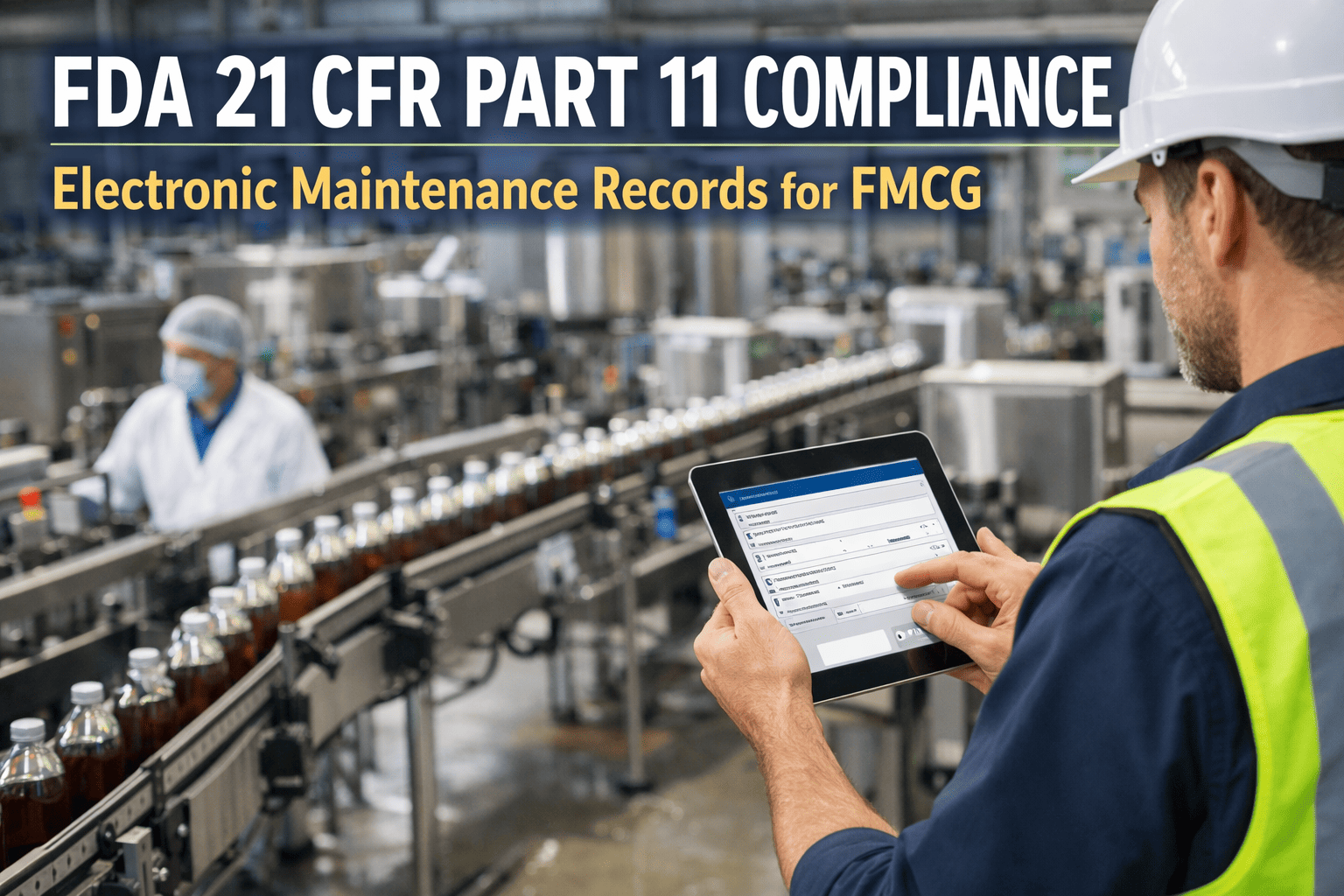
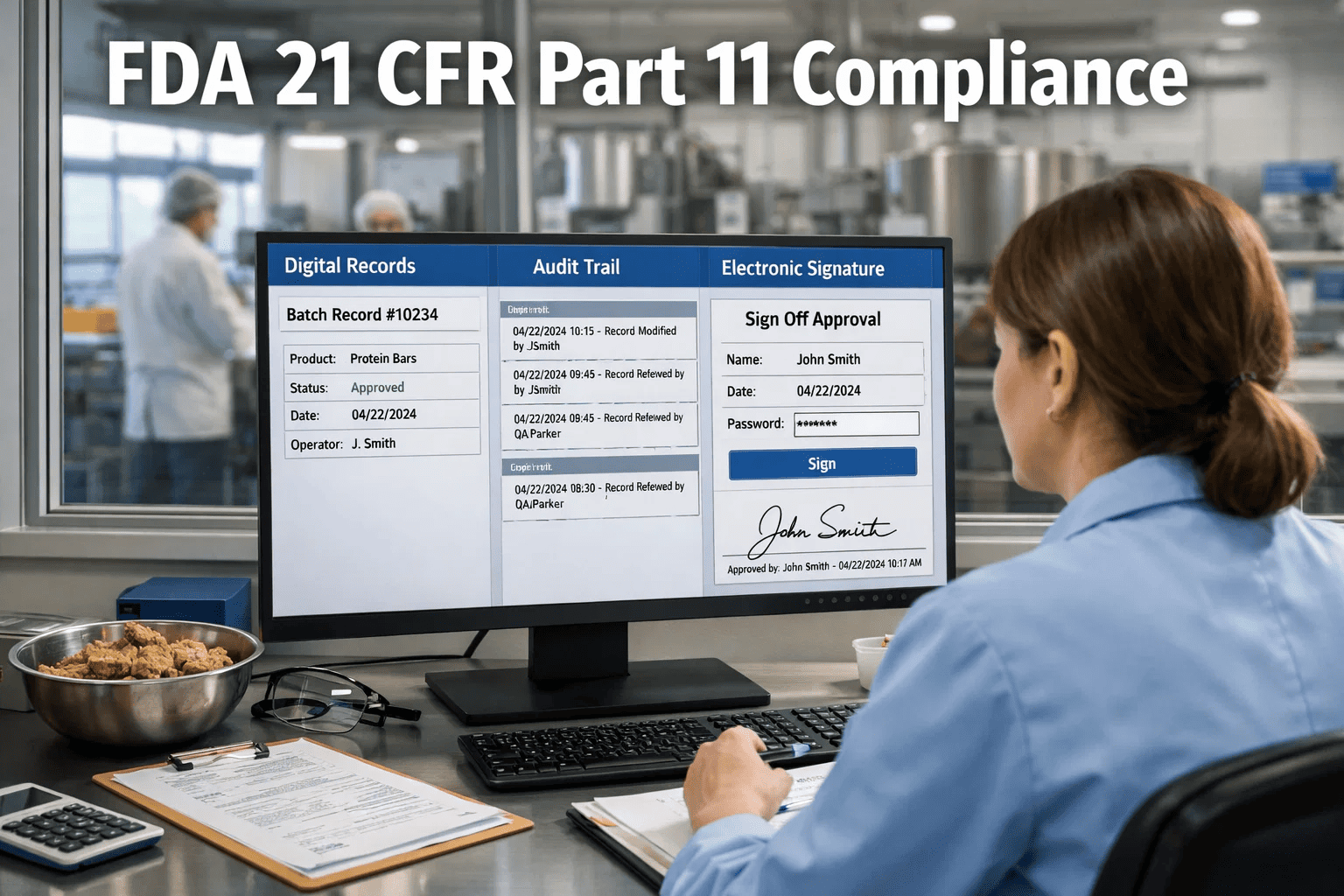
A snack food manufacturer in Gujarat was exporting to the US market when an FDA import inspection flagged its CMMS records as potentially non-compliant with 21 CFR Part 11. The plant had a digital maintenance system — but work orders could be edited after closure, there was no unique user authentication, and electronic signatures were applied with a shared login. The result: a Warning Letter citing data integrity concerns, a 90-day import hold, and $2.1 million in lost export revenue while the corrective action programme was implemented. FDA 21 CFR Part 11 is not about having digital records — it is about having electronic records that meet specific, auditable standards for integrity, access control, and traceability. Every FMCG plant targeting the US export market, and increasingly any plant seeking FSSC 22000 or BRC Grade A certification, must understand what Part 11 actually requires from its CMMS. Oxmaint is built to satisfy FDA 21 CFR Part 11 requirements for electronic maintenance records out of the box. Book a demo to see how it works for your compliance programme.
Basic Digital Records (Non-Compliant)
Record Modification
Editable after closure — no audit trail of changes
User Authentication
Shared logins — individual accountability impossible
Electronic Signatures
Absent or applied with generic shared credentials
Audit Trail
No log of who changed what and when
Inspection Readiness
Manual search — hours under inspection pressure
Part 11-Compliant CMMS (Oxmaint)
Record Modification
Closed records immutable — corrections via audit-trailed amendment only
User Authentication
Unique login per user — role-based access enforced system-wide
Electronic Signatures
Legally binding e-signatures with identity re-verification at point of signing
Audit Trail
Every action logged with user ID, timestamp, and before/after values
Inspection Readiness
Any record retrieved and printed within 2 minutes on demand
Non-Compliant Electronic Records Carry the Same FDA Risk as No Records at All: Data Integrity Warning Letters & Import Holds
What FDA 21 CFR Part 11 Actually Covers for FMCG Maintenance Teams
FDA 21 CFR Part 11 establishes the conditions under which electronic records and electronic signatures are considered trustworthy, reliable, and equivalent to paper records and handwritten signatures. For FMCG maintenance teams, Part 11 applies whenever electronic records are used to satisfy an FDA regulatory requirement — this includes maintenance logs for food contact equipment, calibration records for CCP monitoring instruments, cleaning validation records, preventive maintenance completion records, deviation logs, and CAPA documentation. The regulation is divided into two primary areas: technical controls (what the system must do) and procedural controls (what the organisation must do). Both must be satisfied for a CMMS to be considered Part 11-compliant. A system that has the right technical features but lacks the procedural framework — user training records, access control SOPs, periodic system validation reviews — is not compliant. This distinction matters because FDA investigators examine both the system and the programme during a data integrity inspection.
The Six Technical Requirements Every Part 11-Compliant CMMS Must Meet
The technical requirements of 21 CFR Part 11 define what a CMMS must do at the software level to generate compliant electronic maintenance records. These are non-negotiable system capabilities — no amount of procedural controls can compensate for a system that lacks audit trail functionality or allows closed record modification without logging. FMCG plants evaluating CMMS platforms for FDA compliance must verify each capability before deployment, and that verification must be documented as part of the system validation package.
Secure Audit Trail
§11.10(e)
Computer-generated, time-stamped record of all record creation, modification, and deletion events — not operator-alterable by any user, including administrators
Unique User Identification
§11.10(d)
Every user has unique, individual login credentials — shared accounts are a direct Part 11 violation that makes all attributed records legally unreliable
Binding Electronic Signatures
§11.50
Signatures permanently linked to the signed record — displays signer's name, date/time, and meaning; requires password re-entry at point of signing, not at login
Record Integrity Protection
§11.10(c)
Closed records cannot be modified — any correction creates a new amendment record with reason, author, and timestamp linked to the original
On-Demand Record Retrieval
§11.10(b)
System produces accurate, complete, human-readable copies of any electronic record at any time during the retention period — within minutes, not hours
System Validation
§11.10(a)
CMMS validated with IQ/OQ/PQ documentation before use for regulated records — revalidation required after any system update affecting Part 11 functions
Electronic Signatures Under Part 11 — What Most FMCG Plants Get Wrong
Electronic signatures are one of the most misunderstood requirements in 21 CFR Part 11. Many FMCG plants believe that clicking a "confirm" button, entering a username, or applying a typed name constitutes a compliant electronic signature. FDA's definition is considerably more specific. A Part 11-compliant electronic signature must be unique to one individual, cannot be reused by or reassigned to another person, and the signing individual must actively verify their identity at the point of signing — not at login, but at the exact moment the signature is applied to the record. For maintenance records, this means every work order sign-off, calibration verification, and cleaning validation approval must use an individually authenticated electronic signature that is permanently linked to that specific record in its signed state.
Unique to One Individual (§11.100(a))
Each e-signature belongs exclusively to one person — cannot be shared, reassigned, or reused under any circumstance
Often Violated
Two-Component Verification at Signing (§11.200(a))
Username + password re-entry required at point of signing — active login session alone does not satisfy this requirement
Frequently Missing
Signature Meaning Displayed (§11.50(a))
Printed name, date/time, and meaning shown on the signed record — e.g., "PM Completed and Verified by [Name]"
Partially Implemented
Permanently Bound to Signed Record (§11.70)
Signature information travels with the record if copied, transferred, or exported — cannot be removed or falsified
Often Missing
Non-Repudiation Certification to FDA (§11.100(c))
One-time written submission to FDA district office certifying that e-signatures are intended as legally binding equivalents of handwritten signatures
Rarely Completed
Written SOP for Signature Management (§11.10(i))
Documented procedure covering who may sign, what constitutes valid signing, and how compromised credentials are revoked and managed
Often Absent
A checkbox or pre-authenticated click-to-sign is not a Part 11-compliant electronic signature. FDA investigators ask a maintenance technician to demonstrate signing live during an inspection. If the system does not require password re-entry at that moment, the signatures on every record in the system are legally non-binding — making the entire maintenance record set non-compliant.
Audit Trails — The Most Scrutinised Part 11 Requirement in FMCG Inspections
The audit trail requirement under §11.10(e) is the single most scrutinised element in FDA data integrity inspections of FMCG facilities. An audit trail is a secure, computer-generated, time-stamped record that allows reconstruction of the course of events relating to the creation, modification, or deletion of an electronic record. For CMMS maintenance records, this means every action taken on a work order — creation, assignment, status change, field update, photo attachment, signature, and closure — must be captured in a tamper-evident log that identifies the user and the exact time of each action. Critically, the audit trail itself must be technically protected from modification: a system where any user, including a database administrator, can alter the audit trail makes the entire record set non-compliant regardless of how complete the logging otherwise is.
Record-Level Audit Trail
Every Field Change Logged
Every change to any field in a work order is logged with original value, new value, user ID, and timestamp. No field can be changed without creating an audit trail entry. Closed records are immutable — any correction creates a linked amendment record with reason and author. Records cannot be deleted, only deactivated with the deactivation reason captured.
System-Level Audit Trail
Login, Access & Admin Events
Every login, failed login attempt, password change, user account creation or deactivation, and role change is logged with timestamps. Administrator actions — including any access to system configuration or audit trail settings — are captured separately. All system logs are stored in a write-once format inaccessible to application-level users and database administrators alike.
Signature Audit Trail
Every E-Signature Event Captured
Each electronic signature event creates a permanent record: the user's full name, unique ID, date and time of signing, the meaning of the signature, and a link to the exact signed record state at that moment. If a record is subsequently amended, the original signature is preserved alongside the amendment signature. Signature records cannot be deleted or modified under any circumstance.
ALCOA+ Principles: The Data Integrity Standard That Underpins Part 11
FDA's data integrity expectations for electronic records are articulated through the ALCOA+ framework — a set of data quality principles defining what every regulated record must be, whether paper or electronic. For FMCG maintenance teams, ALCOA+ establishes exactly what a compliant electronic maintenance record looks like in practice. A Part 11-compliant CMMS automatically satisfies all ALCOA+ requirements for electronic records — and does so in ways that paper systems are structurally unable to replicate. The most important practical difference is contemporaneity: a CMMS timestamps entries at the moment of creation, making retrospective completion technically impossible. Paper records have no such enforcement mechanism.
Attributable — who did it and when
Unique user login and audit trail ensure every record entry is attributed to a specific, identified individual with a system-generated timestamp
Automated
Legible — readable now and in future
Electronic records in standardised format — human-readable on screen and in print throughout the full retention period
Automated
Contemporaneous — recorded at time of action
System-generated timestamps at point of entry — back-dating is technically prevented by the CMMS, not merely prohibited by policy
Enforced
Original — first capture of information
Direct entry into CMMS at point of work — transcription from paper introduces a data integrity risk that must be formally controlled if used
By Design
Accurate — true, correct, and complete
Mandatory fields enforced system-wide — records cannot be closed without all required structured data; free-text workarounds for required fields are blocked
Enforced
Complete — all required data captured
System prevents work order closure without required fields, photos, and signatures — incompleteness is technically impossible, not just procedurally discouraged
Enforced
Enduring — retained for required period
Cloud storage with documented retention policy and data migration plan — records survive platform changes, upgrades, and vendor transitions
By Design
Available — accessible when needed
Any record retrievable within 2 minutes during inspection; offline access available for plant floor use where connectivity is intermittent
Automated
The most common paper record failure in FDA FMCG inspections is retrospective completion — maintenance logs filled in after the fact, sometimes by a different person than the one who performed the work. A Part 11-compliant CMMS makes this structurally impossible because timestamps are system-generated at the moment of entry, not typed manually by the technician completing the record.
Procedural Controls — The Part 11 Requirements Your System Cannot Satisfy Alone
Having a technically compliant CMMS is necessary but not sufficient for Part 11 compliance. The regulation also requires procedural controls — written SOPs, training records, system validation documentation, and periodic reviews — that govern how the electronic system is operated day to day. FDA investigators examine both the technical system and the procedural programme during data integrity inspections. In practice, many FMCG plants implement a Part 11-capable CMMS but fail the procedural side because they treat system deployment as the end of the compliance programme rather than its foundation.
01
System Validation & Qualification
CMMS validated with IQ/OQ/PQ before use for any regulated record
Validation covers all Part 11 functions: audit trail, e-signatures, access control
Change control process for software updates — revalidation scope assessed for each
Validation package retained for life of system plus full retention period
Output: System Validation Package
02
Access Control SOPs
Written procedure for account creation, role assignment, and access levels
Mandatory account deactivation within 24 hours when staff leave or change roles
Annual access review — verify all active accounts are authorised and current
Password policy: minimum length, complexity, expiry interval, prohibition on sharing
Output: Access Control Procedure
03
Training & Competency Records
All CMMS users trained on Part 11 responsibilities before access is granted
Training covers: unique credentials, e-signature meaning, record correction rules
Individual training completion records retained with competency sign-off
Refresher training required when system or procedures change materially
Output: Training Completion Records
04
Periodic System Reviews
Annual audit trail integrity review — confirm logs are complete and unaltered
Access log review for anomalies: after-hours activity, repeated failed logins
Record retention verification — confirm all records within window are accessible
Review documented with QA sign-off and corrective actions for any finding
Output: Annual System Review Record
Eight Part 11 Failures That Trigger FDA Data Integrity Observations in FMCG Plants
These are the most frequently cited data integrity and Part 11 deficiencies found during FDA inspections and third-party audits of FMCG CMMS implementations. Each one is a system design or procedural failure — not a documentation gap that can be papered over with a memo. Every item requires a structural fix in either the CMMS configuration or the compliance programme before an FDA inspection.
Editable Closed Records
Critical Finding
Work orders modifiable after closure with no amendment trail. FDA treats this as a fundamental data integrity failure — the entire record set becomes suspect, not just the edited records.
Shared Login Credentials
Critical Finding
Multiple technicians using a "Maintenance" or "Shift" login. Every action becomes unattributable. Part 11 §11.10(d) requires individual unique credentials — shared logins are a direct regulatory violation with no corrective workaround short of eliminating them.
Click-to-Sign Without Re-Verification
Major Finding
Checkbox or session-authenticated signatures without password re-entry at the point of signing. Part 11 requires two-component identity verification at signing — the existing login session alone does not satisfy this requirement.
Incomplete Audit Trail Coverage
Critical Finding
Audit trail logs record creation but not modifications, or covers some record types but not others. Part 11 §11.10(e) requires all record actions to be captured — partial coverage creates exploitable gaps that investigators specifically look for and probe during inspections.
No CMMS Validation Package
Major Finding
CMMS used for regulated records without documented IQ/OQ/PQ. Part 11 §11.10(a) requires validation before use. "We trust the vendor" is not an acceptable response to an FDA investigator — it has resulted in Warning Letters at multiple FMCG facilities.
No §11.100(c) FDA Certification
Major Finding
Using electronic signatures as legally binding without the mandatory one-time written submission to the FDA district office. This standalone procedural requirement cannot be inferred from system capability — it must be actively filed before signatures are applied to any regulated record.
Active Accounts for Departed Employees
Major Finding
Former employee accounts remaining active after departure create unexplained audit trail activity. Access control SOPs must mandate deactivation within 24 hours of departure — verified and documented in the annual access review.
Administrator Audit Trail Access
Critical Finding
System administrators technically able to edit or delete audit trail entries. Even if this capability is never used, its existence alone makes the records untrustworthy. A Part 11 audit trail must be technically write-protected from every user without exception.
What a Part 11 FDA Data Integrity Inspection Looks Like for FMCG Plants
FMCG facilities exporting to the US should understand exactly what FDA investigators examine when auditing electronic maintenance records for Part 11 compliance. The inspection follows a predictable sequence — and knowing this sequence allows a prepared maintenance team to retrieve the right records quickly and demonstrate the system's compliance features confidently. Facilities with a compliant CMMS typically satisfy every one of these requests within 60 minutes. Facilities without compliant systems spend days attempting to reconstruct records and explain why the system cannot produce what is being requested.
Active User Account List
Print all active and inactive accounts with roles and last login date — investigators look for shared accounts, departed employee accounts still active, and roles with excessive permissions beyond job function
Day 1, Hour 1
Audit Trail for Selected Work Orders
Full audit trail for investigator-selected PM and calibration records — every action, who, when, and change detail — investigators look for gaps, after-hours edits, and systematic modification patterns suggesting retrospective completion
Day 1, Hour 2
Live E-Signature Demonstration
Demonstrate signing a maintenance record live in front of the investigator — verifying whether password re-entry is required, whether signature meaning is displayed, and whether the signature is permanently linked to the specific record
Day 1, Hour 3
System Validation Documentation
IQ/OQ/PQ validation package for the CMMS — scope, test protocols, results, and approval signatures; change log for all software updates since initial validation was completed
Day 2, Morning
Access Control SOPs and Training Records
Written procedures for user account management; training records confirming all current users completed Part 11 training before system access was granted — not after deployment
Day 2, Afternoon
Response Time Without a Compliant CMMS
Days to Weeks
A Part 11-compliant CMMS with a prepared team should satisfy every one of these requests in under 60 minutes. The difference between a smooth inspection outcome and a data integrity Warning Letter is almost always preparation — because a compliant system is only defensible if the team can demonstrate it confidently and immediately on demand.
90-Day Part 11 Compliance Implementation Roadmap for FMCG Plants
Achieving FDA 21 CFR Part 11 compliance for electronic maintenance records is a structured programme covering both technical configuration and procedural implementation. This 90-day roadmap takes an FMCG plant from an initial gap assessment through to a validated, inspection-ready system. Oxmaint includes a vendor-supplied IQ/OQ validation package that significantly reduces the technical validation phase. Book a demo to see how the implementation works for your regulatory scope and facility size.
01
Days 1–20: Gap Assessment
Audit current CMMS against all Part 11 technical requirements
Review all active user accounts — identify shared accounts and departed employees
Assess whether existing validation documentation covers Part 11 scope
Map procedural gaps: missing SOPs and absent training records
Output: Part 11 Gap Register
02
Days 21–50: Technical Remediation
Deploy or configure CMMS with audit trail, unique accounts, and e-signature
Eliminate all shared accounts — individual credentials issued to every user
Configure role-based access, password policy, and account lockout
Execute CMMS validation: IQ, OQ, and site-specific PQ protocols
Output: Validated Part 11 System
03
Days 51–75: Procedural Programme
Write and approve SOPs: access control, e-signature use, record correction
Train all CMMS users — issue completion certificates before access granted
Submit §11.100(c) certification letter to FDA district office
Document data migration, backup, and record retention procedures
Output: Complete Procedural Package
04
Days 76–90: Mock Inspection
Conduct internal mock FDA data integrity inspection using standard request list
Verify audit trail retrieval speed and completeness under inspection conditions
Demonstrate e-signature workflow as investigators will request it live
QA sign-off on Part 11 programme readiness — document findings and closure
Output: Inspection-Ready Status
Frequently Asked Questions
FDA 21 CFR Part 11 — Built In, Not Bolted On
Electronic Maintenance Records That Satisfy FDA on Day One
Oxmaint is engineered for Part 11 compliance from the ground up — immutable audit trails, unique user authentication, binding electronic signatures with password re-verification at point of signing, role-based access controls, and mandatory workflow sequencing. Every electronic maintenance record your team creates is inspection-ready the moment it is signed.
Tamper-Evident Audit Trail — §11.10(e) Compliant
Binding E-Signatures with Password Re-Verification at Signing
Unique Individual Accounts — Zero Shared Credentials
Immutable Closed Records — All Corrections Audit-Trailed
Any Record Retrieved in Under 2 Minutes at Inspection
Vendor IQ/OQ Validation Package Included at No Extra Cost