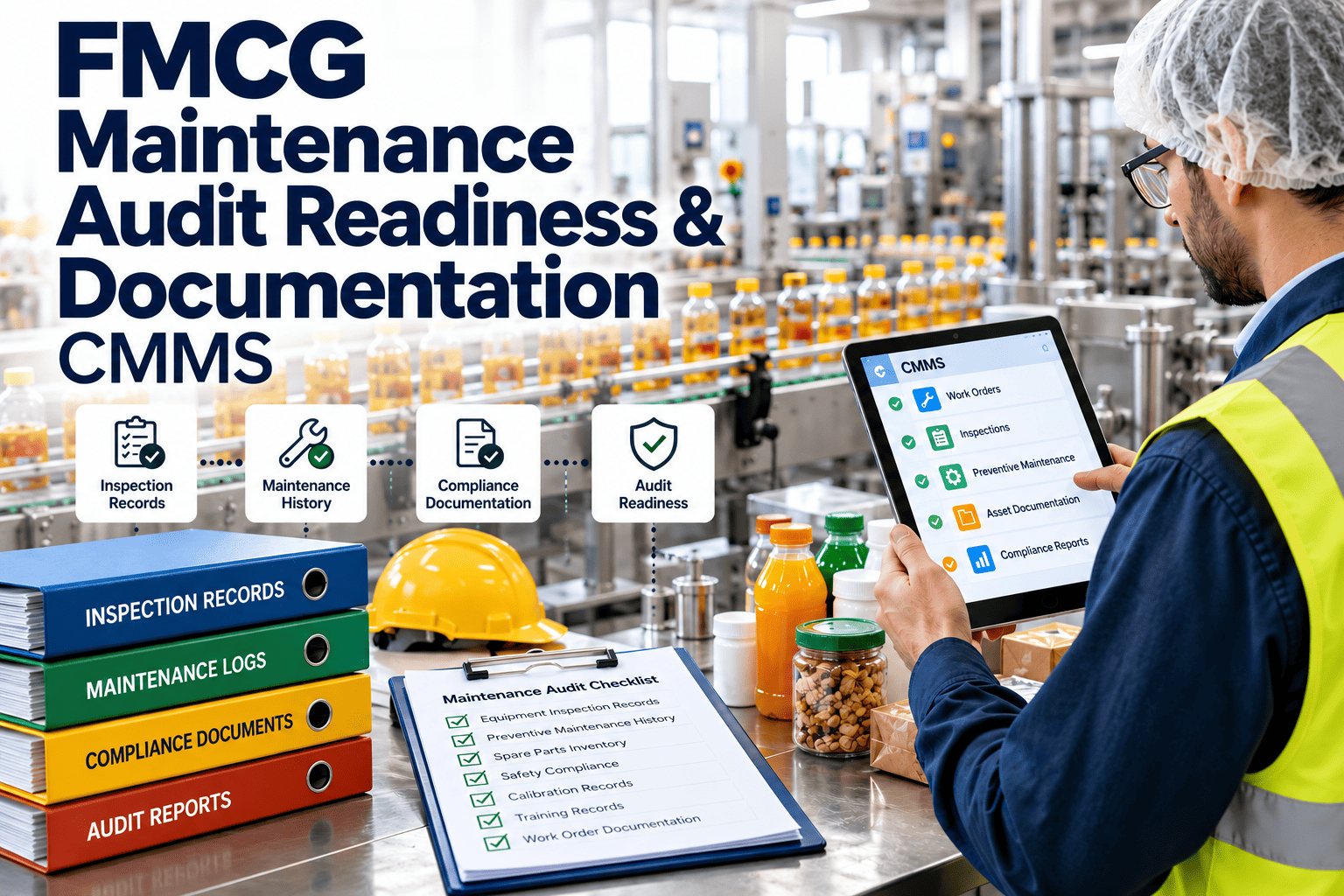
An FMCG audit rarely fails because a pump was never maintained. It fails because nobody can prove, within minutes, that the pump was maintained, by whom, to which procedure and with what verified result. Auditors working to BRCGS, SQF, FSSC 22000, IFS or a retailer's own standard follow one asset through its history, its calibrations and its cleaning records. When those records sit in binders, spreadsheets and memory, the audit turns into a search party. This guide explains how to build an audit package that already exists before the auditor arrives, supported by Oxmaint maintenance management software.
FMCG Maintenance Audit Readiness: Be Able to Prove It in Minutes, Not Days
Maintenance history, calibration certificates and CIP compliance logs, tied to the asset and retrievable on demand, so every audit question has a record behind it.
Where Audit Readiness Actually Breaks Down
Most FMCG sites do the maintenance. The weakness is evidence: records that are late, incomplete, scattered or impossible to link to a specific line, asset or production run.
- Paper PM sheets collected from three lines and two shifts
- Calibration certificates found in a quality office drawer
- CIP charts printed, signed late and filed by date, not by asset
- Repair history rebuilt from emails and technician recall
- Overdue tasks discovered by the auditor, not by the team
- Every PM completion timestamped, signed and filed to the asset
- Certificates attached to each instrument with due dates visible
- CIP verification linked to the line, the run and the release
- Repairs, parts and root cause on one chronological history
- Overdue work flagged weeks earlier and escalated internally
Why the same findings keep returning
Certification bodies report that repeat non-conformities usually come from inconsistency, not from missing systems. Controls that depend on routine human action, such as cleaning, maintenance and checks, drift over time. Small lapses accumulate until they become a pattern an auditor can see.
- A PM schedule exists, but completion is recorded on paper that is never reviewed
- Calibration is tracked by one person whose spreadsheet nobody else can read
- Post-maintenance hygiene checks are performed but not documented
- Corrective actions are closed without a verified effect
The Standards Context: What Auditors Expect in 2026
BRCGS Food Safety Issue 9 remains the current version, and its maintenance requirements sit in Clause 4.7, with calibration of measuring and monitoring devices handled separately. BRCGS is developing Issue 10, with commentary pointing to stronger emphasis on food safety culture, environmental monitoring and consistent day-to-day application. Updated position statements take effect for audits from 10 August 2026, so confirm the detail with your certification body.
| Framework | What it asks of maintenance | Typical evidence requested |
|---|---|---|
| BRCGS Food Safety | Planned, risk-based maintenance; controlled hygiene after repairs; calibrated monitoring devices | PM schedules, work orders, post-maintenance clearance, calibration records |
| SQF Code | Equipment maintained to prevent contamination; documented maintenance programme | Schedules, completion records, verification by food safety team |
| FSSC 22000 | Prerequisite programmes for equipment suitability, cleaning and maintenance | PRP records, cleaning verification, corrective action trail |
| US FSMA preventive controls | Equipment and utensils maintained, with records supporting verification and calibration | Calibration logs, monitoring records, corrective action documents |
| Retailer and customer audits | Evidence that agreed standards are met between third-party audits | Same records, often requested at short notice |
The Five Evidence Families in an Audit Package
Whatever the standard, auditors tend to trace the same five families of record. Build the package around them and a new question rarely catches you out.
Documented Maintenance History That Survives a Trace Test
A trace test starts with one asset, often a filler, a seamer or a mixer, and asks for everything. The answer should come from one screen, not four departments.
Anatomy of an audit-grade work order
Checks that expose weak history
- Can you list every unplanned stop on a critical asset for the last twelve months?
- Do emergency repairs carry the same hygiene clearance as planned work?
- Are temporary repairs tracked until a permanent fix is completed?
- Can you show who is authorised to release a line after maintenance?
Calibration Certificates: Controlling the Instruments Behind Critical Limits
Temperature probes, pressure gauges, metal detectors, checkweighers and conductivity sensors support food safety decisions. If the instrument is wrong, the record built on it is weak.
What happens when an instrument fails
An as-found result outside tolerance is not just a maintenance event. It raises the question of what product was monitored with that device since the last good check.
- Record the as-found deviation and the date of the last good calibration
- Identify the lines, runs and decisions that relied on the instrument
- Document the product safety assessment and who approved it
- Close the corrective action only after the device is verified as repaired or replaced
CIP Compliance Logs: Proving the Clean Happened
For beverage, dairy, sauces and liquid personal care, the CIP cycle is a control the auditor expects to see evidenced every time, with parameters and verification.
- Circuit and line identified
- Start and end time
- Temperature, flow and contact time
- Chemical concentration
- Deviations and operator actions
- Final rinse conductivity or pH check
- Visual inspection result
- Swab or ATP result where used
- Quality sign-off before production
- Link to the next production run
- Spray ball, valve and gasket inspections
- Dosing pump and probe calibration
- Repairs on the circuit since last verified clean
- Failed cycle follow-up work orders
- Sanitary fitting condition notes
Turn Audit Preparation Into a Routine With Oxmaint
Oxmaint helps FMCG teams hold PM schedules, work orders, inspections, calibration tasks and compliance records in one place, so the package is a by-product of daily work. Start building your asset register or see the audit workflow in a demo.
Who Owns What in Audit Readiness
Audit evidence breaks down at hand-offs. Agree ownership for each record family before the audit calendar forces the conversation.
| Role | Owns | Reviews | Escalates when |
|---|---|---|---|
| Maintenance manager | PM schedules, work order closure, spares records | Overdue task report weekly | Critical asset PM is more than one cycle late |
| Technician | Accurate completion notes, photos, hygiene clearance entry | Own open tasks each shift | Procedure cannot be followed as written |
| Quality or food safety lead | Calibration programme, CIP verification, product safety assessments | Clearance records and corrective actions | Instrument fails as-found or a CIP cycle deviates |
| Production supervisor | Line handover, release after maintenance | Open deferrals on their line | Maintenance is deferred repeatedly on the same asset |
| Site leadership | Resources, audit readiness targets | Monthly readiness KPIs | Gaps remain open past agreed dates |
Questions Auditors Commonly Ask, and the Record That Answers Them
Prepare for the question behind the question. Each one below is really asking whether your control is systematic or accidental.
Record Retention, Access and Version Control
Evidence is only useful if it is complete, protected and retrievable. Decide how records are kept before an auditor asks how long you hold them.
- Set retention periods that cover product shelf life, customer contracts and your certification scheme requirements
- Restrict who can edit completed work orders, and keep a visible history of any change
- Control procedure versions, so each PM record shows which task list was in force at the time
- Test access from a standard user account, not only from an administrator login
- Keep supplier certificates for calibration standards with the instrument records they support
Stop Rebuilding Records the Week Before the Audit
Keep maintenance, calibration and cleaning evidence attached to the asset from the day it is created.
A 30-Day Audit Readiness Timeline
If your next audit is a month away, or could be unannounced, this sequence closes the most common gaps in order of risk.
Which Documentation Gaps Cost the Most
Not every gap carries the same consequence. Use a simple matrix to decide where the next hour of effort goes.
| Documentation gap | Likelihood of being found | Potential impact | Priority |
|---|---|---|---|
| Expired calibration on a critical limit device | High | High, product safety review needed | Fix first |
| No clearance record after food contact repair | High | High, release decision unsupported | Fix first |
| Overdue PM on a critical asset | High | Medium to high | Fix this week |
| CIP records not linked to production runs | Medium | Medium | Fix this week |
| Corrective actions closed without verification | Medium | Medium | Fix this week |
| Inconsistent task descriptions across shifts | Medium | Low to medium | Plan and schedule |
Handling the Unannounced Audit
Unannounced audits reward sites where evidence is already organised. The first hour usually sets the tone for the rest.
- Name a records lead who can open any asset history without searching
- Pull the overdue task report before the auditor asks for it
- Confirm calibration due dates for every critical instrument
- Have the latest CIP verification results ready for each circuit
- Keep open corrective actions visible, with owners and target dates
What a CMMS Must Do to Generate the Package
Not every system produces audit evidence equally well. Check that your CMMS maps to each family of record, rather than just logging repairs.
| Evidence need | CMMS capability required | Oxmaint workflow |
|---|---|---|
| Programme definition | Asset hierarchy, criticality, PM templates | Asset management and preventive maintenance |
| Execution records | Timestamped, signed work orders on mobile | Work orders and mobile workflows |
| Calibration control | Recurring tasks, attachments, due alerts | Scheduling and inspections with document attachment |
| Hygiene evidence | Checklists and sign-offs tied to the asset | Inspections and compliance records |
| Corrective closure | Linked follow-up work and status tracking | Corrective maintenance and reporting |
| Parts traceability | Spares linked to the work order | Inventory management |
KPIs That Show You Are Audit Ready
Track a few indicators monthly and review them in the same meeting that reviews production performance.
Frequently Asked Questions
Make Every Audit Question Answerable From One Record
Bring PM history, calibration certificates and cleaning evidence into one maintenance system, and walk into the next audit knowing where everything is.