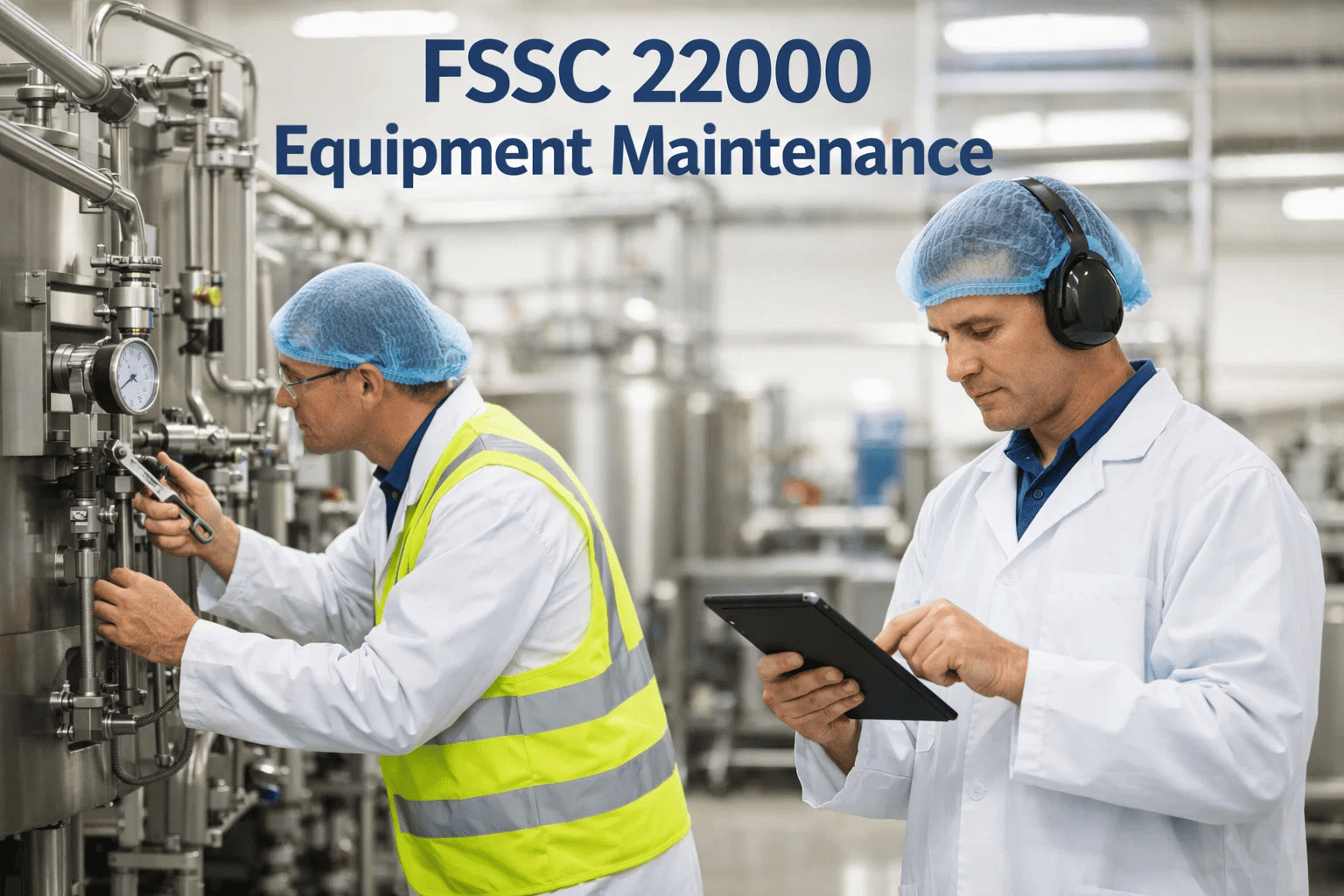
FSSC 22000 certification is the gold standard for food safety management — recognized by the Global Food Safety Initiative (GFSI) and required by major retailers, QSR chains, and food service companies worldwide. Yet the single most common cause of FSSC 22000 audit non-conformances is not food handling procedures or hazard analysis — it is maintenance documentation gaps. Auditors consistently find that facilities have equipment maintenance programs that are incomplete, poorly documented, or disconnected from their food safety management system. FSSC 22000 Version 6 introduced specific requirements for equipment management (Clause 2.5.15) that go beyond routine maintenance — requiring documented purchase specifications for new equipment, risk-based change management for equipment modifications, and food-grade lubricant registers that many facilities have never formalized. Facilities with CMMS-managed maintenance programs pass FSSC 22000 audits with 75% fewer non-conformances than those using paper-based or spreadsheet-managed systems. Start a free trial to build FSSC 22000 compliant maintenance programs in Oxmaint, or book a demo to see audit-ready maintenance documentation in action.
Pass Your FSSC 22000 Audit Without a Single Maintenance Non-Conformance
Oxmaint provides the documented PM programs, calibration tracking, food-grade lubricant registers, and change management workflows that FSSC 22000 auditors specifically look for — generated automatically from your daily maintenance operations.
FSSC 22000 Maintenance Requirements: What Auditors Actually Check
FSSC 22000 builds on ISO 22000 and ISO/TS 22002-1 — with additional requirements that specifically target equipment maintenance as a Prerequisite Program (PRP). Understanding exactly what auditors verify during the maintenance portion of the audit is essential for closing the documentation gaps that generate non-conformances. Below are the six specific maintenance areas that auditors evaluate, with the evidence they expect to see for each. Book a demo to see how Oxmaint generates this evidence automatically.
Documented Preventive Maintenance Program
Auditors verify a systematic, documented PM program covering all food-contact and safety-critical equipment. They check for defined PM schedules, task descriptions, frequencies, and completion records. Paper systems fail here because records are incomplete, lost, or illegible.
Calibration of Monitoring Equipment
Thermometers, scales, pH meters, metal detectors, and flow meters must be calibrated at defined intervals with traceability to national standards. Auditors check calibration schedules, certificates, and adjustment records — including personnel identification.
Equipment Purchase Specifications
Before acquiring new equipment, FSSC V6 requires documented specifications for hygienic design, material compatibility, and intended use. This ensures food safety is designed into equipment from procurement, not retrofitted after installation.
Risk-Based Change Management
Any significant equipment change must undergo documented risk assessment before implementation. This includes new equipment installation, equipment modification, layout changes, and process alterations that could impact food safety or cleaning procedures.
Food-Grade Lubricant Register
A formal register of all lubricants used on food-contact equipment is mandatory. Auditors verify that lubricants are food-grade (H1 rated), properly stored, and that records link specific lubricants to specific equipment. Non-food-grade lubricant use on food-contact surfaces is an automatic major non-conformance.
Temporary Repair Management
Temporary repairs must be documented, minimized, and tracked with a defined timeline for permanent correction. Auditors check that temporary repairs are not left indefinitely — a common finding in facilities without CMMS tracking of repair status.
How Oxmaint Makes FSSC 22000 Audit Preparation Effortless
Audit-Ready Documentation From Daily Operations
Every work order, calibration event, PM completion, and change request generates timestamped, signed documentation that satisfies FSSC 22000 evidence requirements automatically. No separate audit prep — your daily operations create your audit evidence.
Instrument Tracking With Auto-Alerts
Every calibration-critical instrument tracked with due dates, calibration certificates, adjustment history, and traceability records. Automatic alerts prevent overdue calibrations — eliminating the #2 most common FSSC maintenance audit finding.
Digital Change Control Workflow
Structured change request → risk assessment → food safety impact analysis → approval → implementation → verification workflow for equipment changes. Digital audit trail documents every step of the process for Clause 2.5.15 compliance.
Food-Grade Lubricant Management
Central lubricant register with H1 certifications linked to specific equipment. When a PM work order is created for food-contact equipment, Oxmaint specifies the approved lubricant — preventing the non-food-grade lubricant errors that trigger major non-conformances.
Frequently Asked Questions
What is the difference between FSSC 22000 and ISO 22000 for maintenance requirements?
ISO 22000 provides the overall food safety management system framework and identifies maintenance as a Prerequisite Program (PRP). FSSC 22000 builds on ISO 22000 by incorporating the technical specifications of ISO/TS 22002-1 (which details specific PRP requirements including maintenance) and adding its own additional requirements — most notably Clause 2.5.15 for Equipment Management, which requires documented purchase specifications and risk-based change management. A facility can be ISO 22000 certified but not FSSC 22000 certified if it does not meet the additional requirements. Start a free trial to configure maintenance programs for both standards simultaneously.
How should we handle post-maintenance sanitation verification for FSSC 22000?
FSSC 22000 requires post-maintenance sanitation verification before equipment returns to production. This means every maintenance event on food-contact equipment must include a documented sanitation step and QA sign-off confirming the equipment is clean and safe for food contact. Oxmaint automates this through work order templates that include mandatory sanitation verification steps with photo evidence and QA approval — the work order cannot be closed until sanitation has been performed and verified. Book a demo to see post-maintenance sanitation workflows.
How long does FSSC 22000 certification take, and how does CMMS help accelerate it?
Initial FSSC 22000 certification typically takes 8–14 months from decision to certificate. The maintenance-related components (documented PM program, calibration management, lubricant registers, change management) typically represent 15–20% of the total implementation effort but generate 30–40% of audit non-conformances. Implementing a CMMS at the start of the certification process — rather than after — accelerates certification by 2–4 months because maintenance documentation is built into daily operations from day one rather than assembled retrospectively before the audit.
What are the most common maintenance-related FSSC 22000 audit findings?
The top four maintenance-related findings are: (1) Incomplete PM records — missing dates, technician IDs, or verification signatures; (2) Overdue calibrations — instruments past their calibration due date with no documented extension or risk assessment; (3) Missing food-grade lubricant documentation — no register or no H1 certification on file; (4) Unmanaged temporary repairs — temporary fixes left indefinitely without a permanent correction plan. All four are documentation failures, not equipment failures — which is precisely why CMMS implementation eliminates them so effectively.
FSSC 22000 Audit Confidence Starts With Your Maintenance Program — Build It in Oxmaint
Food manufacturers preparing for initial FSSC 22000 certification or maintaining existing certification use Oxmaint to eliminate the maintenance documentation gaps that generate audit non-conformances — with auto-generated PM records, calibration tracking, change management workflows, and complete audit trail evidence.