SQF Compliance: Maintenance Program Requirements for FMCG Facilities
By Jonas on March 7, 2026
SQF Code Edition 9 places maintenance programs at the center of food safety certification — not as a back-office function, but as a documented, auditable system that directly affects your site's ability to pass SQF audits and maintain certification. For FMCG facilities managing high-throughput production lines, packaging equipment, utilities, and cold chain assets, meeting SQF maintenance requirements means more than scheduling PMs. It means calibration records tied to food contact equipment, pest control integration with asset records, documented corrective actions, and a digital audit trail that your SQF practitioner can produce in minutes when the auditor arrives. This page covers what SQF Edition 9 requires from your maintenance program, where most facilities fall short, and how Oxmaint delivers the compliance tracking and calibration management infrastructure to close every gap. Start your free trial to build SQF-aligned PM schedules, or book a demo to see how Oxmaint closes the gap between maintenance records and food safety compliance.
Paper-Based Maintenance vs SQF-Compliant CMMS
Performance gap between FMCG plants running standard PM versus SQF Edition 9-aligned maintenance programmes
Paper / Spreadsheet
Documentation
Incomplete records — no SQF clause linkage
Calibration Records
Performed informally — not traceable to standards
Audit Readiness
3–5 audit findings per cycle on average
Certification Risk
$380K average decertification exposure
SQF-Aligned CMMS
Documentation
Digital records linked to SQF clause — auto-generated
Calibration Records
Scheduled per clause 11.7.3 — timestamped and traceable
Audit Readiness
First-pass audits — zero unresolved findings
Certification Risk
Zero — records complete before auditor arrives
Compliance Improvement: 3–5 Audit Findings → Zero with SQF-Aligned PM
Why SQF Compliance Is a Maintenance Responsibility
SQF Module 11 Section 11.7 requires a written maintenance program, calibration records traceable to national standards, documented corrective actions for every food safety finding, and pest control documentation accessible on-site at audit. The SQF practitioner cannot demonstrate these requirements without the maintenance team generating them — and SQF auditors don't just check process records, they check the maintenance logs that prove the equipment generating those records was functioning correctly at the time. A general-purpose PM programme that has no concept of SQF clause classification, calibration traceability, or corrective action documentation will fail a food safety audit regardless of how well the physical maintenance was performed.
Four Core SQF Maintenance Requirements — Clause by Clause
SQF Edition 9 defines four specific areas where maintenance operations must generate documentary evidence. Each one is audited at every certification and recertification cycle, and a major non-conformance in any one of them can trigger corrective action requests, conditional certification, or full decertification.
Four Core SQF Maintenance Requirements — Equipment Documentation and Compliance Evidence
Written Maintenance Program
Clause 11.7.1
A documented maintenance program covering all food production equipment — defining frequency, responsible personnel, and completion records. A program that exists only in someone's head or a personal spreadsheet does not meet this requirement and will generate a major finding.
Calibration of Measuring Equipment
Clause 11.7.3–4
All measuring and monitoring devices affecting food safety must be calibrated on a defined schedule against traceable standards. Records must show what was calibrated, when, against what standard, and the result — with out-of-tolerance events triggering documented corrective actions.
Pest Control Integration
Clause 11.8
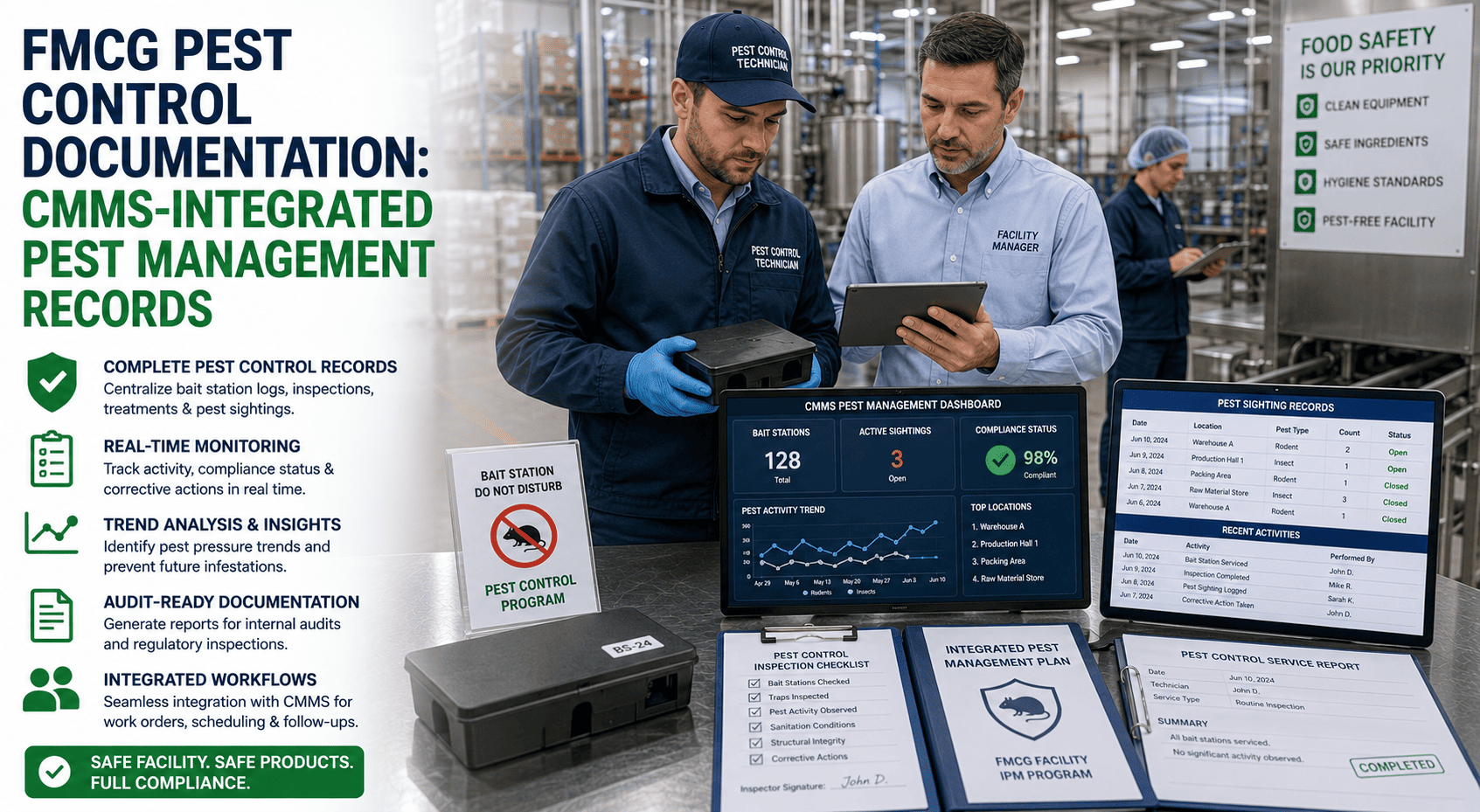
Pest control records must be accessible, current, and linked to facility maps showing device locations. SQF auditors require evidence that pest control activities are integrated with the broader maintenance program — not managed in a separate contractor binder stored off-site.
Corrective Action Documentation
Clause 2.5.2
When maintenance identifies a food safety risk — a failed seal, a lubricant leak, a faulty temperature sensor — the corrective action must be documented with what was found, what was done, who did it, and when. Verbal handoffs are not acceptable evidence under SQF document control requirements.
SQF Edition 9 Maintenance Clause Reference — What Auditors Check
SQF Edition 9 auditors check six specific clause areas during every maintenance-related audit element. Each clause below maps directly to the documentation your SQF practitioner must produce on audit day — and the evidence Oxmaint generates automatically from completed work orders.
SQF Edition 9 — Maintenance Clause Reference
Clause, requirement summary, and what auditors check at each on-site inspection
Clause 11.7.1 Maintenance Program Scope
Written program for all food production equipment — frequency, responsibility, and completion records required for every PM activity
Mandatory
Written schedule + signed completion records per PM cycle
Clause 11.7.2 Food Safety Risk During Maintenance
Food-grade lubricants on food contact equipment, foreign material control during maintenance, post-maintenance inspection before production resumption
Mandatory
Post-maintenance sign-off record before production resumes
Clause 11.7.3 Calibration Requirements
All food safety monitoring equipment calibrated at defined frequency — traceable to national or international standards. Out-of-tolerance triggers corrective action and product impact assessment
Mandatory
Calibration cert + traceable standard reference per event
Clause 11.7.4 Calibration Records
Equipment identity, calibration date, standard used, result, and name of person performing calibration — retained for defined period and available for auditor review
Mandatory
Structured record per calibration event — retained minimum 12 months
Clause 11.8 Pest Control Program
Documented pest control program — inspections, treatments, device checks, bait station maps — current, site-specific, and accessible to the SQF auditor on request
Required
Current inspection and treatment records with facility map
Clause 2.5.2 Document Control & Retention
All maintenance and calibration records must be legible, identifiable, retrievable, and protected from unauthorized modification — retention periods defined and enforced across all record types
Required
Searchable digital records with tamper-evident audit trail
Plants using structured CMMS for SQF maintenance compliance achieve first-pass audit rates of 94% compared to 41% for paper-based programs — a difference of $300K+ in re-audit, corrective action, and recertification costs per operating year.
SQF Calibration Requirements — Equipment Categories and Record Standards
Calibration is the most technically specific maintenance requirement in SQF Edition 9 and the one where most facilities have the weakest documentation. The table below maps the equipment categories SQF auditors examine against the records they expect to see, the classification of each device, and the minimum documentation standard required to satisfy Clauses 11.7.3 and 11.7.4.
SQF Calibration Record Requirements by Equipment Category
What auditors check, required record content, SQF classification, and minimum calibration frequency per Edition 9
Metal Detectors & X-Ray Each Production Run
Challenge test records, sensitivity settings, test piece ID, pass/fail result, operator signature per shift
CCP
Calibration log with reject count and test piece result per shift
Checkweighers & Scales Daily / Monthly
Calibration certificate, reference weight used, as-found/as-left reading, traceable standard reference
CCP
Certificate with reference weight lot and technician sign-off
Continuous temp log with calibration certificate reference
pH Meters Each Use / Daily
Buffer solution lot, electrode condition, two-point calibration result, expiry of buffers used for calibration
CCP
Two-point calibration log with buffer certificate traceability
Pressure Gauges Annually / Per Risk
Gauge ID, reference standard used, as-found reading, pass/fail against tolerance, replacement trigger criteria
PRP
Gauge ID with reference standard and as-found reading on file
Coding & Dating Equipment Start of Each Shift
Date/time verification log, print quality check, responsible operator, correction record if incorrect date code applied
PRP
Shift-start verification log with operator signature
Out-of-tolerance findings must always trigger a documented corrective action, including an assessment of whether product produced since the last successful calibration has been affected. Oxmaint enforces this workflow automatically — the corrective action fields are required before the calibration work order can close.
How Oxmaint Automates SQF Maintenance Compliance
A CMMS platform built for SQF-certified food manufacturing doesn't just schedule preventive maintenance — it creates the unbroken digital audit trail that SQF verification requires, links every work order to the clause it satisfies, and auto-generates the compliance reports auditors need in minutes instead of days.
Four-Layer SQF Compliance Automation in Oxmaint
01
Asset-Linked PM Schedules
Every food production asset has a documented PM schedule
Frequency, task checklist, and responsible technician built in
Completion records auto-generated when work orders are closed
PM schedule is the written maintenance program SQF 11.7.1 requires
Output: Written Program — Clause 11.7.1 Met
02
Calibration Management
Calibration tasks scheduled as dedicated work order types
Records capture equipment ID, standard, as-found/as-left, pass/fail
Technician digital signature on every calibration event
Output: Calibration Records — Clauses 11.7.3–4 Met
03
Pest Control Integration
Pest control inspections entered as scheduled work orders
Tied to specific facility zones and device assets in system
Bait station checks and treatment records stored in Oxmaint
Records alongside maintenance program — not in a separate binder
Output: Pest Control Records — Clause 11.8 Met
04
Instant SQF Audit Package
Filter all records by SQF clause, date range, or equipment
Export signed, timestamped audit package in one click
Compliance dashboard shows PM and calibration status live
Zero manual reconstruction — every record already exists
Output: Audit Ready in Under 10 Minutes
ROI of SQF-Aligned Maintenance Programs
The economic case for integrating SQF requirements into a CMMS platform is unambiguous. The full financial case includes decertification avoidance, re-audit cost elimination, emergency repair reduction, and the compounding audit-pass rate improvement over the facility's operating lifecycle. For a certified FMCG facility, the annual value of a fully documented SQF maintenance programme consistently exceeds 13x the cost of the platform that enables it.
SQF-Aligned Maintenance Program — Annual Financial Impact
FMCG food processing facility — single site, 4 production lines
SQF Decertification Avoidance
$380K average decertification cost — eliminated by first-pass audit outcomes and zero major non-conformances driven by documentation gaps
$380,000
Re-Audit and Recertification
$85K per unplanned audit cycle — reduced to $12K for first-pass renewals only with structured CMMS records
$73,000
Emergency Repair Reduction
4.8x emergency cost multiplier eliminated — 14 prevented emergencies × $48K avg avoidance per event with planned PM program
$672,000
Audit Preparation Labour
83% reduction in prep time — 3 days × 4 audits/yr × $1,200/day QA labour saved by instant digital record retrieval
$86,400
Oxmaint Platform Investment
Software, implementation, and support — all production lines, all users, no minimum contract
$65K–$95K/yr
Net Annual Value of SQF-Aligned Maintenance Programme
$1.21M 13–18x ROI
Against $1.21M+ in annual avoided costs, the payback period for a CMMS implementation at an SQF-certified FMCG facility is typically under 4 weeks. Over a 10-year programme, the compounding value of audit-pass rates, decertification avoidance, and reduced emergency spend consistently exceeds $12M per facility.
Six SQF Audit Failures Caused by Maintenance Gaps
Even plants with active SQF certification and PM programs receive major findings when the maintenance programme and SQF plan operate as separate systems. These six failures account for the majority of maintenance-related SQF non-conformances across FMCG facilities audited under Edition 9.
Six Maintenance Documentation Gaps That Trigger SQF Non-Conformances
PM Work Done — Records Missing
Non-Conformance
Technicians complete scheduled maintenance but record-keeping is inconsistent — paper forms lost, fields skipped, dates missing. The maintenance happened. The evidence did not survive. SQF auditors score on records, not on what the maintenance team remembers doing six months ago.
Calibration Schedules Not Followed
Non-Conformance
Metal detectors and checkweighers calibrated verbally or on a "when we remember" basis. No calibration log. No traceability to a reference standard. No record of what happened when a device was found out of tolerance. A major non-conformance under every SQF edition.
Pest Control Records Off-Site
Non-Conformance
Pest control is outsourced and the contractor keeps their own records. The SQF auditor asks for current pest control documentation — the facility cannot produce it because the binder is at the contractor's office or was last updated three months ago.
No Corrective Action Closed-Loop
Non-Conformance
A maintenance technician finds a damaged food contact surface seal and replaces it. No work order. No corrective action record. No product impact assessment. SQF requires evidence that the food safety risk was identified, assessed, corrected, and verified — not assumed resolved.
No Post-Maintenance Food Safety Check
Non-Conformance
SQF Clause 11.7.2 requires inspection before production resumes after maintenance. Maintenance completed without a documented sign-off means the maintenance event itself creates a non-conformance record — regardless of actual equipment condition or production outcome.
Records Not Retrievable for Auditor
Non-Conformance
SQF document control (Clause 2.5.2) requires records to be legible, identifiable, and retrievable. A filing cabinet search that takes three hours during an audit, or records that cannot be found for a specific date range, constitutes a document control failure regardless of whether the maintenance was performed.
Frequently Asked Questions
What specific maintenance records does an SQF auditor ask to see?
SQF auditors typically request: (1) the written preventive maintenance program showing scheduled frequencies and responsible persons for all food production equipment; (2) completed PM records for the past 12 months; (3) calibration records for all food safety-critical measuring devices, including the reference standard used and traceability documentation; (4) records of any out-of-tolerance calibration findings and the corrective actions taken, including product impact assessment; (5) pest control inspection and treatment records with site map and contractor licence if applicable; and (6) maintenance corrective action records where food safety risks were identified. Oxmaint auto-generates all these record types from completed work orders, linking each to its associated SQF clause for instant auditor retrieval.
Does SQF require a CMMS, or can we use paper records?
SQF Edition 9 does not mandate a CMMS — it requires that maintenance records be documented, controlled, legible, identifiable, and retrievable. Paper records technically meet this requirement if they are complete and properly controlled. However, SQF auditors consistently find more non-conformances in paper-based maintenance programs because paper systems cannot enforce mandatory record completion, cannot auto-generate work orders on schedule, and cannot produce a searchable, filterable record package quickly during an audit. Facilities using spreadsheets frequently fail to demonstrate the document control requirements of SQF Clause 2.5.2 even when the underlying maintenance work was performed correctly.
How does Oxmaint handle calibration traceability for SQF purposes?
Oxmaint's calibration work order type includes structured fields for: equipment ID and description, calibration date, the reference standard used (including standard ID and traceability certificate reference), as-found measurement, as-left measurement, pass/fail determination against defined tolerance, and the name and role of the person performing the calibration. For out-of-tolerance results, the work order cannot be closed without completing the corrective action fields — including a product impact assessment field. This complete record satisfies SQF Clauses 11.7.3 and 11.7.4 fully and can be exported in a filtered report by instrument category, date range, or facility zone.
We have an SQF audit in 8 weeks. Can Oxmaint help us get compliant in time?
Yes — 8 weeks is enough time to build a compliant maintenance program and begin accumulating the records an SQF auditor expects to see. Week 1–2: build the asset register and tag calibration-critical instruments. Week 3–4: configure PM schedules and calibration work order templates aligned to SQF frequencies. Week 5–6: run the first PM and calibration cycles, logging all records in the system. Week 7: SQF practitioner reviews the compliance dashboard and closes any open corrective actions. Week 8: export the audit record package and verify completeness before the auditor arrives. Facilities that have gone through this process consistently report that having a structured, exportable record package dramatically reduces auditor time on-site.
How long must SQF maintenance records be retained?
SQF Edition 9 requires records to cover the full product shelf life plus one year — which for ambient FMCG products can mean 5–7 years of retention. For refrigerated and short shelf-life products, a minimum of 12 months is the baseline. Calibration records must be retained for the full calibration cycle period plus a defined buffer. Oxmaint stores all records with tamper-evident timestamps, making them instantly retrievable at any point within the retention window without the space and management burden of paper archives.
What happens to SQF status when food production equipment is repaired?
Any significant repair, part replacement, or configuration change on food contact equipment or calibration-critical devices triggers a corrective action record requirement and may require revalidation before production resumes. Maintenance must document the repair, QA must verify the equipment meets original performance standards, and a post-maintenance inspection must confirm the food safety risk is addressed before sign-off. The repair record becomes a permanent part of the equipment's SQF maintenance documentation and will be checked at the next audit cycle.
SQF Compliance for Food Manufacturing
Your SQF Auditor Will Ask for These Records. Make Sure They Exist.
Oxmaint connects every PM task to the SQF clause it satisfies — auto-generating calibration logs, corrective action records, pest control documentation, and audit-ready compliance reports that satisfy SQF Edition 9 requirements. Stop treating maintenance and food safety certification as separate systems.
Asset-Linked PM Schedules — Written Program Clause 11.7.1
Calibration Management with Traceable Standard Records
Pest Control Integration — Records In-Platform, Always Current
Corrective Action Auto-Generation on Out-of-Tolerance Findings
SQF Audit Export — Filtered by Clause, Equipment, or Date Range
7-Year Record Retention with Tamper-Evident Audit Trail