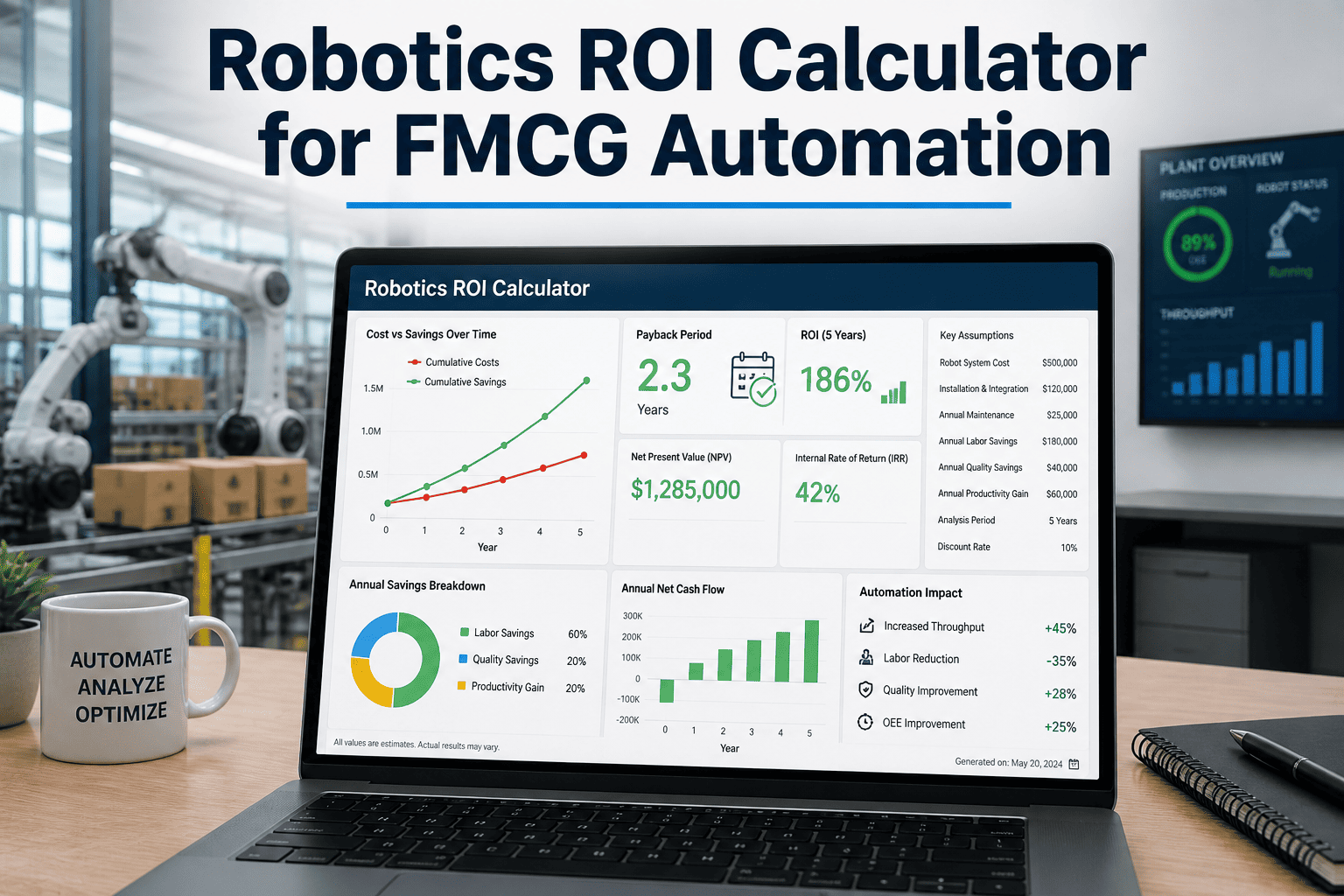
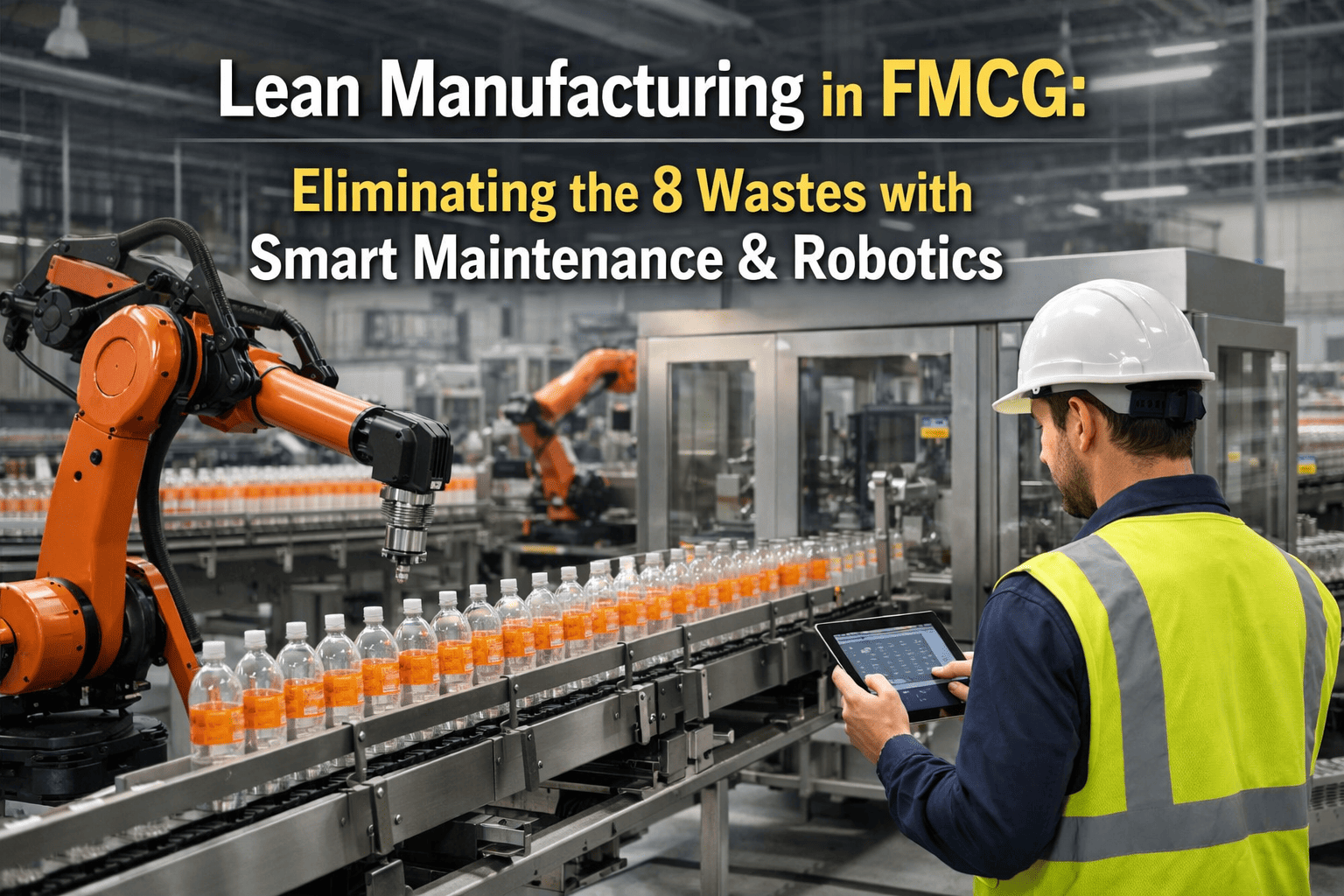
North American FMCG manufacturers face a convergence of pressures in 2026: ESG mandates from retailers like Walmart and Costco, rising energy costs that have climbed 23% since 2022, and consumer demand for verifiable sustainability credentials on every package they purchase. The uncomfortable truth is that most factory sustainability programs still rely on quarterly spreadsheet audits that measure what already happened rather than preventing waste in real time. Robotics changes this equation fundamentally — energy-efficient picking systems, AI-optimized packaging material usage, and automated recycling workflows that generate auditable sustainability data as a byproduct of normal operations. Oxmaint ties robotic energy and waste data to maintenance workflows — Schedule a Consultation.
Sustainable Manufacturing 2026
How robotics helps FMCG brands meet sustainability goals — energy-efficient automation, optimized packaging, and circular economy workflows tracked through Oxmaint.
35%Average energy reduction with optimized robotic cells
40%Packaging material waste reduction through AI sizing
$2.4MAverage annual savings from robotic waste reduction programs
Real-TimeCarbon, energy, and waste metrics per production run
The Sustainability Gap in FMCG Manufacturing
Most FMCG producers have sustainability targets on paper but lack the operational infrastructure to measure, control, and verify progress in real time. Manual audits conducted quarterly capture a snapshot — not the continuous picture needed to optimize energy consumption, minimize material waste, and prove compliance to retailer ESG scorecards. Oxmaint automates sustainability data capture from robotic systems — Sign Up Free.
Why Traditional Sustainability Programs Fall Short
01
Quarterly Audits
Measuring waste 90 days after it happened means three months of inefficiency baked into operations before anyone notices.
02
Energy Blind Spots
Legacy robots consume 2-3x more energy than modern servo-driven systems but nobody tracks per-unit energy cost by cell or line.
03
Packaging Overuse
Fixed packaging profiles designed for the largest SKU apply excess material to every smaller item — cardboard, film, and void fill wasted at scale.
04
Unverifiable Claims
Without granular production data, sustainability reports rely on estimates. Retailer ESG scorecards increasingly demand sensor-verified metrics.
05
Linear Waste Streams
Production scrap goes to landfill instead of being sorted, measured, and routed to recycling or reprocessing partners automatically.
Three Pillars of Robotic Sustainability
Sustainability in FMCG manufacturing is not a single initiative — it is the convergence of energy efficiency, material optimization, and circular waste management. Robotics addresses all three simultaneously because automated systems generate the granular operational data needed to measure, optimize, and verify sustainability performance at the production-run level.
Energy → Materials → Circularity
Three interconnected pillars tracked through Oxmaint
1
Energy-Efficient Robotics
Modern servo-driven robots with regenerative braking consume 35-50% less energy than hydraulic predecessors. Smart sleep modes power down during idle periods. Per-unit energy cost tracked automatically.
kWh per Unit
2
AI-Optimized Packaging
Vision-guided systems measure each product and select the minimum packaging footprint — right-sizing cartons, reducing film usage by 25-40%, and eliminating void fill on properly fitted packages.
Grams per SKU
3
Automated Waste Sorting
Robotic waste sorting cells use AI vision to classify production scrap by material type — separating recyclable cardboard, film, and compostable materials at line speed with 95%+ accuracy.
Diversion Rate %
4
Circular Packaging Loops
Robotic systems handle reusable packaging — washing, inspecting, and reintroducing returnable crates, bottles, and trays into production. Each cycle tracked for material fatigue and contamination.
Reuse Cycles
5
Sustainability Reporting
Automated data aggregation from all robotic cells feeds ESG dashboards with verified metrics — energy per unit, material per SKU, waste diversion rate, and carbon intensity per production run.
Audit-Ready
Turn Sustainability Data into Maintenance Action
Oxmaint connects energy spikes, material waste events, and equipment degradation into unified maintenance workflows. When a robotic cell starts consuming 15% more energy, Oxmaint generates the work order before waste compounds.
Energy is the largest controllable operating cost in FMCG manufacturing and the most visible sustainability metric on every ESG scorecard. Modern robotic systems are engineered for energy efficiency from the ground up — but that efficiency degrades over time without proper maintenance tracking. Oxmaint monitors energy consumption per robotic cell — Book a Demo.
Legacy vs. Modern Robotic Energy Profiles
Legacy Hydraulic / Pneumatic
Constant energy draw even at idle
No regenerative braking capability
8-15 kWh per 1,000 pick cycles
No per-unit energy tracking
vs
Modern Servo-Driven Robotics
Smart sleep mode during idle periods
Regenerative braking returns 15-20% energy
3-6 kWh per 1,000 pick cycles
Per-unit energy data via CMMS integration
AI-Optimized Packaging: Eliminating Material Waste
Packaging material represents the second-largest waste stream in FMCG manufacturing after food waste itself. Traditional packaging lines use fixed carton sizes and standard film lengths designed for the largest product variant, applying excess material to every smaller item that passes through. AI-driven robotic packaging systems eliminate this waste by measuring each product in real time and selecting the minimum viable packaging configuration. Track material usage per SKU automatically in Oxmaint — Sign Up Free.
AI Packaging Optimization Capabilities
Right-Size Cartons
25-40% cardboard reduction
3D vision measures each product before carton selection
Dynamic carton forming from flat stock to exact dimensions
Eliminates void fill on 80%+ of shipments
Saves $0.03-$0.12 per package in material cost
Film Optimization
20-35% stretch film reduction
Variable-tension wrapping adapts to load geometry
Pre-stretch technology maximizes film yield per roll
Sensor feedback prevents overwrapping and film breaks
Reduces film spend by $80K-$200K annually per line
Robotic handling adapts to thinner mono-material films
Force-sensitive grippers prevent damage to lighter packaging
Sealing parameters auto-adjust for new material properties
Enables switch from multi-layer to recyclable packaging
Circular Packaging: Robotics Enabling Reuse at Scale
The circular economy in FMCG requires infrastructure that legacy manual processes cannot provide. Returnable crates, reusable bottles, and refillable containers all require inspection, cleaning, and quality verification at scale before re-entering the production line. Robotic systems handle this cycle with the speed, consistency, and traceability that circularity demands. Oxmaint tracks reuse cycles and material fatigue per container — Book a Demo.
Robotic Circular Packaging Workflow
From return to reintroduction — every cycle tracked
1
Automated Receiving & Sort
Returned packaging is robotically unloaded, sorted by type and condition using AI vision. Damaged units are separated for recycling; reusable units advance to cleaning.
Sort Accuracy 98%
2
Robotic Wash & Sanitize
Automated washing systems clean containers to food-grade standards. Robotic handling ensures consistent positioning for complete coverage. Water and chemical usage optimized per load.
FDA Compliant
3
Quality Inspection Gate
AI vision inspects each container for cracks, staining, warping, and contamination residue. Units exceeding wear thresholds are retired and logged in Oxmaint for material lifecycle tracking.
Defect Detection
4
Reintroduction to Line
Verified containers re-enter the production line. Each reuse cycle is logged against the container's lifetime limit, ensuring retirement before material integrity degrades.
Cycle Logged
5
End-of-Life Recycling
Containers reaching maximum reuse cycles are robotically sorted by material type and routed to recycling partners. Full lifecycle data exported for sustainability reporting.
Zero Landfill
Automated Waste Sorting: Closing the Loop
Production waste in FMCG facilities is not homogeneous — it includes cardboard, plastic film, compostable organics, metal scraps, and contaminated materials that each require different disposal pathways. Manual sorting achieves 60-70% accuracy at best. Robotic waste sorting cells using AI vision and pneumatic separators achieve 95%+ classification accuracy at line speed, dramatically increasing landfill diversion rates while generating the verified waste stream data that ESG reporting demands.
The facilities achieving the highest landfill diversion rates all share one characteristic: they treat waste as a measurable production output, not an afterthought. When you install robotic sorting on your waste stream and connect it to your CMMS, you suddenly have data on exactly how much cardboard, film, and organic waste each production line generates per shift. That data transforms waste from an uncontrolled cost into an optimizable metric. The plants connecting waste data to their maintenance system — where a spike in film waste auto-generates a calibration check on the wrapping station — those are the plants hitting 90%+ diversion.
— Director of Sustainable Operations, Top 10 North American FMCG Manufacturer
95%
Sorting accuracy with AI vision
90%+
Landfill diversion achievable
Real
Verified waste stream data
Sustainability Metrics That Matter for FMCG
Retailer ESG scorecards are moving from self-reported estimates to sensor-verified, production-level metrics. Robotic systems integrated with Oxmaint generate these metrics automatically as a byproduct of normal operations — no separate sustainability audit required. Oxmaint aggregates sustainability data across all robotic cells — Sign Up Free.
Key Sustainability KPIs for FMCG Operations
Automatically captured through robotic system integration
Energy Intensity (kWh/unit)
Pillar: Energy
Energy consumed per unit produced, tracked by robotic cell and production line. Identifies degrading motors, miscalibrated drives, and inefficient motion profiles.
Material Yield (%)
Pillar: Materials
Percentage of raw packaging material that ends up in finished goods vs. scrap. AI right-sizing pushes yield from 75% to 92%+ on carton and film lines.
Landfill Diversion Rate (%)
Pillar: Circularity
Production waste sorted and routed to recycling or composting vs. landfill. Robotic sorting pushes rates from 65% manual baseline to 90%+ verified diversion.
Carbon Intensity (kg CO₂/unit)
Pillar: Energy
Calculated from energy consumption data combined with grid carbon factors. Enables Scope 1 and 2 emissions reporting at the production-run level.
Reuse Cycle Count
Pillar: Circularity
Average number of times reusable containers complete the return-wash-inspect-refill loop before end-of-life. Higher counts reduce per-use material cost and environmental impact.
Make Sustainability Measurable, Not Aspirational
Oxmaint turns robotic production data into verified sustainability metrics — energy per unit, material yield, waste diversion, and carbon intensity tracked per shift, per line, per facility. Build the audit trail that satisfies retailer ESG scorecards and drives continuous improvement.
Sustainability-focused robotic programs fail not because the technology underperforms but because energy monitoring is neglected after commissioning, material savings are not tracked per SKU, and waste diversion data is not connected to the maintenance workflows that prevent regression.
Critical Success Factors
01
Monitor Energy Continuously
Install per-cell energy metering and connect it to Oxmaint. A 10% energy drift triggers a calibration work order before waste compounds across thousands of production cycles.
02
Track Material per SKU
Log packaging material consumed per SKU per run. Correlate spikes with equipment condition — a worn sealing bar wastes film; a misaligned former wastes cardboard.
03
Connect Waste to Maintenance
When waste sorting data shows a spike in a specific material stream, Oxmaint should auto-generate an investigation ticket targeting the upstream production cell.
Frequently Asked Questions
How much energy do modern robotic systems actually save compared to legacy equipment?
Modern servo-driven robots with regenerative braking typically consume 35-50% less energy per production cycle than hydraulic or pneumatic predecessors. The savings come from three sources: regenerative braking that returns 15-20% of kinetic energy, intelligent sleep modes that power down during idle periods, and optimized motion profiles that reduce peak current draw. At scale across a multi-line FMCG facility, this translates to $150K-$400K in annual energy cost reduction.
Can AI packaging optimization work with our existing packaging lines?
Yes, in most cases. AI right-sizing systems can be retrofitted onto existing carton formers, case packers, and stretch wrappers. The AI layer adds 3D vision measurement upstream of the packaging station and feeds optimal dimensions to the machine's existing control system. Full greenfield installations achieve higher savings (35-40% material reduction), while retrofits typically deliver 20-30%. The key requirement is that your packaging equipment accepts variable size inputs rather than being fixed-format only.
What waste diversion rates are realistic with robotic sorting?
FMCG facilities implementing robotic waste sorting typically achieve 85-95% landfill diversion rates within the first year, compared to 60-70% with manual sorting. The improvement comes from higher classification accuracy (95%+ vs. 70% manual), consistent performance across all shifts, and the ability to separate materials that are difficult for humans to distinguish visually, such as different plastic resin types. Contamination rates in sorted streams also drop significantly, increasing the value of recycled materials.
How do we prove sustainability claims to retailers like Walmart and Costco?
Retailer ESG scorecards increasingly require sensor-verified, production-level data rather than estimated annual figures. Robotic systems integrated with a CMMS like Oxmaint generate this data automatically: energy consumed per unit, packaging material per SKU, waste diversion percentage per shift, and carbon intensity per production run. This granular data trail satisfies Project Gigaton (Walmart), Costco's supplier sustainability requirements, and emerging SEC climate disclosure rules.
What ROI timeline should we expect from sustainability-focused robotic programs?
Most FMCG facilities report 10-18 month payback driven by three concurrent savings: energy cost reduction (35-50% per robotic cell), packaging material savings ($80K-$200K per line annually), and waste diversion revenue from selling sorted recyclables instead of paying landfill tipping fees. Facilities also avoid growing ESG non-compliance penalties and maintain preferred supplier status with major retailers — benefits that are harder to quantify but strategically significant.