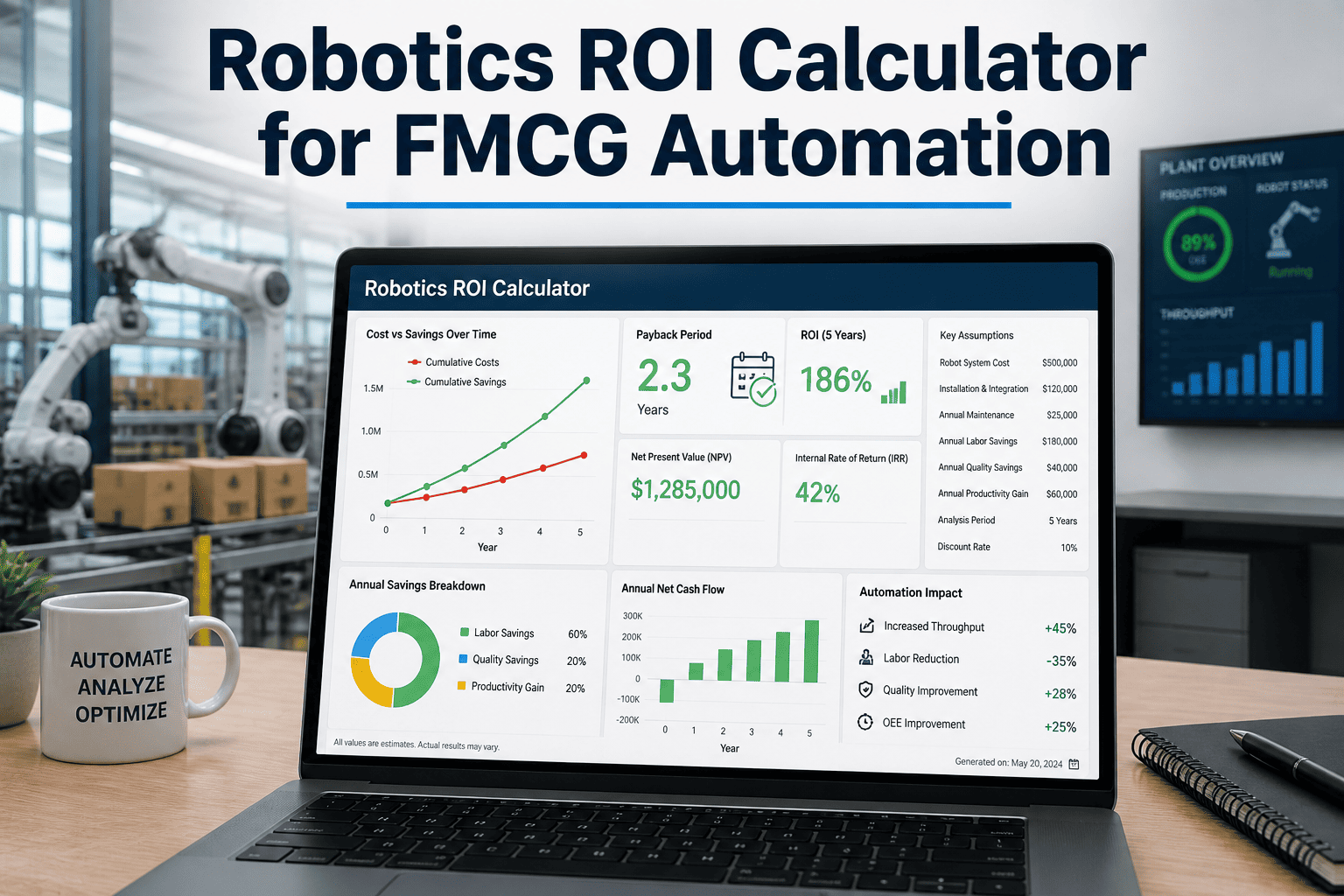
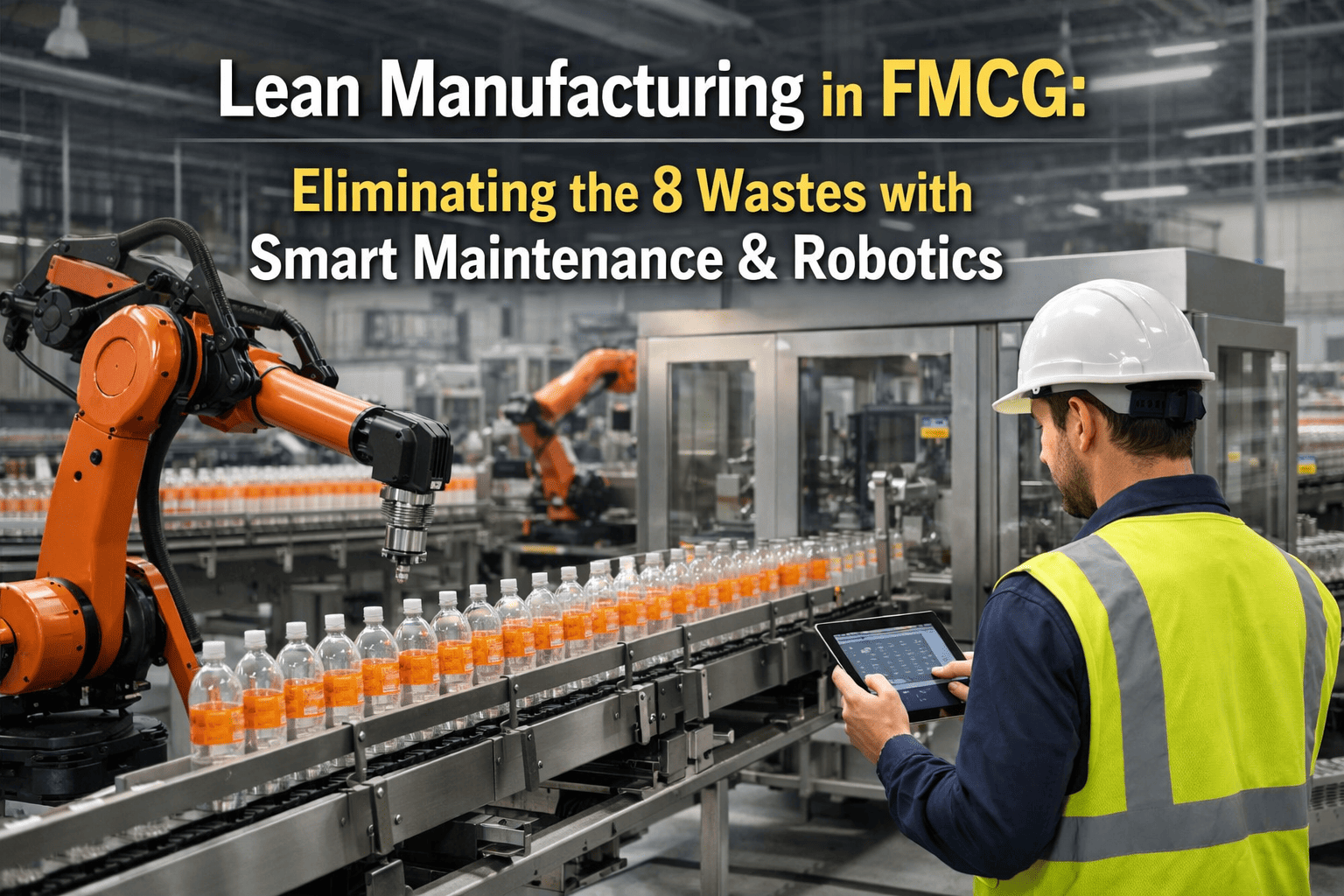
Between January 2024 and February 2026, peer-reviewed robotics research output targeting FMCG production applications increased 62% over the prior two-year period — driven by three converging breakthroughs: soft grippers that handle deformable food products without bruising, multi-robot cooperation protocols that eliminate single-point-of-failure bottlenecks on packaging lines, and reinforcement learning models that teach robots new SKU changeovers in hours instead of weeks. Yet the gap between published research and production floor deployment remains enormous. Fewer than 8% of FMCG plants in North America have piloted any robotic system introduced after 2023. The barrier is not the technology — it is the absence of structured pilot tracking, maintenance integration, and performance documentation that operations directors need to justify scaling from proof-of-concept to production. This roundup synthesizes the robotics research trends most likely to reach FMCG production lines by 2027 and maps each to the operational infrastructure required to deploy, maintain, and scale them. Sign Up to start building your R&D-to-production tracking system.
Research Output Growth
62%
Increase in peer-reviewed FMCG robotics papers published 2024–2026 vs. 2022–2023
Pilot Adoption Gap
<8%
Of North American FMCG plants have piloted post-2023 robotic systems
SKU Changeover Acceleration
12x
Faster robot reprogramming via reinforcement learning vs. traditional teach-pendant methods
Five Research Frontiers Reshaping FMCG Robotics
The robotics research landscape for FMCG is no longer about whether robots can work on packaging and palletizing lines — that question was answered a decade ago. The 2024–2026 research wave addresses the harder problems: handling fragile and irregularly shaped products without damage, adapting to the SKU proliferation that makes FMCG changeovers constant, cooperating across multi-robot cells without centralized control bottlenecks, maintaining performance in washdown environments, and learning new tasks from demonstration rather than manual programming. Each research frontier maps to a specific production challenge that operations directors face daily.
1
Soft Robotics & Adaptive Grippers
$2.1B projected market by 2027
Key Research Developments (2024–2026):
• Pneumatic soft grippers achieving sub-2N grasp force for tomatoes, berries, and baked goods without deformation
• Jamming-based universal grippers adapting to irregular shapes (snack bags, pouches, wrapped confections) in <200ms
• Embedded tactile sensor arrays providing real-time grip force feedback — reducing product damage 85–92% vs. rigid grippers
• FDA-compliant silicone and TPU gripper materials rated for direct food contact and CIP/SIP washdown cycles
Production Impact: Enables robotic primary handling of fresh produce, bakery, dairy, and delicate confections — categories where 70% of FMCG plants still rely on manual labor due to product fragility.
2
Multi-Robot Cooperation Protocols
40% higher throughput vs. single-robot cells
Key Research Developments (2024–2026):
• Decentralized task allocation algorithms enabling 4–8 robots to coordinate pick-and-place without central controller
• Collision-free path planning at 120+ picks/min across shared workspaces using predictive trajectory negotiation
• Graceful degradation — line continues at reduced throughput when any single robot enters maintenance, no full-line stop
• Fleet health monitoring protocols broadcasting maintenance alerts across the cooperative cell for predictive scheduling
Production Impact: Multi-robot cells eliminate the single-point-of-failure problem that has kept operations directors skeptical of robotic packaging lines — one robot down no longer means line down.
3
Reinforcement Learning for SKU Changeover
Hours instead of weeks to teach new products
Key Research Developments (2024–2026):
• Sim-to-real transfer learning — robots train on digital twins then adapt to physical production in 50–200 real-world trials
• Few-shot learning from human demonstration — operator shows the task 3–5 times, robot generalizes to full SKU family
• Continuous online learning that improves grasp success rate from 89% to 97%+ over the first production week
• Automatic parameter tuning for new package formats (size, weight, rigidity) without manual reprogramming
Production Impact: Directly addresses the #1 barrier to FMCG robotic adoption — the changeover cost. FMCG lines switch SKUs 8–15 times per shift. Traditional robot reprogramming takes 2–6 weeks per new SKU. Learning-based systems reduce this to hours.
4
Vision-Guided Manipulation & Quality Inspection
99.2% pick accuracy on mixed-SKU lines
Key Research Developments (2024–2026):
• 3D point cloud processing at 60fps enabling bin-picking of randomly oriented products without structured presentation
• Hyperspectral vision detecting contamination, freshness degradation, and packaging defects invisible to RGB cameras
• Simultaneous manipulation and inspection — robot checks product quality during the pick-and-place motion, zero added cycle time
• Transfer learning for brand-new SKUs using as few as 20 labeled images to achieve 95%+ recognition accuracy
Production Impact: Collapses two traditionally separate systems (pick-and-place robot + downstream vision inspection) into a single operation, reducing equipment footprint, capital cost, and maintenance burden by 30–40%.
Tracking Robotics Pilots from Lab to Production Line
Oxmaint's R&D Project Tracking and Pilot Deployment Logs give your engineering team structured documentation from proof-of-concept through production scale — tracking commissioning milestones, maintenance requirements, performance metrics, and the ROI evidence your CFO needs to approve full-line rollout.
The Pilot-to-Production Gap: Why 92% of FMCG Plants Haven't Moved
The research is compelling. The technology works in laboratory settings. But the gap between published performance and production floor reality is where most FMCG robotics initiatives stall. Operations directors and plant managers face a specific set of barriers that have nothing to do with gripper technology or path planning algorithms — they are infrastructure, maintenance, and documentation problems that a CMMS solves.
Why Robotics Pilots Stall Before Production Scale
Survey of 120 FMCG operations directors • North America • 2024–2025
No structured maintenance plan for robotic assets
67%
Robots treated as "IT" — no PM schedule
Pilot performance not documented for ROI justification
58%
CFO can't approve what isn't measured
No integration between robot diagnostics and plant CMMS
73%
Robot faults invisible to maintenance team
Changeover time undocumented — no baseline for comparison
61%
Can't prove the learning system works
Pilots that fail to scale due to operational gaps (not tech)
72%
Technology works — documentation doesn't
Research Trend #5: Hygienic Design and Washdown-Ready Robotics
FMCG production environments — especially food, beverage, and personal care — require equipment that survives daily washdown cycles with caustic cleaning agents, high-pressure water, and foaming sanitizers. Until 2023, most collaborative robots were rated IP54 at best, requiring protective enclosures that added cost and limited flexibility. The 2024–2026 research wave has produced fundamental advances in hygienic robot design that remove this barrier entirely.
IP67/IP69K-Rated Collaborative Robots
Full submersion and high-pressure washdown without protective covers
✓ Stainless steel housings with food-grade seals eliminating crevices where bacteria harbor
✓ NSF/ANSI 169 and EHEDG-certified designs for open food contact zones
✓ Maintenance interval extended to 10,000+ hours between lubrication events vs. 2,000 hours for standard cobots
Impact: Eliminates $15K–$40K per robot in protective enclosure costs and reduces daily sanitation time 25–35%
Self-Cleaning Gripper Materials
Antimicrobial and low-surface-energy gripper compounds that resist biofilm formation
✓ Silver-ion infused silicone achieving 99.7% microbial reduction between sanitation cycles
✓ PTFE-coated contact surfaces preventing product adhesion — reducing gripper cleaning frequency 60%
✓ Modular quick-change gripper systems allowing tool-free swap in <30 seconds for allergen changeovers
Impact: Enables robotic handling in allergen-controlled zones — the last major holdout for manual-only operations in FMCG
Predictive Hygiene Monitoring
Embedded sensors detecting sanitation effectiveness and contamination risk in real time
✓ ATP bioluminescence sensors integrated into robot end-effectors verifying sanitation after each CIP cycle
✓ Environmental monitoring data (temperature, humidity at gripper surface) logged in CMMS for FSMA compliance
✓ Automated sanitation verification work orders generated when post-CIP readings exceed threshold
Impact: Connects robotic sanitation verification directly to CMMS audit trail — the documentation FSMA and SQF auditors require
Mapping Research to Production: Technology Readiness by Application
Not every research breakthrough is equally ready for your production floor. This readiness assessment maps the five key research areas to specific FMCG line applications, rating each by technology maturity, integration complexity, and estimated time to production-ready deployment. Book a Demo to discuss which technologies match your facility's current automation roadmap and how Oxmaint tracks pilot deployments through production readiness.
End-of-Line Palletizing — Production Ready Now
Multi-robot cooperative palletizing with mixed-case and mixed-SKU capability
✓ Technology maturity: High — multi-robot palletizing deployed at 200+ FMCG sites globally since 2024
✓ Key research applied: Decentralized cooperation, vision-guided mixed-case building, graceful degradation
✓ CMMS requirement: PM scheduling for servo drives, vacuum grippers, vision cameras; track pallet pattern changeover times
Deploy now. ROI typically 14–18 months. Oxmaint tracks every robot asset with manufacturer PM schedules from Day 1.
Secondary Packaging — Pilot Ready 2026
Case packing, cartoning, and variety pack assembly with adaptive gripping
✓ Technology maturity: Medium-High — soft grippers handling 85–90% of common FMCG secondary packaging formats
✓ Key research applied: Adaptive grippers, few-shot learning for new carton formats, simultaneous inspection
✓ CMMS requirement: Gripper wear tracking (silicone/TPU lifecycle), changeover time logging, defect rate correlation with gripper condition
Pilot in 2026, scale 2027. Oxmaint Pilot Deployment Logs document every trial run, failure mode, and changeover baseline.
Primary Product Handling — Emerging Pilots 2026–2027
Direct handling of unpackaged food, beverages, and personal care products
✓ Technology maturity: Medium — soft gripper and hygienic design research converging but not yet standard
✓ Key research applied: Sub-2N soft grippers, IP69K housings, antimicrobial surfaces, ATP verification
✓ CMMS requirement: Sanitation cycle logging, gripper contamination monitoring, FSMA compliance documentation per production run
Early pilots only. Requires robust sanitation documentation from Day 1 — exactly what Oxmaint's compliance logs provide.
Full-Line Autonomous Operation — Research Stage 2027+
End-to-end robotic production from raw material handling through palletization
✓ Technology maturity: Low — individual subsystems proven, full integration with autonomous decision-making still in research
✓ Key research applied: All five frontiers converging — soft grippers, multi-robot cooperation, RL changeover, vision, hygienic design
✓ CMMS requirement: Enterprise-scale robotic fleet management, predictive maintenance from robot self-diagnostics, OEE tracking per cell
3–5 year horizon. Plants building CMMS infrastructure for current pilots will be positioned to scale when full-line systems arrive.
The Best Time to Build Your Robotic Maintenance Infrastructure Is Before the Robots Arrive
Every robotic system you pilot or deploy needs the same operational infrastructure: PM scheduling, parts tracking, performance logging, changeover documentation, and compliance records. Oxmaint gives your engineering and maintenance teams a single platform that tracks robotic assets alongside every other asset on your production floor — from commissioning through full production.
The Economic Case: Research-Backed ROI for FMCG Robotics
Operations directors and CFOs evaluating robotic deployments need production-floor economics, not laboratory metrics. The research literature published between 2024 and 2026 increasingly includes total cost of ownership models and production-validated ROI data that reflect real-world FMCG operating conditions — including maintenance costs, changeover losses, and gripper consumable replacement.
Research-Validated ROI: Robotics in FMCG Production
Aggregated from 18 peer-reviewed production deployment studies • 2024–2026
Palletizing cell ROI (4-robot cooperative)
14–18 mo
Includes maintenance + consumables
Labor cost displacement per shift
$180K/yr
3 manual positions per robotic cell
Changeover time reduction (RL-based vs. manual program)
82%
4.2 hrs → 45 min avg. per new SKU
Product damage reduction (soft gripper vs. rigid)
87%
$45K–$120K/yr in waste avoided
Annual maintenance cost per robotic cell (with CMMS PM)
$8K–$14K
vs. $22K–$38K without structured PM
Building Your Pilot-to-Production Tracking System
The FMCG plants that successfully scale robotic deployments share one characteristic: they document everything from the first pilot hour. Changeover times, cycle rates, failure modes, gripper wear patterns, maintenance events, and production quality metrics are all tracked in a CMMS that provides the longitudinal data needed to justify scale-up investment. Plants that run pilots without structured tracking end up with anecdotes instead of evidence — and anecdotes do not survive CFO scrutiny. Sign Up to start building your pilot documentation infrastructure today.
Phase 1: Pre-Pilot Asset Registration
Document every robotic component before the first production trial
✓ Register each robot arm, controller, gripper, vision system, and safety device as individual tracked assets in Oxmaint
✓ Enter manufacturer PM schedules — servo lubrication intervals, gripper replacement cycles, vision camera calibration frequencies
✓ Establish baseline metrics: manual line speed, changeover time, product damage rate, labor hours per shift
Deliverable: Complete robotic cell asset hierarchy in CMMS with PM schedules active before first production hour
Phase 2: Pilot Operation and Data Collection
Run the pilot with structured logging of every performance metric and maintenance event
✓ Log every changeover event — SKU, time to complete, operator intervention required, learning system performance
✓ Track every fault, stoppage, and maintenance event with root cause, resolution time, and parts consumed
✓ Document gripper condition at each PM interval — wear patterns, grip force degradation, replacement triggers
Deliverable: Pilot Deployment Log with week-over-week performance trending and maintenance cost accumulation
Phase 3: ROI Documentation and Scale-Up Justification
Convert pilot data into the financial case your CFO requires
✓ Generate CMMS reports comparing robotic cell OEE vs. manual line baseline — availability, performance, quality
✓ Calculate total cost of ownership including maintenance, consumables, energy, and changeover time savings
✓ Document compliance impact — FSMA sanitation records, OSHA ergonomic injury reduction, SQF audit readiness
Deliverable: Board-ready ROI report with CMMS-sourced production data — not estimates, not projections, documented results
Phase 4: Production Scale and Fleet Management
Replicate the proven pilot across additional lines and facilities
✓ Clone PM schedules and checklists from pilot to new robotic cells — zero reconfiguration per deployment
✓ Build cross-facility fleet dashboard comparing robotic cell performance, maintenance costs, and OEE across all sites
✓ Integrate robot self-diagnostic data into CMMS for predictive maintenance — servo temperature trending, vibration patterns, gripper cycle counts
Deliverable: Enterprise robotic fleet management with standardized maintenance, performance benchmarking, and predictive capabilities
The Research Is Published. The Technology Works. Your Documentation System Determines Whether You Scale.
Oxmaint gives your engineering and operations teams the R&D project tracking and pilot deployment logs that convert robotic proof-of-concepts into production-scale deployments — tracking every asset, every PM task, every changeover event, and every failure mode from first trial through full-line operation. Plants that document their pilots scale. Plants that don't, don't.
Frequently Asked Questions
Which robotics research trends are closest to FMCG production deployment in 2026?
Multi-robot cooperative palletizing is production-ready now, with 200+ global deployments since 2024. Secondary packaging automation using adaptive soft grippers is pilot-ready in 2026 for 85–90% of common FMCG formats. Reinforcement learning for SKU changeover is the most operationally transformative — reducing new-product programming from weeks to hours — and is being validated in production pilots at major FMCG manufacturers. Primary product handling with full hygienic compliance is in early pilot stage, with production-ready systems expected by late 2027.
Book a Demo to discuss which technologies match your production roadmap.
What does a soft gripper maintenance program look like in a FMCG environment?
Soft grippers are consumable components with predictable wear patterns. Silicone and TPU gripper fingers typically last 500,000–2,000,000 cycles depending on product weight, grip force, and sanitation chemical exposure. The CMMS tracks gripper cycle count, logs grip force readings at each PM interval, and triggers replacement work orders when force degradation exceeds threshold — typically 15–20% below baseline. Sanitation-related gripper inspections occur every CIP cycle (daily in most food plants). Annual replacement cost runs $2,000–$8,000 per robotic cell depending on gripper complexity and changeover frequency.
Sign Up to set up gripper lifecycle tracking in Oxmaint.
How do multi-robot cooperation systems handle maintenance without stopping the line?
The key research breakthrough is graceful degradation — decentralized cooperation protocols that redistribute tasks when any robot in the cell goes offline. In a 4-robot palletizing cell, taking one robot offline for maintenance reduces throughput roughly 25% but does not stop the line. The CMMS schedules robot PM during planned low-demand windows (shift changeovers, planned breaks) and staggers maintenance across the cell so no two robots are offline simultaneously. Fleet health monitoring broadcasts maintenance alerts across all robots in the cooperative cell, enabling predictive scheduling that minimizes the overlap of maintenance events and production peaks.
What maintenance data should we track during a robotic pilot to justify production scale-up?
Track everything from Day 1: cycle count per robot, faults per shift (categorized by type — mechanical, electrical, software, gripper), mean time between failures, mean time to repair, changeover time per SKU transition (compare to manual baseline), gripper condition at each PM interval, consumable usage (grippers, vacuum cups, filters), energy consumption per unit produced, and product damage rate comparison. Oxmaint's Pilot Deployment Logs structure all of this data automatically through work order completion and digital checklists. The resulting report gives your CFO production-validated TCO and ROI — not vendor estimates.
What does it cost to pilot a robotic cell in an FMCG production environment?
A single-cell robotic pilot (1–4 robots) for secondary packaging or palletizing in an FMCG plant typically costs $150,000–$400,000 including hardware, integration, and commissioning. Annual maintenance runs $8,000–$14,000 per cell with a structured CMMS PM program — compared to $22,000–$38,000 without one. Gripper consumables add $2,000–$8,000 annually. Most well-documented pilots achieve ROI within 14–18 months. The critical investment is not the robots — it is the documentation infrastructure that proves whether the pilot justifies scaling. That infrastructure costs a fraction of one robot arm.
Book a Demo to model pilot tracking for your facility.