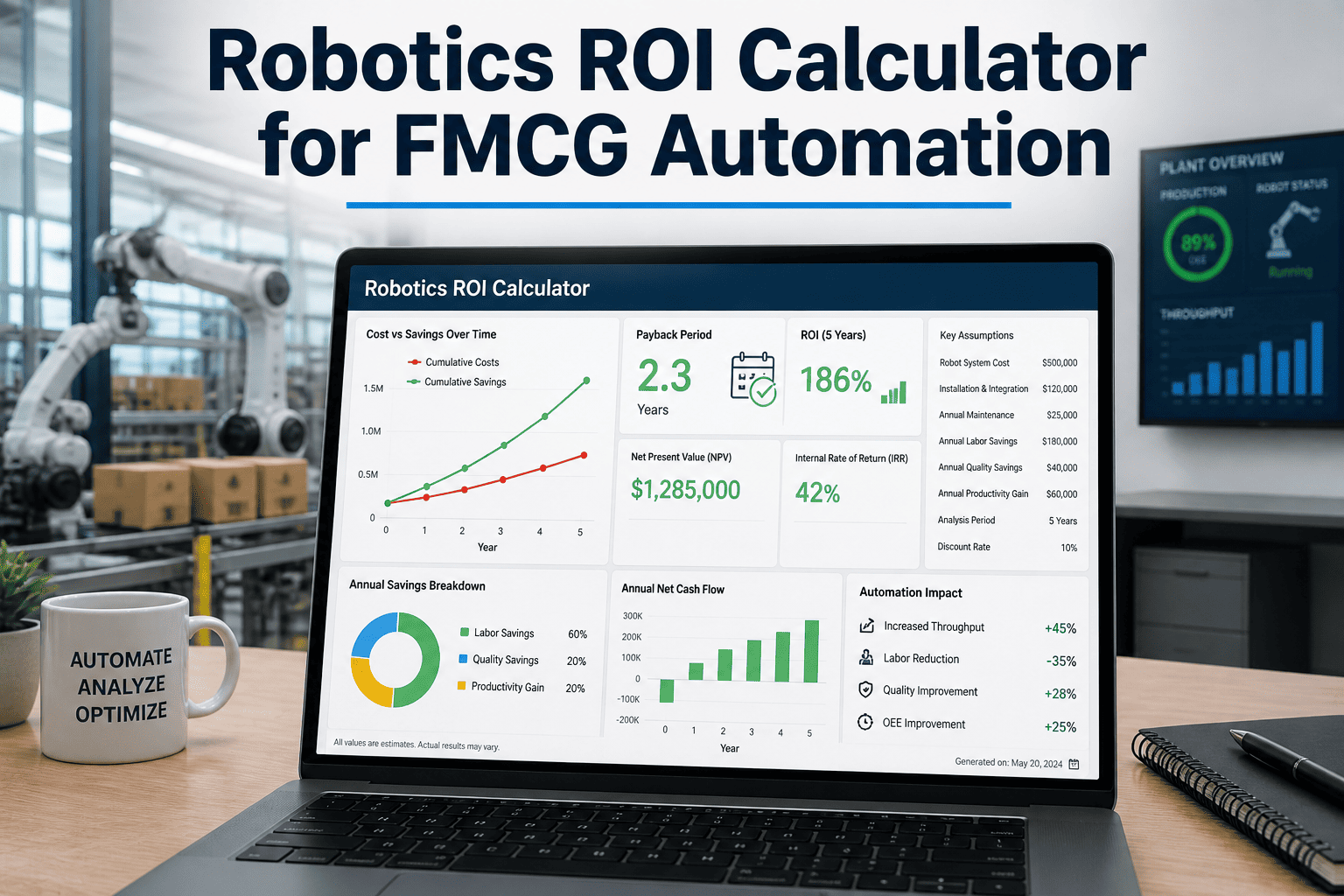
Robotics ROI Calculator: Estimating Savings for FMCG Automation Projects
By Oxmaint on February 21, 2026
A snack foods manufacturer in Ohio spent 14 months building the business case for a robotic palletizing cell on their highest-volume line — and the CFO rejected it twice. Not because the numbers were wrong, but because the numbers were incomplete. The engineering team calculated labor substitution savings of $186,000 per year from eliminating two palletizing positions across three shifts, subtracted the $420,000 capital cost, and presented a 27-month payback that the finance team considered marginal. What the proposal omitted was $94,000 per year in eliminated product damage from manual stacking errors, $67,000 in reduced workers compensation claims from repetitive lifting injuries, $41,000 in overtime elimination during peak season staffing gaps, and $23,000 in maintenance cost reduction from replacing three aging manual palletizers with one robotic cell tracked through structured preventive maintenance. When the full ROI model captured all five cost categories — labor, damage, safety, overtime, and maintenance — the payback dropped to 11 months and the project was approved in a single meeting. The difference between a rejected proposal and an approved one was not the robot — it was the ROI model. Oxmaint tracks the maintenance cost data that completes your robotics ROI model — Book a Demo.
Why Most FMCG Robotics ROI Models Fail
The majority of robotics investment proposals in FMCG are built on a single savings category: labor substitution. An engineer counts the headcount eliminated, multiplies by loaded labor cost, subtracts the capital expense, and presents a payback period. This approach systematically underestimates ROI by 40–60% because it ignores the secondary and tertiary cost categories where robotics delivers measurable, trackable savings — categories that finance teams will credit if the data exists. Plants that track maintenance costs, downtime events, and damage incidents per asset in Oxmaint — Sign Up Free have the historical data to build ROI models that capture the full savings picture and get projects approved.
40–60%
ROI underestimation when models count only labor substitution savings
5
Cost categories required for a complete FMCG robotics ROI model
11 vs 27 mo
Payback difference between a complete model and a labor-only model
Your maintenance data is your ROI evidence. Oxmaint tracks repair costs, downtime hours, and damage incidents per asset — the exact data points that turn a marginal robotics proposal into an approved capital project.
A defensible robotics ROI model for FMCG operations captures savings across five distinct categories. Each category has specific data sources, calculation methods, and confidence levels that finance teams can verify independently. Presenting all five with documented assumptions gives the CFO a model they can stress-test rather than a single number they must accept on faith.
Category 1: Labor Substitution
Direct headcount reduction or reallocation. Calculate loaded labor cost (wages + benefits + overtime + training + turnover cost) × positions eliminated × shifts covered. Include seasonal temp labor premiums and agency fees. This is the category every proposal includes — but it is typically only 45–55% of total savings.
Category 2: Quality & Damage Reduction
Product damage from manual handling errors — dropped cases, crushed packaging, incorrect stacking patterns, contamination from human contact. Pull 12 months of damage write-offs from your ERP by production area. Robotic cells typically reduce handling damage 55–75% on the automated tasks.
Category 3: Safety & Workers Comp
Ergonomic injury claims from repetitive lifting, forklift collision incidents, slip/fall events in production areas. Pull workers comp claims history by department. OSHA recordable rates drop 60–80% on tasks transitioned from manual to robotic operation. Include experience modifier (EMR) impact on insurance premiums.
Category 4: Throughput & Uptime Gains
Robots run through shift changes, breaks, absenteeism, and holidays without throughput degradation. Calculate the pallet moves, cases packed, or units processed during the hours that manual operations lose to handover gaps, fatigue decline, and staffing shortages. This category alone often justifies 15–25% of the ROI.
5
Category 5: Maintenance Cost Reduction
The category most proposals miss entirely. Compare the total maintenance cost of existing manual equipment (unplanned repairs, emergency callouts, parts replacement from operator-induced damage, overtime maintenance labor) against the projected maintenance cost of a robotic cell with CMMS-structured preventive maintenance. FMCG plants consistently see 40–77% lower per-unit maintenance costs on robotic systems versus aging manual equipment — but only when the robotic fleet is maintained through structured PM programs rather than run-to-failure.
Calculating CAPEX: What the Robot Actually Costs
The capital expenditure for an FMCG robotic cell extends well beyond the robot arm purchase price. A complete CAPEX model includes every cost incurred before the cell produces its first unit — and omitting any line item creates a budget overrun that erodes the ROI your CFO approved.
Robot Hardware — $80K–$250KRobot arm, controller, teach pendant. Price varies by payload (25 kg pick-place to 700 kg palletizing), reach, speed, and brand. Collaborative robots (cobots) at the low end; high-speed delta and articulated arms at the high end.
End-of-Arm Tooling (EOAT) — $15K–$80KGrippers, vacuum heads, clamps, and custom fixtures. Multi-SKU lines require changeover-capable EOAT or multiple tool sets. Tooling cost often exceeds expectations on mixed-product FMCG lines.
Integration & Programming — $50K–$150KSystem integration, PLC programming, HMI development, safety system design, conveyance modifications, and commissioning. Typically 40–60% of the robot hardware cost. Underestimating integration is the number one cause of robotics budget overruns.
Safety & Guarding — $20K–$60KSafety fencing, light curtains, area scanners, interlocked gates, and risk assessment documentation per ANSI/RIA 15.06. Collaborative robot cells reduce but do not eliminate guarding costs — risk assessment determines requirements.
Site Prep & Infrastructure — $10K–$40KFloor reinforcement, electrical supply, compressed air, network connectivity, and facility modifications. Cold storage installations add insulation, heated enclosures, and condensation management.
Calculating OPEX: The Ongoing Cost of Running Robots
Unplanned repairs: $8K–$25K per unit from operator-induced damage
Emergency callout labor: $150–$250/hr for after-hours breakdown response
Parts: Accelerated wear from inconsistent operation and missed PMs
Downtime cost: $2K–$18K per hour depending on line position
No subsystem tracking — costs attributed to "maintenance" in aggregate
$4,800/mo per unit (FMCG forklift benchmark)
Robotic Cell OPEX (Annual)
Scheduled PMs: $800–$2,400/mo per cell with CMMS-driven intervals
Planned parts: Gripper wear items, belts, sensors on predictable cycles
Energy: $3K–$8K/year per cell — electric servo drives vs. pneumatics
Software: $2K–$12K/year for OEM support and firmware updates
Every cost tracked per subsystem with full audit trail in CMMS
$1,100/mo per unit with structured PM (FMCG benchmark)
Labor Substitution Math: Getting the Numbers Right
Labor substitution is the core of every robotics ROI model — but the calculation is frequently wrong because it uses base wage instead of fully loaded cost, ignores turnover expense, and assumes 100% headcount elimination when the reality is often reallocation. Here is the correct formula.
1
Calculate Fully Loaded Labor Cost per Position
Base wage + benefits (health, retirement, FICA) + overtime premium + shift differential + training cost + turnover cost (recruiting, onboarding, productivity ramp). For FMCG manufacturing in the US, fully loaded cost typically runs 1.35–1.55× the base wage. A $22/hour base wage becomes $30–$34/hour loaded, or $62,400–$70,700 annually per position.
2
Count Positions Across All Shifts
A robotic palletizer replacing one manual position per shift eliminates 3.0 FTEs on a three-shift operation — or 4.2 FTEs when accounting for weekend coverage, vacation relief, and absenteeism backup. Use your actual coverage factor, not the theoretical headcount. Most FMCG plants run 1.3–1.4 FTEs per scheduled position when relief is included.
3
Add Turnover Cost
FMCG manufacturing turnover averages 35–45% annually for production floor positions. Each turnover event costs $4,000–$8,000 in recruiting, training, and productivity loss during the ramp period. For three eliminated positions with 40% turnover, that is $4,800–$9,600 per year in avoided turnover expense that belongs in the ROI model.
4
Subtract Reallocation Offset (If Applicable)
If displaced workers are reassigned rather than eliminated, the labor savings are the wage differential between the original position and the new assignment, plus the avoided cost of hiring for the new position externally. Full savings apply only to positions eliminated through attrition or not backfilled. Be honest about this — finance teams will verify.
Build your ROI model on real maintenance data, not estimates. Oxmaint provides per-asset maintenance cost reports that document exactly what your current equipment costs to operate — the baseline your CFO needs to approve the robotics investment.
Throughput gains from robotics are real but frequently excluded from ROI models because they are harder to quantify than labor costs. The key is calculating the revenue value of the additional production capacity — not assuming throughput gains only matter if the plant is already at maximum capacity. Even plants running below capacity benefit because throughput gains reduce per-unit fixed cost absorption and create scheduling flexibility that reduces overtime.
15–30%
Shift-Change Recovery
Production minutes recovered during shift handovers, breaks, and start-of-shift ramp-up periods that robots operate through continuously
8–15%
Fatigue Elimination
Throughput decline in hours 6–8 of manual shifts from operator fatigue — robots maintain consistent cycle time regardless of shift duration
10–25%
Absenteeism Buffer
Production lost when positions go unfilled due to callouts, no-shows, and staffing agency gaps — robots have zero absenteeism
5–12%
Speed Optimization
Cycle time improvement from optimized robot motion paths versus variable human pace — most impactful on repetitive pick-place and palletizing
$2K–$18K/hr
Downtime Cost
Revenue impact of production hour lost — the denominator that converts throughput percentage gains into dollar values for CFO review
OEE +5–12%
Availability Component
OEE availability improvement from eliminating operator-dependent start/stop events and reducing changeover variability
Payback Period Calculation: The Formula That Gets Approval
CFOs evaluate robotics investments against alternative uses of capital. A payback period under 18 months typically receives approval without escalation. Between 18–30 months requires additional justification. Beyond 30 months is rejected at most FMCG companies. Here is how to calculate it correctly using all five cost categories. Oxmaint provides per-asset cost reports that populate each savings category with actual data — Sign Up Free.
Simple Payback Formula
Payback (months) = Total CAPEX ÷ (Monthly Net Savings)
Where Monthly Net Savings = (Labor Savings + Damage Reduction + Safety Savings + Throughput Value + Maintenance Savings) ÷ 12 − Monthly OPEX of Robotic Cell
For formal capital approval, include NPV and IRR analysis.
Discount rate: Use your company's WACC (typically 8–12% for FMCG). Project life: 7–10 years for robotic cells (conservative). Include annual OPEX escalation at 2–3%. Include a terminal/salvage value of 10–15% of original CAPEX. An IRR above 25% — common with complete five-category models — exceeds the hurdle rate at most FMCG companies.
FMCG Robotics ROI Examples by Application
Different robotic applications produce different ROI profiles because the balance between labor savings, damage reduction, safety improvement, throughput gain, and maintenance savings varies by task type. These benchmarks reflect actual FMCG deployment data across palletizing, pick-and-place, case packing, and material handling applications.
ROI Benchmarks by FMCG Robotic Application
Application
Typical CAPEX
Annual Savings
Primary Savings Source
Payback
End-of-Line Palletizing
$350K–$600K
$280K–$450K
Labor (50%) + Safety (25%) + Damage (15%)
10–18 months
Robotic Pick-and-Place
$200K–$400K
$150K–$320K
Throughput (40%) + Labor (35%) + Quality (15%)
12–20 months
Case Packing / Erecting
$250K–$500K
$180K–$350K
Labor (45%) + Throughput (30%) + Damage (15%)
14–22 months
Autonomous Forklifts
$150K–$300K per unit
$120K–$220K per unit
Labor (40%) + Damage (30%) + Maintenance (20%)
12–18 months
Vision Inspection
$80K–$200K
$100K–$250K
Quality (45%) + Labor (30%) + Throughput (15%)
8–16 months
Common ROI Model Mistakes in FMCG
After reviewing hundreds of robotics investment proposals across FMCG manufacturing, these are the systematic errors that lead to rejected proposals, budget overruns, and disappointing post-deployment ROI reviews.
01
Using Base Wage Instead of Loaded Cost
A $22/hour base wage is not a $22/hour saving. Benefits, FICA, workers comp, overtime, training, and turnover add 35–55% to the real cost. Using base wage understates labor savings by $15K–$25K per eliminated position per year.
02
Ignoring the Coverage Factor
Eliminating one position per shift on a 3-shift operation requires 3.0 FTEs on paper — but 3.9–4.2 FTEs when you include vacation relief, absenteeism backup, and weekend coverage. Using the theoretical 3.0 understates savings by 30–40%.
03
Omitting Integration Cost from CAPEX
The robot arm is 40–55% of total project cost. Integration, programming, safety systems, and site prep add 45–60% on top. A $150K robot quote becomes a $320K installed project. Underestimating CAPEX makes the payback look better initially — then creates a budget overrun that destroys credibility.
04
Counting Only Labor Savings
Labor substitution is the obvious savings category — but damage reduction, safety improvement, throughput gains, and maintenance cost reduction collectively equal or exceed labor savings at most FMCG operations. Omitting these categories makes payback periods look 2–3× longer than reality.
The robotics ROI proposal that gets approved is not the one with the most optimistic numbers — it is the one backed by verifiable data. When you can show the CFO actual maintenance costs per asset from your CMMS, actual damage write-offs from your ERP, and actual workers comp claims from HR, the ROI model becomes a fact-based investment case rather than an engineering wish list. That is the difference between first-meeting approval and third-round rejection.
Your CMMS Data Is Your ROI Evidence
Oxmaint tracks maintenance costs, downtime hours, repair frequency, and parts consumption per asset — the exact data points that populate Category 5 of your robotics ROI model and document the current-state costs that justify the investment. Before your next capital proposal, make sure your maintenance data tells the full story.
The ROI model does not end at project approval. The most credible robotics programs track actual savings against projections monthly for the first 24 months, adjusting maintenance intervals and operational parameters to close any gaps between the model and reality. This validation discipline also builds organizational trust for the next robotics investment. Oxmaint generates per-asset cost reports that validate every line of your ROI projection — Book a Demo.
Month 1–3
Baseline Establishment
Capture actual OPEX per robotic asset in Oxmaint. Document every maintenance event, parts cost, and downtime incident. Compare actual vs. projected monthly costs. Adjust PM intervals based on real operating conditions.
Month 4–6
Savings Validation
Pull labor cost reports for the automated area — verify headcount reduction or reallocation. Compare damage write-offs before and after. Review safety incident records. Calculate actual throughput gain from production data.
Month 7–12
ROI Scorecard Publication
Publish a formal ROI scorecard comparing projected vs. actual savings across all five categories. Present to the leadership team that approved the project. This document becomes the evidence base for the next robotics proposal.
Month 13–24
Continuous Optimization
Refine PM intervals based on 12 months of actual failure and wear data. Optimize cycle times and motion paths. Identify the next highest-ROI automation opportunity using the validated framework.
Build the ROI Model That Gets Your Robotics Project Approved
Oxmaint gives your engineering team the verifiable maintenance cost data that turns a marginal robotics proposal into a compelling capital investment case. Track per-asset costs, document downtime impact, and build the five-category savings model that CFOs approve in the first meeting — then validate every dollar of projected savings with actual post-deployment data from the same platform.
What payback period do FMCG CFOs typically approve for robotics investments?
Most FMCG companies approve robotics projects with payback periods under 18 months without requiring executive committee escalation. Projects in the 18–24 month range are approved with additional justification — typically strategic benefits like improved quality consistency, reduced safety exposure, or capacity for future growth. Beyond 24 months, approval rates drop significantly unless the project addresses a regulatory requirement or critical safety concern. The five-category ROI model consistently produces payback periods 40–60% shorter than labor-only models, bringing borderline projects well within the approval threshold.
How do we calculate the damage reduction savings for our specific operation?
Pull 12 months of product damage, waste, and write-off data from your ERP system, filtered by the specific production area being automated. Include damaged packaging, crushed product, contamination events from handling, and incorrectly assembled cases. For palletizing, include pallet load failures (collapses, lean, shrink-wrap tears) that require restacking. Apply a reduction factor of 55–75% to the total — the range depends on whether the robotic cell handles all product contact (higher reduction) or only a portion of the handling chain. Conservative models use 55%; aggressive models use 75%. Present both to the CFO with the methodology documented.
Should we include throughput gains in the ROI if our plant is not running at full capacity?
Yes — but frame it differently. If the plant is capacity-constrained, throughput gains translate directly to additional revenue. If the plant has excess capacity, throughput gains reduce per-unit fixed cost absorption (because fixed overhead is spread across more units), create scheduling flexibility that reduces overtime, and build buffer capacity that prevents missed shipments during demand spikes. The dollar value is lower than in a capacity-constrained scenario, but it is real and measurable. Calculate it as: additional units per year × variable margin contribution for capacity-constrained plants, or overtime hours eliminated × overtime labor rate for plants with excess capacity.
How does Oxmaint help build the maintenance cost category in the ROI model?
Oxmaint provides per-asset maintenance cost reports that break down every dollar spent on each piece of equipment — labor hours, parts consumed, contractor charges, and downtime duration. For the current-state analysis, these reports document exactly what your existing manual equipment costs to maintain, including the operator-induced damage repairs that robotics eliminates. For the projected-state analysis, Oxmaint's data from other robotic cell deployments provides benchmark OPEX ranges by robot type and application. Post-deployment, Oxmaint tracks actual robotic cell maintenance costs against projections, providing the validation data that CFOs use to assess whether the investment delivered as promised.
What is the total cost of ownership (TCO) for a robotic palletizing cell over 10 years?
A typical FMCG robotic palletizing cell has a 10-year TCO of $600K–$900K, comprising initial CAPEX of $350K–$600K, annual OPEX of $15K–$30K (maintenance, energy, software), and one major refurbishment at year 5–7 of $40K–$80K (servo motor rebuilds, cable replacement, controller upgrade). Against this TCO, a well-documented five-category savings model generates $2.5M–$4.5M in cumulative savings over the same period — a 3–5× return on total investment. The key variable is maintenance discipline: cells managed through structured CMMS programs achieve the lower end of the OPEX range, while run-to-failure cells hit the upper end and require earlier refurbishment.