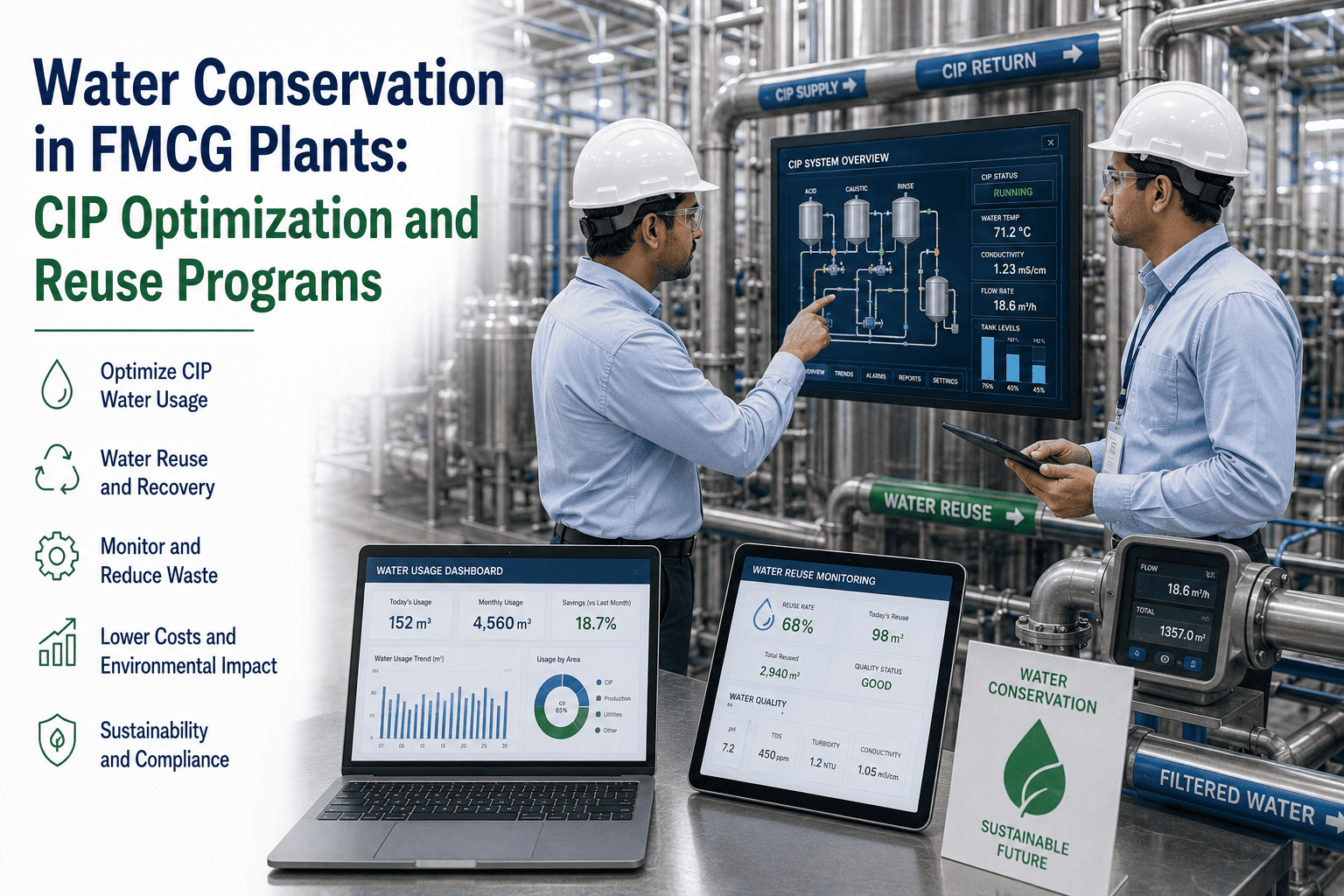
Water Management & Conservation in FMCG Plants: Maintenance Strategies That Save Millions
By spencer on March 2, 2026
A mid-size FMCG beverage plant was consuming 6.8 litres of water for every litre of finished product — nearly double the industry benchmark of 3.5 litres. Annual water costs exceeded $230,000, and the plant faced two regulatory show-cause notices for exceeding discharge limits. A systematic audit revealed three maintenance-driven root causes: leaking CIP return valves wasting 14,000 litres daily, cooling tower blowdown running at 8 cycles instead of the achievable 12 due to uncalibrated conductivity sensors, and a reverse osmosis membrane bank operating at 62% recovery instead of the design specification of 85% because of missed replacement schedules. Within 10 months of implementing a maintenance-first water conservation program, water consumption dropped to 3.2 litres per litre of product, annual water costs fell by $138,000, and discharge compliance reached 100%. The total investment in maintenance upgrades and monitoring was $21,500. In FMCG manufacturing, water waste is almost always a maintenance failure — not a process design problem. Start your free trial today to digitize water-critical asset maintenance. Schedule a 30-minute demo with our FMCG water management specialists.
Stop losing money to water waste. Oxmaint auto-generates work orders the moment a valve leaks, sensor drifts, or membrane fouls — before it hits your water bill.
Six Water-Intensive Systems That Demand Maintenance Excellence
In FMCG manufacturing, six interconnected systems account for 92% of total water consumption. Each system has specific maintenance failure modes that silently inflate water usage — leaking valves, drifting sensors, fouled membranes, and miscalibrated controls. Addressing these maintenance gaps through Oxmaint delivers immediate and measurable water savings without capital-intensive process redesign.
01
CIP (Clean-in-Place) Systems
35–40%
Rinse water recovery valve maintenance
Chemical concentration sensor calibration
Spray ball nozzle inspection and replacement
02
Cooling Towers & Chillers
20–25%
Blowdown valve and conductivity control
Drift eliminator condition monitoring
Fill media fouling prevention
03
Boiler & Steam Systems
12–18%
Steam trap inspection and replacement
Condensate recovery system maintenance
Blowdown automation and TDS control
04
RO & Water Treatment
10–15%
Membrane fouling prevention and replacement
Pre-filter maintenance schedules
Reject water recovery optimisation
05
Process Water & Filling
8–12%
Filling valve seal integrity checks
Conveyor lubrication water optimisation
Product changeover flush minimisation
06
ETP & Effluent Systems
Critical
Aeration blower and diffuser maintenance
Sludge pump and dewatering equipment
Treated water recycling system upkeep
Water you can't measure is water you can't save. Oxmaint connects water-critical asset maintenance to real-time consumption data — so every leak and drift is caught before it hits your water bill.
Maintenance-Driven Water Conservation Strategies for FMCG
The highest-impact water savings in FMCG come not from installing new treatment plants but from maintaining existing water-using equipment to its design specifications. Every system has a design water consumption rate — the gap between design and actual consumption is almost always caused by maintenance neglect. The eight strategies below address the most common and highest-value maintenance gaps across FMCG water systems.
Eight Proven Maintenance Strategies for Water Conservation
01
CIP Optimisation
Calibrate flow meters and concentration sensors monthly
Inspect and replace spray balls on wear-based schedule
Implement multi-stage rinse water recovery systems
Savings: 30–45% CIP Water
02
Cooling Tower Management
Maintain conductivity controllers for optimal cycles
Replace drift eliminators before efficiency drops
Schedule fill media cleaning to prevent fouling
Savings: 25–40% Makeup Water
03
Steam Trap Maintenance
Quarterly ultrasonic steam trap surveys
Replace failed traps within 48 hours of detection
Maximise condensate return to boiler feed
Savings: 15–20% Boiler Water
04
RO Membrane Care
Track membrane differential pressure weekly
CIP membranes on schedule — not after performance drops
Maintain pre-filters to protect membrane life
Savings: 85%+ RO Recovery
05
Leak Detection Program
Zone-based water metering for consumption mapping
Automated leak detection via flow anomaly alerts
Valve and gasket replacement on preventive schedule
Savings: 8–15% Total Water
06
ETP Performance
Aeration system maintenance for biological efficiency
Treated water quality monitoring for reuse potential
Sludge handling equipment on PM schedule
Savings: 60–80% Water Recycled
07
Conveyor Lube Optimisation
Transition from wet to dry or micro-lube systems
Nozzle maintenance prevents over-application
Timer and sensor calibration for precise dosing
Savings: 90% Lube Water
08
Rainwater Harvesting
Collection system gutter and filter maintenance
Storage tank cleaning and treatment schedules
Pump and distribution system preventive care
Savings: 10–20% Freshwater Offset
Water Consumption and Savings by FMCG Category
Water intensity varies dramatically across FMCG product categories. Understanding your category benchmark is the first step to identifying whether your plant has a maintenance-driven water problem — or a process design limitation. Most plants operating above benchmark have maintenance gaps, not design gaps.
FMCG Category
Industry Benchmark (L/L or L/kg)
Savings Potential
Carbonated Beverages
2.5–3.2 litres of water per litre of product (CIP + cooling dominant)
$5,400–$9,600/yr
Dairy Processing
3.0–4.5 L/L — pasteurization, CIP, and cooling are major consumers
$6,600–$13,200/yr
Packaged Foods & Snacks
2.0–3.5 L/kg — steam, washing, and conveyor lubrication dominant
$3,600–$7,200/yr
Personal Care & Home Care
4.0–6.0 L/kg — batch mixing, vessel cleaning, and cooling water
2.5–4.0 L/kg — steam, degumming, neutralization, and cooling
$4,200–$7,800/yr
Benchmarks represent well-maintained facilities operating at design specifications. Plants exceeding benchmarks by more than 30% have maintenance-addressable water losses in 85% of cases. Savings estimates assume mid-size plant with 4 production lines.
Every Litre Wasted Is Profit Down the Drain. Fix the Maintenance. Fix the Water.
Oxmaint connects water-critical equipment maintenance to consumption monitoring — auto-generating work orders when valve leaks, sensor drifts, or membrane fouling begin wasting water.
ROI of Maintenance-First Water Conservation in FMCG
The financial case for water conservation is built on three pillars: direct water cost savings, avoided regulatory penalties, and recovered production capacity from systems operating at design efficiency. Maintenance-driven water programs deliver the fastest ROI because they require minimal capital expenditure — the value comes from restoring existing assets to their designed performance, not from buying new ones.
Category
Calculation Basis
Annual Value
Direct Water Cost Savings
45% reduction in water consumption × $10.25/KL avg cost including treatment
$8,160
Effluent Treatment Reduction
38% less effluent volume — lower chemical, energy, and sludge disposal costs
$2,880
Energy Savings (Linked)
Less water pumped, heated, cooled, and treated — 12% energy reduction
$2,160
Regulatory Penalty Avoidance
Zero CPCB show-cause notices — no fines, no production stop orders
$1,800
Equipment Life Extension
Properly maintained water systems last 35–50% longer — deferred CAPEX
$2,640
ESG & Brand Value
Water stewardship reporting, CDP water disclosure, customer sustainability audits
$1,440
Total Annual Value Delivered
$19,080
Program investment: $1,450–$2,640/year including sensor upgrades, CMMS integration, and training. Net ROI: $16,440–$17,630. Return: 7–13x in first year. Water-scarce regions with higher water tariffs see even faster payback.
Implementation Roadmap: From Water Waste to Water Intelligence
Deploying a maintenance-first water conservation program follows a structured path that delivers measurable savings at each phase. Start with the highest-consumption systems and expand systematically. Schedule a demo to design a water conservation deployment plan for your facility.
01
Week 1–3: Water Audit
Map all water sources, uses, and discharge points
Install zone meters on high-consumption systems
Baseline water use ratio per product category
Output: Water Balance Map
02
Week 4–8: Quick Wins
Fix all identified leaks — valves, gaskets, traps
Calibrate conductivity, flow, and level sensors
Optimise CIP rinse sequences and recovery
Output: 20–30% Savings
03
Month 3–6: Systematize
Preventive maintenance for all water-critical assets
Real-time water consumption dashboards deployed
ETP optimisation for maximum water recycling
Output: 40–50% Savings
04
Month 6+: Optimize
Predictive analytics for water system maintenance
ZLD pathway planning and treated water reuse
Continuous improvement driven by consumption data
Output: 7–13x ROI
Real-World Water Conservation Wins in FMCG
The most compelling evidence for maintenance-first water conservation comes from documented cases where FMCG plants achieved dramatic water reductions through systematic maintenance programs — not expensive capital projects.
Result After 4 MonthsCIP water at 28,000 litres/day — 46% reduction
Annual Savings$45,600 (Water + Chemical + Energy)
Win 2: Beverage Plant — South India
ChallengeCooling tower at 6 cycles (design: 12) — wasting 18,000 litres/day in blowdown
Maintenance ActionsReplaced conductivity sensor, cleaned fill media, fixed blowdown valve
Result After 6 MonthsCooling tower at 11.5 cycles — 42% less makeup water
Annual Savings$31,200 (Water + Chemical Treatment)
Frequently Asked Questions
CIP systems are consistently the largest source of water waste in FMCG manufacturing, accounting for 35–40% of total plant water consumption. The primary maintenance-driven waste sources are worn spray balls that fail to achieve adequate cleaning coverage (leading to extended rinse cycles), leaking return valves that dump recoverable rinse water to drain, and uncalibrated chemical concentration sensors that trigger unnecessary additional rinse stages. A well-maintained CIP system with multi-stage rinse recovery can reduce CIP water consumption by 30–45%. Sign up free to start tracking CIP system maintenance and water consumption.
Cooling towers lose water through evaporation, drift, and blowdown. Maintenance directly controls two of these three: drift (through drift eliminator condition) and blowdown (through conductivity control accuracy). A cooling tower designed for 12 cycles of concentration but running at 6 cycles due to a drifted conductivity sensor wastes nearly double the makeup water needed. Quarterly conductivity sensor calibration, semi-annual drift eliminator inspection, and regular fill media cleaning can reduce cooling tower makeup water by 25–40%.
Failed steam traps directly waste water by allowing live steam to blow through to the condensate return or atmosphere. A single failed-open steam trap can waste 25,000–50,000 litres of treated water per month as the boiler must replace the lost steam with fresh makeup water. In a typical FMCG plant with 100–200 steam traps, 15–25% are likely failed at any given time. Quarterly ultrasonic surveys with 48-hour replacement protocols can recover 15–20% of boiler water consumption.
CPCB discharge standards require treated effluent to meet specific parameters for BOD, COD, TSS, pH, and other constituents before discharge or reuse. When ETP equipment is poorly maintained — clogged diffusers reducing aeration efficiency, failed dosing pumps causing under-treatment, or worn filter presses producing high-moisture sludge — treated water quality deteriorates and discharge limits are breached. A preventive maintenance program for ETP equipment ensures consistent treatment quality, 100% compliance, and maximum treated water recycling potential. Book a demo to see how Oxmaint tracks ETP maintenance alongside discharge compliance.
Most FMCG plants achieve full payback on maintenance-first water conservation programs within 4–8 months. The initial investment ($1,450–$2,640 for sensors, CMMS integration, leak repairs, and training) is recovered through direct water cost savings of $600–$960 per month. Quick wins in the first 8 weeks — fixing leaks, calibrating sensors, and optimising CIP — typically deliver 20–30% water savings immediately. By month 6, systematic preventive maintenance across all water-critical systems pushes total savings to 40–50%.
Water Management for FMCG Plants
Your Plant Is Wasting Water Right Now. Your Maintenance Program Can Stop It.
Oxmaint connects water-critical asset maintenance to consumption analytics — catching leaks, drift, and fouling before they inflate your water bill or trigger compliance violations.
.png)