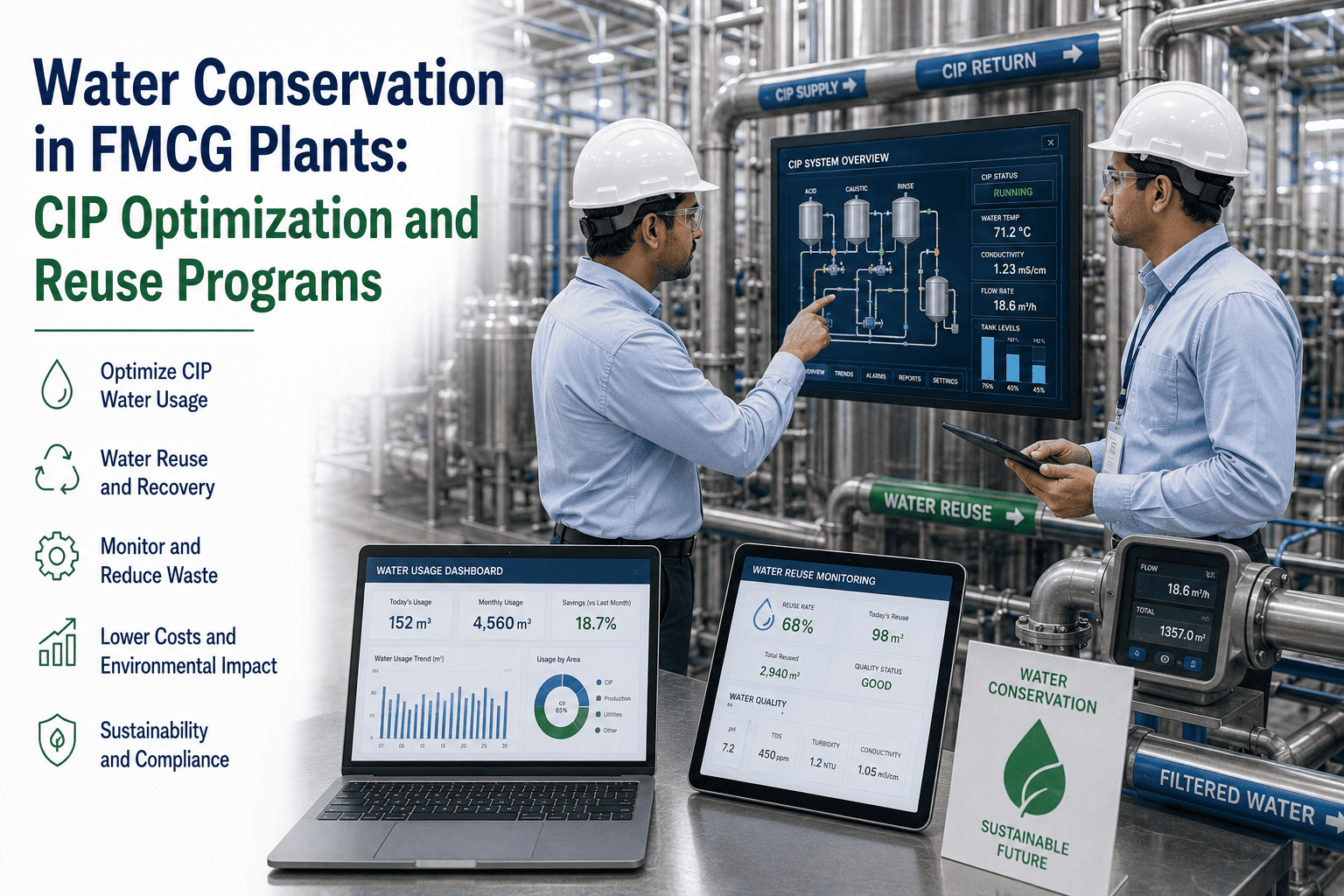
Water bills are climbing 6-12% annually in major FMCG regions, and the Corporate Sustainability Reporting Directive now demands documented evidence of water reduction with verifiable baselines, methodologies, and year-over-year improvements. Most FMCG plants use 60-80% of their total water on CIP cycles cleaning the same equipment that delivers product quality. Every liter of CIP water carries downstream costs in heating, chemical dosing, effluent treatment, and disposal. A structured CIP optimization and reuse program reliably cuts 20-35% of total plant water consumption while maintaining microbiological compliance, and CMMS becomes the audit-ready system of record CSRD requires. To see how OxMaint tracks every CIP cycle, water meter reading, and reuse loop event for sustainability reporting start a free trial or book a demo with our team.
FMCG Water Conservation · CIP Optimization · CSRD Evidence
Water Conservation in FMCG Plants: CIP Optimization and Reuse Programs
Water bills are climbing fast and CSRD demands proof of reduction. See the CIP optimization and reuse program that cuts 20-35% of plant water consumption while creating the auditable CMMS evidence regulators now require.
20-35%
Achievable total plant water reduction
60-80%
Of FMCG water consumed in CIP cycles
6-12%
Annual water cost inflation in major FMCG regions
100%
CSRD evidence coverage with structured CMMS
Understanding the Opportunity
What Is CIP Optimization and Why Does FMCG Water Reduction Hinge On It?
Clean-in-place (CIP) is the automated cleaning of process equipment between batches or production runs without disassembly. It consumes the dominant share of water at FMCG plants because every product changeover, every shift, every allergen run, and every microbiological reset requires a cycle. CIP optimization is the disciplined effort to reduce water consumed per cycle through right-sized rinse durations, recovered final rinse water, conductivity-controlled chemical dosing, and intelligent scheduling that consolidates cleanings.
Reuse programs add the second lever taking water that was used once for a low-criticality cleaning step and using it again for an even lower-criticality step before discharging it. Final rinse water from one tank can become pre-rinse for the next. Pasteurizer cooling water can become utility wash water. Combined, optimization and reuse routinely cut 20-35% of total plant water consumption without touching production recipes. Start a free trial to see how OxMaint logs every CIP cycle and verifies water savings, or book a demo with our team.
Six Levers of FMCG Water Reduction
The Six Levers That Move Plant Water Consumption
Most plants do not have a single water-waste problem. They have six smaller problems that compound. A structured program isolates each lever, sets a 90-day target, and measures the reduction. Plants that work through these levers systematically routinely deliver 25-30% reduction inside a single fiscal year.
Lever 01
CIP Rinse Duration Right-Sizing
Most CIP rinse cycles are 30-50% longer than required. Conductivity-controlled rinses end automatically when water hits target purity instead of running fixed times.
Lever 02
Final Rinse Water Recovery
Capture and store final rinse water (essentially clean) for use as pre-rinse on the next cycle. Typically recovers 30-40% of water per cycle with no microbiological risk.
Lever 03
CIP Scheduling Consolidation
Sequence production runs to minimize allergen changeovers and product transitions. Fewer transitions mean fewer CIP cycles. Often the highest-ROI lever.
Lever 04
Cooling Water Reuse Loops
Pasteurizer and chiller cooling water can be reused for utility wash, exterior cleaning, or boiler makeup. Cooling tower blowdown can sometimes be reused for CIP pre-rinse.
Lever 05
Hose and Nozzle Discipline
Open hoses consume 8-12 GPM. Trigger-controlled spray nozzles cut that to 2-3 GPM. Plant-wide nozzle replacement is one of the cheapest water wins in FMCG.
Lever 06
Sub-Metering and Leak Detection
Without sub-metering, leaks and process drift hide in the master meter. Strategic sub-meters on CIP skid, cooling, utility, and effluent expose the real water flows.
Industry Pain Points
Why Most FMCG Water Programs Stall
Most FMCG plants have run at least one water reduction initiative. Few have sustained the gains past 12 months. The failure pattern is the same across every sub-vertical: programs without CMMS-grade tracking quietly degrade as personnel changes and operational pressure rises. If your plant has had stalled water programs, start a free trial to see the sustained tracking workflow, or book a demo.
01
No Sub-Metering Visibility
A single master meter hides everything. Without sub-meters on CIP, cooling, utility, and effluent, plant managers cannot tell which lever to pull or whether changes worked.
02
CIP Run on Default Recipes
CIP recipes from the OEM installation 8 years ago are still in use. Nobody has revalidated them. Plants run 50% more water than current product mix requires.
03
Reuse Loops Documented But Disabled
Recovery tanks installed during last capital project sit unused because operators were never trained or because microbiological policy was never updated to permit reuse.
04
No Audit Trail for CSRD
CSRD requires verifiable evidence of water reduction with baselines and methodologies. Spreadsheet-tracked programs cannot survive third-party audit.
05
Effluent Treatment Cost Surprises
Every liter of water consumed becomes a liter of effluent to treat. Plants focus only on intake cost and miss the downstream BOD/COD treatment surcharges.
06
Microbiological Anxiety Blocks Reuse
Quality teams default to refusing reuse without microbiological data to support safe loops. Without CMMS evidence, every reuse proposal stalls indefinitely in QA review.
How Oxmaint Solves It
How OxMaint Builds CSRD-Ready Water Reduction Programs
OxMaint becomes the system of record for every CIP cycle, every meter reading, every reuse loop event, and every microbiological verification swab. It creates the audit-ready evidence chain CSRD requires while making the program operationally sustainable through structured PMs and real-time dashboards. Start a free trial or book a demo to see the CSRD evidence chain.
CIP Tracking
Per-Cycle Water Consumption
Every CIP cycle logged with water consumed, chemical dosed, rinse duration, and conductivity profile. Trend analysis exposes recipe drift before it inflates total consumption.
Sub-Meters
IoT Water Meter Integration
Direct integration with sub-meters on CIP, cooling, utility, and effluent. Real-time dashboards show actual flow distribution rather than master-meter averages.
Reuse Logging
Reuse Loop Audit Trail
Every reuse cycle logged with source water, destination use, and microbiological verification swab result. Creates the QA evidence that unblocks reuse approval.
CSRD Evidence
Auditable Reduction Reporting
Generate CSRD-compliant water reduction reports with baselines, methodologies, and per-asset evidence trails. Survives third-party audit without manual reconstruction.
Multi-Site
Portfolio Water Intensity
Liters per case shipped tracked across every plant. Cross-site rankings expose outliers and accelerate best-practice transfer to high-consumption sites.
Predictive PMs
CIP Skid Reliability
Pump, valve, and heat exchanger PMs on CIP skids prevent the failures that cause runaway cycles. A single stuck valve can waste a year of reduction gains in one shift.
Before vs After CIP Optimization
Unmanaged CIP vs OxMaint-Tracked CIP: Side-by-Side
| CIP Cycle Parameter | Unmanaged Baseline | OxMaint-Tracked Optimized |
| Pre-rinse duration |
10 minutes fixed |
4-6 minutes conductivity-controlled |
| Caustic wash water use |
1,200 L per cycle |
850 L per cycle |
| Final rinse water use |
900 L per cycle |
550 L per cycle |
| Final rinse recovery |
Discharged to drain |
30-40% recovered for next pre-rinse |
| Total water per CIP |
2,800 L |
1,900 L |
| CIP frequency per shift |
5 (frequent allergen changes) |
3 (consolidated scheduling) |
| Cycle documentation |
Paper logbook |
Auto-logged in CMMS |
| CSRD audit readiness |
None |
Full audit trail per cycle |
ROI and Sustainability Outcomes
What FMCG Water Reduction Programs Actually Deliver
20-35%
Total Plant Water Reduction
Combined CIP optimization and structured reuse programs cut total plant water consumption by 20-35% within 12 months without compromising microbiological compliance.
$400K-1.5M
Annual Cost Avoidance
Mid-to-large FMCG plants typically capture $400K-$1.5M annually in combined intake, heating, chemical, and effluent treatment savings from a structured water program.
100%
CSRD Evidence Coverage
Every CIP cycle, meter reading, and reuse event captured in CMMS provides the auditable baseline and methodology evidence CSRD requires for water reduction claims.
30-40%
Final Rinse Recovery Per Cycle
Final rinse water recovery loops capture 30-40% of water per CIP cycle for safe reuse as next-cycle pre-rinse the single highest-ROI engineering change in CIP optimization.
Frequently Asked Questions
FMCG Water Conservation Common Questions
Is rinse water reuse safe in food and beverage CIP cycles?
Yes, when implemented correctly. Final rinse water from one cycle is essentially purified and safe to reuse as pre-rinse on the next cycle. Microbiological verification swabs, conductivity gates, and clear policy documentation make reuse safe and auditable. CMMS tracks every reuse event for QA evidence.
Book a demo to see the reuse audit trail.How much sub-metering is needed to run a water reduction program?
A pragmatic starting point is four sub-meters: CIP skid intake, cooling tower makeup, utility/wash water, and effluent discharge. This exposes 90%+ of where water actually flows. Additional meters on specific processes can follow as the program matures.
Start a free trial to see meter integration.How does CMMS-tracked water data support CSRD reporting?
CSRD requires verifiable baselines, methodologies, and year-over-year reduction evidence. CMMS provides per-cycle CIP logs, meter readings, and reuse event records that constitute the auditable evidence chain CSRD demands. Spreadsheet-based tracking cannot survive third-party audit; CMMS-tracked programs can.
Will CIP optimization compromise food safety or product quality?
Not when done correctly. Conductivity-controlled rinses end when water purity hits target, which is a stricter quality standard than fixed-duration rinses that often run past the necessary endpoint. Optimized CIP programs frequently improve microbiological consistency while using less water the optimization is not a corner-cut, it is a precision upgrade.
Water Conservation · CIP Optimization · CSRD-Ready · Free to Start
Cut 25-35% of Plant Water Use With CSRD-Audit-Ready Evidence
Water bills are not coming back down, and CSRD reporting deadlines are not slipping. OxMaint gives you the CIP cycle tracking, sub-meter integration, reuse audit trail, and CSRD-ready reporting that makes water reduction sustainable and provable. Live in days, not months. No heavy implementation. Audit-ready evidence from day one.



.png)