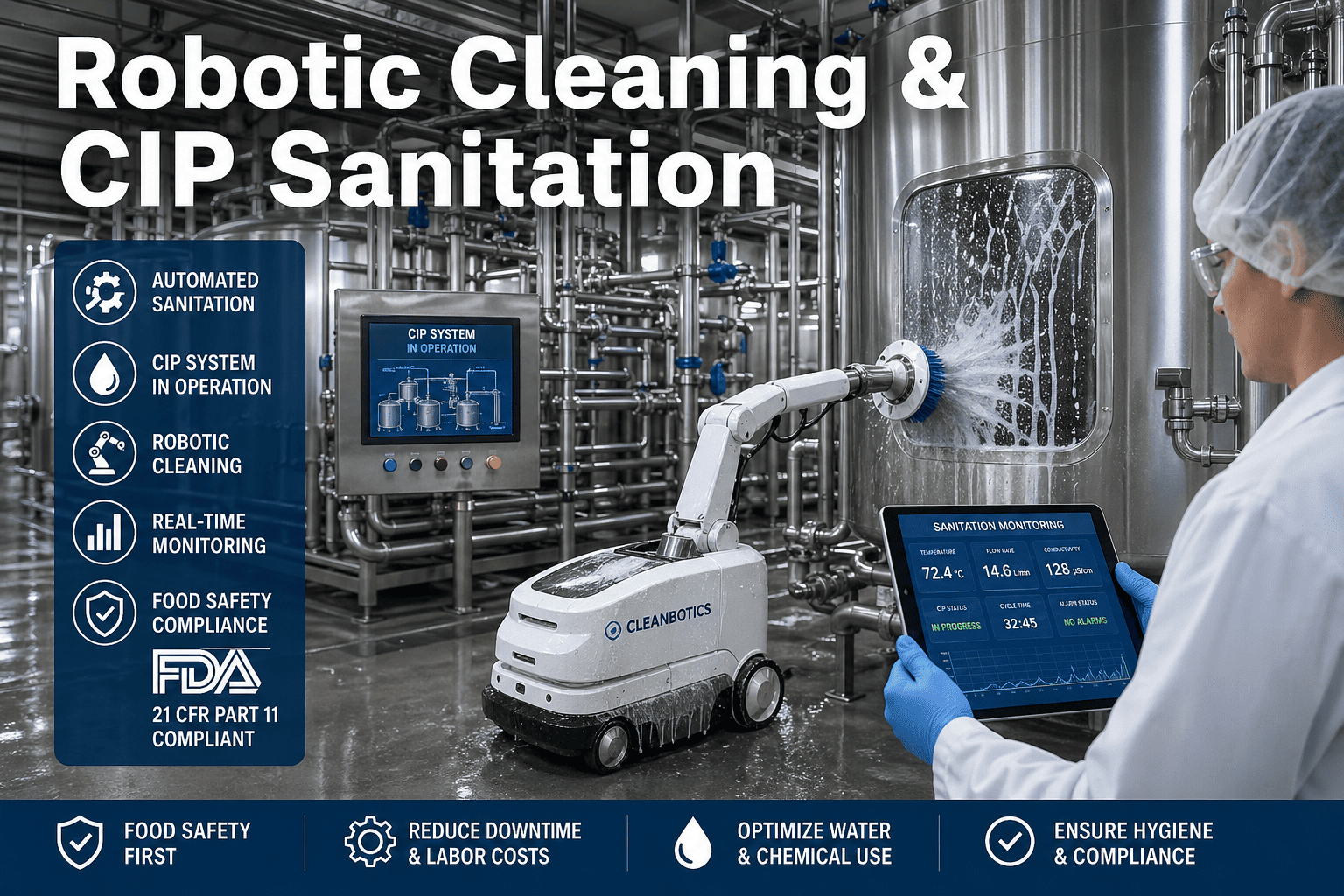
A listeria outbreak traced to a single conveyor belt return roller cost a mid-size FMCG processor $47 million in 2024 — product recalls, lawsuits, and a 14-month FDA consent decree that froze two production lines. The root cause was not a failure of sanitation chemicals or crew effort. It was a failure of coverage: manual cleaning teams consistently missed the underside of a belt joint during third-shift changeovers, and no verification system caught the gap until swab results came back positive after product had already shipped. Robotic sanitation systems eliminate this failure mode entirely — executing identical, sensor-verified cleaning paths on every cycle, documenting coverage with photographic evidence, and flagging any deviation before the next production run starts. See how Oxmaint schedules robotic sanitation cycles — Book a Demo.
$47M
Average cost of a major FMCG recall event including legal, operational, and brand damage
30%
Of food safety incidents traced to inadequate cleaning in hard-to-reach production zones
99.7%
Surface coverage achieved by robotic sanitation vs. 85% average for manual crews
Why Manual Sanitation Falls Short in FMCG Plants
FMCG sanitation is not a cleaning problem — it is a consistency problem. Crews working overnight shifts face fatigue, time pressure from production schedules, and the physical impossibility of reaching every surface inside complex equipment geometries without full disassembly. The result is variable coverage that passes visual inspection but fails microbiological verification. FDA and CFIA enforcement data shows that sanitation-related citations account for more Warning Letters in food manufacturing than any other single category. For plants ready to close the gap between scheduled cleaning and verified cleaning, Oxmaint logs every sanitation cycle with verification data — Sign Up Free.
Coverage Gaps
Manual crews miss 10-15% of target surfaces per cycle — belt undersides, mixer shaft seals, conveyor frame joints, and filler valve interiors. Gaps compound across shifts, creating biofilm harboring zones invisible to visual inspection.
Chemical Exposure Risk
Peracetic acid, chlorinated alkaline cleaners, and quaternary ammonium compounds cause skin burns, respiratory irritation, and long-term health effects. OSHA logs show sanitation crews experience 3x the chemical injury rate of production workers.
Documentation Failures
Paper-based sanitation logs capture what was supposed to happen, not what actually happened. During FDA inspections, facilities cannot prove coverage completeness, chemical concentration accuracy, or contact time compliance with verifiable data.
Stop relying on visual checks to verify sanitation quality. Oxmaint connects robotic sanitation data to compliance logs and chemical inventory tracking — making every cycle auditable and every surface accountable.
How Robotic Sanitation Systems Work in FMCG Environments
Robotic sanitation platforms are not floor scrubbers with an industrial label. They are programmable, sensor-guided systems designed to execute precise chemical application, mechanical cleaning, and rinse cycles across complex production equipment — reaching surfaces that manual crews physically cannot access without full disassembly. Each system type addresses a different sanitation challenge within the FMCG production environment, from enclosed piping to open production floors.
CIP Robotic Nozzle Systems
Application: Enclosed vessels, piping, tanks
Programmable rotary spray heads navigate pipe interiors and tank walls, applying cleaning chemicals at controlled pressure, temperature, and flow rate. Turbidity sensors verify rinse completeness before the system signals production readiness. Coverage maps logged per cycle.
Autonomous Floor Disinfection
Application: Production floors, drains, walls
AMR platforms equipped with UV-C arrays and chemical spray systems patrol production floors on programmed routes. LiDAR navigation ensures complete coverage including floor-wall junctions, drain surrounds, and equipment base perimeters — areas where biofilm accumulates fastest.
Conveyor Belt Cleaning Robots
Application: Belt surfaces, rollers, frames
Mounted systems that traverse conveyor lengths cleaning both carrying and return sides simultaneously. Brush, spray, and vacuum modules remove product residue, apply sanitizer, and verify surface cleanliness using ATP fluorescence sensors — the same method used in swab testing but applied continuously.
Application: Air handling, packaging zones
Robotic UV-C systems deliver measured germicidal doses to packaging contact surfaces, air handling units, and exposed production zones. Dosimetry sensors verify that every surface receives the minimum exposure required for target pathogen inactivation — zero chemical residue left behind.
From Cleaning Cycle to Verified Compliance: The CMMS Connection
A robotic sanitation system that cleans perfectly but cannot prove it cleaned perfectly is an incomplete solution. Without a direct connection between sanitation execution data and your maintenance management system, cleaning records sit in a separate dashboard waiting for someone to review, interpret, and manually reconcile with production schedules. That delay defeats the purpose of automation. When robotic cleaning data feeds directly into your CMMS, every cycle becomes an auditable compliance event with sensor-backed evidence. Oxmaint turns sanitation data into audit-ready records — Book a Demo.
Sanitation-to-Compliance Workflow
1
Surface Risk Mapping
Classify every production surface by contact type — Zone 1 (direct food contact), Zone 2 (adjacent), Zone 3 (environmental) — and contamination risk level
2
Robot Path & Chemical Assignment
Define cleaning trajectories that reach every mapped surface; assign cleaning agents, concentrations, temperatures, and contact times per SSOP requirements
3
Automated Cycle Execution
Robots execute scheduled sanitation — applying chemicals at controlled dosage, scrubbing, rinsing — while inline sensors verify effectiveness at each checkpoint
4
Verification & Exception Routing
ATP readings, turbidity data, and coverage maps pushed to Oxmaint. Failed checkpoints trigger immediate re-clean cycles and generate investigation work orders
5
Audit-Ready Documentation
Every cycle produces a timestamped compliance record — coverage maps, chemical concentrations, contact times, and pass/fail results stored in Oxmaint for instant retrieval
Close the loop between cleaning and compliance. Our team will walk you through how Oxmaint processes robotic sanitation findings into verified compliance logs, chemical inventory alerts, and corrective action tracking.
Chemical Safety: Protecting Workers While Improving Results
Sanitation chemicals that kill pathogens are inherently hazardous to the workers who apply them. Peracetic acid — the workhorse sanitizer in FMCG food processing — causes severe respiratory irritation at concentrations above 0.4 ppm and chemical burns on skin contact. Robotic application removes workers from direct chemical exposure during the most dangerous phase of the sanitation cycle: initial application at full concentration in enclosed or poorly ventilated spaces. Oxmaint tracks chemical inventory and safety compliance — Sign Up Free.
Chemical Safety: Manual vs. Robotic Application
Validation: Proving Sanitation Effectiveness With Sensor Data
Cleaning a surface and proving a surface is clean are two fundamentally different activities. Manual sanitation relies on visual inspection as the primary validation method — a technique that cannot detect microbial contamination, chemical residue, or biofilm that has not yet reached visible thickness. Robotic sanitation systems integrate real-time verification sensors that validate cleaning effectiveness at every checkpoint during every cycle, generating the objective evidence that FDA, CFIA, and GFSI auditors require.
100%
Cycle documentation rate when sanitation is scheduled and verified through a CMMS — vs. 72% with standalone paper logs
45%
Reduction in sanitation-related production delays when cleaning schedules integrate with PM calendars
3 min
Time to generate a complete sanitation compliance report in Oxmaint — vs. 4+ hours compiling manual records
The plants that consistently pass unannounced FDA inspections share one trait: they treat sanitation as a maintenance function with the same rigor they apply to equipment PM. Every cleaning cycle is scheduled, every execution is verified with sensor data, and every exception generates a corrective action tracked to closure. The facilities still running sanitation on paper logs and visual sign-offs are the ones scrambling during audits and finding contamination after the fact.
— VP Quality Assurance, Top 5 North American FMCG Manufacturer
Where Robotic Sanitation Creates the Most Value in FMCG
Not every surface in an FMCG plant benefits equally from robotic cleaning. The highest return comes from zones where manual access is restricted, contamination risk is severe, and the consequences of missed cleaning are catastrophic — product recalls, regulatory action, and brand damage that no amount of marketing can repair. Here is where robotic sanitation delivers outsized impact. Oxmaint tracks zone-level sanitation compliance — Book a Demo.
Why it matters: Belt undersides, return rollers, and frame joints are the #1 harborage site for listeria and salmonella in FMCG processing — and the hardest surfaces for manual crews to reach consistently
Robot capability: Mounted conveyor cleaning robots traverse both carrying and return sides, applying sanitizer and verifying with ATP sensors on every pass
CMMS action: Elevated ATP readings auto-generate re-clean work orders and flag the belt section for maintenance investigation in Oxmaint
Why it matters: Enclosed systems cannot be visually inspected without disassembly. Spray shadow zones — areas blocked from cleaning solution flow by internal baffles or dead legs — create persistent contamination reservoirs
Robot capability: Programmable rotary nozzle systems navigate interior geometries, monitoring turbidity and conductivity to confirm rinse completeness before signaling production readiness
CMMS action: Extended rinse cycles flag potential equipment degradation or chemical concentration drift in Oxmaint
Why it matters: Floor drains and floor-wall junctions are primary environmental listeria reservoirs. FDA environmental monitoring guidance specifically targets these zones in every food safety audit
Robot capability: Autonomous floor AMRs with LiDAR navigation deliver chemical spray and UV-C treatment to every drain surround, equipment base, and wall junction on programmed routes
CMMS action: Coverage maps and UV-C dosimetry data logged per cycle in Oxmaint as environmental monitoring compliance evidence
Why it matters: Post-lethality contamination — pathogens introduced after the kill step — is the highest-risk failure in ready-to-eat FMCG production. Packaging zones and air handling are the primary vectors
Robot capability: UV-C disinfection arrays deliver measured germicidal doses to packaging film paths, sealing surfaces, and HVAC coils without chemical residue
CMMS action: UV-C lamp degradation tracked in Oxmaint with replacement work orders generated before output drops below validated dose thresholds
Unify Sanitation, Maintenance, and Compliance in One Platform
Oxmaint schedules robotic sanitation cycles alongside equipment PM, tracks chemical inventory and SDS compliance, logs verification data from every cleaning event, and generates audit-ready reports in minutes — giving your food safety team the documentation that regulators trust.
Frequently Asked Questions
Can robotic sanitation systems handle the variety of equipment in a typical FMCG plant?
Yes, but through a combination of system types rather than a single robot. CIP robotic nozzle systems handle enclosed vessels, tanks, and piping. Conveyor cleaning robots address belt surfaces and rollers. Autonomous floor disinfection AMRs cover production floors, drains, and wall junctions. UV-C arrays handle packaging zones and air handling. Most FMCG facilities deploy two to three complementary systems to achieve complete coverage, with each system's schedule and verification data unified in a single CMMS platform.
Are robotic sanitation systems approved for use in FDA-regulated food processing facilities?
Robotic sanitation systems themselves do not require individual FDA premarket approval — sanitation equipment is not regulated the same way food contact surfaces are. However, the cleaning chemicals they apply must be EPA-registered and FDA-compliant for food contact use, and the system must be constructed from food-grade materials (typically 316 stainless steel) meeting 3-A Sanitary Standards or equivalent. The key regulatory requirement is that the sanitation process achieves documented microbial reduction targets, which robotic systems with integrated verification sensors demonstrate more reliably than manual methods.
How much water and chemical does robotic sanitation save compared to manual cleaning?
Robotic CIP systems typically reduce water consumption by 20-40% and chemical usage by 15-30% compared to manual cleaning. The savings come from precise flow control (applying exact volumes rather than over-spraying), automated concentration management (eliminating manual over-dosing), and optimized rinse cycles that end when turbidity sensors confirm cleanliness rather than running for fixed durations. A mid-size dairy processing facility reported saving 2.4 million gallons of water annually after switching from manual to robotic CIP.
What happens when a robotic sanitation cycle fails validation?
When inline sensors detect a failed checkpoint — elevated ATP reading, insufficient chemical concentration, or incomplete surface coverage — the system automatically initiates a targeted re-clean of the failed zone. If the re-clean also fails, the system locks out production start and generates a critical work order requiring manual investigation. Every failure and re-clean is logged with sensor evidence, creating the corrective action documentation that auditors expect to see during inspections.
What ROI timeline should we expect from robotic sanitation deployment?
Most FMCG facilities report 12-18 month payback driven by four concurrent savings: labor reallocation from overnight sanitation crews (typically 40-60% fewer manual hours), water and chemical reduction (20-40%), production time recovery from faster validated cleaning cycles (15-25% shorter changeovers), and risk mitigation from reduced recall exposure. Facilities processing high-risk products like ready-to-eat foods, dairy, or infant formula see faster payback due to the higher cost of contamination events in those categories.