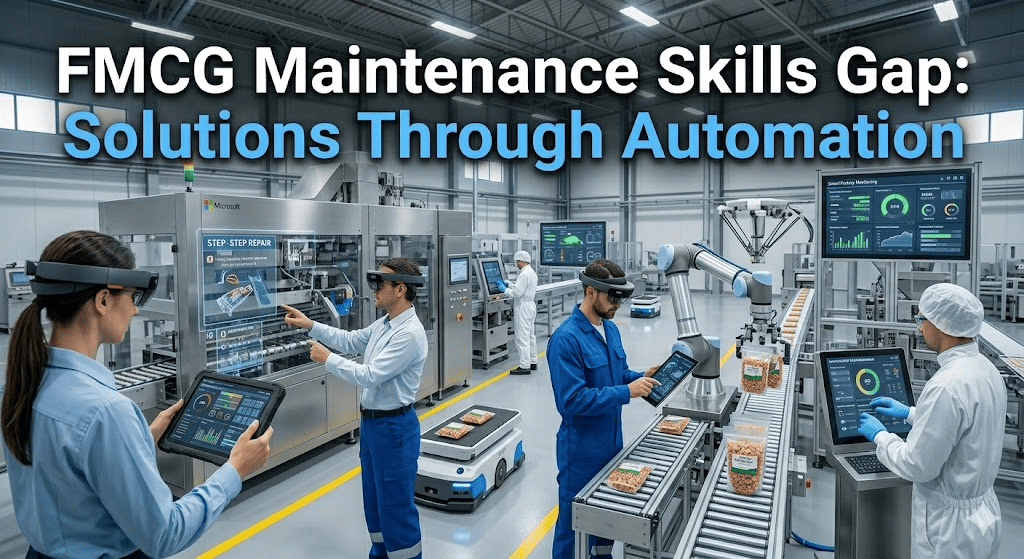
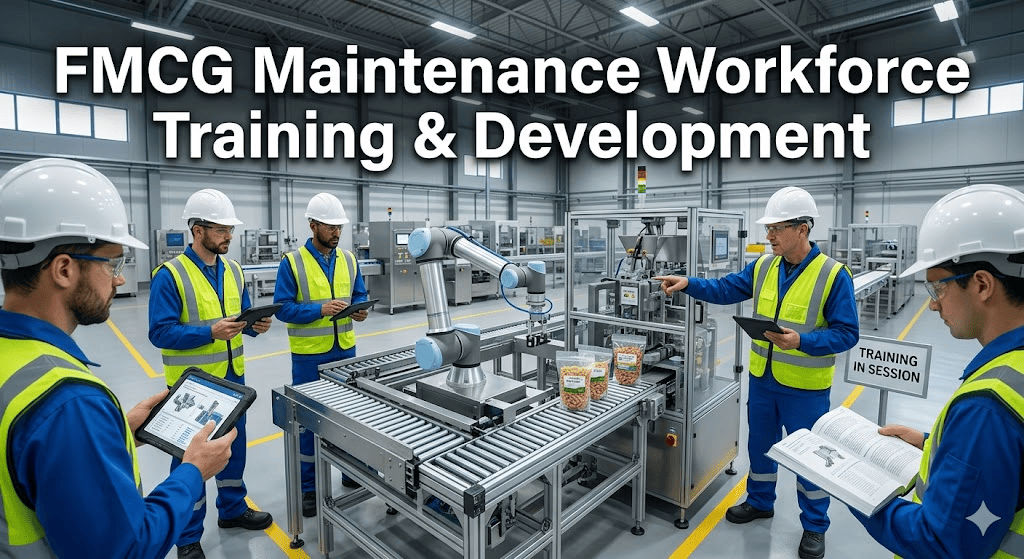
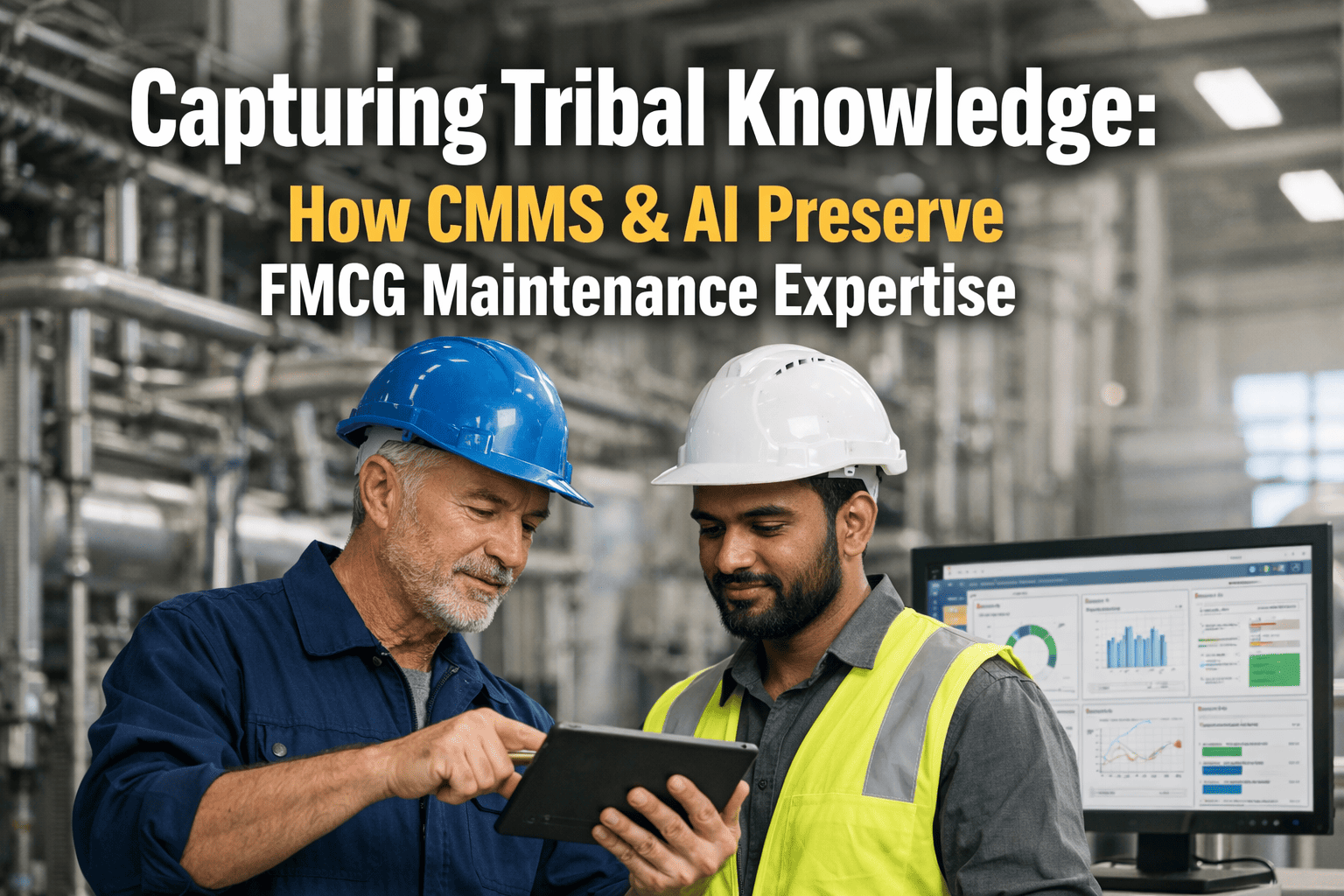
The most experienced people on your maintenance floor are leaving in the next 36 months, and the apprentices coming behind them have never seen a 1990s-era filler, a mechanical batch coder, or a manual CIP set point in their working lives. 69% of maintenance professionals are now over 50, and 26% of the U.S. manufacturing workforce is expected to retire by 2030 — leaving more than 1.5 million roles vacant. For FMCG plants, where a single line stoppage can cost $30,000 to $50,000 an hour, this is not a future HR problem. It is a present-day uptime crisis. The plants that are winning are not waiting for the hiring market to fix itself — they are capturing tribal knowledge in CMMS and using AI-assisted SOPs to onboard apprentices in weeks instead of years. To see how OxMaint turns retiring technician knowledge into structured digital procedures, start a free trial or book a demo with our team.
FMCG Workforce Cliff · Knowledge Capture · AI-Assisted SOPs
FMCG Maintenance Workforce Cliff: Retain Skills Before They Walk Out
30-year veterans are retiring 4x faster than apprentices can absorb their knowledge. See how leading FMCG plants are capturing tribal knowledge in CMMS and using AI-assisted SOPs to onboard new technicians in weeks — not the 5–7 years it used to take.
Maintenance Workforce Demographics
69%
Of maintenance professionals are 50 or older
1.9M
Manufacturing roles projected unfilled by 2033
42 days
Average time to fill a production maintenance role
$50K/hr
Cost of unplanned downtime on a high-speed FMCG line
Understanding the Cliff
What Is the FMCG Maintenance Workforce Cliff?
The workforce cliff is the demographic point at which the volume of retiring senior FMCG maintenance technicians exceeds the volume of qualified apprentices being trained to replace them — and that point has already arrived in most North American, UK, and German plants. Senior technicians carry 25–30 years of asset-specific tribal knowledge: which valve sticks in humid weather, why the seamer needs a half-turn extra on the second can format, when a particular gearbox starts whining before it fails. None of that is in your CMMS. When the technician walks out, the knowledge walks with them — and apprentices are left rebuilding it from scratch through expensive failures.
FMCG operations are uniquely exposed because line speeds, changeover frequencies, and food-safety regulations leave zero tolerance for slow-learning technicians. A new hire who takes 18 months to become productive costs the plant 18 months of elevated MTTR, missed PMs, and rework. The plants pulling ahead are treating senior technicians as knowledge assets to be systematically captured before retirement — not as headcount to be replaced after. Start a free trial to see how OxMaint turns each completed work order into a searchable, reusable SOP, or book a demo with our team.
The Capture Framework
Six Pillars of FMCG Maintenance Knowledge Retention
Capturing tribal knowledge is not a one-time documentation project. It is a structured, ongoing operational discipline that touches every work order, every shutdown, and every shift handover. Plants that retain technician knowledge consistently apply the following six pillars across all sites.
Pillar 01
Asset-Linked Digital SOPs
Every SOP attached directly to the asset in CMMS — searchable by asset ID, failure mode, and component. No paper binders, no shared drives, no tribal Word docs.
Pillar 02
Failure-Mode Knowledge Tags
Senior technicians tag their work orders with failure mode, root cause, and resolution. Over 12 months, this builds an asset-specific failure library new hires can search.
Pillar 03
Video and Photo Capture
Mobile CMMS lets technicians attach short videos and photos to work orders. A 60-second video of a tricky seamer adjustment is worth 200 words of written procedure.
Pillar 04
AI-Assisted SOP Generation
AI converts free-text work order notes into structured, repeatable SOPs. Senior technicians dictate; the system formats, tags, and indexes for future retrieval.
Pillar 05
Apprentice Pairing Programs
Structured 12–18 month pairing where apprentices complete senior-mentored work orders and digital checklists. CMMS tracks competencies achieved per asset class.
Pillar 06
Exit Interview Capture
In the 90 days before retirement, senior technicians complete structured asset reviews — top failure modes, hidden quirks, vendor contacts. Captured directly in CMMS.
Industry Pain Points
Why FMCG Plants Are Losing the Knowledge Race
Most FMCG operations recognize the workforce cliff is coming — but their current systems are structurally unable to capture knowledge at the speed it is leaving. Here is exactly where the breakdown happens. If any of these match your plant, start a free trial to see a different operating model, or book a demo to walk through your assets.
01
Paper-Based SOPs Nobody Updates
Binders dating back 15+ years sit in maintenance offices. Updates require approval cycles nobody completes. New hires either ignore them or learn the wrong way.
02
Tribal Knowledge in Senior Heads Only
The fix for the recurring seamer issue exists in exactly one person. When that person retires, the next failure becomes a 6-hour learning event instead of a 30-minute repair.
03
5–7 Year Apprenticeship Timelines
Traditional time-served apprenticeships do not match the retirement curve. By the time an apprentice is fully productive, three more seniors have left.
04
No Structured Exit Process
When a 30-year technician retires, most plants run a farewell lunch and a handshake. No structured capture. No asset reviews. No failure-mode debriefs. The institutional memory walks out the door.
05
Contractor Dependency Trap
When internal knowledge fails, plants call OEM or third-party contractors at premium rates. Contractor spend has doubled in many FMCG operations over five years.
06
PM Compliance Quietly Collapsing
As senior technicians retire, PM compliance drops because newer technicians do not know which steps actually matter. Compliance reports look fine; actual asset health degrades.
How Oxmaint Solves It
How OxMaint Captures FMCG Tribal Knowledge Before It Walks Out
OxMaint is built around the principle that every completed work order should make the next one faster. Senior technicians do not need to write documentation — they need to do their job in a system that captures what they do automatically. Then AI-assisted features convert raw notes into structured SOPs the next generation can actually use. Start a free trial or book a demo to see the workflow in action.
Knowledge Library
Asset-Linked SOP Repository
Every SOP, drawing, video, and vendor contact lives on the asset record. Search by asset ID, component, or failure mode — find the right procedure in seconds, not hours.
AI Assist
Voice-to-SOP Conversion
Technicians dictate notes after completing a work order. AI structures the content into reusable SOP format with steps, tools required, safety checks, and expected duration.
Failure Library
Searchable Failure Mode Database
Every work order tags failure mode and root cause. Over time the plant accumulates a searchable library of every failure that has ever occurred on every asset.
Apprentice Tracking
Competency-Based Onboarding
Track which asset classes each apprentice is qualified on. Assign mentored work orders for unqualified assets. Build a transparent competency map across the workforce.
Multi-Site
Cross-Plant Knowledge Sharing
Solutions found at one plant become searchable across all sites. A fix discovered in Indianapolis is available to technicians in Manchester within minutes.
Mobile-First
Field-Ready Knowledge Access
Technicians scan an asset QR tag and immediately see every past work order, every photo, every SOP — directly on their phone next to the machine, even offline.
Old vs New Knowledge Model
Paper Binders vs OxMaint Knowledge Capture: Side by Side
| Capability | Paper / Tribal Model | OxMaint Knowledge Model |
|---|
| SOP Location | Binder in maintenance office | On asset record, searchable, mobile |
| SOP Update Process | Multi-week approval cycle | Inline edit, version-controlled |
| Knowledge Capture | Verbal, ad-hoc, lost on retirement | Auto-captured in every work order |
| Apprentice Onboarding | 5–7 years time-served | Competency-based, 6–18 months |
| Failure History Access | Senior technician's memory | Searchable database, all assets |
| Video / Photo Evidence | None or stored on personal phones | Attached to work order, asset-linked |
| Exit Knowledge Transfer | Farewell lunch, handshake | Structured 90-day capture program |
| Cross-Site Sharing | None | Real-time across all plants |
ROI and Results
What FMCG Plants See After 12 Months of Structured Knowledge Capture
60–70%
Faster Apprentice Time-to-Productivity
Apprentices working with digital SOPs and AI-assisted procedures reach full productivity in 6–18 months versus 5–7 years on traditional time-served programs.
35%
Reduction in MTTR for New Technicians
Mean Time to Repair drops sharply when newer technicians can search past work orders and find the proven fix for the exact failure mode they are facing.
40+ points
PM Compliance Recovery
Mobile CMMS with embedded SOPs lifts PM compliance 40+ percentage points by removing ambiguity about what each step actually requires.
25–40%
Reduction in Contractor Spend
Plants with structured knowledge capture rely less on premium-rate OEM contractors because internal teams can resolve issues using documented past solutions.
Frequently Asked Questions
FMCG Workforce Knowledge Retention Common Questions
How long before retirement should we start capturing a senior technician's knowledge?
Start at least 12–18 months out, but structured capture during every work order should be standard practice from day one. The final 90 days should include dedicated asset review sessions for the technician's highest-value assets — failure modes, hidden quirks, vendor relationships, and spare parts intelligence.
Book a demo to see the structured capture workflow.Can OxMaint generate SOPs automatically from existing work order history?
Yes. Once you have a baseline of completed work orders with notes, OxMaint's AI features can analyze recurring failure modes and generate draft SOPs that senior technicians review and approve. This turns 5 years of historical work order data into a working SOP library in weeks.
Start a free trial to see it on your own data.How do we get senior technicians to actually document their work?
By making the system fast enough that documentation is faster than not documenting. OxMaint's mobile app allows voice dictation, photo capture, and one-tap failure tagging. The friction is so low that even resistant senior technicians adopt within 30–60 days. The trick is never asking them to write — only to record what they already do.
What if our senior technicians refuse to share their knowledge?
This is rare when the capture process is built into daily work rather than positioned as a documentation project. Recognition programs that reward seniors for the most-reused SOPs and the most apprentices successfully mentored shift culture quickly. The goal is to make knowledge-sharing the visible path to status and influence.
FMCG Workforce · Knowledge Capture · Free to Start
Stop Losing 30 Years of Tribal Knowledge to a Retirement Lunch
Every retiring technician walks out with hard-won asset intelligence your apprentices will spend years rebuilding through expensive failures. OxMaint captures it before they go — into searchable SOPs, asset-linked videos, failure libraries, and competency-based onboarding tracks. Live in days, not months. No heavy implementation.

.png)