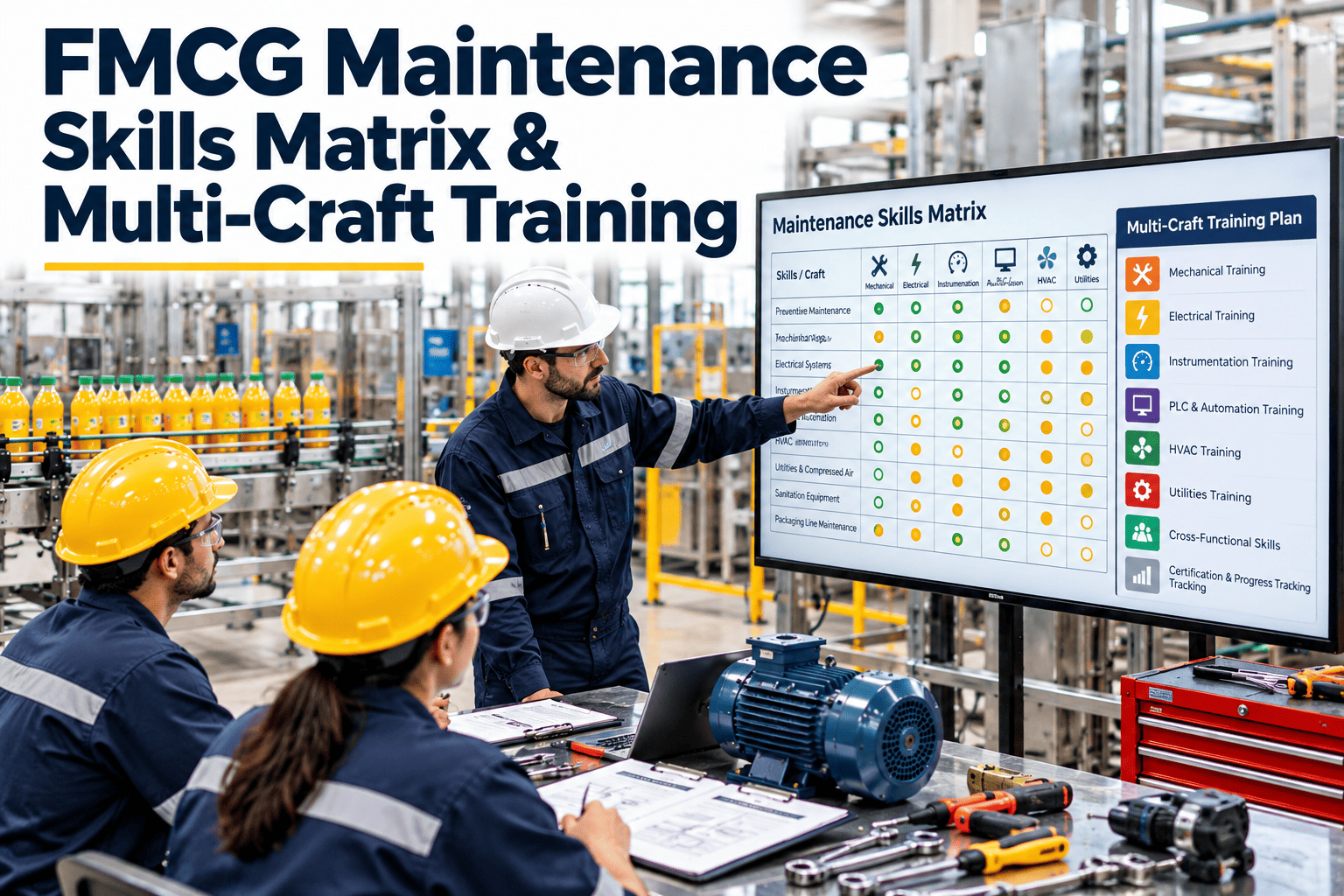
When a filler stops at 2 a.m. and the only technician who can read the PLC fault is off shift, the line waits. FMCG plants run around the clock, and maintenance teams are rarely large enough to cover every skill on every shift. A skills matrix shows who can do what, and multi-craft training closes the gaps before they cause downtime. This guide explains how to build both, track certifications, and use Oxmaint maintenance software to connect skills to real work orders.
FMCG Maintenance Skills Matrix and Multi-Craft Training Guide
Map technician skills, remove single points of failure on shifts, and build mechanical-electrical cross-training with certification tracking.
| Technician | Mechanical | Electrical | PLC and controls | Pneumatics | Lockout |
|---|---|---|---|---|---|
| Technician A | 3 | 1 | 0 | 2 | 3 |
| Technician B | 2 | 3 | 2 | 1 | 2 |
| Technician C | 1 | 2 | 3 | 0 | 3 |
| Technician D | 2 | 0 | 0 | 3 | 2 |
Illustrative matrix. Levels: 0 none, 1 learning, 2 works independently, 3 can train others.
Why FMCG maintenance teams need a skills matrix
Assigning work by who is available, rather than who is qualified, leads to slow repairs, repeat visits, and safety risks.
Single points of skill
One person knows a servo drive or a vision system. When they leave or take leave, repairs stall.
Uneven shift coverage
Night shifts often lack electrical or controls skills that day shifts have in abundance.
Hand-offs between trades
A mechanical fault that needs a sensor adjustment waits for an electrician to arrive.
Expired or unknown certification
Safety and compliance training lapses unnoticed without a tracking system.
Building the matrix in five steps
1
List the equipment and tasks
Start from your asset register: fillers, wrappers, cappers, conveyors, utilities, and controls.
2
Define skills in observable terms
Write what a person can actually do, such as changing a servo or diagnosing a sensor fault, not vague labels.
3
Set levels with clear criteria
Use four levels, from no skill to able to train others, and document what evidence supports each level.
4
Assess honestly with supervisors
Combine observation, work history, and a short practical check. Avoid self-rating alone.
5
Find gaps against shift needs
Compare the matrix with the skills each shift must cover, and rank gaps by downtime risk.
Gap analysis: where the risk really sits
| Skill area | Typical FMCG equipment | Risk when coverage is thin |
|---|---|---|
| Controls and PLC | Packaging machines, robots, palletizers | Long fault diagnosis, extended stops |
| Electrical and drives | Motors, VFDs, panels, sensors | Delays on every electrical fault |
| Mechanical and alignment | Gearboxes, chains, belts, seals | Poor repairs and repeat failures |
| Pneumatics and hydraulics | Cylinders, valves, grippers | Intermittent faults that are hard to trace |
| Hygienic and sanitary practice | Food contact surfaces and washdown areas | Contamination and audit findings |
| Safety procedures | All equipment | Injury risk and compliance exposure |
Rank gaps by two questions: how much downtime would this skill gap cause, and how many people can cover it today?
Skill levels defined by what a technician can prove
A matrix is only fair when every level has written criteria and every assessor reads them the same way.
| Level | Description | Evidence to accept |
|---|---|---|
| 0: No skill | Has not been trained on the task or equipment | None. Must not work unsupervised. |
| 1: Learning | Understands the task and works under supervision | Training completed, observed attempts |
| 2: Independent | Completes the task safely and correctly alone | Assessor sign-off, repeat jobs without rework |
| 3: Trainer | Diagnoses unusual faults and teaches others | Has coached a colleague to level 2 |
A sample task card for cross-training
Task: replace a proximity sensor
- Lock out and verify zero energy
- Note sensor position and type
- Replace, align, and tighten to specification
- Test the signal at the controller
Skills it builds
- Electrical safety awareness
- Reading a simple wiring or I/O list
- Basic diagnostics with a multimeter
- Documenting the change in the work order
Sign-off criteria
- Completed three supervised jobs
- No rework within the following month
- Correct records entered on each job
- Assessor and learner both sign
Onboarding new technicians in 30, 60, and 90 days
Days 1 to 30
Safety and orientation
Site induction, lockout, hygiene rules, equipment tours, and shadowing on routine PM.
Days 31 to 60
Guided work
Complete common tasks under supervision and learn the CMMS routines for closing jobs.
Days 61 to 90
Independent tasks
Take on selected work orders alone, with assessor review and feedback.
After day 90
Plan the next skills
Update the matrix and agree on one cross-trade skill to develop next.
Pairing operators with technicians
- Teach operators the early signs of wear so faults reach maintenance sooner.
- Let operators take over simple cleaning, inspection, and lubrication tasks with clear instructions.
- Keep technicians responsible for repairs, adjustments outside agreed limits, and anything involving energy isolation.
Retention and succession: protecting knowledge you cannot replace
Experience held in one head
Capture machine-specific fixes in work order notes and task cards before senior technicians retire or move.
No path to grow
Show technicians how added skills lead to higher grades or responsibility, so training feels worthwhile.
Training that never gets used
Schedule new skills into real jobs within weeks, or the knowledge fades.
Contractor dependence
Track which specialist call-outs repeat, and decide which skills are worth building in-house.
Mistakes that undermine a skills matrix
- Building it once and never updating it after hires, departures, or new equipment.
- Treating it as a performance review, which encourages inflated self-ratings.
- Listing hundreds of skills, which makes assessment slow and the matrix unreadable.
- Ignoring shift patterns, so coverage looks fine on paper but fails at night.
- Skipping assessor training, so two supervisors score the same technician differently.
Matching skills to work order types
Once the matrix exists, planners can route work to the right person instead of the nearest one.
| Work order type | Minimum skill level | Planning note |
|---|---|---|
| Routine PM inspection | Level 1 with a level 2 supervisor | Good for training and shadowing |
| Sensor or drive replacement | Level 2 in electrical | Confirm lockout authorization |
| PLC fault diagnosis | Level 2 or 3 in controls | Schedule a back-up person on each shift |
| Major gearbox or alignment work | Level 2 in mechanical | Allow time for precision measurement |
| Hygienic zone repairs | Level 2 plus current hygiene training | Check tools and clearance rules |
Planning shift coverage
- List the critical skills each shift needs, based on the machines that run.
- Check that at least one qualified person covers each critical skill, including leave and sickness.
- Use call-out lists for rare skills, and record how often they are needed.
- Rotate technicians through shifts so knowledge is spread more evenly.
Weighing training cost against downtime cost
- Estimate the downtime minutes avoided if a second person could handle a common fault.
- Compare that with course fees, wages during training, and assessor time.
- Start with the cheapest high-impact skills, such as basic controls diagnosis and sensor work.
Assessing fairly: a guide for supervisors
Before the assessment
- Explain the purpose: coverage and training, not punishment
- Share the criteria for each level in advance
- Choose a real task on real equipment
- Agree on safety rules for the assessment
During the assessment
- Observe without prompting unless safety requires it
- Check method, safety, tools, and records
- Ask the technician to explain their choices
- Note evidence for the score you give
After the assessment
- Share the result and the reasons
- Agree on the next learning step
- Record the date, assessor, and evidence
- Set a review date for the skill
Skills data worth recording against each technician
| Data item | Purpose | Review cycle |
|---|---|---|
| Skill and level | Match work to capability | Quarterly or after training |
| Assessment date and assessor | Show how the level was set | With each assessment |
| Certification and expiry date | Prevent unqualified work and lapses | Monthly expiry check |
| Equipment authorizations | Control who may work on high-risk assets | When equipment or roles change |
| Training plan and progress | Keep development on track | Monthly one-to-one |
A quarterly review checklist
- Which critical skills have only one qualified person on a shift?
- Which certifications expire in the next ninety days?
- Which repeat faults involved a skill gap rather than an equipment problem?
- Which technicians are ready to move up a level?
- What new equipment is coming, and which skills will it need?
Autonomous maintenance: building operator skills
When operators handle basic care, technicians spend more time on repairs and improvement. It only works with training and clear limits.
Clean and inspect
Operators spot leaks, loose parts, and wear during cleaning.
Standardize
Simple tasks are written as visual steps and linked to the asset.
Report early
Faults become work requests before they stop the line.
Review together
Operators and technicians discuss findings and update tasks.
Limits to agree before handing tasks to operators
- List which tasks operators may perform, and which always need a technician.
- Require training and sign-off before an operator works on any task.
- Exclude energy isolation, electrical work, and guard removal unless formally authorized.
- Record operator tasks in the same system so history stays complete.
Signs your multi-craft program is paying off
- Night and weekend shifts resolve common electrical and mechanical faults without waiting for a call-out.
- Technicians describe faults using the same terms as the controls and mechanical teams.
- Training records, certificates, and work history agree, and audits find no surprises.
- Planners can say, at any moment, who is qualified for each critical job on the current shift.
Connect skills to the work orders your team receives
Keep technician profiles, certifications, and work history alongside the maintenance work they perform.
Multi-craft training: from single trade to cross-skilled technician
Multi-craft does not mean everyone does everything. It means each person can handle the common tasks across trades safely, and call for help early on the rest.
Mechanical technician learns
- Basic electrical safety and testing
- Sensor adjustment and replacement
- Reading simple PLC fault messages
- Motor and VFD checks
Electrical technician learns
- Alignment, belt, and chain basics
- Gearbox and bearing inspection
- Lubrication standards
- Pneumatic circuit checks
Operators learn
- Routine cleaning and inspection tasks
- Early signs of wear and abnormal noise
- Safe stop and reporting procedures
- Simple adjustments within agreed limits
Training methods that work on a plant floor
- Shadowing: a skilled technician works alongside, then supervises while the learner leads.
- Task cards: step-by-step instructions linked to the work order and the machine.
- Short micro-sessions during planned stops, rather than long classroom blocks.
- Sign-off by a qualified assessor before work is done independently.
Certification tracking: what to record and when it expires
| Certification or training | Why it matters | What to track |
|---|---|---|
| Lockout and tagout | Controls hazardous energy during repairs | Training date, refresher date, authorization level |
| Electrical safety | Protects against shock and arc hazards | Qualification, expiry, equipment scope |
| Confined space and work at height | Required for tanks, silos, and elevated equipment | Permit authority, medical or training validity |
| Hot work | Fire prevention around welding and cutting | Permit training and renewal |
| Forklift and lifting equipment | Safe handling of parts and machinery | Operator license, expiry |
| Food safety and hygiene | Prevents contamination during maintenance | Induction, annual refresher |
| OEM or specialist training | Needed for robots, vision systems, and servo drives | Course completed, equipment covered |
Requirements differ by country and employer. Confirm the standards that apply with your safety team and keep certificates on file.
Using the CMMS to put skills to work
Technician profile
Skills, level, and certifications
Work order requirement
Skill and certification needed
Assignment
Match qualified people on shift
Learning record
Completed tasks build evidence
How Oxmaint supports skills-based maintenance
- Work orders with task checklists and instructions, so less experienced technicians follow a standard method.
- Assignment and scheduling tools that help planners balance workload across shifts.
- Asset history that shows which equipment generates the most repeat calls and needs deeper training.
- Reports on completed work by technician and asset type to support skill assessments.
- Preventive maintenance schedules that create predictable training opportunities during planned work.
Check how technician profiles and certification fields are configured in your plan during a demo, and align them with the way your plant records skills.
A 12-week multi-craft training plan
Weeks 1 to 3
Assess
Define skills, score the team, and map shift coverage gaps.
Weeks 4 to 6
Prioritize
Pick the three gaps with the highest downtime risk and select learners.
Weeks 7 to 10
Train
Run shadowing, task cards, and planned-stop sessions with assessor sign-off.
Weeks 11 to 12
Review
Update the matrix, check response times, and plan the next cohort.
Measures that show the program is working
- Time from fault report to qualified technician on the machine.
- Share of shifts with full coverage of critical skills.
- Repeat visits on the same fault by different trades.
- Training and certification compliance rate.
- Rework or repeat failures after repairs by newly cross-trained staff.
Skills matrix and multi-craft FAQs
How many skill levels should a matrix have?
Four is practical: none, learning, independent, and trainer. More levels slow down assessment.
Do we need to cross-train everyone?
No. Focus on skills that cause the longest delays and the most shift coverage risk.
How often should the matrix be reviewed?
Review it quarterly, and after any hire, departure, or new equipment installation.
Can a CMMS replace a training system?
It complements one. Use Oxmaint to link work, history, and skills where your plan supports it.
Where should we start?
Pick one line or shift, build its matrix, then book a demo to see how to scale it.
Build a team that can fix any fault on any shift
Use skills data, structured training, and a single maintenance system to reduce delays and strengthen coverage.