Maintenance Technician & Robotics Training Program for FMCG: Building a Skilled Workforce
By Jacob on March 7, 2026
The FMCG maintenance skills gap is not a future problem — it is costing production floors today. With 2.1 million skilled manufacturing positions projected to go unfilled in the US alone by 2030, and robotics adoption in FMCG accelerating at 14% annually, the gap between the workforce plants have and the workforce they need is widening faster than traditional hiring can close it. The answer is not to hire differently — it is to train deliberately. A structured maintenance technician and robotics training programme does not just fill skill gaps; it builds a workforce that can maintain, programme, and optimise the automated production systems that determine whether your FMCG plant is competitive or outpaced. This guide covers the competency frameworks, technical training modules, cobot safety certifications, CMMS skill development, and career pathways that transform a reactive maintenance team into a skilled automation-ready workforce. Start your free trial to deploy Oxmaint's training module and skill tracking from day one, or book a demo to see how Oxmaint tracks technician competencies, certifications, and training completion across your entire maintenance team.
Unstructured Training vs. Oxmaint-Managed Technician Development
The workforce capability and operational gap between ad-hoc skills development and a structured CMMS-tracked training programme
Unstructured / Reactive Training
Skills Visibility
No competency map — tribal knowledge only
Certification Tracking
Paper records — expiry dates missed, compliance gaps
Robotics Readiness
Technicians untrained on cobot and automation systems
Knowledge Continuity
Retirement and turnover delete institutional knowledge
Oxmaint Training Module
Skills Visibility
Full competency matrix per technician — always current
Certification Tracking
Digital records with automated renewal alerts per technician
Robotics Readiness
Structured cobot and PLC training paths with progress tracking
Knowledge Continuity
Documented SOPs and asset-linked procedures retained in platform
Workforce Gap: Reactive Skills Management → Strategic Competency Development with Oxmaint
Why FMCG Maintenance Training Has Become a Business-Critical Priority
FMCG maintenance training was once a line item managed by HR. Today it is a production continuity imperative. Three structural forces have converged to make technician development the single highest-leverage investment a maintenance leader can make — and failing to address them has direct operational consequences that show up in OEE, downtime events, and emergency repair spend.
Four Forces Making Maintenance Training a Business-Critical Investment
Skills Gap
2.1M Unfilled Positions by 2030
The Deloitte–Manufacturing Institute analysis projects 2.1 million skilled manufacturing roles unfilled by 2030. FMCG maintenance is among the hardest-hit categories — the applicant pool for experienced multi-craft technicians is shrinking faster than the roles are being created.
Automation
14% Annual Robotics Adoption Growth
FMCG robotics adoption is growing at 14% per year — cobots, AMRs, vision systems, and automated packaging lines are standard equipment in new and retrofitted plants. Technicians hired for mechanical maintenance are now expected to diagnose robot faults, reprogram parameters, and validate safety circuits.
Retirement
25% of Skilled Workforce Retiring by 2026
An estimated 25% of the current FMCG skilled maintenance workforce is expected to retire within two years. With them goes decades of asset-specific knowledge that exists nowhere except inside their experience — SOP libraries, CMMS work history, and structured apprenticeships are the only tools that transfer that knowledge before it walks out the door.
Compliance
Expanding Safety and GMP Certification Requirements
ISO 10218, ISO/TS 15066 for collaborative robots, OSHA LOTO compliance, and GMP documentation requirements for food-grade and pharmaceutical FMCG lines all require certified, documented technician competencies — not just practical skill. The compliance burden on maintenance training has expanded significantly in the past five years.
The FMCG Maintenance Competency Framework: Six Skill Domains
A structured maintenance training programme begins with a competency framework that defines what skills are required, at what level, for each technician role in the FMCG maintenance team. Without a framework, training is reactive and unmeasurable. With one, every development activity maps to a documented capability gap with a clear outcome.
Six Core Competency Domains — FMCG Maintenance Technician Framework
Skill domain, key competencies required, proficiency levels, and primary training pathway for each area
Diagnosis, disassembly, rebuild, and alignment of rotating and static mechanical components. PM procedure execution, torque specification compliance, and precision reassembly to manufacturer tolerance. Foundational skill for all FMCG production equipment.
Foundation All technician levels
Electrical and PLC Systems Panel wiring · drives · PLCs · HMIs · sensors
Single and three-phase electrical diagnosis, VSD parameter reading, PLC fault interpretation using HMI and SCADA interfaces, sensor calibration and replacement. LOTO implementation per OSHA 29 CFR 1910.147 as a mandatory pre-requisite for all electrical work.
Robot teach pendant operation, waypoint programming, payload and reach verification, safety zone configuration, fault code interpretation and first-response recovery. ISO/TS 15066 collaborative robot risk assessment and safety validation. Growing to primary skill requirement as FMCG automation density increases.
Vibration measurement and trend interpretation using handheld analysers, thermal imaging for hot spot identification in electrical panels and bearings, ultrasonic leak detection on compressed air and steam systems. Feeds data into CMMS condition records to support predictive maintenance decision-making.
Advanced Level 3 specialists
CMMS and Digital Workflow Work orders · asset records · PM scheduling · reporting
Mobile work order completion with accurate time, parts, and fault code recording. Asset condition data entry, PM checklist execution with digital sign-off, and spare parts consumption logging that feeds inventory forecasting. The data quality of the entire maintenance programme depends on technician CMMS proficiency.
Hygienic design principles for maintenance in food contact zones, allergen contamination prevention during maintenance interventions, FSMA and BRC documentation requirements for maintenance records, and audit-ready work order completion standards that satisfy food safety certification bodies.
Foundation Food and pharma sites
Multi-craft maintenance technicians — skilled across mechanical, electrical, and robotics domains — reduce mean time to repair by 35% and eliminate the scheduling delays caused by waiting for a specialist from a different crew to attend a fault. FMCG plants that invest in cross-domain training deliver measurably better OEE than those maintaining strict craft silos.
Robotics Training for FMCG Maintenance: What Technicians Need to Know
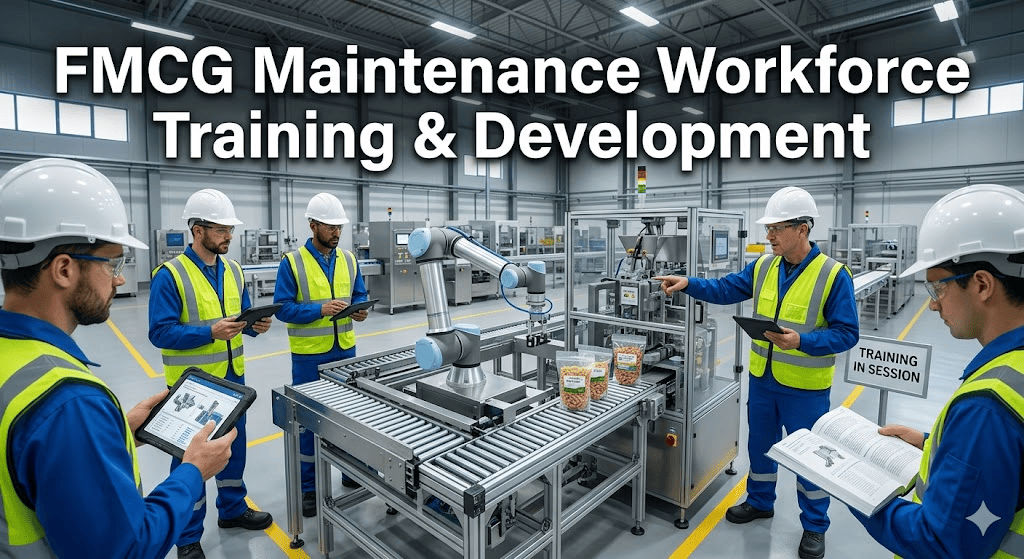
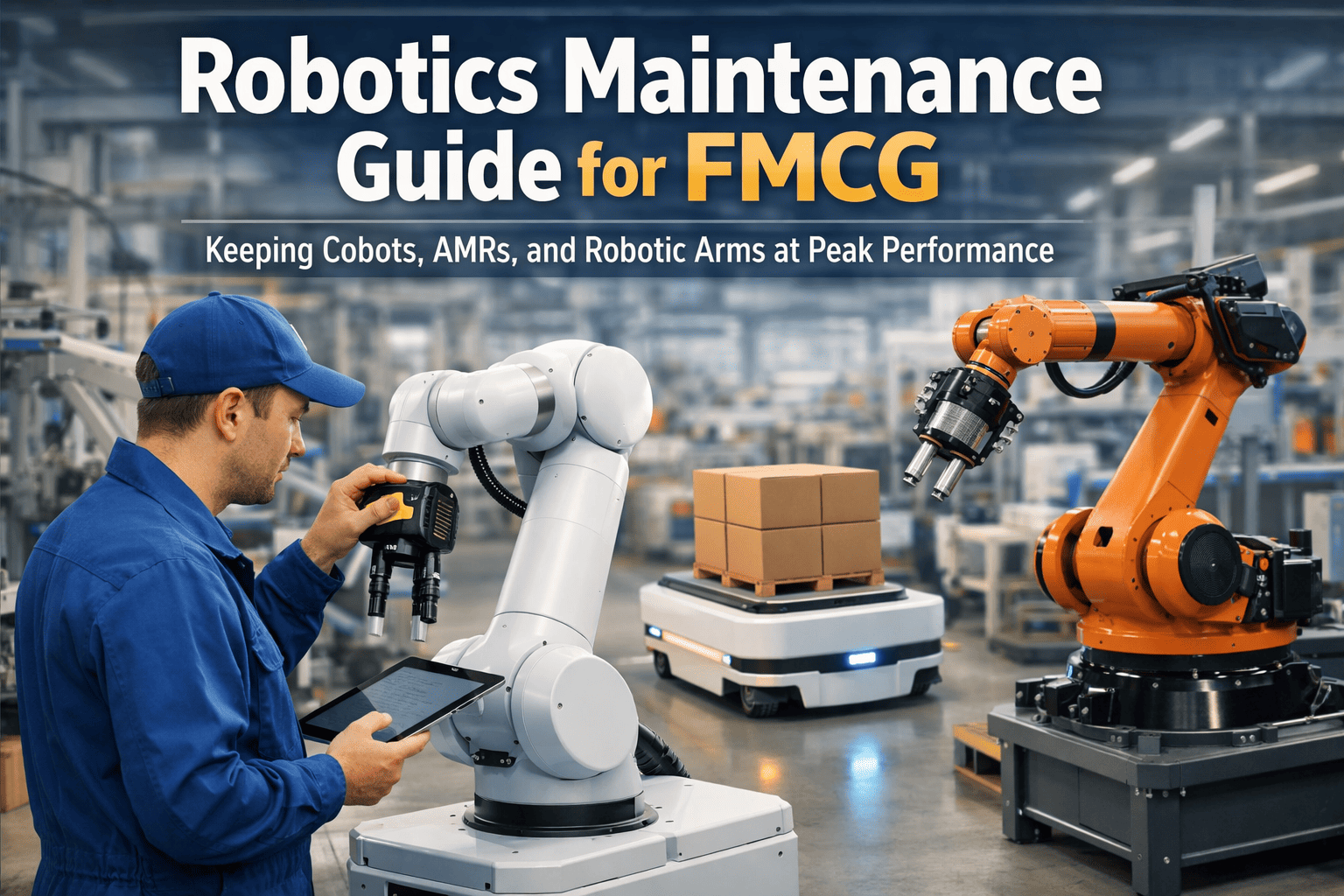
Robotics competency in FMCG maintenance is no longer a specialist add-on — it is becoming a baseline requirement. As collaborative robots enter packaging, palletising, pick-and-place, and quality inspection applications, every maintenance technician on a modern FMCG production floor will need to interact with, troubleshoot, and safely restart robotic systems as part of routine maintenance work.
Six Essential Robotics Training Modules for FMCG Maintenance Technicians
Robot Safety and ISO/TS 15066
Mandatory Foundation
Collaborative robot safety — speed and force limits, safety-rated monitored stops, hand-guiding modes, and power-and-force limiting applications. ISO/TS 15066 risk assessment methodology for cobot installations. This training is a mandatory pre-requisite before any maintenance interaction with a cobot installation in an FMCG facility.
Teach Pendant Operation
Core Practical Skill
Hands-on training on the teach pendant interfaces for the robot brands deployed on site — Universal Robots PolyScope, FANUC iPendant, ABB FlexPendant. Jogging in all coordinate frames, reading and navigating programme structure, executing manual moves for maintenance access without disrupting recorded waypoints.
Fault Code Interpretation
Downtime Reduction
Reading and interpreting fault logs from the robot controller — distinguishing between hardware faults (joint errors, encoder issues, motor overtemperature) and software or integration faults (I/O signal failures, communication errors, safety circuit interruptions). First-response recovery procedures for the top-10 most common fault codes per robot model.
Preventive Maintenance Procedures
Asset Life Extension
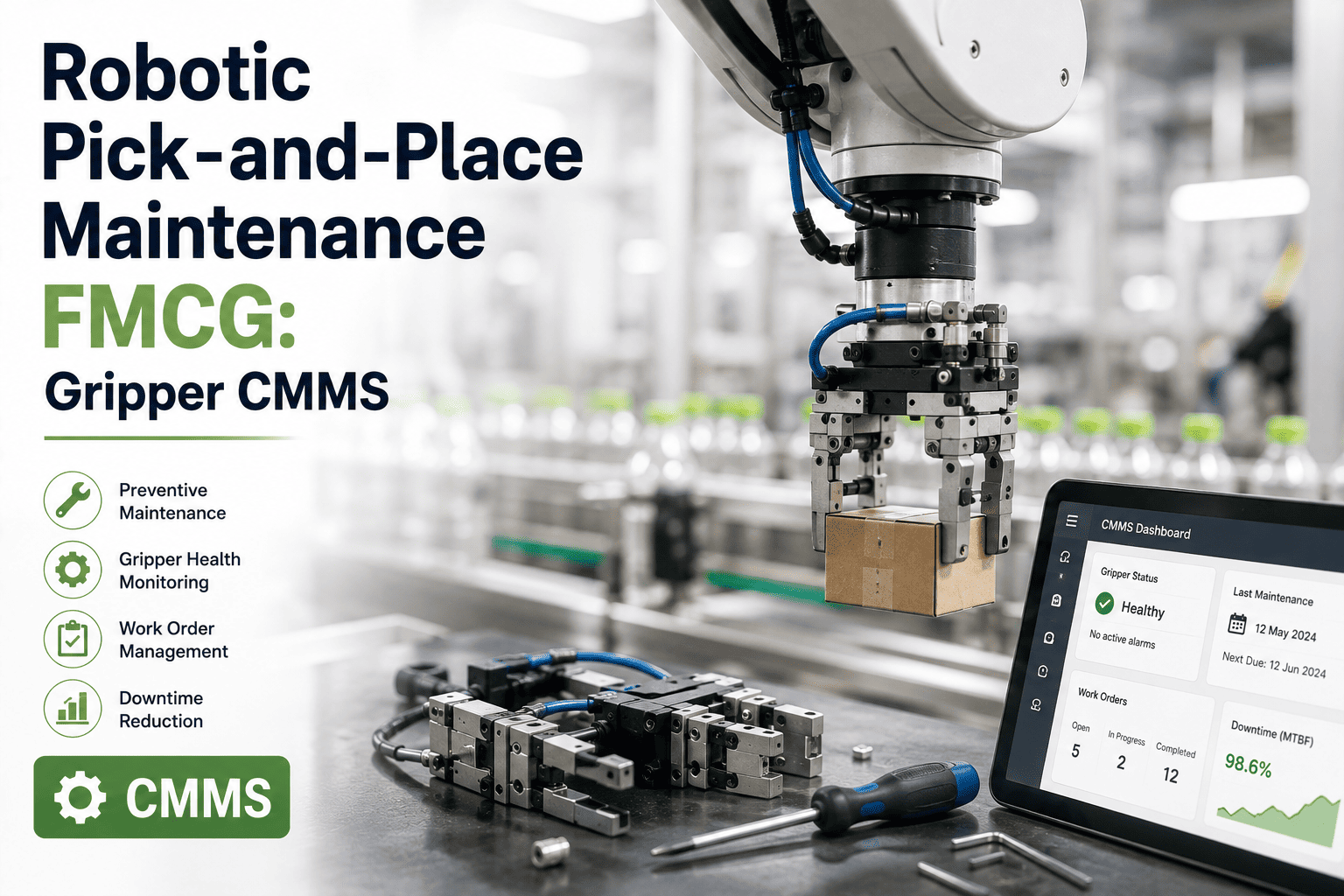
Robot-specific PM tasks: grease nipple lubrication intervals per joint, cable management inspection and replacement criteria, end-of-arm tooling wear assessment, battery backup testing for controller memory, and teach pendant connector inspection. PM intervals vary significantly by robot brand and application — technicians must execute to manufacturer specification, not approximation.
Basic Programme Modification
Operational Flexibility
Adjusting speed, acceleration, and approach parameters within approved ranges following tooling changes or product changeovers. Re-teaching pick positions after conveyor or fixture adjustment. Modifying wait times and I/O triggers to accommodate product format changes. Technicians who can make approved programme modifications reduce engineering call-outs by 40–60%.
Vision System Maintenance
Quality Continuity
Camera lens cleaning procedures and frequency, lighting check and replacement criteria, calibration verification using reference samples, and communication with the vision system's host software. Vision system degradation is a leading cause of quality-related stoppages in FMCG inspection and label verification applications — preventive care by trained technicians reduces false reject rates significantly.
How Oxmaint Tracks Technician Training, Skills, and Certifications
A training programme without visibility into completion, competency levels, and certification status is no better than no programme at all. Oxmaint's training module and skill tracking capability gives maintenance managers a live competency dashboard — showing who is qualified to do what, which certifications are approaching expiry, and where individual development gaps exist across the entire team.
Four-Layer Technician Development Architecture in Oxmaint
01
Competency Matrix Management
Define required skills per technician role and level
Assess current competency level per technician per domain
Gap analysis visible at individual and team level
Matrix updated automatically as training is completed
Output: Live Skills Gap Visibility Across the Team
02
Certification and Compliance Tracking
Digital storage of all certifications with expiry dates
Automated renewal alerts 90, 60, and 30 days before expiry
LOTO, ISO 15066, GMP, and confined space records in one place
Audit export — all certifications by technician or by standard
Output: Zero Missed Certification Renewals
03
Training Path Assignment
Assign structured training paths per technician role
Module completion tracked against timeline targets
Practical assessment sign-off linked to work order history
Robotics, electrical, and CMMS paths available as standard
Output: Structured Development with Measurable Progress
04
Knowledge Capture and SOPs
Asset-linked SOPs accessible at point of maintenance
Work order history captures tacit knowledge in structured records
Retiring technician knowledge transfer tracked as a handover task
Mobile-accessible procedure library — no paper manuals required
Output: Institutional Knowledge Retained, Not Lost
Building the Four-Level Technician Career Pathway
A structured career pathway is not just a retention tool — it is a training programme architecture. When technicians understand what skills are required to progress, training investment becomes self-directed. When maintenance managers can see exactly what each level requires, workforce planning becomes data-driven. Oxmaint's skill tracking module supports all four levels with competency records that document progression from entry to specialist.
Four-Level FMCG Maintenance Technician Career Pathway
Role level, core competency requirements, key certifications, and typical development timeline per tier
Supervised PM execution, basic mechanical tasks, CMMS work order completion, LOTO procedures, GMP hygiene maintenance, and safety induction. Primary objective is building procedure-following discipline and CMMS data quality habits that support the entire maintenance programme above them.
Foundation LOTO · GMP · CMMS
Level 2 — Maintenance Technician 18 months–4 years · independent mechanical and electrical
Independent fault diagnosis and repair across mechanical and electrical systems, PLC fault reading and basic HMI navigation, preventive and corrective work order management, cobot safety awareness and first-response fault recovery, and initial condition monitoring data collection. Backbone of daily production support.
Intermediate PLC · Cobot Safety · CM
Level 3 — Senior Technician / Multi-Craft 4–8 years · advanced diagnostics and robotics programming
Complex root cause analysis across multiple craft domains, robot programming and parameter modification, advanced condition monitoring interpretation (vibration analysis, thermal imaging), PM programme improvement contributions, CMMS data analysis, and mentoring of Level 1 and Level 2 technicians. High individual production value.
Advanced ISO 15066 · Vibration · RCA
Level 4 — Maintenance Engineer / Specialist 8+ years · programme design and automation ownership
Full robotics integration and commissioning, predictive maintenance programme design, CapEx justification using CMMS condition data, maintenance KPI ownership, training programme development and delivery, contractor technical oversight, and knowledge management for team resilience planning. Strategic workforce asset.
Expert Automation · CapEx · KPI
FMCG plants that document and communicate structured career progression paths report significantly higher technician retention — up to 34% lower turnover than plants offering no visible development pathway. The cost of replacing one experienced technician — recruitment, induction, and productivity ramp — is estimated at 60–80% of annual salary.
ROI of a Structured Maintenance Training Programme
Training investment in FMCG maintenance is frequently deprioritised because its return is diffuse and delayed. It is not. The financial return from a structured, CMMS-tracked technician development programme is quantifiable across six value categories — and the programme typically pays back within 12 months through downtime reduction alone.
Annual ROI: Structured Maintenance Training Programme
Mid-size FMCG manufacturer — 2 production sites, 24-person maintenance team, 3 robotic work cells per site
MTTR Reduction
35% MTTR improvement from multi-craft training × 180 annual fault events × £2,200 average downtime cost per hour saved per event — skilled diagnosis replaces diagnostic guesswork
£138,600
Robotics Engineering Call-Out Reduction
40% reduction in external robotics engineering call-outs × 65 annual call-outs × £1,800 average external visit cost — technicians recover faults independently using trained first-response procedures
£46,800
Turnover Cost Avoidance
34% turnover reduction from structured career pathways × 3 technicians retained per year × £28,000 estimated replacement cost per head (recruitment + induction + productivity ramp)
£84,000
Compliance Penalty Avoidance
Zero missed LOTO, GMP, and cobot safety certification renewals — CMMS automated alerts prevent the certification gaps that result in regulatory findings, insurance premium increases, and production line holds
£35,000+
Training Programme Investment
Structured training delivery (internal and external), Oxmaint training module and skill tracking, cobot safety certification costs for 24 technicians across both sites
£55K–£85K/yr
Net Annual Value of Structured Training Programme
£304K+ 4–6x ROI
The MTTR reduction from multi-craft training alone typically recovers the full annual training investment within the first 8–10 months. Turnover reduction and robotics call-out savings compound the return significantly — and the value accelerates each year as technicians progress through competency levels and the skills database matures.
Six Common Training Programme Failures and How to Avoid Them
Most FMCG maintenance training programmes fail not because of inadequate content — but because of structural execution failures that prevent the learning from translating to measurable on-the-floor performance improvement. Understanding these failure modes before building your programme is the difference between a development investment and a training expense.
Six Training Programme Failures — Root Cause and Structural Fix
No Framework
Training Without a Competency Map
Training delivered without a defined competency framework produces no measurable outcome. Fix: Build the skills matrix first. Every training activity must map to a documented gap with a before/after competency level that can be assessed and recorded in the CMMS.
No Tracking
Completion Not Linked to Performance
Training certificates filed in HR folders with no connection to actual maintenance outcomes. Fix: Link training completion in Oxmaint to MTTR trends, work order quality scores, and PM compliance rates — making the performance impact of each development investment visible and reportable.
Theory Only
Classroom Learning Without Practical Assessment
Maintenance training that is not assessed on actual equipment produces technicians who understand concepts but cannot execute procedures reliably under production conditions. Fix: Require practical sign-off on real assets, with the assessing supervisor's name and date recorded in the technician's competency profile in Oxmaint.
No Pathway
Training With No Career Development Connection
One-off training events disconnected from a visible career pathway produce neither retention nor sustained motivation to develop. Fix: Every training activity must connect to a level progression in the four-tier career pathway — technicians need to see how today's learning leads to tomorrow's capability and compensation.
Siloed
Craft Silos Preventing Multi-Skill Development
Strictly siloed mechanical and electrical crews prevent the multi-craft development that drives MTTR reduction and scheduling flexibility. Fix: Structure Level 2 and Level 3 training paths explicitly across craft boundaries — with practical assessments that require technicians to diagnose faults that span mechanical and electrical root causes.
No Renewal
Certifications Allowed to Expire Undetected
Expired LOTO, cobot safety, and GMP certifications create compliance exposure that only surfaces during an incident or an audit. Fix: Centralise all certification records in Oxmaint with automated renewal alerts — a missed renewal should be impossible when the system flags it 90, 60, and 30 days in advance with the responsible manager notified at each stage.
Frequently Asked Questions
How long does it take to train an FMCG maintenance technician to work independently on cobot systems?
Practical independence on cobot first-response fault recovery — the most time-critical skill for production continuity — typically requires 40–60 hours of structured training over 6–8 weeks, combining classroom safety content (ISO/TS 15066, robot-specific LOTO procedures), simulator or offline programming practice, and supervised on-site hands-on sessions using the actual robot models deployed at the facility. Full programme modification capability — re-teaching waypoints, adjusting parameters for product changeovers — requires an additional 30–40 hours of supervised practical work and is typically assessed at the Level 3 milestone in the technician career pathway. The most critical accelerator is access to the actual robot hardware during training, not simulators alone. Technicians trained on the specific robot brand and model they will maintain in production achieve practical competency 40% faster than those trained on generic robotics curricula.
Which safety certifications are mandatory for FMCG maintenance technicians working near collaborative robots?
The mandatory certification baseline for any technician performing maintenance on or near collaborative robot installations in an FMCG facility includes: site-specific LOTO procedures under OSHA 29 CFR 1910.147 (US) or equivalent BS EN ISO 14118 (UK/EU), cobot safety awareness training aligned to ISO/TS 15066 covering speed and force limits, safety-rated monitored stops, and power-and-force limiting application principles, and robot-specific safety training provided or endorsed by the robot manufacturer (Universal Robots Academy, FANUC training certification, ABB RobotWare safety module). For food-grade FMCG facilities, additional GMP and allergen contamination awareness training is required before performing any maintenance that involves opening or entering a food contact zone. All certifications should be stored in Oxmaint with expiry tracking — cobot safety certifications typically require renewal every two to three years or when the robot installation changes significantly.
How does Oxmaint support maintenance training programme delivery and skill tracking?
Oxmaint's training module provides four core capabilities for FMCG maintenance workforce development. First, the competency matrix builder allows maintenance managers to define required skills at each level of the technician career pathway, assess current competency per technician, and generate a live gap analysis dashboard that prioritises where training investment will deliver the highest operational return. Second, the certification tracking module stores all qualifications digitally with automated renewal alerts at 90, 60, and 30 days before expiry — eliminating the compliance risk of manually managed certification records. Third, training path assignment links structured development programmes to each technician profile, with module completion tracked against timeline milestones and practical assessment sign-off recorded by the assessing supervisor with timestamp and asset reference. Fourth, asset-linked SOP libraries make procedure documentation accessible at point of maintenance via mobile — ensuring trained procedures are reinforced at every work order execution rather than forgotten between training sessions.
How should FMCG manufacturers approach the knowledge transfer risk from retiring skilled technicians?
The knowledge transfer risk from retiring skilled maintenance technicians is one of the most underestimated operational risks in FMCG manufacturing. The structured mitigation has four elements. First, identify at-risk knowledge holders 24–36 months before anticipated retirement — not six months, when the urgency prevents systematic transfer. Second, map the asset-specific knowledge that exists only in the individual's experience: non-documented fault patterns, supplier contacts, equipment history, and workarounds for known equipment quirks that have never been formally recorded. Third, use Oxmaint's SOP library and work order history to externalise that knowledge systematically — the retiring technician authors or reviews asset-linked procedures, and complex work orders are completed with a detailed notes requirement that captures reasoning, not just outcomes. Fourth, implement a structured shadowing programme where a nominated Level 2 or Level 3 technician is assigned to shadow the at-risk knowledge holder on all complex maintenance events during the 12 months preceding departure. Oxmaint's training module tracks this handover programme as a formal development pathway with milestone sign-offs.
What is the most effective structure for an FMCG maintenance technician apprenticeship programme?
The most effective FMCG maintenance apprenticeship structures combine three elements in a defined sequence. The first six months focus on safety and procedure compliance: LOTO certification, GMP induction, CMMS work order completion to quality standard, and supervised PM execution. This phase builds the foundation habits that determine data quality for the entire maintenance programme above them. Months 7–18 introduce diagnostic skills: fault finding on mechanical and electrical systems, condition monitoring data collection, and participation in planned overhaul events with documented assessment sign-off at each milestone. Months 19–36 introduce cross-craft exposure: electrical fundamentals for mechanical apprentices, robotics safety and first-response for all streams, and introduction to predictive maintenance data interpretation. Assessment throughout should be practical — not written exams — with every milestone requiring documented on-the-job demonstration witnessed by a qualified assessor and recorded in Oxmaint against the apprentice's competency profile.
Maintenance Workforce Development for FMCG Operations
Your Training Programme Is Only as Strong as the System That Tracks It.
Investing in technician development without a system to track competencies, certifications, and training progress means the value of every training day disappears into filing cabinets and memory. Oxmaint's training module and skill tracking capability gives you a live competency dashboard across your entire maintenance team — showing who is qualified to do what, which certifications need renewal, where skills gaps create operational risk, and how each technician is progressing through their development pathway.
Live Competency Matrix — Skills Gap Visible Across the Entire Team
Certification Tracking with Automated Renewal Alerts — Zero Missed Renewals
Structured Training Paths — Robotics, Electrical, CMMS, and GMP Modules
Four-Level Career Pathway Tracking — Development Progress Always Documented
Asset-Linked SOPs — Knowledge Retained in the Platform, Not the Person
Multi-Site Skill Visibility — Portfolio-Level Workforce Intelligence in One Dashboard
Used by FMCG maintenance and operations teams across food, beverage, and consumer goods manufacturing. Training module and skill tracking included. No minimum contract term.