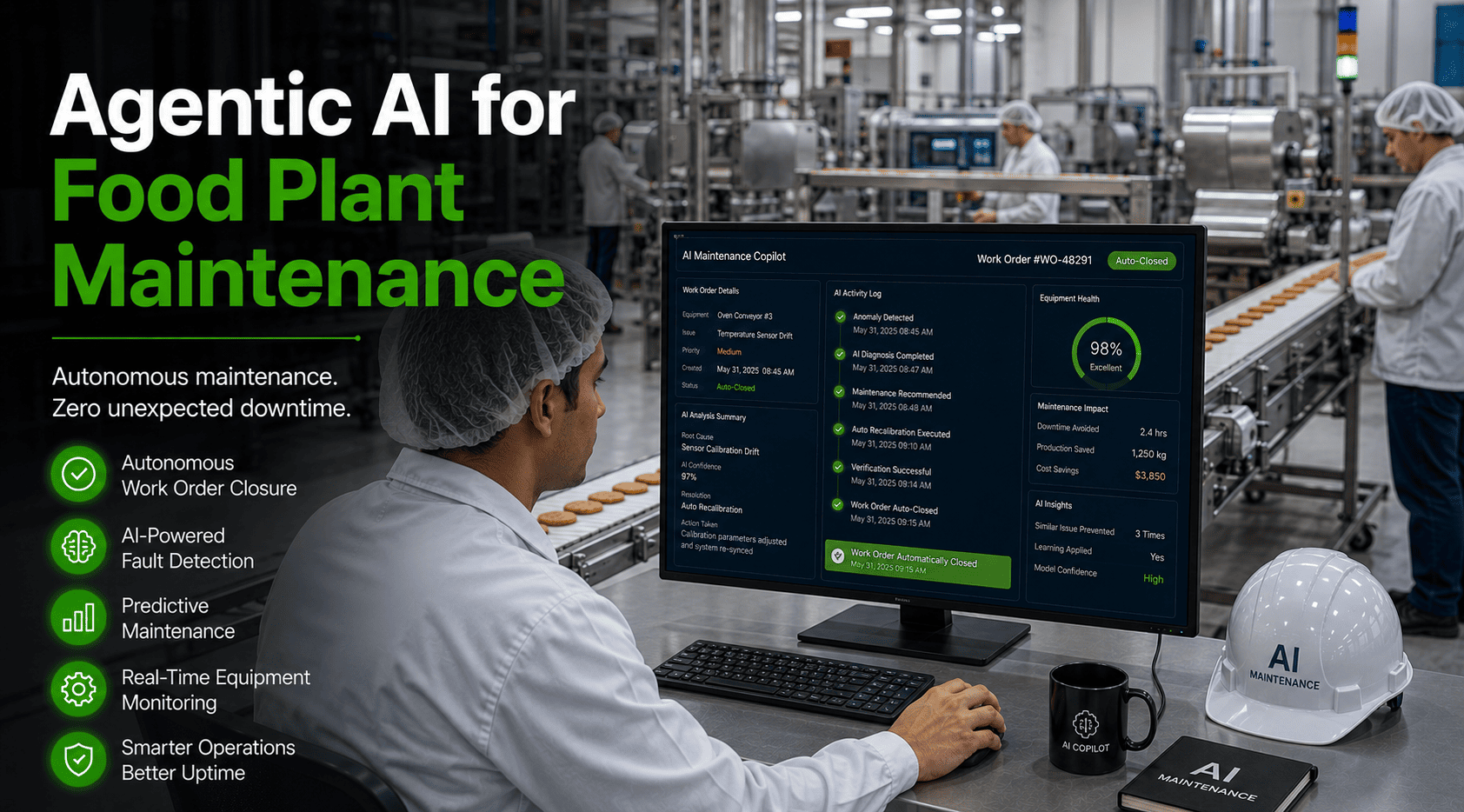
A conveyor drive motor in a ready-meal line shows a thermal spike at 3:14 AM. In a traditional food plant, that signal sits in a monitoring dashboard until a technician logs in at 6:00 AM, reviews the alert, creates a work order, checks parts availability, assigns a technician, and schedules the repair — a 2–4 hour response window during which the line either runs degraded or stops entirely. Agentic AI compresses that entire sequence to under 60 seconds: the agent detects the anomaly, cross-references the asset's maintenance history, confirms the correct spare part is in stock, generates and assigns the work order, and dispatches the technician — without a single human decision in the loop. This is not automation of individual tasks. It is autonomous end-to-end maintenance orchestration, and it is the next frontier for food manufacturing operations. Start a free trial to see how OxMaint's agentic AI layer handles autonomous work order management in your food plant.
AGENTIC AI FOR FOOD MANUFACTURING
From Sensor Signal to Closed Work Order — In Under 60 Seconds. No Human Required.
OxMaint's agentic AI detects failures, dispatches technicians, orders parts, enforces HACCP compliance, and closes work orders autonomously — so your maintenance team responds to outcomes, not alerts.
Trusted by operations teams managing 10,000+ food plant assets — live in days, not months.
Autonomous failure detection and dispatch
HACCP-compliant work order closure
Zero manual handoff from alert to repair
What Is Agentic AI in Food Plant Maintenance?
Agentic AI refers to AI systems that pursue multi-step goals autonomously — perceiving conditions, planning a sequence of actions, executing those actions across connected tools, and verifying outcomes — without human approval at each step. In food plant maintenance, an agentic system does not just flag an anomaly and wait. It reasons about what the anomaly means, decides what response is appropriate, executes that response across the CMMS, parts inventory, and technician dispatch system, and confirms the outcome meets the required standard.
The distinction from conventional automation is significant. A rule-based automation fires a single predefined action when a threshold is crossed. An agentic AI evaluates context — asset criticality, HACCP status, current production schedule, available technician skills, parts inventory, regulatory documentation requirements — and constructs a contextually appropriate response that no single rule could capture. It behaves less like a trigger and more like an experienced maintenance coordinator who never sleeps, never misses an alert, and never forgets a compliance step.
For food manufacturing specifically, the stakes are higher than in general industrial settings. Every maintenance event on CCP-linked equipment carries regulatory documentation obligations. An agentic AI that closes work orders autonomously must also close them compliantly — with the correct digital signatures, HACCP verification steps, food-grade chemical confirmations, and corrective action records attached. OxMaint's agentic layer enforces compliance at every autonomous decision point, not as an afterthought. Book a demo to see how autonomous work order closure maps to your specific HACCP plan and food safety requirements.
60s
Alert-to-dispatch time with agentic AI
vs. 2–4 hours with manual maintenance coordination workflows
4.8×
Higher cost of reactive repairs
McKinsey Industrial Operations — emergency vs. planned repair cost multiplier
73%
of food plant downtime events
traceable to equipment faults detectable 2–4 weeks before failure (Plant Engineering)
$340K
Average FDA Warning Letter remediation cost
driven by documentation failures — not contamination events
Most food plants detect failures. The gap is the 2–4 hour response window between detection and action — where product runs degraded, compliance risk accumulates, and repair costs compound. Agentic AI closes that window to under 60 seconds.
What Is Agentic AI in Food Plant Maintenance?
Understanding how agentic AI operates in a food plant requires understanding the decision layers it replaces. Each concept below represents a capability that previously required human judgment — now executed autonomously by the agent in sequence.
01
Perception Layer: Multi-Signal Fault Detection
The agent continuously monitors vibration, thermal, current, and process sensor streams across all connected assets. Anomaly detection models classify deviations against baseline profiles, with severity scoring that accounts for operating context — production schedule, current load, ambient conditions — before escalating to action.
02
Reasoning Layer: Asset Context Evaluation
Before acting, the agent retrieves the asset's full context from OxMaint's registry: HACCP criticality rating, last PM date, open work orders, failure history, condition score trajectory, and upcoming production schedule. This context determines whether the appropriate response is an immediate emergency work order, a scheduled PM adjustment, or a monitoring flag.
03
Planning Layer: Response Strategy Selection
The agent selects from a library of response strategies based on fault type, asset criticality, and production impact. A bearing anomaly on a non-CCP motor may trigger a next-available scheduled repair. The same anomaly on a CCP-linked pasteurizer triggers an immediate emergency work order with production line hold notification and food safety manager escalation.
04
Execution Layer: Autonomous Work Order Creation
The agent creates work orders in OxMaint pre-populated with fault description, required intervention type, asset location, estimated labor hours, required skill level, and linked HACCP documentation checklist. No form-filling by a coordinator. No missing fields. No work orders created from memory hours after the alert fired.
05
Parts Verification: MRO Inventory Cross-Check
Before dispatching a technician, the agent queries the MRO parts inventory for required components. If stock is available, the part is reserved against the work order. If stock is insufficient, the agent generates a purchase order automatically — with lead time factored into the repair scheduling decision, not discovered on arrival at the equipment.
06
Dispatch Layer: Skill-Matched Technician Assignment
The agent queries available technician profiles — current location, active work orders, skill certifications, and shift schedule — and assigns the best-matched available technician to the work order. CCP equipment repairs requiring food safety sign-off are routed only to technicians with the requisite certification level, preventing non-compliant closures.
07
Compliance Layer: Autonomous HACCP Documentation
For CCP-linked work orders, the agent attaches the required HACCP verification checklist, food-grade chemical confirmation form, and corrective action template to the work order before dispatch. The technician executes and signs — the agent verifies all required fields are complete before marking the work order closed. Incomplete documentation triggers automatic re-escalation.
08
Learning Layer: Feedback Loop and Model Refinement
Every closed work order — actual repair time, parts used, root cause confirmed, effectiveness of intervention — feeds back into the agent's decision models. Fault classification accuracy improves over time. Response strategies are refined based on outcome data. The agent becomes more precise at your facility's specific failure patterns with every completed repair cycle.
Where Manual Maintenance Coordination Fails Food Plants
01
Alert Fatigue Buries Critical Signals
Food plants with hundreds of monitored assets generate thousands of sensor alerts per shift. Human coordinators triage these by instinct and availability — not by objective severity scoring. Critical early-stage fault signals on CCP equipment get buried under lower-priority noise, reaching dangerous degradation levels before anyone responds. Agentic AI prioritizes every alert against asset criticality and regulatory status with zero fatigue.
02
Compliance Steps Are Skipped Under Production Pressure
When a line is running behind schedule, the pressure to get equipment back online fast is enormous. HACCP corrective action documentation, food-grade lubricant verification, and allergen changeover swab recording are the first steps skipped. An agentic AI does not respond to production pressure — it enforces every compliance step as a non-negotiable condition of work order closure, regardless of shift urgency.
03
Night Shifts and Weekend Gaps Create Response Blind Spots
Most food plants operate 24 hours but staff maintenance coordination only during core business hours. Equipment failures occurring between midnight and 6 AM either go unaddressed until morning or trigger expensive on-call callouts. Agentic AI operates continuously — detecting, deciding, dispatching, and documenting at 3 AM with identical capability to 10 AM, eliminating the time-of-failure cost premium entirely.
04
Parts Unavailability Discovered at the Equipment
In manual workflows, parts availability is checked when a technician arrives at the equipment — not when the work order is created. Discovering that a required bearing or seal is not in stock adds hours to the repair cycle and forces a second visit. Agentic AI verifies parts availability before dispatch and triggers procurement automatically, so the technician arrives with every required component in hand.
05
Audit Trails Are Reconstructed, Not Recorded
When an FDA inspector requests maintenance records for a CCP asset, coordinators in manual systems reconstruct the history from memory, spreadsheets, and paper logs — introducing gaps, errors, and time pressure. Every agentic AI-managed work order creates an immutable, timestamped record attached to the asset at the moment of execution, with digital signatures that satisfy 21 CFR Part 11 without reconstruction.
06
CapEx Decisions Made Without Degradation Data
Capital replacement budgets in food plants are typically set using manufacturer lifetime estimates and finance spreadsheets — not actual measured asset condition. Agentic AI continuously updates condition scores from sensor data and repair outcomes, feeding OxMaint's rolling 5–10 year CapEx models with degradation trajectories that reflect real equipment state — not statistical averages applied uniformly across an aging fleet.
Food plants operating with manual maintenance coordination average 2–4 hours from fault detection to technician dispatch — a window in which product quality degrades, compliance risk accumulates, and repair costs escalate. Start a free trial to see how OxMaint's agentic layer compresses that window to under 60 seconds, or book a demo and we will walk through the autonomous workflow on your specific asset structure.
Every skipped HACCP documentation step under production pressure is a potential FDA Warning Letter. Agentic AI enforces compliance at every work order closure — not as a reminder, but as a structural requirement.
How OxMaint's Agentic AI Handles the Full Maintenance Cycle
Detect — Continuous Multi-Asset Monitoring
OxMaint ingests sensor data from IoT devices, SCADA systems, and edge AI platforms across every monitored asset. Anomaly detection models classify deviations in real time, with severity scoring that factors in HACCP criticality, production schedule impact, and asset condition history before triggering the response pipeline.
Decide — Context-Aware Response Selection
The agent retrieves asset context — HACCP status, condition score, last PM, open work orders, production schedule — and selects the appropriate response strategy. Emergency work order, scheduled repair, PM adjustment, or monitoring escalation are each triggered based on the full operational context, not a single threshold rule.
Dispatch — Instant Work Order and Technician Assignment
Work orders are created, parts are reserved from MRO inventory, and the best-matched available technician is assigned — all within 60 seconds of fault detection. The technician receives a mobile notification with full asset context, failure description, required parts, and the HACCP compliance checklist they must complete before work order closure.
Document — Autonomous HACCP-Compliant Closure
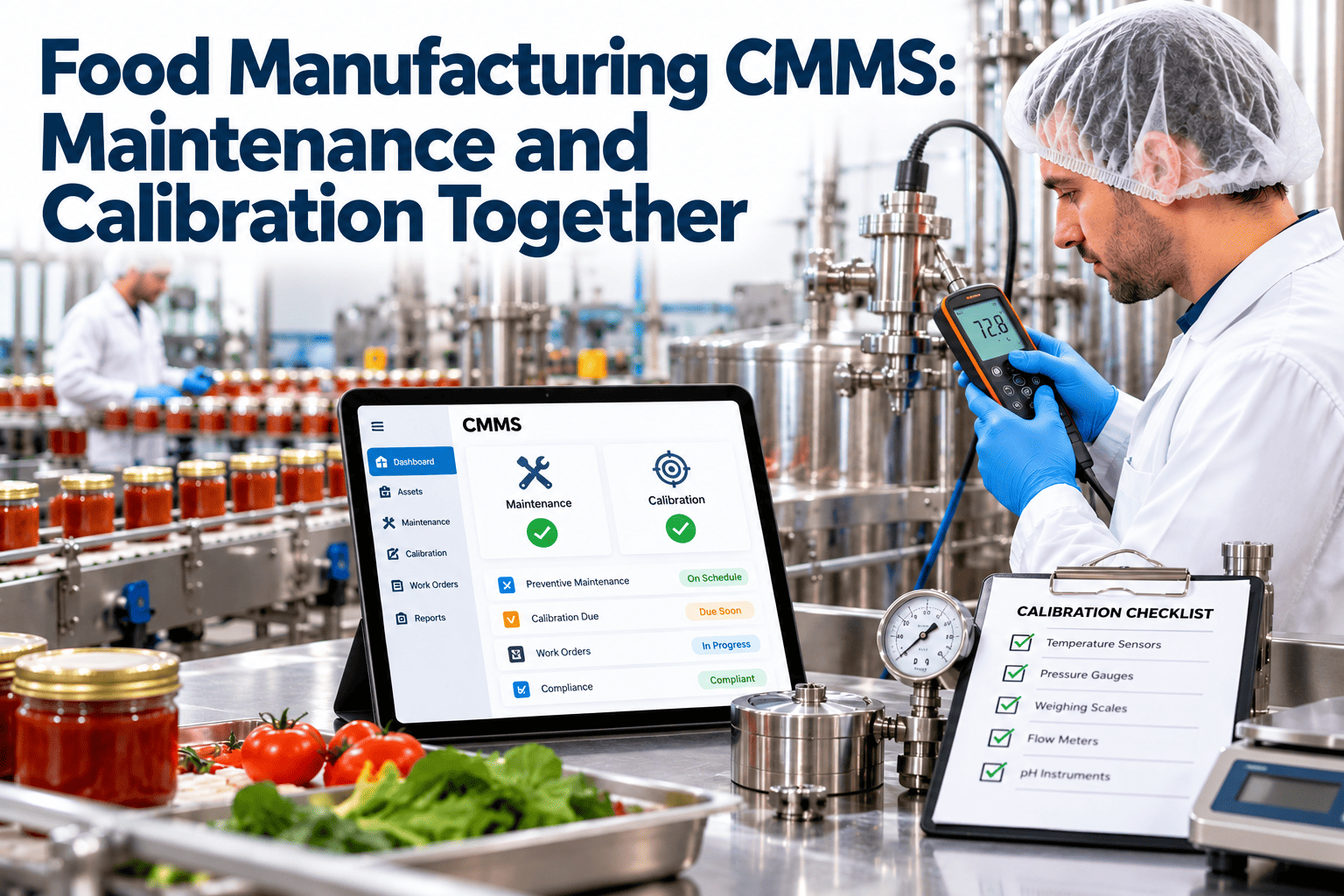
For CCP equipment, the agent verifies that all required documentation is complete before the work order can close: corrective action record, food-grade chemical confirmation, calibration verification if applicable, and QA digital signature. Incomplete closures are automatically escalated — preventing the documentation gaps that become FDA violations.
Forecast — CapEx Updates From Every Repair
Every completed work order updates the asset's condition score and degradation trajectory in OxMaint's registry. These trajectories feed the rolling 5–10 year CapEx model — adjusting replacement timelines based on actual measured degradation rather than scheduled review cycles, producing capital plans that respond to real equipment condition in real time.
Learn — Continuous Model Improvement
Repair outcomes — actual root cause, parts consumed, time to resolution, recurrence rate — are fed back into the agent's decision models. Fault classification becomes more specific to your facility's equipment profiles over time. Response strategies are refined. The agent's accuracy and efficiency compound with every completed repair cycle in your plant.
Manual Maintenance Coordination vs. Agentic AI: The Operational Difference
| Workflow Stage |
Manual Coordination |
OxMaint Agentic AI |
| Fault detection to work order |
2–4 hours — coordinator reviews alert, creates WO manually |
Under 60 seconds — autonomous detection, creation, and dispatch |
| Parts verification |
Checked on arrival — missing parts discovered at equipment |
Verified and reserved before dispatch; procurement auto-triggered if stock is low |
| Technician assignment |
Based on availability and personal knowledge of who handles what |
Skill-matched, schedule-aware, certification-verified assignment in seconds |
| HACCP documentation |
Completed under pressure, often skipped or reconstructed after the fact |
Enforced as a mandatory closure condition — cannot be bypassed or skipped |
| Night and weekend response |
Delayed until shift start or expensive on-call callout |
Identical autonomous response at 3 AM as at 10 AM — no time-of-failure premium |
| Audit document retrieval |
Reconstructed manually from spreadsheets and paper logs |
Immutable, timestamped records attached to asset at point of execution |
| CapEx forecasting input |
Annual review using manufacturer MTBF estimates |
Real-time updates from every repair outcome — condition-based, not calendar-based |
| Alert fatigue management |
Human triage — critical signals missed under high alert volume |
Objective severity scoring across every alert — zero signals missed, zero fatigue |
ROI and Operational Results: Agentic AI in Food Manufacturing
40%
Lower unplanned downtime costs
Food plants using condition-based agentic dispatch vs. reactive manual coordination
60s
Alert-to-dispatch window
vs. 2–4 hours with manual workflows — eliminating the most costly response gap in food plant operations
Zero
Missed HACCP documentation steps
Compliance enforced at work order closure — not dependent on shift pressure or individual memory
30 days
Time to measurable results
OxMaint customers report visible downtime reduction and compliance improvement within the first month
Operations teams that deploy OxMaint's agentic maintenance layer report measurable downtime reduction, zero missed compliance steps, and technicians who arrive at equipment already knowing what is wrong — start a free trial to get your custom maintenance automation plan, or book a demo and we will walk through what autonomous work order closure looks like in your specific food plant environment.
Frequently Asked Questions
Does agentic AI replace maintenance technicians in food plants?
No. Agentic AI replaces the coordination layer — the detection, decision-making, dispatch, and documentation that sits between a fault signal and a technician's hands on equipment. Skilled technicians still perform the physical repair. What changes is that they arrive faster, better-informed, with the right parts, and with the compliance documentation pre-populated. Technicians spend more time on skilled work and less time on administrative coordination and alert triage.
How does OxMaint ensure autonomous work order closures satisfy HACCP and FDA requirements?
OxMaint enforces HACCP compliance at the work order closure level — not as a suggestion, but as a structural requirement. CCP-linked work orders cannot be marked closed until all required documentation is verified: corrective action records, food-grade chemical confirmation, calibration verification where applicable, and QA digital signature per 21 CFR Part 11. Incomplete closures trigger automatic escalation to the food safety manager, preventing the documentation gaps that become FDA violations.
What data sources does OxMaint's agentic AI require to operate?
OxMaint's agentic layer connects to IoT sensor platforms, SCADA systems, edge AI gateways, and existing ERP or MRO inventory systems via MQTT, OPC-UA, REST, and standard industrial protocols. It also ingests OxMaint's own asset registry data — maintenance history, condition scores, HACCP classification, PM schedules, and technician profiles. Facilities with partial sensor coverage can deploy incrementally, expanding agentic coverage as instrumentation is added.
How quickly can agentic AI be operational in an existing food manufacturing facility?
For facilities with an existing CMMS and connected sensor infrastructure, OxMaint's agentic layer can be operational within days. Asset hierarchy configuration, HACCP classification mapping, and response strategy templates are established during onboarding. Initial agentic coverage focuses on the highest-criticality assets and expands progressively. No extended implementation project, no heavy IT infrastructure change, and no months-long delay before the first autonomous work order fires.
OXMAINT AGENTIC AI FOR FOOD MANUFACTURING
Stop Losing Production Hours to Manual Maintenance Coordination
OxMaint detects failures, dispatches technicians, orders parts, enforces HACCP compliance, and closes work orders autonomously — compressing the 2–4 hour response window your plant currently accepts to under 60 seconds.
Autonomous failure detection and dispatch
HACCP-compliant work order closure — enforced, not suggested
5–10 year CapEx forecasting from real condition data
No heavy implementation. Works across multi-site food manufacturing portfolios. Measurable results in the first 30 days.